Country: Saudi Arabia 79 documents
Search documents matching “Saudi Arabia” →Countries mentioned in each document. A country may be mentioned directly (e.g., France) or inferred from a related reference, such as a city (Paris -> France) or a domain name (.fr -> France).
Graphs
By document date (11 years)
By Banner
By Classification
Refine (combine with another filter, via search)
Sort: Title
Documents
-
SID 's Antipodal Colleagues SIDtoday [pdf]
Description of an NSA office in Canberra, Australia, staffed by 16 people who work closely with the Australian and New Zealand spy agencies, including to break a network used by the Papua New Guinea Defence Force.
The Intercept ↗ (2016-08-10) -
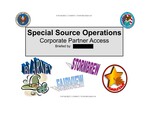
Special Source Operations - Corporate Partner Access [pdf]
A classified NSA Special Source Operations briefing detailing the four major corporate partner surveillance programs — BLARNEY, FAIRVIEW, STORMBREW, and OAKSTAR — their legal authorities, collection access points, target lists, and funding profiles totaling nearly $480 million in FY2010, revealing the infrastructure through which the NSA taps U.S. telecommunications companies to intercept international fiber optic communications on American soil.
Programs: BLARNEY · FAIRVIEW · STORMBREW · OAKSTAR · LITHIUM · ARTIFICE · ROCKSALT · SERENADE · PINECONE · BRECKENRIDGE · TAHOE · SUNVALLEY · WHISTLER · KILLINGTON · COPPERMOUNTAIN · MAVERICK · CONUS · TURMOIL · UTT · STEELKNIGHT · SSO“Snowden document reveals key role of companies in NSA data collection” - The Guardian ↗ (2013-11-01) · “NSA files decoded: Edward Snowden's surveillance revelations explained” - The Guardian ↗ (2013-11-01) · “No Place to Hide” - Metropolitan Books ↗ (2014-05-13) · “NSA Spying Relies on AT&T’s ‘Extreme Willingness to Help’” - ProPublica ↗ (2015-08-15) · “AT&T Helped U.S. Spy on Internet on a Vast Scale” - The New York Times ↗ (2015-08-15) · “Titanpointe: The NSA’s Spy Hub in New York, Hidden in Plain Sight” - The Intercept ↗ (2016-11-16) · MacAskill, Ewen · Rushe, Dominic · Dance, Gabriel · Greenwald, Glenn · Angwin, Julia · Larson, Jeff · Savage, Charlie · Moltke, Henrik · Poitras, Laura · Risen, James · Gallagher, Ryan -
SSO Weekly Brief 25 April 2013: Excerpt [pdf]
This document highlights a PRISM FAA report from 10 April 2013, detailing U.S.-based Uzbek refugee Fazliddin Kurbanov’s communications with Adnan, an official from the Pakistan-based Islamic Movement of Uzbekistan (IMU). Kurbanov expressed his continued intention to attack the U.S., involving explosives and potentially raising money for the IMU, despite believing he was under surveillance by the FBI.
-
Sunni Extremists and Short Message Service (SMS) SIDtoday [pdf]
Islamic extremists are increasingly using SMS messaging. This document details counterterrorism SIGINT development efforts to target and collect SMS traffic.
Programs: SODThe Intercept ↗ (2016-08-10) -
Surging U.S. Strategic Energy Interest in West Africa SIDtoday [pdf]
A SIGINT Africa expert describes how an oil boom in West Africa will increase needs from SID customers to make security in the Gulf of Guinea a much higher priority.
The Intercept ↗ (2016-12-07) -
Synergising Network Analysis Tradecraft [pdf]
These Five Eyes slides give an overview of Synergising Network Analysis Tradecraft, a program the NSA and its closest allies developed to plant spyware on smartphones without the knowledge or consent of the user. Specifically, the method seeked to alter the content of data packets moving between targeted smartphones and app servers, causing the spyware to be downloaded along with the app.
Programs: ATLAS · ATHENA · FRETTINGYETI · CRAFTYSHACK · IRRITANTHORN · XKEYSCORE · BLAZINGSADDLES · SPLUNK · SCORPIOFORE · PLINKO · MASTERSHAKE · PEITHO · HYPERION · DANAUS · CONVERGENCE · UCWEB · EONBLUE -
Targeting Rationale (TAR) [pdf]
An NSA document describing how analysts should explain their targeting decisions under the FISA Amendments Act.
-
The Current Israel-Hizballah-Lebanon Hostilities -- What Caused Them? SIDtoday [pdf]
An analysis of the latest conflict between Hezbollah and Israel. Following the kidnapping of two Israeli soldiers, critics called Israel's retaliation disproportional. Moderate Arab nations, however, criticized the Hezbollah action that provoked the conflict.
The Intercept ↗ (2019-05-29) -
The Saudi Assassination Plot -- How It Was Thwarted SIDtoday [pdf]
A plot by Libyan dictator Moammar Gadhafi to assassinate the Saudi Crown Prince was revealed by an alleged terrorist during interrogation and corroborated using signals intelligence.
Programs: FOLLOWTHEPEOPLE“NSA Secretly Helped Convict Defendants in U.S. Courts, Classified Documents Reveal” - The Intercept ↗ (2017-11-30) · The Intercept ↗ (2018-03-01) · Aaronson, Trevor -
The State of Covert Collection -- An Interview with SCS Leaders (conclusion) SIDtoday [pdf]
Since 9/11, the joint NSA/CIA Special Collection Service (SCS) has added 12 new sites, totaling 82 covert collection sites in US embassies. Power issues, tough conditions, and legacy hardware are among the challenges facing personnel.
The Intercept ↗ (2019-05-29) -
The TAC's Metadata Analysis Cell (MAC) SIDtoday [pdf]
Description of the Metadata Analysis Cell, starting with a success story about a counterterrorism analyst using tools MAC provided to discover six terrorism-related phone numbers. MAC specializes in contact chaining procedures.
The Intercept ↗ (2016-12-07) -
'Top 10' SIDtoday Articles of 2005 SIDtoday [pdf]
The top articles in 2005 are “a combination of administrative information, success stories and human interest.”
Marking: UNCLASSIFIEDPeople: al-Zarqawi, Abu MusabThe Intercept ↗ (2018-08-15) -
Top Linguists Take Home CLA Awards SIDtoday [pdf]
Five individuals received awards from the Crypto-Linguistic Association for supporting Operation Iraqi Freedom, the Sudanese peace talks, investigations into the Khobar Towers bombing in Saudi Arabia, and the CLA itself.
The Intercept ↗ (2017-09-13) -
United States SIGINT System January 2007 Strategic Mission List [pdf]
This 2007 list of the National Security Agency’s major missions illustrates the sweep of the agency’s goals for signals intelligence (Sigint) or electronic eavesdropping, which include not only such obvious targets as terrorist groups and Iran’s nuclear program, but the diplomacy and economic policy of friendly countries.
-
Using SIGINT to Sniff Out Phony Passports (and Other Persona Identifiers) SIDtoday [pdf]
The NSA is now exploring ways to use passports and other official identification cards as a form of signals intelligence. Some countries include a checksum with passport serial numbers, and passports from these countries with incorrect checksums are likely fraudulent. Venezuelan passports will be the first analyzed as part of this exploration.
People: Quirk, RichardThe Intercept ↗ (2018-03-01) -
Using XKEYSCORE to Enable TAO [pdf]
A TOP SECRET training presentation from 2009, authored by a Booz Allen Hamilton contractor, teaching NSA analysts how to use XKeyscore to harvest the login credentials, router configurations, browser versions and server software details that the Tailored Access Operations hacking unit needs to break into foreign computer networks — with worked examples stealing Cisco router passwords, Iranian government webmail logins and jihadi web forum credentials directly from intercepted internet traffic.
-
Voice/Fax User Group Minutes of September 2008 meeting [pdf]
Page 3 of 7 of the minutes of GCHQ's Voice/Fax User Group (VFUG), September 2008: plans for data-quality testing, a request that linguists flag "Pick Your Own Number" calls in the B3M voice database, and the B14/MCS team's update on the Diariser and on speaker and language identification. The Intercept's PDF shows only the speaker ID section; the rest of the page is in the file (see the archive comment).
-
Working at Prince Sultan Air Base, SA SIDtoday [pdf]
This intern was deployed to Prince Sultan Air Base in Saudi Arabia a year before the Iraq War. He describes his time as an analyst there, including the relative comfort of the base (“I’m embarrassed to say that it actually had a pool!”).
People: Clancy, TomThe Intercept ↗ (2016-08-10) -
ZAIN INTRANET NETWORK ENGINEERING [pdf]
2009 GCHQ report documents the sampling and tasking of a satellite data carrier linking Gabon and Belgium that carried the internal corporate intranet of telecom operator Zain (formerly MTC Vodafone), through which engineers exchanged technical data via SMTP email. The intercept surfaced email selectors belonging to staff across multiple telecom operators — including Zain subsidiaries, Orange Mali, Saudi Telecom, MTC Touch (Lebanon), Tunisie Telecom, and Celtel entities in Niger and Nigeria — reflecting the agency’s systematic targeting of telecom employees as a potential entry point into operators’ internal networks.