Country: China 210 documents
Search documents matching “China” →Countries mentioned in each document. A country may be mentioned directly (e.g., France) or inferred from a related reference, such as a city (Paris -> France) or a domain name (.fr -> France).
Graphs
By document date (13 years)
By Banner
By Classification
Refine (combine with another filter, via search)
Sort: Title
Documents
-
Intellipedia – Air Gapped Network Threats [pdf]
This document from an internal wiki for the U.S. intelligence community, surveys threats to so-called air-gapped systems, arguing that supply-chain compromises, physical implants (BIOS, KVMs, peripherals), infected removable media, and enabled wireless/emanations present realistic paths for adversaries to bridge isolated networks. It assesses likelihoods and attack vectors (including insider help and CDS/guard exploitation), highlights specific historic incidents (Agent.BTZ/MAKERSMARK), and recommends strict removable-media policies, TEMPEST countermeasures, and rigorous cross-domain guard protections to mitigate the risk.
People: Witte, Griff · Warren, Peter · Streeter, Michael · Watson, Paul · Louchard, Bjørn · Crawford, George · Rudge, David · Terrazas, Michael -
Intellipedia – BIOS Threats [pdf]
This from an internal wiki for the U.S. intelligence community, titled “BIOS Threats” details the use of malicious BIOS implants as a means of achieving persistent system compromise for cyber espionage and attack purposes. It discusses the history, technical challenges, detection limitations, and global development of BIOS-based malware by both state and non-state actors, including U.S. and Chinese cyber units.
-
Intellipedia – Supply Chain Cyber Threats [pdf]
This document on Supply Chain Cyber Threats, from an internal wiki for the U.S. intelligence community, outlines vulnerabilities in hardware and firmware components such as power supplies, NICs, RAID controllers, GPUs, and peripheral devices that could be exploited by adversaries through the supply chain. It details assessments from U.S. intelligence agencies (CIA, DIA, FBI, CYBERCOM) highlighting risks from foreign companies, insider threats, and malicious modifications that could compromise critical U.S. government and military systems.
Programs: A-SPACE -
Interagency SARS Conference -- Today SIDtoday [pdf]
Repeat: Announcement of cross-agency analyst forum on SARS (severe acute respiratory syndrome), including impact of the virus on China’s military.
The Intercept ↗ (2016-05-16) -
Interagency SARS Conference May 20th SIDtoday [pdf]
Announcement of a cross-agency analyst forum on SARS (severe acute respiratory syndrome), including impact of the virus on China’s military.
The Intercept ↗ (2016-05-16) -
Internet Anonymity 2011 [pdf]
A TOP SECRET NSA presentation from 2011 providing a comprehensive survey of Internet Anonymity Technologies (IAT) — covering HTTP proxies, VPN anonymity providers, multi-hop networks including Tor and JAP, anonymous remailers and circumvention tools — alongside NSA's capabilities and limitations against each, including XKEYSCORE fingerprints for VPN identification, the PARTNERSNIPPET Tor deanonymisation team, GOLDENFORTIN Netflow data, and a candid assessment that Tor offers "no passive exploitation."
Programs: FOXTRAIL · NKB · NACIRONIN · PONTENTPOTABLES · RONIN · XKEYSCORE · PARTNERSNIPPET · GOLDENFORTIN · SNAPEPeople: Heap, Austin -
Interview with... Carl Johnson, Assistant Deputy Director for Customer Relationships (S1) SIDtoday [pdf]
A senior SID official is interviewed about his career at the agency. His most memorable experience was managing the emergency landing of a U.S. Navy spy plane in China in 2001.
The Intercept ↗ (2016-12-07) -
Interview with... Charlie Meals, Signals Intelligence Deputy Director SIDtoday [pdf]
In an interview, the deputy director describes his early days in the NSA's "weather shop," decrypting Soviet weather reports.
The Intercept ↗ (2017-04-24) -
INTOLERANT – Who Else Is Targeting Your Target? Collecting Data Stolen by Hackers – SIDtoday SIDtoday [pdf]
A TOP SECRET SIDToday article from Menwith Hill Station describing how NSA and CSEC discovered and began exploiting INTOLERANT — a sophisticated email-stealing hacking operation targeting Indian diplomats, Central Asian diplomats, Chinese human rights defenders, Tibetan pro-democracy activists, Uighur activists and European officials — by intercepting the stolen emails as they transited satellite links, a technique internally called "fourth party collection" or "outsourcing SIGINT."
Programs: INTOLERANT -
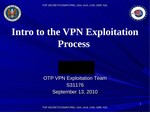
Intro to the VPN Exploitation Process [pdf]
NSA introduction to the VPN exploitation process from September 2010, presented by the OTP VPN Exploitation Team, covering the full workflow from initial collection through to sustained decryption of IPSec, PPTP, SSL and SSH traffic, with named exploitation successes including airlines, diplomatic missions, banks and intelligence services across Iran, Jordan, Russia, Turkey, Pakistan, Afghanistan, Somalia, Indonesia and Mexico.
Programs: BLEAKINQUIRY · TOYGRIPPE · XKEYSCORE · MAILORDER · CORALREEF · VULCANDEATHGRIP · SCISSORS · TURTLEPOWER · PINWALE · FOURSCORE · CADENCE · UTT · VULCANMINDMELD · CAPRIOS · AGILITY · NKB · FOLLOWTHEMONEY -
Introducing Carl Johnson as Assistant Deputy Director for Customer Relationships SIDtoday [pdf]
The assistant deputy director for customer relationships describes his first month on the job.
The Intercept ↗ (2016-05-16) -
Iraqis Vote for First Permanent Parliament -- A Report from Baghdad SIDtoday [pdf]
A report from the first Iraqi parliamentary election, which — in addition to extensive, U.S.-backed logistics and security support — received 24/7 signals intelligence coverage from a dedicated NSA team.
People: Hussein, SaddamThe Intercept ↗ (2018-08-15) -
Is NSA Correctly Postured Against the Most Critical Missions? SIDtoday [pdf]
Signals Intelligence Directorate leadership decides where to expend the most resources based on the SIGINT Mission List. The list includes 15 critical functional missions -- each of which has an area of focus and an area in which SID decides not to devote as much attention, thus accepting some amount of risk. China, North Korea, Iraq, Iran, and Russia are "regarded as 'trump cards'" and can take priority over any one of these missions.
People: Quirk, RichardThe Intercept ↗ (2017-09-13) -
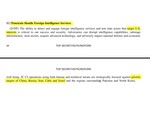
Israel targets the U.S. government for invasive electronic surveillance [pdf]
Israel targets the U.S. government for invasive electronic surveillance, and does so more aggressively and threateningly than almost any other country in the world. Indeed, so concerted and aggressive are Israeli efforts against the U.S. that some key U.S. government documents — including the top secret 2013 intelligence budget — list Israel among the U.S.’s most threatening cyber-adversaries and as a “hostile” foreign intelligence service.
-
Israel-US 1999 Agreement [pdf]
This July 1999 top secret agreement between the U.S. Defense Intelligence Agency and Israel's Directorate of Military Intelligence establishes comprehensive intelligence-sharing arrangements covering Middle Eastern threats, terrorism, weapons of mass destruction, and foreign materiel exploitation, superseding previous agreements dating back to 1968 and including specific provisions for conferences, written requests, face-to-face analyst meetings, and security protocols.
-
Japan official NSA visit, cyber briefing [pdf]
This document outlines cooperation between the NSA and Japan’s Directorate for SIGINT (DFS) to develop Japan’s capabilities for providing signals intelligence (SIGINT) support to cyber defense operations, particularly against Chinese cyber activities. It details meetings, training, and data-sharing efforts from 2012–2013 aimed at enhancing Japan’s cyber intelligence capacity under U.S. guidance.
“Japan Made Secret Deals With the NSA That Expanded Global Surveillance” - The Intercept ↗ (2017-04-24) · “アメリカに監視される日本 ~スノーデン“未公開ファイル”の衝撃” - NHK ↗ (2017-04-24) · Gallagher, Ryan · Ikegami, Akira -
Japan official NSA visit, HF briefing [pdf]
The document describes ongoing NSA efforts to renew high-frequency direction-finding (HFDF) collaboration with Japan’s Directorate for SIGINT (DFS) after Japan withdrew from the CROSSHAIR network in 2009. By 2012–2013, both sides were manually exchanging HFDF data, and the NSA sought to advance toward automated data sharing via its BORESIGHT system while reassuring Japan that it would not replace or override its existing technology.
“Japan Made Secret Deals With the NSA That Expanded Global Surveillance” - The Intercept ↗ (2017-04-24) · “アメリカに監視される日本 ~スノーデン“未公開ファイル”の衝撃” - NHK ↗ (2017-04-24) · Gallagher, Ryan · Ikegami, Akira -
Joining S3: An Interview with Rick Ledgett SIDtoday [pdf]
The new assistant deputy director for data acquisition answers questions about his career, his recent tour at Pacific Command, and plans for his management role.
Programs: PURPLE DRAGONPeople: Ledgett, RickThe Intercept ↗ (2018-03-01) -
JORDAN-BELGIUM [pdf]
2008 GCHQ report documenting the interception of a Jordan–Belgium satellite telecommunications link, through which British intelligence monitored call traffic and identified tasked surveillance targets including the Turkish foreign ministry, Palestinian Authority figures and Israeli MK Ahmad Tibi, along with other hits on Kurdish leadership, diplomats, and Jordanian government offices such as the Royal Protocol Office. The published copies redact different entries. Der Spiegel's and The Intercept's show the Turkish and Kurdish ones, Le Monde's (version 8BBAC) the Palestinian and Jordanian ones.
People: Tibi, Ahmad“Turkey Is 'Partner and Target' for the NSA” - Der Spiegel ↗ (2014-08-31) · “How the NSA Helped Turkey Kill Kurdish Rebels” - The Intercept ↗ (2014-08-31) · “L’Autorité palestinienne et la Jordanie espionnées par les services américains et britanniques” - Le Monde ↗ (2016-12-07) · Poitras, Laura · Rosenbach, Marcel · Sontheimer, Michael · Stark, Holger · Follorou, Jacques -