Country: Afghanistan 114 documents
Search documents matching “Afghanistan” →Countries mentioned in each document. A country may be mentioned directly (e.g., France) or inferred from a related reference, such as a city (Paris -> France) or a domain name (.fr -> France).
Graphs
By Banner
By Classification
Refine (combine with another filter, via search)
Sort: Title
Documents
-
Counterterrorism Analytic Working Group Meets in Madrid SIDtoday [pdf]
This SIDtoday document details the 11th SIGINT Seniors Counterterrorism (SISECT) Analytic Working Group meeting in Madrid, which focused on enhancing counterterrorism collaboration through topics like terrorist use of the Internet, metadata sharing, and language capabilities. Key outcomes included initiatives for SIGINT exploitation of the Internet, improving language processing and translation via SIGDASYS, and fostering deeper cooperation between nations on counterterrorism efforts.
-
CSEC Surveillance of Travellers Through Airport Wi-Fi Tracking [pdf]
The leaked 2012 top secret CSEC presentation details a trial program that used airport Wi-Fi metadata to identify and track travellers’ devices across Canada and internationally, developing advanced “IP profiling” techniques to map movements through hotels, airports, and public hotspots. The program, conducted with NSA support, aimed to build powerful analytic tools for surveillance and real-time alerts within the Five Eyes intelligence network.
Marking: TOP SECRET -
Cyber Integration [pdf]
The leaked 2012 GCHQ JTRIG presentation detail a wide range of offensive cyber and influence operations designed to “deny, disrupt, degrade, and deceive” targets, including hackers, foreign governments, companies, and individuals. Tactics include hacking, DDOS attacks, disinformation, honey traps, credential harvesting, and psychological operations, reflecting a shift from traditional surveillance to active disruption and manipulation campaigns.
“Exclusive: Snowden Docs Show British Spies Used Sex and 'Dirty Tricks'” - NBC News ↗ (2014-02-07) · “No Place to Hide” - Metropolitan Books ↗ (2014-05-13) · Cole, Matthew · Esposito, Richard · Schone, Mark · Greenwald, Glenn -
Elegant Chaos: collect it all, exploit it all [pdf]
This document outlines a classified project, "Elegant CHAOS," focused on advanced signals intelligence (SIGINT) collection, processing, and analysis using cutting-edge technologies like automated surveys and modems. It highlights goals such as real-time data analysis, collaboration with international partners, and integration with cloud-based platforms to manage massive data. See also the document with notes (by GCHQ): "Elegant-Chaos-collect-it-all-exploit-it-all-plus"
Programs: ELEGANTCHAOS · ASPHALT · ASPHALT-A · ASPHALT-A-PLUS · STORMFORCE · DARKQUEST · TORUS · XKEYSCORE · MHS CLOUD · TURMOIL · TARMAC · ASDF · SLR · POPQUIZ · WEALTHYCLUSTER2 · TRAVELLINGWAVE · BILBOBADGER · DRINKYBIRD · GLOBETROTTER · MASTERSHAKE · REST · TRAFFICTHIEF · VENUSAFFECT · FOGHORN · MATCHMAKER · ROADBED · MOONPENNY · AMULETSTELLAR · CLOUD · WEALTHYCLUSTER · MVR · TINT · IPGEOTRAP · MARINA · PLUS -
Elegant Chaos: collect it all, exploit it all (plus notes) [pdf]
GCHQ/NSA presentation describing ELEGANT CHAOS — an automated system at the Menwith Hill Station satellite interception facility that scores and ranks thousands of intercepted satellite signals by intelligence value, automatically deciding which ones deserve collection resources based on criteria like geographic location, target network hits, technology type and Computer Network Operations interest — built to implement the station's directive to "Sniff it All, Know it All, Collect it All, Process it All, Exploit it All, Partner it All" as collection capacity scaled from 100 signals to a planned 3,000 simultaneous intercepts.
Programs: ELEGANTCHAOS · ASPHALT · ASPHALT-A · ASPHALT-A-PLUS · STORMFORCE · DARKQUEST · TORUS · XKEYSCORE · MHS CLOUD · TURMOIL · TARMAC · ASDF · SLR · POPQUIZ · WEALTHYCLUSTER2 · TRAVELLINGWAVE · BILBOBADGER · DRINKYBIRD · GLOBETROTTER · MASTERSHAKE · REST · TRAFFICTHIEF · VENUSAFFECT · FOGHORN · MATCHMAKER · ROADBED · MOONPENNY · WHIZBANG · CLOUDBASE · APLUS · MAILORDER · CROSSBONES · AMULET STELLAR · MVR · TINT · WEALTHYCLUSTER · IPGEOTRAP · MARINA · CLOUD · PLUS -
ESOC: Report on the experiences of one NSA worker [pdf]
A NSA intelligence analysis intern details their 2007 temporary assignment to the European Security Operations Center (ESOC), where they successfully established a new signals intelligence (SIGINT) mission targeting Angola's energy sector. The author describes the end-to-end process from initial research and target development to successful collection and the first intelligence product.
-
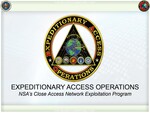
Expeditionary Access Operations: NSA’s Close Access Network Exploitation Program [pdf]
The document describes NSA/TAO’s Expeditionary Access Operations (EAO, S3283), a deployable arm that conducts human-enabled Close Access Network Exploitation (CNE) worldwide—using techniques from physical implants and gifted/compromised laptops to wireless injection tools (e.g., BLINDDATE, NITESTAND) and Wi-Fi geolocation—to support tactical customers like SOCOM, DIA, and task forces in Afghanistan, Iraq, and elsewhere. It details organization, tools, operational theaters (Bagram, Kabul, Kandahar, Stuttgart, Texas, etc.), specific operations (IRONPERSISTENCE, CLIMBINGSHIRT), and plans to formalize partnerships with USCYBERCOM and expand expeditionary CANO capabilities.
Programs: NITESTAND · HAPPY HOUR · BADDECISION · MASTERSHAKE · IRONPERSISTENCE · CLIMBINGSHIRT · BLINDDATE -
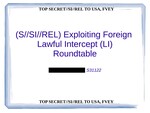
Exploiting Foreign Lawful Intercept (LI) Roundtable [pdf]
Top-secret PowerPoint presentation, "Exploiting Foreign Lawful Intercept Roundtable," highlights the agency’s strategy to exploit vulnerabilities in lawful intercept systems from telecom companies, such as Ericsson, Motorola, and Nokia, in countries like Mexico, Indonesia, and Egypt. The presentation also discusses NSA's use of various "Fingerprints" for identifying data and its collaboration with industry players and foreign lawful intercept systems.
“A Death in Athens” - The Intercept ↗ (2015-09-28) · “Americans and Greeks started the 2004 wiretaps together” - Kathimerini ↗ (2015-09-29) · Bamford, James · Petropoulos, Aggelos -
FINAL Agenda SWEDUSA [pdf]
Detailed list of points and participants in the summit meeting between the top brass of the FRA and the NSA in April 2013.
Programs: TURTLEPOWER · TURMOIL · XKEYSCORE · WINTERLIGHT · QUANTUM · PARTNERMALL · VIVIAN · NAPA-3 · GCE · SSO -
First-Ever Formal SIGINT Development (SIGDEV) Training Is Provided to SIGINT Seniors Europe (SSEUR) Partners [pdf]
This internal NSA report details the first formal training course on "SIGINT Development" (SIGDEV) offered to the "SIGINT Seniors Europe" (SSEUR) coalition, a group comprising the Five Eyes nations and nine European third-party partners. The document highlights the strategic goal of standardizing analytic tradecraft among these allies to improve collaboration on priority missions like counter-terrorism and the war in Afghanistan.
“New NSA Revelations: Inside Snowden's Germany File” - Der Spiegel ↗ (2014-06-18) · “Read the Snowden Documents From the NSA” - SVT Nyheter ↗ (2013-12-11) · Becker, Sven · Gude, Hubert · Horchert, Judith · Müller-Maguhn, Andy · Poitras, Laura · Reißmann, Ole · Rosenbach, Marcel · Schindler, Jörg · Schmid, Fidelius · Sontheimer, Michael · Stark, Holger · Björklund, Axel -
FY 2013 Congressional Budget Justification, Volume I, National Intelligence Program Summary, February 2012 [pdf]
This document outlines the $52.6 billion “black budget,” detailing the structure, priorities, successes, and shortcomings of the 16 U.S. intelligence agencies. It reveals unprecedented insight into funding allocations, operations, and intelligence gaps—including the CIA’s dominant role, expanding cyber operations, and persistent challenges in areas such as North Korea and counterterrorism—while emphasizing the tension between secrecy and public accountability.
-
-
GCHQ - PCS Harvesting [pdf]
A TOP SECRET STRAP1 report details how GCHQ industrialized the theft of GSM subscriber authentication keys (Ki) by automating trawls of bulk “C2C” content to extract IMSI/Ki pairs from emails and FTP transfers between SIM personalisation centers and mobile operators. It shows the program scaling key harvesting across networks and countries, complementing computer network exploitation against core mobile infrastructure to suppress billing and lift authentication secrets.
-
GCHQ Ministry Stakeholder Relationships Spreadsheets [pdf]
This document details GCHQ's strategic engagement and intelligence support across various UK government departments (e.g., Bank of England, FCO, MoJ, DECC) for 2008-2009, covering areas from economic stability and national security to social policy and infrastructure protection. Each departmental overview outlines specific GCHQ objectives, current headline issues, areas of impact, and intelligence products provided.
People: King, Mervyn · Gieve, John · Bailey, Andrew · Allen, Stuart · Brown, Gordon · Haywood, Jeremy · Fletcher, Tom · Catsaras, Nick · King, Simon · Cavanagh, Matt · Jacobs, Michael · Forsyth, Justin · Wood, Stuart · Hepburn, Eric · Groves, John · O'Donnell, Gus · Hannigan, Robert · McDonald, Simon · Cunliffe, Jon · Allen, Alex · Dowse, Tim · Wright, Chris · Grey, Sue · Johnson, Chris · Styles, Roger · Aldred, Margaret · Cleveland, Alexis · Taylor, Michael · Blears, Hazel · Housden, Peter · Scholefield, Susan · Williams, David · Freeman, Jonathan · Hasan, Jenan · Greaves, Daniel · Boyle, Louise · Whiting, Ed · Pyott, Ian · Usher, Peter · Balls, Ed · Bell, David · Gough, Hermione · Gibbens, Nigel · Anderson, Rodney · Anderson, Michael · Lebrecht, Andy · Cowan, Richard · Derwent, Henry · Dodwell, Chris · Thompson, Jan · Nixon, Tony · Perfect, Trevor · Miliband, Ed · O'Donnell, Rory · Wallace, Moira · Ruddock, Joan · O'Brien, Mike · White, Graham · Neve, John · Benn, Hilary · Ghosh, Helen · Alexander, Douglas · Shafik, Minouche · Lowcock, Mark · Fish, Dave · Warmington, Beverley · Manuel, Marcus · Wardell, Sue · Drummond, Jim · Conway, Gordon · Hendrie, Barb · Leigh, Andy · Dick, Kenny · Leith, Jennifer · Tilbrook, Richard · Kenningham, Andrew · Crawford, Patrick · Havelock, David · Welsh, Gordon · Gotts, Roger · Faulkner, Anthony · Johnson, Alan · Taylor, Hugh · Donaldson, Liam · Harper, David · Beavan, Penny · Ritchie, Judith · Woodall, Mike · Brain, Leon · Eckles, Graeme · McCarthy, Kraig · Eldon, Stuart · Sawers, John · Gass, Simon · Brinkley, Robert · Jenkins, John · Prentice, Christopher · Pringle, Anne · Ehrman, William · Sedwill, Mark · Phillipson, Antony · Noble, Andrew · Bethlehem, Daniel · Thomson, Adam · Johnston, Paul · Davenport, Michael · Rankin, John · Roberts, Colin · Wightman, Scott · Bronnert, Deborah · Bowman, Vicky · Hitchens, Tim · Wood, Adam · Manley, Simon · Choudhury, Anwar · Cowper-Coles, Sherard · Mather, Tony · Fraser, Simon · Grant, Mark Lyall · Leslie, Mariot · Gould, Matthew · MacFarland, David · Hickey, Stephen · Brooker, Catherine · Merron, Gillian · Flint, Caroline · Malloch-Brown · Rammell, Bill · Ricketts, Peter · Miliband, David · Sants, Hector · Robinson, Philip -
GCHQ Visit to NSA on Voice Analytics Systems [pdf]
This document is a GCHQ report detailing a late-November (2007?) visit to NSA’s R64 division focused on collaboration in language identification (LID) and speaker identification (SID) systems, including sharing models and research insights. It also describes NSA tools like Hotzone and Voice RT for real-time voice analysis, and mentions an upcoming visit from the CLEAR consortium to address challenges in speech intelligibility and audio recovery for intercepted communications.
-
Ghosthunter and the geolocating of internet cafes [pdf]
This document announces an NSA “R Spotlight” webcast introducing GHOSTHUNTER, a multi-agency geolocation program designed to locate Time Division Multiple Access (TDMA) VSAT Internet access points, particularly internet cafés across the Middle East and North Africa in support of U.S. military operations. By mid-2009, GHOSTHUNTER had successfully geolocated over 5,000 VSAT terminals across Middle East demonstrating its operational effectiveness and integration with broader intelligence efforts.
Programs: GHOSTHUNTER -
GHOSTHUNTER Tasking Process [pdf]
The document outlines the GHOSTHUNTER (GH) tasking process at Menwith Hill Station, describing how geolocation requests for VSAT terminals and internet-connected targets are managed through coordination with the NSA’s Network Analysis Centre (NAC) and other sites. It details priority levels, task submission procedures, use of locational data from MASTERSHAKE, integration with imagery, and how results are shared with GCHQ and other authorized parties.
-
Global Collaboration Environment: Director’s talking points [pdf]
This NSA document reveals discussions between the agency and GCHQ about establishing a permanent joint surveillance facility in the UK to host the "SIGINT Seniors Europe" coalition, with both agencies coordinating messaging to overcome "persistent pushback" from some member nations. The memo indicates concerns that some European partners were reluctant due to "uncertainty on what missions the center will support, and associated concerns for European human rights laws," while the NSA preferred UK hosting as "optimal in terms of having the most flexibility in tuning the operation to benefit the Five Eyes."
-
GSM tower mapping made easier and more accurate with new tool SIDtoday [pdf]
This document details DYMO, a prototype developed at the NSA’s Menwith Hill Station—the agency’s large British base operated in close cooperation with GCHQ—for highly accurate GSM tower geolocation. It highlights DYMO’s superior performance in mapping accuracy and metadata integrity, its extensive operational use across regions such as Iraq, Iran, and Somalia, and its integration with tools like GOLDENEYE and the Integrated COMINT System (ICS) to streamline analysis and intelligence fusion.
-
Guide to Using Contexts in XKS Fingerprints [pdf]
This technical guide explains how NSA analysts use "contexts" within XKEYSCORE fingerprints to create highly targeted surveillance queries by restricting searches to specific scopes (e.g., web searches, document bodies, geographic locations), enabling precision targeting such as finding "all people in Kabul performing web searches on Jihad" while avoiding the overwhelming noise of broader keyword searches.