Classification: TOP SECRET 823 documents
Search documents matching “TOP SECRET” →Each document's classification level, as component values. If a document contains multiple classifications, the highest is used here.
Graphs
By document date (14 years)
By published date (9 years)
By Banner
Refine (combine with another filter, via search)
Sort: Title
Documents
-
CLASSIFICATION GUIDE FOR ECI PAWLEYS (PAW) [pdf]
This 2006 NSA classification guide outlines the protocols for ECI PAWLEYS (PAW). PAWLEYS is an Exceptionally Compartmented Information (ECI) category designed to protect clandestine operations—both physical (HUMINT) and digital (CNE)—specifically aimed at acquiring foreign cryptographic information and material. The document confirms that the NSA actively seeks to circumvent encryption through clandestine HUMINT and computer network access aimed at cryptographic information and material, rather than relying solely on traditional codebreaking.
Programs: PAWLEYS -
Classification Guide for FISA, the Protect America Act and the FISA Amendments Act [pdf]
The Foreign Intelligence Surveillance Act regulates spying for national security purposes on domestic soil. This guide lays out secrecy restrictions for various aspects of those programs. Among other things, it mentions the Large Content FISA order, a term that has not previously been disclosed.
-
Classification guide for NSA/CSS Quantum Computing Research (10-25) [pdf]
The NSA/CSS Quantum Computing Research Classification Guide (10-25) outlines how information related to the NSA’s quantum computing research should be classified, distinguishing between unclassified academic work and classified cryptanalytic programs. It defines classification levels for research activities, breakthroughs, algorithms, collaborations, and materials, with the goal of protecting U.S. cryptographic systems while advancing the agency’s offensive capabilities in quantum cryptanalysis.
-
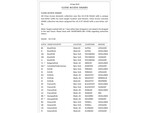
Close Access SIGADS [pdf]
A 10 September 2010 NSA reference list of Close Access SIGADs revealing the codenames, locations and collection methods used to bug the embassies and UN missions of 38 targets — including US allies France, Italy, Greece, Japan, India, Mexico, South Korea and the EU — through implants, computer-screen capture, hard-drive imaging and electromagnetic emanation collection, most conducted against diplomatic facilities in Washington DC and New York.
Programs: KATEEL · POCOMOKE · MERCED · BANISTER · PERDIDO · MAGOTHY · BLACKFOOT · WABASH · NAVARRO · POWELL · KLONDIKE · NASHUA · OSAGE · OSWAYO · BRUNEAU · HEMLOCK · MULBERRY · ALAMITO · FLEMING · DOBIE · SULPHUR · REQUETTE · YUKON · WESTPORT · NAVAJO · PANTHER · LIFESAVER · HIGHLANDS · VAGRANT · MINERALIZ · DROPMIRE · PBX · MAGNETIC · OCEAN · GENIE · BLACKHEART · CRYPTOENABLED · CUSTOMS · DEWSWEEPER · RADON · MINERALIZE · COOP · STARRUBY · TRASHINT“No Place to Hide” - Metropolitan Books ↗ (2014-05-13) · “Espionnage de la NSA : la diplomatie française était sur écoute aux Etats-Unis” - Le Monde ↗ (2013-10-22) · “Da qui ci spiano gli americani” - L'Espresso ↗ (2013-12-05) · Greenwald, Glenn · Follorou, Jacques · Maurizi, Stefania -
CNE Analysis in XKEYSCORE [pdf]
This document is an NSA training presentation from October 2009 demonstrating how XKEYSCORE integrates with Computer Network Exploitation (CNE) operations, allowing analysts to search and analyze data extracted from compromised computers including keystrokes, browser history, registry files, documents, emails, and directory structures collected through implants like UNITEDRAKE and OLYMPUS.
Programs: XKEYSCORE · OLYMPUS · UNITEDRAKE · PINWALE · TUNINGFORK · TURBOCHASER · MARINA · JOLLYROGER · TREASUREMAP · TURBINE · PRESSUREWAVE · MAD · TUCKER · EXPANDINGPULLY · UNIX · SEARCHLIGHT · KEYLOGGER · PILBEAM · FOXACID · WAYTIDE · SHADOWQUEST · SEAGULLFARO · DARKHELMET · LUTEUSICARUS · FOGGYBOTTOM · GREENCHAOS · RADIUS · NKB · VALIDATOR -
CNE End Point Requirements [pdf]
This NSA/GCHQ document outlines comprehensive requirements for an endpoint surveillance systems that enables analysts to systematically identify intelligence collection needs and discover appropriate tools for data extraction from compromised computers. The framework covers capabilities for remote data collection, cross-platform intelligence integration, query functions, tasking procedures, and visualization tools across implanted networks.
Programs: STARGATE · LOOKING GLASS · QUANTUM · GOLDENEYE · XKEYSCORE · MARINA · JTRIG · BROADOAK · UTT · GLOBALREACH · GLOBALSURGE · THUGGEE · EREPO · DANCINGBEAR · HAUSTORIUM · SHAREOWN · MUTANTBROTH · MOONRAKER · CARBONROD · RUFFLE · ROCKOPERA · QUINCEY · ECLIPSE · MUGSHOT · HIGHNOTE · UDAQ2 · EKB · TURBINE · ACNO · FLAMECARPET · FUMECUPBOARD · JACKPOT · SLIPSTREAM · B13B · PSC · QUINCY · DAREDEVIL · ROADBED -
CNE EndPoint Project Load [pdf]
The CNE EndPoint Project Load document lists multiple GCHQ exploitation projects, with “PFENNING ALPHA” targeting Flag Telecom’s network. It notes automated pulls of router monitoring webpages, collection of performance statistics, and ongoing efforts to gain further access points within Reliance’s infrastructure, while other projects and targets remain redacted.
Programs: PFENNING ALPHA · BURRITO ALPHA · GLADDY IOTA · HEADRESS IOTA · HEADRESS KAPPA · HEADRESS NU · HEADRESS OMICRON · GLADDY CHI · EREPO · RELIANCE · GTE“Vodafone – der lange Arm des britischen Geheimdienstes?” - WDR ↗ (2014-11-20) · “Spy cable revealed: how telecoms firm worked with GCHQ” - Channel 4 ↗ (2014-11-20) · “Der lange Arm des Geheimdienstes?” - NDR ↗ (2014-11-21) · “Snowden-Leaks: How Vodafone-Subsidiary Cable & Wireless Aided GCHQ’s Spying Efforts” - Süddeutsche Zeitung ↗ (2014-11-25) · Restle, Georg · White, Geoff · Strozyk, Jan · Moltke, Henrik · Poitras, Laura · Obermaier, Frederik -
CNE Presence in CT10 Status Report [pdf]
A TOP SECRET NSA status report from April 2008 describing how a counterterrorism analysis team began importing data from the agency's hacking operations into their tracking system — specifically logs from FOXACID, an NSA tool that infects targets' computers mainly through their web browsers — enabling real-time alerts when new targets were successfully hacked, with plans to expand into tracking four named surveillance implants (VALIDATOR, UNITEDRAKE, OLYMPUS and STRAITBIZARRE) as they phone home to NSA servers for instructions and stolen data.
-
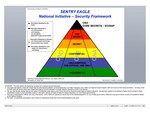
CNO Core Secrets Security Structure [pdf]
A 3-slide NSA presentation outlining the classification architecture of Sentry Eagle, a national cyber operations initiative, showing how its most sensitive components — covering network hacking, encryption sabotage, and covert industry relationships — are locked behind ECI and SAP designations accessible only to a tiny circle of government officials.
Programs: SENTRYEAGLE · SENTRYHAWK · SENTRYFALCON · SENTRYOSPREY · SENTRYRAVEN · SENTRYCONDOR · SENTRYOWL -
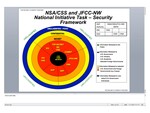
CNO Core Secrets Slide Slices [pdf]
This document outlines the Security Framework for a joint national initiative between the NSA/CSS and JFCC-NW, detailing the highly compartmented structure used to protect cyber and intelligence secrets. It utilizes a concentric security framework diagram to visualize the layers of sensitivity, placing the most critical technical capabilities at the absolute center of the intelligence community's protection.
Programs: SENTRY-EAGLE · SENTRYHAWK · SENTRYFALCON · SENTRYOSPREY · SENTRYRAVEN · SENTRYCONDOR · SENTRYOWL -
CNO Legal Authorities [pdf]
An NSA Office of General Counsel briefing on the legal authorities for computer network operations and the NTOC floor: constitutional and EO 12333 limits, NSCID 6 definitions, Wiretap Act exceptions, NSD 42, service-provider information-assurance rules (DoD 5240.1-R), and oversight and compliance.
-
Collaboration in Overdrive: A CNE Success SIDtoday [pdf]
A collaboration between several NSA departments achieved, for the first time, Computer Network Exploitation against "Turkish leadership."
Programs: CMAP“Turkey Is 'Partner and Target' for the NSA” - Der Spiegel ↗ (2014-08-31) · “How the NSA Helped Turkey Kill Kurdish Rebels” - The Intercept ↗ (2014-08-31) · The Intercept ↗ (2019-05-29) · Poitras, Laura · Rosenbach, Marcel · Sontheimer, Michael · Stark, Holger -
Collaboration Tool Is Used to Set Up Collection at Distant Site SIDtoday [pdf]
A Special Collection Service staffer at the US Embassy in Phnom Penh needed assistance with an SS7 cell phone signal but no one was available to travel to Cambodia. So an operator in Maryland used Microsoft NetMeeting to remotely access the staffer's desktop, and to map and tweak the signals.
The Intercept ↗ (2018-08-15) -
Collecting SIGINT Success Stories SIDtoday [pdf]
The SIGINT Planning, Programming and Execution office is collecting signals intelligence success stories. These stories will appear in several reports, including to Congress and in the Director's Budget Testimony. Example success stories include "how NSA provided SIGINT during the Iraqi elections" and "how we assisted with security at the Pope's funeral."
The Intercept ↗ (2017-09-13) -
Collection Accesses 30 Nov - 06 Dec 2009 [pdf]
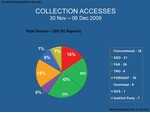
This National Security Agency chart shows the varied sources of 103 “accesses” to communications or computers collected in a single week in 2009 at the N.S.A.’s big station in San Antonio, Texas.
Programs: SSO -
Collection Breakthrough Gives Added Hope for Hostage Rescue in Colombia SIDtoday [pdf]
In September 2006, NSA analysts reported on emails from a FARC leader, which was a breakthrough in the U.S. hunt for three hostages held by the FARC. The reporting was derived from FBI FISA collection.
The Intercept ↗ (2019-05-29) -
Collection Survey Closes Intelligence Gaps in Pakistan SIDtoday [pdf]
A joint survey targeting radio signals emanating from Afghanistan and Pakistan was carried out at U.S. consulates in Lahore and Karachi, Pakistan.
Programs: MUSKETEER LECTERThe Intercept ↗ (2018-08-15) -
Colombian Special Forces Unit Scores One for the Good Guys — SIGINT Enabling HUMINT at Its Best SIDtoday [pdf]
After collaboration among Colombia, the NSA, the CIA, and Medina Regional Signals Intelligence Operations Center, Columbian Special Forces ambushed and killed Humberto Valbuena Morales, a commander in the Revolutionary Armed Forces of Colombia (FARC) wanted for kidnappings, bombings, and extortion.
People: Valbuena Morales, HumbertoThe Intercept ↗ (2017-09-13) -
COMET NEWS (March 2010) [pdf]
This document is a March 2010 edition of the COMET NEWS newsletter, a high-level GCHQ publication designed to inform targeting teams about the latest capabilities and successful operations within the "Overhead" satellite constellation. It specifically highlights a coordinated GCHQ and US overhead (OH) effort to intercept high-priority military and leadership communications from Argentina, utilizing specialized US satellite assets and geolocation techniques to map digital microwave emitters.
Programs: COMET“Britain Used Spy Team to Shape Latin American Public Opinion on Falklands” - The Intercept ↗ (2015-04-02) · “#EspiadosPorLosIngleses: los nuevos documentos de Snowden revelan un plan de espionaje de Gran Bretaña en Argentina por Malvinas” - Todo Noticias ↗ (2015-04-02) · Fishman, Andrew · Greenwald, Glenn -
Communications Capability Development Programme [pdf]
The Communications Capability Development (CCD) Programme (formerly the Intercept Modernisation Programme, IMP) was a Home Office–led effort to maintain the U.K.’s lawful interception and communications data capabilities amid changing technologies, emphasizing that law enforcement faced a “significant decline” without new measures. GCHQ supported CCD with technical expertise and interim services like MILKWHITE Enrichment, while stressing that CCD was politically contentious, technically complex, and required legislation to mandate data retention by U.K. network operators.