CNE EndPoint Project Load
Open PDFDocument date: -
Pages: 1
Genre: report
Classification: TOP SECRET STRAP 1
Dissemination: -
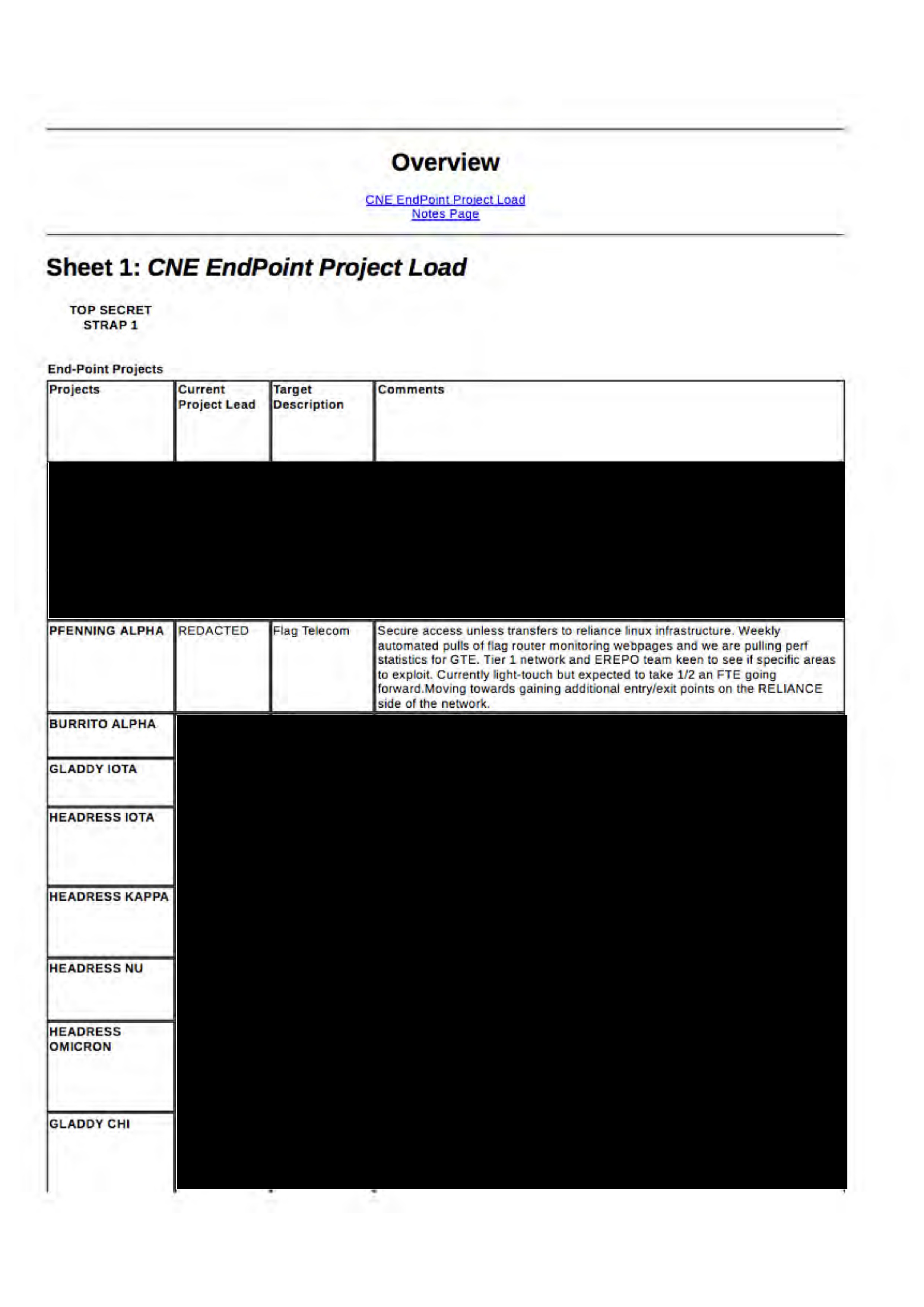
The CNE EndPoint Project Load document lists multiple GCHQ exploitation projects, with “PFENNING ALPHA” targeting Flag Telecom’s network. It notes automated pulls of router monitoring webpages, collection of performance statistics, and ongoing efforts to gain further access points within Reliance’s infrastructure, while other projects and targets remain redacted.
My notes
Overview
CNE EndPoint Project Load
Notes Page
Sheet 1: CNE EndPoint Project Load
TOP SECRET
STRAP 1
End-Point Projects
| Projects | Current Project Lead | Target Description | Comments |
|---|---|---|---|
| [REDACTED] | [REDACTED] | [REDACTED] | [REDACTED] |
| PFENNING ALPHA | [REDACTED] | Flag Telecom | Secure access unless transfers to reliance linux infrastructure. Weekly automated pulls of flag router monitoring webpages and we are pulling perf statistics for GTE. Tier 1 network and EREPO team keen to see if specific areas to exploit. Currently light-touch but expected to take 1/2 an FTE going forward.Moving towards gaining additional entry/exit points on the RELIANCE side of the network. |
| BURRITO ALPHA | [REDACTED] | [REDACTED] | [REDACTED] |
| GLADDY IOTA | [REDACTED] | [REDACTED] | [REDACTED] |
| HEADRESS IOTA | [REDACTED] | [REDACTED] | [REDACTED] |
| HEADRESS KAPPA | [REDACTED] | [REDACTED] | [REDACTED] |
| HEADRESS NU | [REDACTED] | [REDACTED] | [REDACTED] |
| HEADRESS OMICRON | [REDACTED] | [REDACTED] | [REDACTED] |
| GLADDY CHI | [REDACTED] | [REDACTED] | [REDACTED] |
Published in the Same Report
(10 of 12 documents)
-
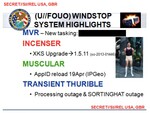
WINDSTOP SYSTEM HIGHLIGHTS [pdf]
Secret document describing WINDSTOP program's highlights.
“Vodafone – der lange Arm des britischen Geheimdienstes?” - WDR ↗ (2014-11-20) · “Spy cable revealed: how telecoms firm worked with GCHQ” - Channel 4 ↗ (2014-11-20) · “Der lange Arm des Geheimdienstes?” - NDR ↗ (2014-11-21) · “Snowden-Leaks: How Vodafone-Subsidiary Cable & Wireless Aided GCHQ’s Spying Efforts” - Süddeutsche Zeitung ↗ (2014-11-25) · Restle, Georg · White, Geoff · Strozyk, Jan · Moltke, Henrik · Poitras, Laura · Obermaier, Frederik -
MTI Access Project - Weekly Status w/e 27 June 08 [pdf]
The document outlines the MTI Access Project’s progress, including the deployment of access equipment, risk reviews with GERONTIC, and internal testing of surveillance capabilities like DRUDGE and remote switching. This reflects broader revelations about how companies like Cable & Wireless (now Vodafone) facilitated GCHQ’s mass surveillance, including covert access to telecom networks like FLAG through systems like GERONTIC.
“Vodafone – der lange Arm des britischen Geheimdienstes?” - WDR ↗ (2014-11-20) · “Spy cable revealed: how telecoms firm worked with GCHQ” - Channel 4 ↗ (2014-11-20) · “Der lange Arm des Geheimdienstes?” - NDR ↗ (2014-11-21) · “Snowden-Leaks: How Vodafone-Subsidiary Cable & Wireless Aided GCHQ’s Spying Efforts” - Süddeutsche Zeitung ↗ (2014-11-25) · Restle, Georg · White, Geoff · Strozyk, Jan · Moltke, Henrik · Poitras, Laura · Obermaier, Frederik -
MTI Access Project - Weekly Status w/e 28 November 08 [pdf]
The document details the MTI Access Project’s status in November 2008, including a significant payment to GERONTIC, updates on organizational changes, and discussions about future access opportunities and cost reductions. This aligns with broader revelations about GERONTIC’s role in supporting GCHQ's surveillance operations, facilitating access to telecom infrastructure and shaping surveillance strategies.
“Vodafone – der lange Arm des britischen Geheimdienstes?” - WDR ↗ (2014-11-20) · “Spy cable revealed: how telecoms firm worked with GCHQ” - Channel 4 ↗ (2014-11-20) · “Der lange Arm des Geheimdienstes?” - NDR ↗ (2014-11-21) · “Snowden-Leaks: How Vodafone-Subsidiary Cable & Wireless Aided GCHQ’s Spying Efforts” - Süddeutsche Zeitung ↗ (2014-11-25) · Restle, Georg · White, Geoff · Strozyk, Jan · Moltke, Henrik · Poitras, Laura · Obermaier, Frederik -
MTI Access Project - Weekly Status w/e 6 February 09 [pdf]
This is a UK TOP SECRET STRAP1 COMINT GCHQ GCWiki page — a weekly status update for the MTI Access Project, week ending 6 February 2009.
Programs: GERONTIC“Vodafone – der lange Arm des britischen Geheimdienstes?” - WDR ↗ (2014-11-20) · “Spy cable revealed: how telecoms firm worked with GCHQ” - Channel 4 ↗ (2014-11-20) · “Der lange Arm des Geheimdienstes?” - NDR ↗ (2014-11-21) · “Snowden-Leaks: How Vodafone-Subsidiary Cable & Wireless Aided GCHQ’s Spying Efforts” - Süddeutsche Zeitung ↗ (2014-11-25) · Restle, Georg · White, Geoff · Strozyk, Jan · Moltke, Henrik · Poitras, Laura · Obermaier, Frederik -
PTC Glossary [pdf]
This GCWiki PTC Glossary excerpt defines SIGINT-related telecom terms—IMEI, IMSI, INMARSAT—and documents internal collection systems (e.g., INCENSER at Bude) and targeting notes (which identifiers are useful for targeting and which are not). It’s a technical reference for signals analysts describing selectors, collection sources, and operational caveats.
“Vodafone – der lange Arm des britischen Geheimdienstes?” - WDR ↗ (2014-11-20) · “Spy cable revealed: how telecoms firm worked with GCHQ” - Channel 4 ↗ (2014-11-20) · “Der lange Arm des Geheimdienstes?” - NDR ↗ (2014-11-21) · “Snowden-Leaks: How Vodafone-Subsidiary Cable & Wireless Aided GCHQ’s Spying Efforts” - Süddeutsche Zeitung ↗ (2014-11-25) · Restle, Georg · White, Geoff · Strozyk, Jan · Moltke, Henrik · Poitras, Laura · Obermaier, Frederik -
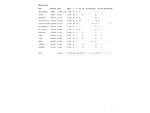
Where we are [pdf]
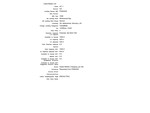
This GCHQ document is a table tracking the agency's access to undersea fiber-optic cables as of an unspecified date, listing 13 cables with their codenames, telecommunications company partners (primarily "GERONTIC"/Cable & Wireless and "REMEDY"), and the capacity of data access and egress points measured in 10 gigabit connections. The table shows GCHQ had access to 592 10-gigabit connections across these cables with 69 egress points, with an unlabelled column totalling 2,960, with GERONTIC (Cable & Wireless) providing access to 9 of the 13 cables including FEA (NIGELLA), APOLLO North and South, and TAT-14S.
Programs: NUMDAH · SCEPTRE · NIGELLA · LATUS · ARCANO · MONDELLO · GIBUS · KIRKISTOWN · LINNELL · ELAPSE · GRASP · CATEGORY · KNAPWEED · DACRON · GERONTIC · REMEDY · SOLAS · APOLLO · FEA · SMW3“Vodafone – der lange Arm des britischen Geheimdienstes?” - WDR ↗ (2014-11-20) · “Spy cable revealed: how telecoms firm worked with GCHQ” - Channel 4 ↗ (2014-11-20) · “Der lange Arm des Geheimdienstes?” - NDR ↗ (2014-11-21) · “Snowden-Leaks: How Vodafone-Subsidiary Cable & Wireless Aided GCHQ’s Spying Efforts” - Süddeutsche Zeitung ↗ (2014-11-25) · Restle, Georg · White, Geoff · Strozyk, Jan · Moltke, Henrik · Poitras, Laura · Obermaier, Frederik -
Where we want to be [pdf]
This GCHQ document outlines the agency's aspirational expansion plans for undersea cable surveillance, showing desired access to 24 cables (compared to 13 in the "Where we are" document) with a dramatic increase in surveillance capacity to 1,693 10-gigabit connections and 390 egress points—nearly triple the existing infrastructure. The document includes eight cables with generic names (Cable X, Y, Z and A to E), five of them with blank relationship fields, suggesting GCHQ was actively pursuing partnerships with additional telecommunications companies beyond GERONTIC (Cable & Wireless), REMEDY, DACRON, and newly mentioned partners STELLABLUE, PINNAGE, and LITTLE to achieve comprehensive global communications interception.
Programs: NUMDAH · SCEPTRE · HIASCO · NIGELLA · LATUS · PRESCOTT · ARCANO · MONDELLO · KIRKISTOWN · LINNELL · ELAPSE · CATEGORY · KNAPWEED · STELLABLUE · GRASP · VISAGE · REMEDY · GERONTIC · DACRON · PINNAGE · LITTLE“Vodafone – der lange Arm des britischen Geheimdienstes?” - WDR ↗ (2014-11-20) · “Spy cable revealed: how telecoms firm worked with GCHQ” - Channel 4 ↗ (2014-11-20) · “Der lange Arm des Geheimdienstes?” - NDR ↗ (2014-11-21) · “Snowden-Leaks: How Vodafone-Subsidiary Cable & Wireless Aided GCHQ’s Spying Efforts” - Süddeutsche Zeitung ↗ (2014-11-25) · Restle, Georg · White, Geoff · Strozyk, Jan · Moltke, Henrik · Poitras, Laura · Obermaier, Frederik -
Access Breakdown [pdf]
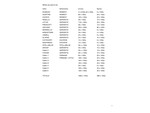
This GCHQ document provides a technical breakdown of surveillance access points showing 11 different interception sites (with codenames like DONNINGTON, LATUS, SCEPTRE) accessing various undersea cables including Flag, Apollo North/South, BT, Cable & Wireless (C&W), SMW-3, Solas, and Verizon, totaling 541 10-gigabit connections representing 5,410 gigabits of surveillance capacity across the network.
Programs: DONNINGTON · LATUS · SCEPTRE · PRESCOTT · GIBUS · KIRKISTOWN · MONDELLO · LINNELL · CATEGORY · KNAPWEED · ELAPSE · BROKER“Vodafone – der lange Arm des britischen Geheimdienstes?” - WDR ↗ (2014-11-20) · “Spy cable revealed: how telecoms firm worked with GCHQ” - Channel 4 ↗ (2014-11-20) · “Der lange Arm des Geheimdienstes?” - NDR ↗ (2014-11-21) · “Snowden-Leaks: How Vodafone-Subsidiary Cable & Wireless Aided GCHQ’s Spying Efforts” - Süddeutsche Zeitung ↗ (2014-11-25) · Restle, Georg · White, Geoff · Strozyk, Jan · Moltke, Henrik · Poitras, Laura · Obermaier, Frederik -
Cable Master List [pdf]
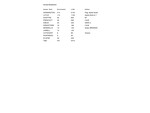
This GCHQ document is a comprehensive master list of undersea fiber optic cables tracked for surveillance purposes, including both cables with UK landing points and international cables without UK connections, detailing technical specifications, ownership, capacity data, and code names for telecommunications partner companies that provided the intelligence agency with surveillance access.
Programs: PINNAGE · PFENNINGALPHA · NIGELLA · REMEDY · HIASCO · GERONTIC · SCEPTRE · PRESCOTT · KIRKISTOWN · LINNELL · CATEGORY · DACRON · KNAPWEED · ELAPSE · VITREOUS · LITTLE · STREETCAR · GIBBUS · VISAGE · LATUS · NUMDAH“Vodafone – der lange Arm des britischen Geheimdienstes?” - WDR ↗ (2014-11-20) · “Spy cable revealed: how telecoms firm worked with GCHQ” - Channel 4 ↗ (2014-11-20) · “Der lange Arm des Geheimdienstes?” - NDR ↗ (2014-11-21) · “Snowden-Leaks: How Vodafone-Subsidiary Cable & Wireless Aided GCHQ’s Spying Efforts” - Süddeutsche Zeitung ↗ (2014-11-25) · Restle, Georg · White, Geoff · Strozyk, Jan · Moltke, Henrik · Poitras, Laura · Obermaier, Frederik -
Cables we do not currently have good access [pdf]
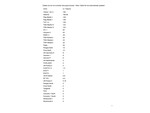
This GCHQ document, titled "Cables we do not currently have good access," lists numerous undersea fiber-optic cables along with their active data capacity ("Lit Capacity"), indicating the substantial portion of global telecommunications infrastructure where the agency lacks adequate surveillance access, in contrast to other internal reports detailing cables it successfully monitors.
“Vodafone – der lange Arm des britischen Geheimdienstes?” - WDR ↗ (2014-11-20) · “Spy cable revealed: how telecoms firm worked with GCHQ” - Channel 4 ↗ (2014-11-20) · “Der lange Arm des Geheimdienstes?” - NDR ↗ (2014-11-21) · “Snowden-Leaks: How Vodafone-Subsidiary Cable & Wireless Aided GCHQ’s Spying Efforts” - Süddeutsche Zeitung ↗ (2014-11-25) · Restle, Georg · White, Geoff · Strozyk, Jan · Moltke, Henrik · Poitras, Laura · Obermaier, Frederik
See all 13 documents published with “Vodafone – der lange Arm des britischen Geheimdienstes?” →
See all 13 documents published with “Spy cable revealed: how telecoms firm worked with GCHQ” →
See all 13 documents published with “Der lange Arm des Geheimdienstes?” →
Related Documents
-
Cable Master List [pdf]
This GCHQ document is a comprehensive master list of undersea fiber optic cables tracked for surveillance purposes, including both cables with UK landing points and international cables without UK connections, detailing technical specifications, ownership, capacity data, and code names for telecommunications partner companies that provided the intelligence agency with surveillance access.
Programs: PINNAGE · PFENNINGALPHA · NIGELLA · REMEDY · HIASCO · GERONTIC · SCEPTRE · PRESCOTT · KIRKISTOWN · LINNELL · CATEGORY · DACRON · KNAPWEED · ELAPSE · VITREOUS · LITTLE · STREETCAR · GIBBUS · VISAGE · LATUS · NUMDAH“Vodafone – der lange Arm des britischen Geheimdienstes?” - WDR ↗ (2014-11-20) · “Spy cable revealed: how telecoms firm worked with GCHQ” - Channel 4 ↗ (2014-11-20) · “Der lange Arm des Geheimdienstes?” - NDR ↗ (2014-11-21) · “Snowden-Leaks: How Vodafone-Subsidiary Cable & Wireless Aided GCHQ’s Spying Efforts” - Süddeutsche Zeitung ↗ (2014-11-25) · Restle, Georg · White, Geoff · Strozyk, Jan · Moltke, Henrik · Poitras, Laura · Obermaier, Frederik -
Partner Cables [pdf]
A classified table mapping which GCHQ cable interception programs had access to specific undersea fiber optic cables worldwide, revealing the codenames and access types — either Direct Cable Order or Indefeasible Right of Use/Landing Capacity — of seven surveillance programs across dozens of international cable systems, with Cable & Wireless (GERONTIC) providing access to the largest number.
“Vodafone – der lange Arm des britischen Geheimdienstes?” - WDR ↗ (2014-11-20) · “Spy cable revealed: how telecoms firm worked with GCHQ” - Channel 4 ↗ (2014-11-20) · “Der lange Arm des Geheimdienstes?” - NDR ↗ (2014-11-21) · “Snowden-Leaks: How Vodafone-Subsidiary Cable & Wireless Aided GCHQ’s Spying Efforts” - Süddeutsche Zeitung ↗ (2014-11-25) · Restle, Georg · White, Geoff · Strozyk, Jan · Moltke, Henrik · Poitras, Laura · Obermaier, Frederik -
Cables we do not currently have good access [pdf]
This GCHQ document, titled "Cables we do not currently have good access," lists numerous undersea fiber-optic cables along with their active data capacity ("Lit Capacity"), indicating the substantial portion of global telecommunications infrastructure where the agency lacks adequate surveillance access, in contrast to other internal reports detailing cables it successfully monitors.
“Vodafone – der lange Arm des britischen Geheimdienstes?” - WDR ↗ (2014-11-20) · “Spy cable revealed: how telecoms firm worked with GCHQ” - Channel 4 ↗ (2014-11-20) · “Der lange Arm des Geheimdienstes?” - NDR ↗ (2014-11-21) · “Snowden-Leaks: How Vodafone-Subsidiary Cable & Wireless Aided GCHQ’s Spying Efforts” - Süddeutsche Zeitung ↗ (2014-11-25) · Restle, Georg · White, Geoff · Strozyk, Jan · Moltke, Henrik · Poitras, Laura · Obermaier, Frederik -
Where we are [pdf]
This GCHQ document is a table tracking the agency's access to undersea fiber-optic cables as of an unspecified date, listing 13 cables with their codenames, telecommunications company partners (primarily "GERONTIC"/Cable & Wireless and "REMEDY"), and the capacity of data access and egress points measured in 10 gigabit connections. The table shows GCHQ had access to 592 10-gigabit connections across these cables with 69 egress points, with an unlabelled column totalling 2,960, with GERONTIC (Cable & Wireless) providing access to 9 of the 13 cables including FEA (NIGELLA), APOLLO North and South, and TAT-14S.
Programs: NUMDAH · SCEPTRE · NIGELLA · LATUS · ARCANO · MONDELLO · GIBUS · KIRKISTOWN · LINNELL · ELAPSE · GRASP · CATEGORY · KNAPWEED · DACRON · GERONTIC · REMEDY · SOLAS · APOLLO · FEA · SMW3“Vodafone – der lange Arm des britischen Geheimdienstes?” - WDR ↗ (2014-11-20) · “Spy cable revealed: how telecoms firm worked with GCHQ” - Channel 4 ↗ (2014-11-20) · “Der lange Arm des Geheimdienstes?” - NDR ↗ (2014-11-21) · “Snowden-Leaks: How Vodafone-Subsidiary Cable & Wireless Aided GCHQ’s Spying Efforts” - Süddeutsche Zeitung ↗ (2014-11-25) · Restle, Georg · White, Geoff · Strozyk, Jan · Moltke, Henrik · Poitras, Laura · Obermaier, Frederik -
Where we want to be [pdf]
This GCHQ document outlines the agency's aspirational expansion plans for undersea cable surveillance, showing desired access to 24 cables (compared to 13 in the "Where we are" document) with a dramatic increase in surveillance capacity to 1,693 10-gigabit connections and 390 egress points—nearly triple the existing infrastructure. The document includes eight cables with generic names (Cable X, Y, Z and A to E), five of them with blank relationship fields, suggesting GCHQ was actively pursuing partnerships with additional telecommunications companies beyond GERONTIC (Cable & Wireless), REMEDY, DACRON, and newly mentioned partners STELLABLUE, PINNAGE, and LITTLE to achieve comprehensive global communications interception.
Programs: NUMDAH · SCEPTRE · HIASCO · NIGELLA · LATUS · PRESCOTT · ARCANO · MONDELLO · KIRKISTOWN · LINNELL · ELAPSE · CATEGORY · KNAPWEED · STELLABLUE · GRASP · VISAGE · REMEDY · GERONTIC · DACRON · PINNAGE · LITTLE“Vodafone – der lange Arm des britischen Geheimdienstes?” - WDR ↗ (2014-11-20) · “Spy cable revealed: how telecoms firm worked with GCHQ” - Channel 4 ↗ (2014-11-20) · “Der lange Arm des Geheimdienstes?” - NDR ↗ (2014-11-21) · “Snowden-Leaks: How Vodafone-Subsidiary Cable & Wireless Aided GCHQ’s Spying Efforts” - Süddeutsche Zeitung ↗ (2014-11-25) · Restle, Georg · White, Geoff · Strozyk, Jan · Moltke, Henrik · Poitras, Laura · Obermaier, Frederik