Agency: NSA National Security Agency (US) 557 documents
Search documents matching “NSA” →The agency that WROTE each document.
Graphs
By document date (13 years)
By Banner
By Classification
Refine (combine with another filter, via search)
Sort: Title
Documents
-
Tailored Access Operations, FOXACID, QUANTUM [pdf]
These NSA presentation slides detail "QUANTUM," a sophisticated system that allows the agency to intercept internet traffic and inject malware onto target computers with up to 80% success rates, far exceeding traditional spam-based methods. The system works by monitoring internet traffic for specific identifiers (like Yahoo or Facebook cookies), then racing to inject malicious code before legitimate web servers can respond, thereby compromising targets' computers without their knowledge and establishing persistent backdoor access.
Programs: FOXACID · QUANTUM · QUANTUMTHEORY · QUANTUMBISCUIT · VALIDATOR · OLYMPUS · UNITEDRAKE · OLYMPUSFIRE · SSO · FORESTPLACE -
Talking Point Topics Proposal - HR DIETMAR B - Director SIGINT Analysis and Production German Federal Intelligence Service, 30 April - 1 May 2013 [pdf]
The memo summarizes preparatory talking points for meetings between NSA/NTOC and German intelligence (BND), BSI, and BfV leadership, highlighting Germany’s T4 cyber unit staffing progress (~130/150 positions), interest in NSA guidance on CND, and German legal prohibitions on near‑real‑time cyber defense activities. It records German interest in NSA programs (TUTELAGE, DIB partnerships), requests for follow‑on technical information, and an internal “landmine” assessment that substantial analytic/operational investment may not be justified yet; recommended next steps emphasize monitoring progress, encouraging interagency German cooperation, and offering selective lessons‑learned briefings.
-
Targeted Killing: Policy, Legal and Ethical Controversy [pdf]
Intellipedia article surveying the policy, legal, and ethical controversy surrounding targeted killing, drone strikes, and related counterterrorism practices by the US, Israel, and NATO, outlining the international and domestic legal justifications offered by officials alongside the growing opposition from human rights groups, the UN, the ACLU, and international law experts. It catalogs key legal cases, government defenses, and debates—from the Awlaki lawsuits and the bin Ladin raid to challenges against CIA and British intelligence personnel—while noting related controversies over surveillance, detention, and interrogation.
People: Shehada, Salah · Sharon, Ariel · Alston, Phillip · Panetta, Leon · Koh, Harold · Leiter, Michael · Obama, Barack · Holder, Eric · Romero, Anthony D. · al-Awlaki, Anwar · Gates, Robert M. · Bates, John · Khan, Samir · Gaddafi, Aisha · Gaddafi, Muammar · Brossollet, Luc · Gaddafi, Saif al-Arab · Mastoura · Seif · Carthage · Heyns, Christof · Scheinin, Martin · Bouchard, Charles · Fox, Liam · Rizzo, John · Stafford Smith, Clive · Sadaullah · Khan, Kareem · Khan, Noor · Moses, Alan · Calderon · Eichensehr, Kristen · Melzer, Nils · bin Laden, Osama -
Targeting Rationale (TAR) [pdf]
An NSA document describing how analysts should explain their targeting decisions under the FISA Amendments Act.
-
Tasking of SCALAWAG [pdf]
An NSA Special Source Operations memo describing bandwidth and latency problems caused by the SCALAWAG bulk voice collection program, and introducing the RETRO Tool — a capability allowing analysts to reach back up to 30 days into a buffer of recorded phone calls from an entire country to retrieve audio that was never individually targeted.
Programs: SCALAWAG · DOUBLEARROW · UTT · OCTAVE · NUCLEON · RETROSPECTIVE · RETROTOOL · RETRO · FASCIA · SSO -
TCB Jamboree 2010 Abstracts [pdf]
This document discusses a 2010 CIA-hosted conference on trusted computing technologies, specifically focusing on security measures such as bypassing disk access for covert execution of code. It highlights a demonstration of Northrop Grumman Xetron's "Orca" system, which enables covert launching of Windows executables without writing to disk, circumventing personal security products that monitor disk activity for malicious software.
-
TCB Jamboree 2011 Abstracts [pdf]
This document discusses a 2011 CIA-hosted conference 2011 TCB Jamboree, focusing on research into emerging security technologies, their vulnerabilities, and methods for exploiting or circumventing trusted computing architectures. The event featured presentations—many redacted—on hardware and software security topics, including processor analysis, driver‑signing forensics, and other advanced techniques relevant to intelligence operations.
-
TCB Jamboree 2012 [pdf]
This document describes a 2012 TCB Jamboree conference highlighting research into security weaknesses in Apple technologies, including analysis of Apple A4/A5 processors and methods for targeting the MacOS and iOS software‑development ecosystem. The focus is on understanding and exploiting architectural or tooling vulnerabilities rather than user‑level devices, all presented in a high‑level research context.
-
TCB Jamboree 2012 Invitation [pdf]
The invitation to the CIA Information Operations Center's seventh annual Trusted Computing Base Jamboree, held at the Lockheed Martin Dulles Executive Plaza in Herndon, Virginia, February 7-9 2012 — an informal conference organised by the Engineering Development Group's Emerging Technologies Branch for developers working to circumvent or exploit new security capabilities, with a focus on applying Security Portfolio research results to Trusted Platform Module threats and opportunities and exploiting new attack vectors.
“The CIA Campaign to Steal Apple's Secrets” - The Intercept ↗ (2015-03-10) · Scahill, Jeremy · Begley, Josh -
TEC Successfully Installs BOTANICREALTY at LADYLOVE (USJ-799) [pdf]
This document outlines technical advancements in NSA surveillance, specifically the deployment of the "BOTANICREALTY" tool at LADYLOVE (USJ-799) to intercept encrypted video feeds, and details the 2007 annual report of the "Joint SIGINT Activity" (JSA), a collaborative operation between the NSA and the German BND. The report highlights massive increases in data collection, including the daily flow of 330,000 SMS messages into the DISHFIRE database and the development of new tools for VoIP analysis.
Programs: BOTANICREALTY · SALTYDOGS · UNCANNY · LADYLOVE · HIGHPRIDE · TROPICPUMA · NORMALRUN · DISHFIRE · FASCIA · JUGGERNAUT · SSO -
Template:POISONNUT Product [pdf]
An NSA WikiInfo page describing the POISONNUT ESP attack scheduling component — the internal software element responsible for determining whether a VPN key recovery attack can proceed, submitting it to the cryptanalytic processing infrastructure, correlating responses, and marking each attack attempt as successful or failed.
Programs: POISONNUT -
The collection challenge [pdf]
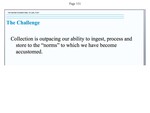
A slide stating the collection problem in one line: “Collection is outpacing our ability to ingest, process and store to the ‘norms’ to which we have become accustomed.”
-
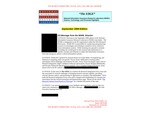
"The EDGE" - National Information Assurance Research Laboratory (NIARL) Science, Technology, and Personnel Highlights, 2008 [pdf]
The September 2008 edition of "The EDGE" — the internal newsletter of NSA's National Information Assurance Research Laboratory (NIARL/R2) — covering research highlights including the TUNDRA project investigating a new AES cryptanalysis technique, the TUNDRA Tau statistic for codebook analysis, photonic logic research at Sandia, anti-tamper work, the CLARIFYMIND wireless pilot, FLOWBEE network metadata collection, POPQUIZ/DISTILLERY analytics and FMAC mandatory access controls for OpenSolaris, notable for containing the first published description of the TUNDRA cryptanalysis project against AES.
Programs: DISTILLERY · HAIRBALL · GRAPHVIZ · POPEYESEAR · RANDOMIZERS · TUNDRA · CLOUD · STARFIRE · CARPAT · MAPREDUCE · NUCLEARWINTER · CLARIFYMIND · FLOWBEE · POPQUIZ · BYZANTINEHADES · TREEVIZ · GROUPDIVE · BLUESASH -
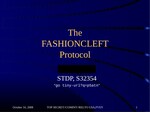
The FASHIONCLEFT Protocol [pdf]
This October 2008 NSA technical specification details FASHIONCLEFT, the encryption and exfiltration protocol used by TAO implants to securely tunnel captured network packets from compromised devices back to the NSA's Common Data Receptor using layered RSA and RC6 encryption with authentication. The document addresses technical integration challenges of implementing FASHIONCLEFT packet reception within TURMOIL's passive collection infrastructure, particularly cache buffering requirements and metadata handling for exfiltrated traffic.
Programs: FASHIONCLEFT · FOGYNULL · FUNNELAPS · SHELLGREY · TURMOIL · SURPASSPIN · PUZZLECUBE · FLASHHANDLE · HAMMERCHANT · AEG · PPF · ISLANDTRANSPORT -
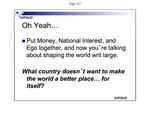
The Role of National Interests, Money, and Egos [pdf]
Slides on standards-setting as an instrument of power, arguing bluntly that the Western world and especially the United States gained influence and money by drafting the earlier standards that shaped today's Internet.
-
The SIGINT Philosopher Is Back -- with a New Face! SIDtoday [pdf]
The inaugural column of the second SIGINT Philosopher series, in which the new columnist uses a personal polygraph experience and the ethical tension of spying on diplomatic targets to argue — somewhat counterintuitively — that thorough, comprehensive surveillance is more ethical than partial or halfhearted monitoring of non-adversarial targets.
Programs: SCQAWK -
The SIGINT Philosopher: Cognitive Overflow? SIDtoday [pdf]
A 2011 NSA SIDtoday opinion column reflecting on whether the SIGINT Directorate's collective analytical capacity has a finite "channel capacity" — borrowing from cognitive psychology to ask whether SID's ever-expanding mission, tools, and information load risks exceeding the combined cognitive limits of its workforce.
Marking: UNCLASSIFIED -
The SIGINT Philosopher: Descartes Would Have Been a Lousy SIGINT Reporter SIDtoday [pdf]
A 2012 SIDtoday SIGINT Philosopher column using Cartesian epistemology to examine the fundamental reliability problem in SIGINT reporting — arguing that by the time raw intercepts pass through collection, translation, interpretation, and reporting, the finished intelligence product is several steps removed from ground truth and risks becoming little more than an analyst's painting of a scene described to them secondhand.
Programs: SCQAWK -
The SIGINT Philosopher: In Praise of Not Knowing SIDtoday [pdf]
A 2012 NSA SIDtoday opinion column in the "SIGINT Philosopher" series arguing that the Intelligence Community — and NSA in particular — too rarely admits the limits of its knowledge, using the misappropriation of the word "agnostic" as a springboard to critique the institutional pressure to produce intelligence reports even when genuine understanding of a target is absent.
People: Kim, Jong-un -
The SIGINT Philosopher: Lessons for Civil Servants from the American Civil War (That Don't Concern Killing Vampires) SIDtoday [pdf]
The final 2012 SIDtoday SIGINT Philosopher column using the American Civil War as a lens to examine how intelligence professionals should reconcile expert disagreement with national policy, arguing that good civil servants can find peace in the possibility that they might simply be wrong — and that committed execution of even imperfect policy can sometimes produce better outcomes than principled dissent.
Programs: SCQAWK