Tasking of SCALAWAG
Open PDFDocument date: -
Pages: 2
Genre: other
Classification: TOP SECRET SI
Dissemination: REL TO USA, FVEY
An NSA Special Source Operations memo describing bandwidth and latency problems caused by the SCALAWAG bulk voice collection program, and introducing the RETRO Tool — a capability allowing analysts to reach back up to 30 days into a buffer of recorded phone calls from an entire country to retrieve audio that was never individually targeted.
My notes
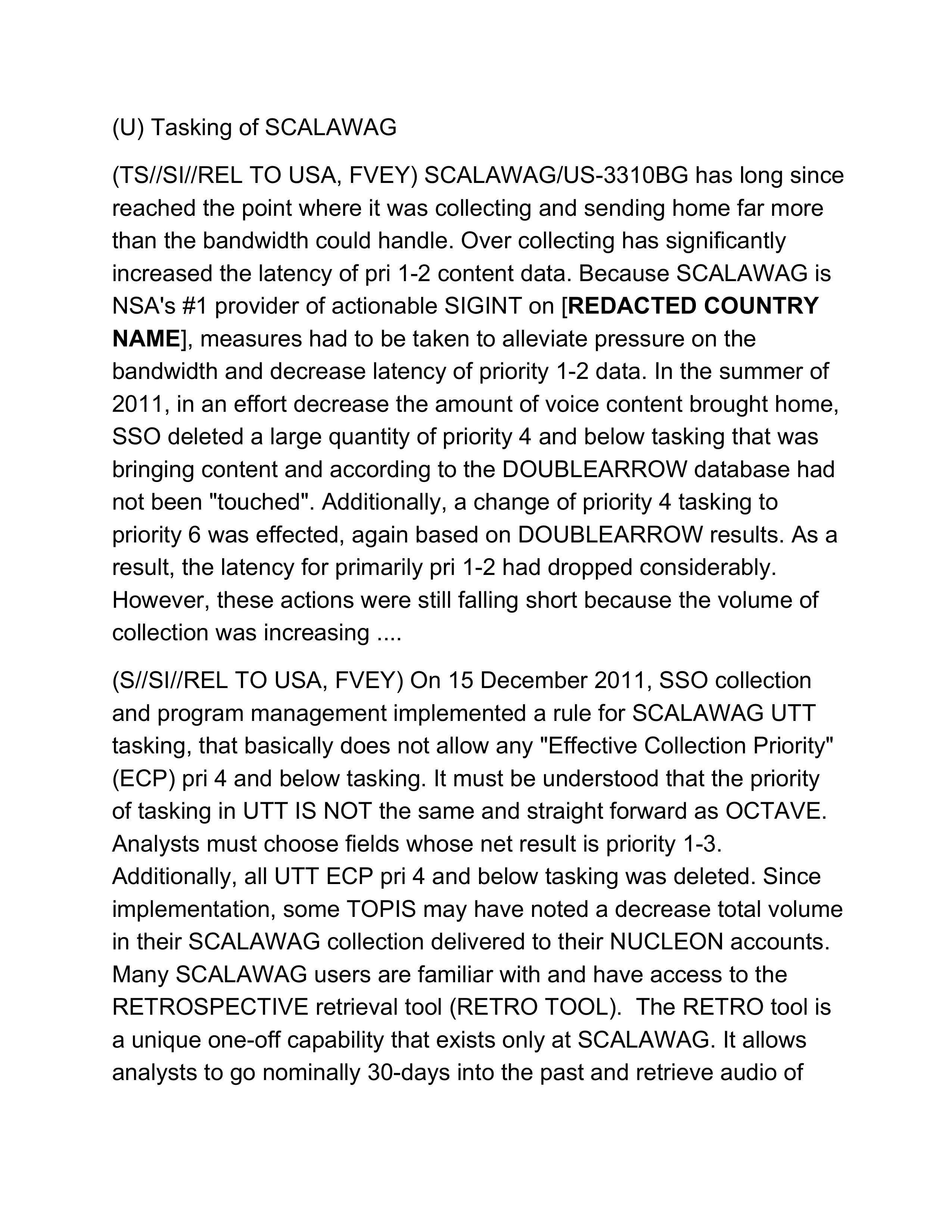
(U) Tasking of SCALAWAG
(TS//SI//REL TO USA, FVEY) SCALAWAG/US-3310BG has long since reached the point where it was collecting and sending home far more than the bandwidth could handle. Over collecting has significantly increased the latency of pri 1-2 content data. Because SCALAWAG is NSA's #1 provider of actionable SIGINT on [REDACTED COUNTRY NAME], measures had to be taken to alleviate pressure on the bandwidth and decrease latency of priority 1-2 data. In the summer of 2011, in an effort decrease the amount of voice content brought home, SSO deleted a large quantity of priority 4 and below tasking that was bringing content and according to the DOUBLEARROW database had not been "touched". Additionally, a change of priority 4 tasking to priority 6 was effected, again based on DOUBLEARROW results. As a result, the latency for primarily pri 1-2 had dropped considerably. However, these actions were still falling short because the volume of collection was increasing ....
(S//SI//REL TO USA, FVEY) On 15 December 2011, SSO collection and program management implemented a rule for SCALAWAG UTT tasking, that basically does not allow any "Effective Collection Priority" (ECP) pri 4 and below tasking. It must be understood that the priority of tasking in UTT IS NOT the same and straight forward as OCTAVE. Analysts must choose fields whose net result is priority 1-3. Additionally, all UTT ECP pri 4 and below tasking was deleted. Since implementation, some TOPIS may have noted a decrease total volume in their SCALAWAG collection delivered to their NUCLEON accounts. Many SCALAWAG users are familiar with and have access to the
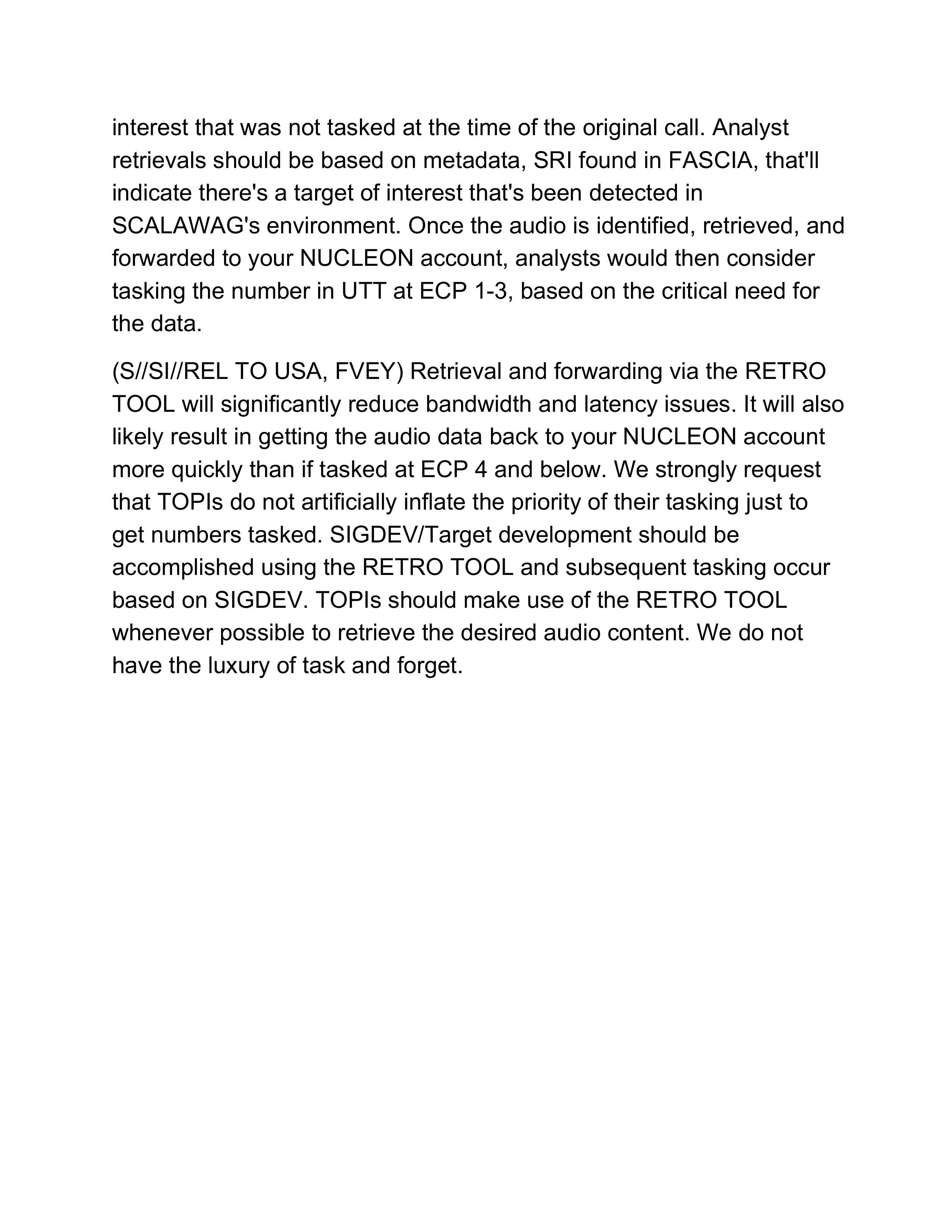
RETROSPECTIVE retrieval tool (RETRO TOOL). The RETRO tool is a unique one-off capability that exists only at SCALAWAG. It allows analysts to go nominally 30-days into the past and retrieve audio of interest that was not tasked at the time of the original call. Analyst retrievals should be based on metadata, SRI found in FASCIA, that'll indicate there's a target of interest that's been detected in SCALAWAG's environment. Once the audio is identified, retrieved, and forwarded to your NUCLEON account, analysts would then consider tasking the number in UTT at ECP 1-3, based on the critical need for the data.
(S//SI//REL TO USA, FVEY) Retrieval and forwarding via the RETRO TOOL will significantly reduce bandwidth and latency issues. It will also likely result in getting the audio data back to your NUCLEON account more quickly than if tasked at ECP 4 and below. We strongly request that TOPIs do not artificially inflate the priority of their tasking just to get numbers tasked. SIGDEV/Target development should be accomplished using the RETRO TOOL and subsequent tasking occur based on SIGDEV. TOPIs should make use of the RETRO TOOL whenever possible to retrieve the desired audio content. We do not have the luxury of task and forget.
Related Documents
-
SSO dictionary relevant entries [pdf]
This document provides a detailed list of relevant entries related to NSA's Special Source Operations (SSO), highlighting various NSA surveillance and data collection systems used to monitor global communications. It includes descriptions of programs such as BIGBIRD and DISHFIRE, which focus on cable and SMS interception, as well as tools like LOPERS and COURIERSKILL for processing telephony metadata and refining target selection. The entries emphasize the extensive and automated nature of the NSA's intelligence-gathering operations, particularly in relation to undersea cables and telecommunication networks, and underscore the secretive and expansive scope of SSO's global surveillance activities.
Programs: ARTIFICE · BIGBIRD · FAIRVIEW · SSO · POORWILL · PINECONE · BLACKBELT · CADENCE · BLACKNIGHT · SHIPMASTER · COURIERSKILL · THEORYMASTER · WEALTHYCLUSTER · CLIFFSIDE · DISHFIRE · MARINA · MAINWAY · NUCLEON · PINWALE · FASCIA · BANYAN · LAMPSHADE · ASSOCIATION · HOMEBASE · SEDB · FRIAR · KEYCARD · TURMOIL · TURBULENCE · UTT · IRISHBEAUTY · OCTAVE · KOZYKOVE · LITHIUM · BLARNEY · LOPERS · MAILORDER · LUMBERYARD · MERLIN · NODDY · SAGUARO · NUTHATCH · CONTRAOCTAVE · XKEYSCORE · PLANK · RODEOSTAR · SAGURA · SERENADE · STARGATE · SILVERCOLLAM · SEALION · SEAGULL · SLIVER · SORA-2 · TITANPOINTE · TUBE · VPCS · STONEGATE“NSA Spying Relies on AT&T’s ‘Extreme Willingness to Help’” - ProPublica ↗ (2015-08-15) · “AT&T Helped U.S. Spy on Internet on a Vast Scale” - The New York Times ↗ (2015-08-15) · “The Wiretap Rooms: The NSA’s Hidden Spy Hubs in Eight U.S. Cities” - The Intercept ↗ (2018-06-25) · Angwin, Julia · Larson, Jeff · Savage, Charlie · Moltke, Henrik · Poitras, Laura · Risen, James · Gallagher, Ryan -
SSO Corporate Portfolio Overview [pdf]
A classified NSA training presentation providing analysts with a detailed overview of SSO's corporate collection portfolio — covering FAIRVIEW, STORMBREW, BLARNEY, MADCAPOCELOT, and OAKSTAR — including their legal authorities, collection capabilities, tasking procedures, and data repositories, with BLARNEY identified as contributing to over 60% of counterterrorism reporting and over 80% of all FAA reporting.
Programs: OCTAVE · UTT · CADENCE · BLARNEY · STORMBREW · FAIRVIEW · DARKTHUNDER · STEELFLAUTA · MONKEYROCKET · SHIFTINGSHADOW · ORANGECRUSH · YACHTSHOP · ORANGEBLOSSOM · SILVERZEPHYR · BLUEZEPHYR · COBALTFALCON · PINWALE · YANKEE · XKEYSCORE · MAINWAY · TOYGRIPPE · BLACKPEARL · TWISTEDPATH · NUCLEON · DISHFIRE · WHITESQUALL · MISTRALWIND · SERRATEDEDGE · PERFECTSTORM · MARINA · MADCAPOCELOT · FIST · MDCP · OAKSTAR · SSO · PRISM · TMM · COWBOY“NSA Spying Relies on AT&T’s ‘Extreme Willingness to Help’” - ProPublica ↗ (2015-08-15) · “AT&T Helped U.S. Spy on Internet on a Vast Scale” - The New York Times ↗ (2015-08-15) · “No Place to Hide” - Metropolitan Books ↗ (2014-05-13) · Angwin, Julia · Larson, Jeff · Savage, Charlie · Moltke, Henrik · Poitras, Laura · Risen, James · Greenwald, Glenn -
Special Source Operations corporate overview [pdf]
A classified NSA training presentation providing an in-depth operational overview of the FAIRVIEW program — the agency's largest corporate partner surveillance program — detailing its collection capabilities, legal authorities, TAO shaping operations, targeting tools, and productivity statistics, while revealing that BLARNEY/PRISM was the single most productive SSO program in 2012 with 806 serialized product reports.
Programs: FAIRVIEW · BLARNEY · PRISM · RAMPART-A · RAMPART-I · RAMPART-X · RAMPART-T · RAMPART-M · DGO · WINDSTOP · MYSTIC · PINWALE · XKEYSCORE · TURMOIL · STORMBREW · OAKSTAR · OCTAVE · UTT · CADENCE · COWBOY · YANKEE · MAINWAY · TOYGRIPPE · BLACKPEARL · TWISTEDPATH · NUCLEON · DISHFIRE · SPYDER · CARBONFURY · NATIVEFLORA · UNICORNSANDWICH · CROSSEYEDBEAR · SCORCHERSIX · TROPICTHUNDER · DARKTHUNDER · STEELFLAUTA · RAGTIME · SWEETSMACK2 · SOURSMACK2 · EVILOLIVE · SCALEABLE · FLEXIBLE · MONKEYROCKET · SHIFTINGSHADOW · ORANGECRUSH · YACHTSHOP · ORANGEBLOSSOM · SILVERZEPHYR · BLUEZEPHYR · COBALTFALCON · RAGTIME-A · RAGTIME-C · SSO · SURREY“NSA Spying Relies on AT&T’s ‘Extreme Willingness to Help’” - ProPublica ↗ (2015-08-15) · “AT&T Helped U.S. Spy on Internet on a Vast Scale” - The New York Times ↗ (2015-08-15) · “The Wiretap Rooms: The NSA’s Hidden Spy Hubs in Eight U.S. Cities” - The Intercept ↗ (2018-06-25) · Angwin, Julia · Larson, Jeff · Savage, Charlie · Moltke, Henrik · Poitras, Laura · Risen, James · Gallagher, Ryan -
VOIP in XKEYSCORE [pdf]
A TOP SECRET XKeyscore training presentation from 2009 describing how the system intercepts internet phone calls — automatically matching the call setup information (who is calling whom) with the actual voice data even when they travel through different countries and collection sites, then decoding the audio into playable recordings that analysts can listen to through Windows Media Player.
-
PRISM/US-984XN Overview [pdf]
A 2013 NSA training presentation revealing that major U.S. tech companies — including Google, Facebook, Apple, Microsoft, and Skype — secretly gave the NSA direct access to their servers, allowing the agency to collect users' emails, chats, photos, and files in real time, with the FBI acting as intermediary.
Programs: PRISM · FAIRVIEW · STORMBREW · BLARNEY · OAKSTAR · UTT · PRINTAURA · PINWALE · NUCLEON · TRAFFICTHIEF · SCISSORS · MARINA · MAINWAY · FALLOUT · CONVEYANCE · REPRISMFISA · SSO“U.S., British intelligence mining data from nine U.S. Internet companies in broad secret program” - The Washington Post ↗ (2013-06-06) · “NSA Prism program taps in to user data of Apple, Google and others” - The Guardian ↗ (2013-06-07) · “L'ampleur de l'espionnage mondial par la NSA” - Le Monde ↗ (2013-10-21) · “NSA files decoded: Edward Snowden's surveillance revelations explained” - The Guardian ↗ (2013-11-01) · “No Place to Hide” - Metropolitan Books ↗ (2014-05-13) · “Dark Mirror: Edward Snowden and the American Surveillance State” - Penguin Press ↗ (2020-05-19) · Gellman, Barton · Poitras, Laura · Greenwald, Glenn · MacAskill, Ewen · Untersinger, Martin · Dance, Gabriel