TCB Jamboree 2011 Abstracts
Open PDFDocument date: -
Pages: 4
Genre: wiki
Banner: TOP SECRET//HCS/SI-GAMMA/TALENT KEYHOLE//NOFORN/ORCON/PROPIN
Classification: TOP SECRET
Dissemination: NOFORN
This document discusses a 2011 CIA-hosted conference 2011 TCB Jamboree, focusing on research into emerging security technologies, their vulnerabilities, and methods for exploiting or circumventing trusted computing architectures. The event featured presentations—many redacted—on hardware and software security topics, including processor analysis, driver‑signing forensics, and other advanced techniques relevant to intelligence operations.
My notes
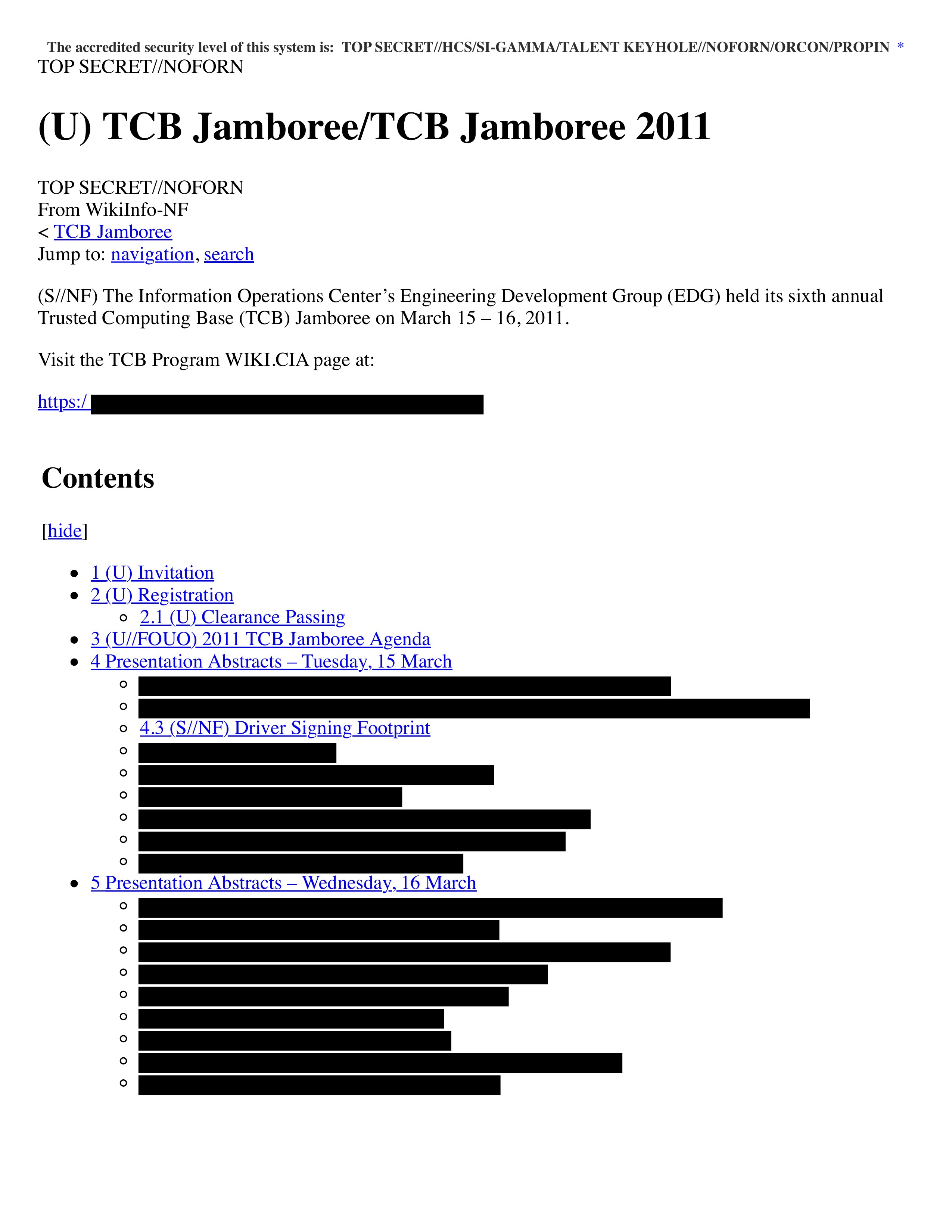
The accredited security level of this system is: TOP SECRET//HCS/SI-GAMMA/TALENT KEYHOLE//NOFORN/ORCON/PROPIN *
TOP SECRET//NOFORN
(U) TCB Jamboree/TCB Jamboree 2011
TOP SECRET//NOFORN
From WikiInfo-NF
< TCB Jamboree
Jump to: navigation, search
(S//NF) The Information Operations Center's Engineering Development Group (EDG) held its sixth annual Trusted Computing Base (TCB) Jamboree on March 15 – 16, 2011.
Visit the TCB Program WIKI.CIA page at:
https:/[REDACTED]
Contents
[hide]
- 1 (U) Invitation
- 2 (U) Registration
- 2.1 (U) Clearance Passing
- 3 (U//FOUO) 2011 TCB Jamboree Agenda
- 4 Presentation Abstracts – Tuesday, 15 March
- [REDACTED]
- 4.3 (S//NF) Driver Signing Footprint
- [REDACTED]
- [REDACTED]
- [REDACTED]
- [REDACTED]
- [REDACTED]
- [REDACTED]
- [REDACTED]
- 5 Presentation Abstracts – Wednesday, 16 March
- [REDACTED]
- [REDACTED]
- [REDACTED]
- [REDACTED]
- [REDACTED]
- [REDACTED]
- [REDACTED]
- [REDACTED]
- [REDACTED]
- [REDACTED]
- [REDACTED]
[edit] (U) Invitation
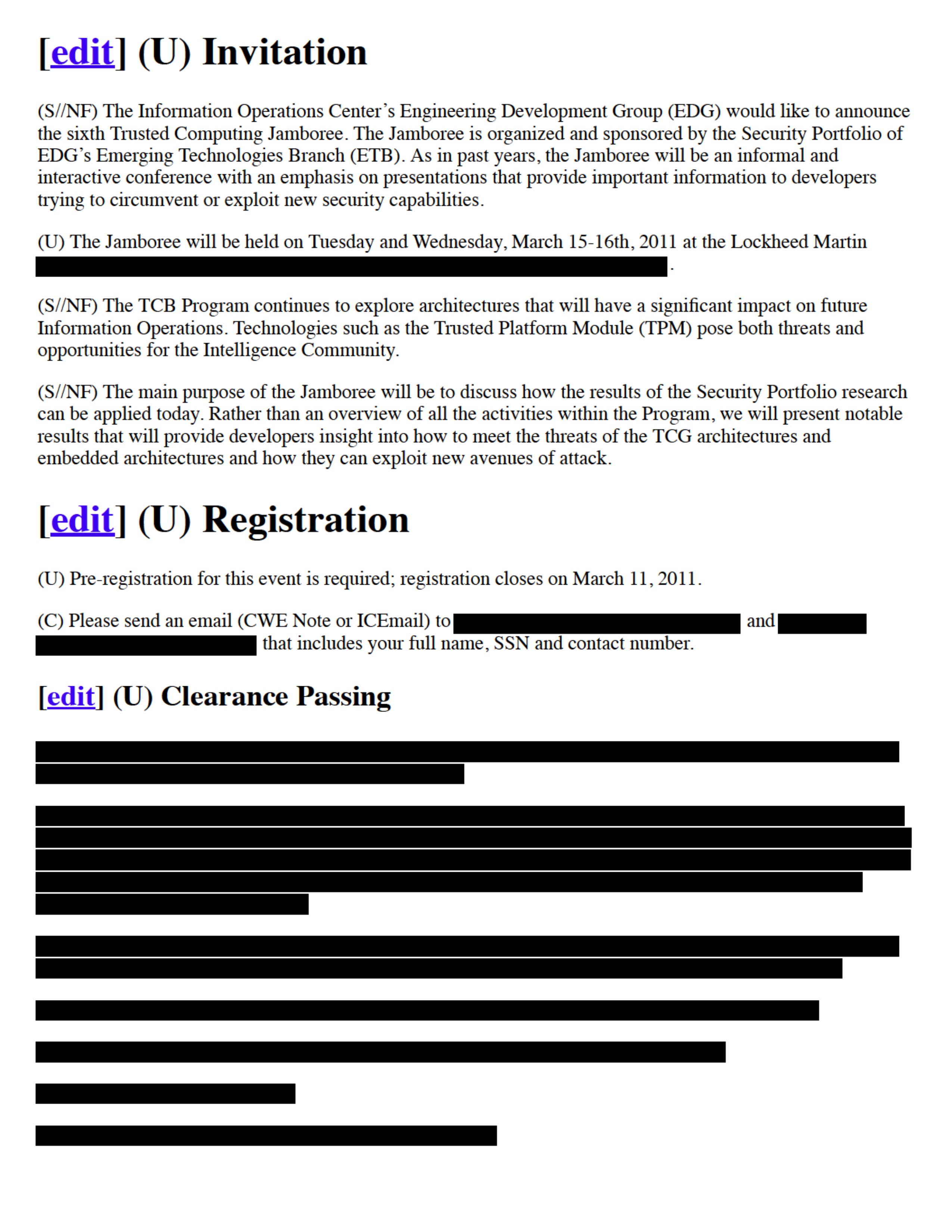
(S//NF) The Information Operations Center's Engineering Development Group (EDG) would like to announce the sixth Trusted Computing Jamboree. The Jamboree is organized and sponsored by the Security Portfolio of EDG's Emerging Technologies Branch (ETB). As in past years, the Jamboree will be an informal and interactive conference with an emphasis on presentations that provide important information to developers trying to circumvent or exploit new security capabilities.
(U) The Jamboree will be held on Tuesday and Wednesday, March 15-16th, 2011 at the Lockheed Martin [REDACTED].
(S//NF) The TCB Program continues to explore architectures that will have a significant impact on future Information Operations. Technologies such as the Trusted Platform Module (TPM) pose both threats and opportunities for the Intelligence Community.
(S//NF) The main purpose of the Jamboree will be to discuss how the results of the Security Portfolio research can be applied today. Rather than an overview of all the activities within the Program, we will present notable results that will provide developers insight into how to meet the threats of the TCG architectures and embedded architectures and how they can exploit new avenues of attack.
[edit] (U) Registration
(U) Pre-registration for this event is required; registration closes on March 11, 2011.
(C) Please send an email (CWE Note or ICEmail) to [REDACTED] and [REDACTED] that includes your full name, SSN and contact number.
[edit] (U) Clearance Passing
[REDACTED]
(U)
[REDACTED]
[edit] (U//FOUO) 2011 TCB Jamboree Agenda
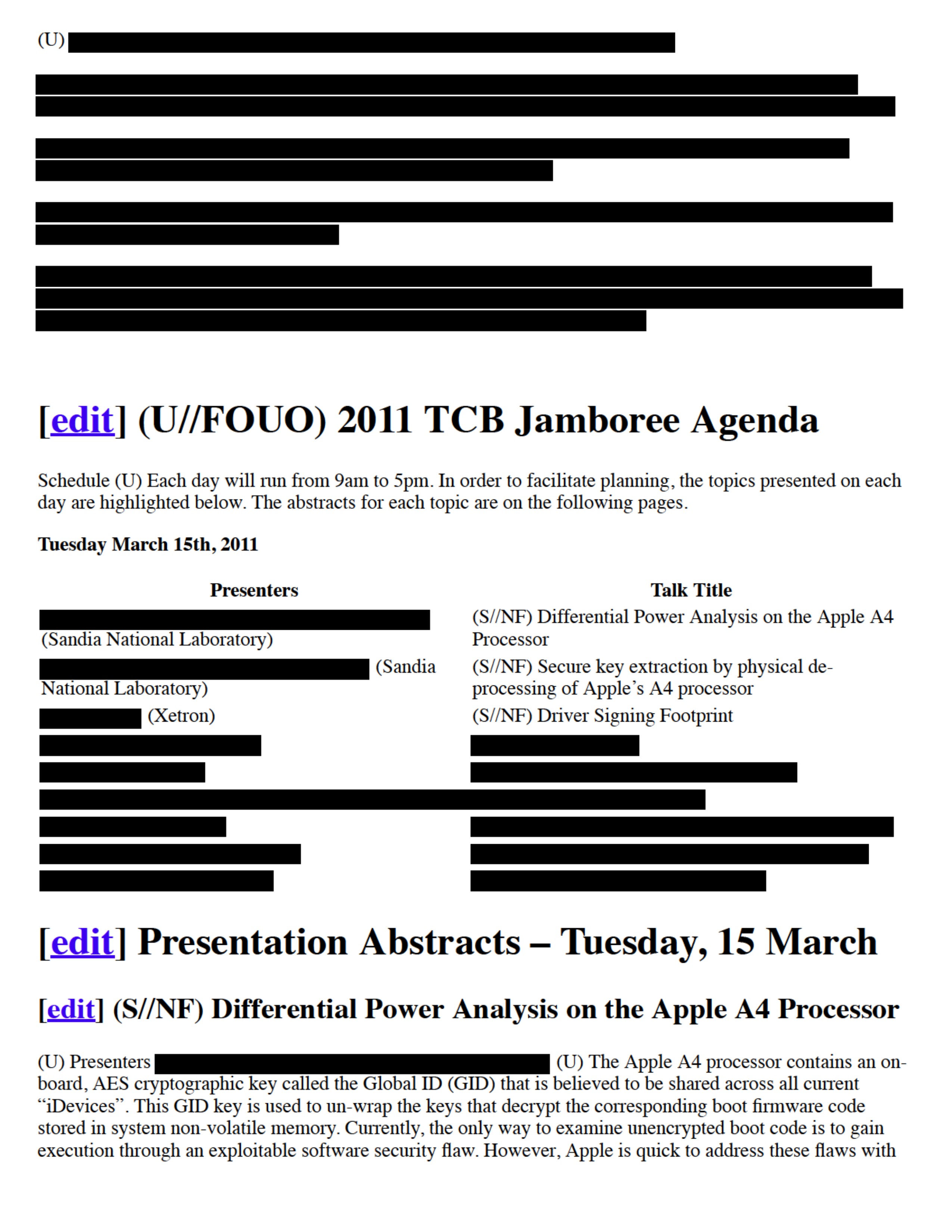
Schedule (U) Each day will run from 9am to 5pm. In order to facilitate planning, the topics presented on each day are highlighted below. The abstracts for each topic are on the following pages.
Tuesday March 15th, 2011
| Presenters | Talk Title |
|---|---|
| [REDACTED] (Sandia National Laboratory) |
(S//NF) Differential Power Analysis on the Apple A4 Processor |
| [REDACTED] (Sandia National Laboratory) |
(S//NF) Secure key extraction by physical de-processing of Apple's A4 processor |
| [REDACTED] (Xetron) | (S//NF) Driver Signing Footprint |
| [REDACTED] | [REDACTED] |
| [REDACTED] | [REDACTED] |
| [REDACTED] | [REDACTED] |
| [REDACTED] | [REDACTED] |
| [REDACTED] | [REDACTED] |
| [REDACTED] | [REDACTED] |
[edit] Presentation Abstracts – Tuesday, 15 March
[edit] (S//NF) Differential Power Analysis on the Apple A4 Processor
(U) Presenters [REDACTED] (U) The Apple A4 processor contains an on-board, AES cryptographic key called the Global ID (GID) that is believed to be shared across all current "iDevices". This GID key is used to un-wrap the keys that decrypt the corresponding boot firmware code stored in system non-volatile memory. Currently, the only way to examine unencrypted boot code is to gain execution through an exploitable software security flaw. However, Apple is quick to address these flaws with
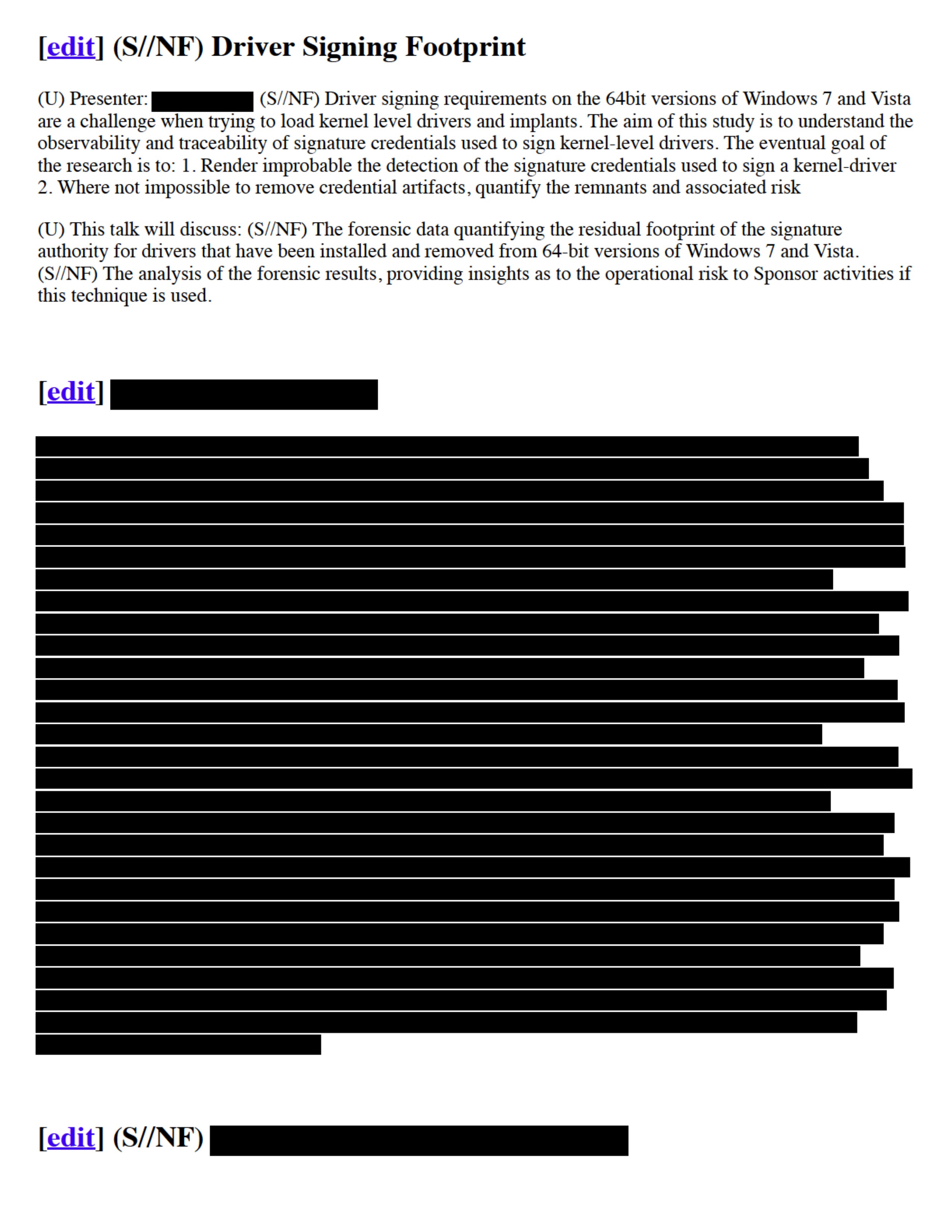
[edit] (S//NF) Driver Signing Footprint
(U) Presenter: [REDACTED] (S//NF) Driver signing requirements on the 64bit versions of Windows 7 and Vista are a challenge when trying to load kernel level drivers and implants. The aim of this study is to understand the observability and traceability of signature credentials used to sign kernel-level drivers. The eventual goal of the research is to: 1. Render improbable the detection of the signature credentials used to sign a kernel-driver 2. Where not impossible to remove credential artifacts, quantify the remnants and associated risk
(U) This talk will discuss: (S//NF) The forensic data quantifying the residual footprint of the signature authority for drivers that have been installed and removed from 64-bit versions of Windows 7 and Vista. (S//NF) The analysis of the forensic results, providing insights as to the operational risk to Sponsor activities if this technique is used.
[edit]
[REDACTED]
[edit] (S//NF) [REDACTED]
Published in the Same Report
(2 documents)
-
TCB Jamboree 2010 Abstracts [pdf]
This document discusses a 2010 CIA-hosted conference on trusted computing technologies, specifically focusing on security measures such as bypassing disk access for covert execution of code. It highlights a demonstration of Northrop Grumman Xetron's "Orca" system, which enables covert launching of Windows executables without writing to disk, circumventing personal security products that monitor disk activity for malicious software.
-
TCB Jamboree 2012 [pdf]
This document describes a 2012 TCB Jamboree conference highlighting research into security weaknesses in Apple technologies, including analysis of Apple A4/A5 processors and methods for targeting the MacOS and iOS software‑development ecosystem. The focus is on understanding and exploiting architectural or tooling vulnerabilities rather than user‑level devices, all presented in a high‑level research context.
Related Documents
-
TCB Jamboree 2012 [pdf]
This document describes a 2012 TCB Jamboree conference highlighting research into security weaknesses in Apple technologies, including analysis of Apple A4/A5 processors and methods for targeting the MacOS and iOS software‑development ecosystem. The focus is on understanding and exploiting architectural or tooling vulnerabilities rather than user‑level devices, all presented in a high‑level research context.
-
TCB Jamboree 2012 Invitation [pdf]
The invitation to the CIA Information Operations Center's seventh annual Trusted Computing Base Jamboree, held at the Lockheed Martin Dulles Executive Plaza in Herndon, Virginia, February 7-9 2012 — an informal conference organised by the Engineering Development Group's Emerging Technologies Branch for developers working to circumvent or exploit new security capabilities, with a focus on applying Security Portfolio research results to Trusted Platform Module threats and opportunities and exploiting new attack vectors.
“The CIA Campaign to Steal Apple's Secrets” - The Intercept ↗ (2015-03-10) · Scahill, Jeremy · Begley, Josh -
TCB Jamboree 2010 Abstracts [pdf]
This document discusses a 2010 CIA-hosted conference on trusted computing technologies, specifically focusing on security measures such as bypassing disk access for covert execution of code. It highlights a demonstration of Northrop Grumman Xetron's "Orca" system, which enables covert launching of Windows executables without writing to disk, circumventing personal security products that monitor disk activity for malicious software.
-
TCB Jamboree 2012 [pdf]
1 p.A TOP SECRET//SI//NOFORN entry from NSA's internal WikiInfo-NF wiki describing the CIA Trusted Computing Base Jamboree — an annual conference hosted by CIA's Emerging Technologies Branch within the Information Operations Center, bringing together CIA analysts and contractors conducting research for the TCB programme, with NSA invited to participate through its own counterpart TCB programme.
“The CIA Campaign to Steal Apple's Secrets” - The Intercept ↗ (2015-03-10) · Scahill, Jeremy · Begley, Josh -
Differential Power Analysis on the Apple A4 Processor [pdf]
1 p.This presentation abstract details a non-invasive method to extract the global AES cryptographic key (GID) from Apple's A4 processor using Differential Power Analysis (DPA). Success would enable the Intelligence Community to decrypt the boot firmware on devices like the iPhone 4 and iPad, providing a persistent means to find vulnerabilities and develop exploits independent of patchable software flaws.
“The CIA Campaign to Steal Apple's Secrets” - The Intercept ↗ (2015-03-10) · Scahill, Jeremy · Begley, Josh