Agency: NSA National Security Agency (US) 557 documents
Search documents matching “NSA” →The agency that WROTE each document.
Graphs
By document date (13 years)
By Banner
By Classification
Refine (combine with another filter, via search)
Sort: Title
Documents
-
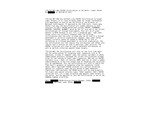
MHS Leverages XKS for QUANTUM Against Yahoo and Hotmail [pdf]
This document describes a technical study conducted at Menwith Hill Station (MHS) in the UK. The study used XKEYSCORE (XKS) to evaluate the feasibility of launching QUANTUMTHEORY "man-on-the-side" attacks against users of Yahoo and Hotmail. Analysts developed a specialized Map/Reduce analytic called DRAGGABLEKITTEN to perform deep packet analysis on bulk internet traffic. The study concluded that 90% of Yahoo sessions and 50% of Hotmail sessions contained the specific technical "keywords" (such as unique cookies or headers) within a single data packet required to trigger a successful automated injection of malware.
-
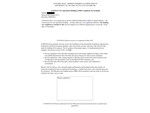
Microsoft releases new service, affects FAA 702 collection [pdf]
An SSO item on Microsoft's new outlook.com service encrypting web chat from 31 July 2012 and cutting off FAA 702 collection, and on the surveillance solution Microsoft built with the FBI, which went live on 12 December 2012 and needed no change to UTT tasking.
-
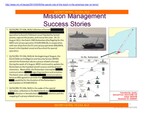
Mission Management Success Stories [pdf]
This document details a joint intelligence operation between the NSA and the Dutch Defense Intelligence and Security Service (MIVD) targeting Somali piracy. This document outlines how the NSA provided the Dutch flagship HMS Rotterdam with specialized intercept capabilities during Operation OCEAN SHIELD in 2012. This collaboration directly facilitated a successful special operation on 13 August 2012, which resulted in the rescue of a hijacked Pakistani vessel's crew and the capture of several pirates.
-
MORECOWBELL [pdf]
This document describes how NSA is covertly monitoring DNS resolutions and target websites in near real-time using covertly rented servers in Malaysia, Germany and Denmark.
-
Moving Data Through Disconnected Networks - Delay-Tolerant Networking and the IC [pdf]
This June 2012 NSA Laboratory for Telecommunications Sciences presentation details Delay-Tolerant Networking (DTN) applications for surveillance operations, including covert communications in denied areas, data exfiltration from isolated networks, unwitting data mules, and integration with TAO's CHIMNEYPOOL implant framework. The document reveals R4 development of FUZZYLINT, an ultra-lightweight DTN implementation designed to enable multi-hop exfiltration from implants without requiring direct physical access.
People: Vahdat, Amin · Becker, David · Juang, Philo · Oki, Hidekazu · Wang, Yong · Martonosi, Margaret · Peh, Li-Shiuan · Rubenstein, Daniel · Grossglauser, Matthias · Tse, David N. C. · Fall, Kevin · Shah, Rahul C. · Roy, Sumit · Jain, Sushant · Brunette, Waylon · Lindgren, Anders · Doria, Avri · Schelen, Olov · Small, Tara · Haas, Zygmunt J. · Zhao, Wenrui · Ammar, Mostafa · Zegura, Ellen · Ginzboorg, Philip · Kärkkäinen, Teemu · Nagata, Akira · Lenders, Vincent · Legendre, Franck · May, Martin · Karlsson, Gunnar · Du, Bowei · Demmer, Michael · Brewer, Eric · Ott, Jörg · Pitkänen, Mikko Juhani · Han, Bo · Hui, Pan -
MYSTIC [pdf]
These excerpts provide foundational details on the MYSTIC program, including its inception in 2009 and its structural organization. It defines MYSTIC as a program managed by the Special Source Operations (SSO) division, focusing on "embedded collection systems" within foreign wireless and mobile networks. The document confirms a deceptive operational model: the equipment is overtly installed to provide "commercial services" for telecommunications companies, while its secret purpose is to provide SIGINT (Signals Intelligence) to U.S. agencies.
-
N.S.A. Memo Expands Access to FISA Information [pdf]
In 2006, the National Security Agency sought to expand access to Foreign Intelligence Surveillance Act information — previously limited to its headquarters in Fort Meade, Md. — to its code-breakers in Georgia, Texas and Hawaii. Part of the deliberations focused on a problem that raised the possibility that the agency had violated rules the surveillance court established for handling the information.
-
N.S.A. Timeline of Surveillance Law Developments [pdf]
This chart, apparently from an internal N.S.A. presentation, lists milestones in surveillance rules over nearly four decades. The July 2002 “Raw Take” sharing order, whose existence has not previously been disclosed, is just one of three rulings by the Foreign Intelligence Surveillance Court to make the list. The other two were 2004 and 2006 rulings allowing bulk collection of data about emails and phone calls.
-
National Security Agency: Overview Briefing [pdf]
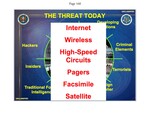
A slide from an unclassified NSA overview briefing, “The threat today”, which lists hackers, criminal elements, insiders and terrorists alongside technologies — the Internet, wireless, high-speed circuits, pagers, facsimile and satellite — as the threats the agency faces.
Marking: UNCLASSIFIED -
Net Defense from Encrypted Communications [pdf]
A NSA Technology Directorate briefing from February 2012 describing BLUESNORT — a capability that repurposes GALLANTWAVE's SSL/TLS decryption pipeline for network defence, re-injecting decrypted traffic into TURMOIL Stage 1 Prime where BLUESNORT detects malware and other malicious activity — representing description of NSA using its own bulk decryption infrastructure for cyber defence as well as intelligence collection.
-
Network Shaping 101 [pdf]
An NSA top-secret training presentation that uses Yemen as a case study to explain how to "shape" a nation's Internet traffic by exploiting Autonomous Systems, upstream providers, BGP routing, and physical link topology to redirect or collect communications. The slide deck walks through practical router/IP/link details, passive SIGINT collection points and limitations, and warns that many assumptions are fabricated for the lesson and that real-world capabilities and link behavior can vary.
-
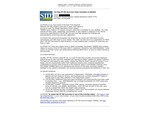
New Contact-Chaining Procedures to Allow Better, Faster Analysis SIDtoday [pdf]
The SIGINT Management Directive 424 briefing (Jan 2011) announces a major procedural shift at the NSA, allowing analysts to conduct contact chaining and large-scale metadata analysis from any selector, regardless of nationality or location. This change removes prior restrictions on U.S. data, enabling more powerful social network mapping for foreign intelligence purposes.
Programs: GATEKEEPER -
New FAA702 Certification in the Works - Cyber Threat [pdf]
A 23 March 2012 SSO article on a draft FAA 702 certification for cyber threats. It would let analysts task selectors tied to malicious cyber activity without attributing them to a foreign government or terrorist group, and would codify tasking of IP addresses and code strings through PRISM and the upstream accesses.
-
New Operations Building at MHS Completed, Fit-Up Begins SIDtoday [pdf]
A 2011 NSA internal report describes the completion of “Project Phoenix” at Menwith Hill Station in the UK — a new operations building featuring a state-of-the-art data center, auditorium, and collaborative office spaces designed to enhance mission resilience, technological capacity, and training infrastructure. The project marks a major modernization effort, expanding Menwith Hill’s operational footprint and preparing it to support new intelligence systems and missions.
-
New RT-RG Overview Video Available on NSANet SIDtoday [pdf]
The NSA's Meade Operations Center released a 10-minute video overview of the Real-Time Regional Gateway (RT-RG), a tool suite designed for forward-deployed analysts. The suite enables faster access to real-time metadata and reporting, improving tactical support for military operations, with new functionalities being developed for use in Afghanistan and beyond.
-
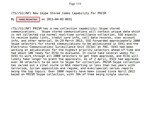
New Skype Stored Comms Capability For PRISM [pdf]
An SSO item on PRISM's new Skype stored-communications capability — buddy lists, credit card details, call data records and account information — with roughly 2,000 Skype selectors sent for FBI adjudication on 29 March 2013 and over 2,800 reports issued from PRISM Skype collection since April 2011.
-
New Technique Geolocates Targets Active at Yemeni Cafes SIDtoday [pdf]
A 2010 NSA document from Menwith Hill Station details a new geolocation technique used in Yemen that combines HUMINT café surveys with SIGINT data — including RADIUS logs, passive collection tools, and TAO access — to track targets frequenting internet cafés linked to Al Qaeda. The method, integrating systems like MORK, WINDCHASER, MARINA, and SPARKLEPONY, enabled analysts to identify and monitor dozens of cafés and correlate user activity with high-priority targets.
Programs: GHOSTHUNTER · MORK · RADIUS · WINDCHASER · MARINA · XKEYSCORE · SPARKLEPONY · GHOSTWOLF · TELIR -
New Tool Combines Multi-INT, Multi-Agency Databases for Complete Target Snapshot SIDtoday [pdf]
A 2008 NSA SIDtoday document from Menwith Hill Station describes the Consolidated Operations Research Explorer (CORE), a tool that integrates SIGINT, HUMINT, and IMINT from seven intelligence agencies to provide analysts with a geospatially layered, real-time “snapshot” of targets. CORE enhances operational efficiency by quickly correlating communications networks, infrastructure, and personnel, enabling rapid mission successes such as identifying VSAT uplinks and tracking high-priority targets.
-
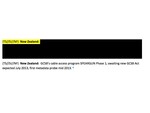
New Zealand SPEARGUN Phase 1 [pdf]
This document snippet provides a concise technical timeline for Project SPEARGUN, the New Zealand Government Communications Security Bureau's (GCSB) mass surveillance initiative. It confirms that the physical tapping of undersea cables (Phase 1) was completed and that the program was strategically synchronized with domestic political and legal developments. Specifically, the document reveals that the deployment of "metadata probes" (real-time automated data extraction) was contingent upon the passage of the GCSB Act in July 2013. This snippet is a critical piece of evidence showing that the legislative changes in New Zealand were tied by the NSA to GCSB's first metadata probe, planned for mid-2013 once the new GCSB Act was passed.
Programs: SPEARGUN -
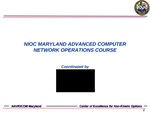
NIOC MARYLAND ADVANCED COMPUTER NETWORK OPERATIONS COURSE [pdf]
Programs: GENIE · HAWKEYE · EINSTEIN · TUTELAGE · NEPTUNETHUNDER · BLINDDATE · HAPPYHOUR · NITESTAND · WAITAUTO · MATCHCRIMP