What is the path an email takes when it is sent on the internet?
Open PDFDocument date: -
Pages: 3
Genre: guide
Banner: SECRET//COMINT//REL TO USA, AUS, CAN, GBR and NZL//20320108
Classification: SECRET COMINT
Dissemination: REL TO USA, AUS, CAN, GBR, NZL
This undated NSA training document, created by Booz Allen Hamilton contractor personnel, provides technical diagrams explaining email transmission paths and network administrator traffic flows for NSA/Five Eyes collection purposes, specifically highlighting how to identify and exploit login credentials, passwords, configuration files, and communications transiting through U.S.-based webmail servers like Hotmail and Yahoo.
My notes
Content POC: [REDACTED]
Booz Allen Hamilton,
SDS Contract
SECRET//COMINT//REL TO USA, AUS, CAN, GBR, and NZL//20320108
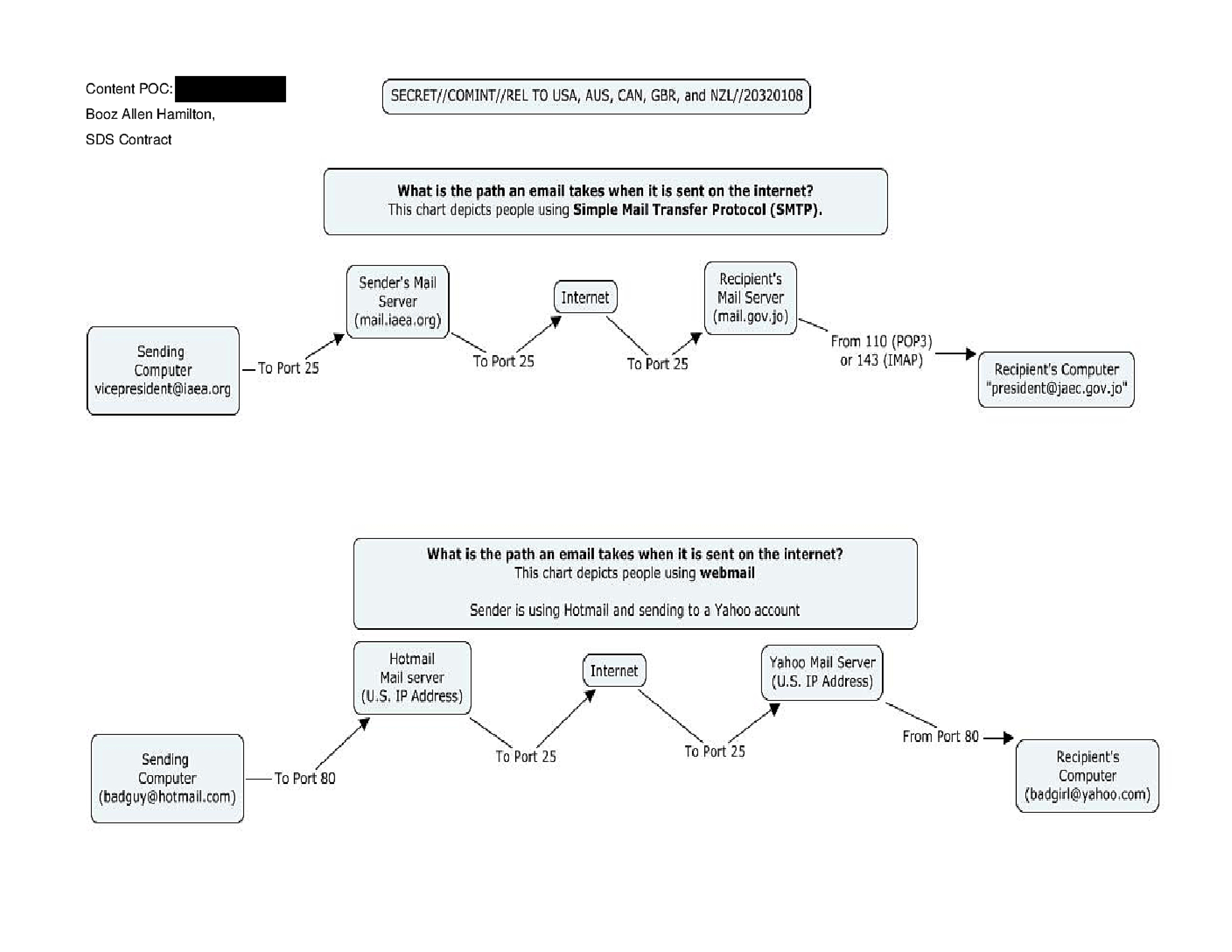
What is the path an email takes when it is sent on the internet?
This chart depicts people using Simple Mail Transfer Protocol (SMTP).
Sender's Mail Server
(mail.iaea.org)
Internet
Recipient's Mail Server
(mail.gov.jo)
Sending Computer
vicepresident@iaea.org
To Port 25
To Port 25
To Port 25
From 110 (POP3)
or 143 (IMAP)
Recipient's Computer
"president@jaec.gov.jo"
What is the path an email takes when it is sent on the internet?
This chart depicts people using webmail
Sender is using Hotmail and sending to a Yahoo account
Hotmail
Mail server
(U.S. IP Address)
Internet
Yahoo Mail Server
(U.S. IP Address)
Sending Computer
(badguy@hotmail.com)
To Port 80
To Port 25
To Port 25
From Port 80
Recipient's Computer
(badgirl@yahoo.com)
Content POC: [REDACTED]
Booz Allen Hamilton,
SDS Contract
SECRET//COMINT//REL TO USA, AUS, CAN, GBR, and NZL//20320108
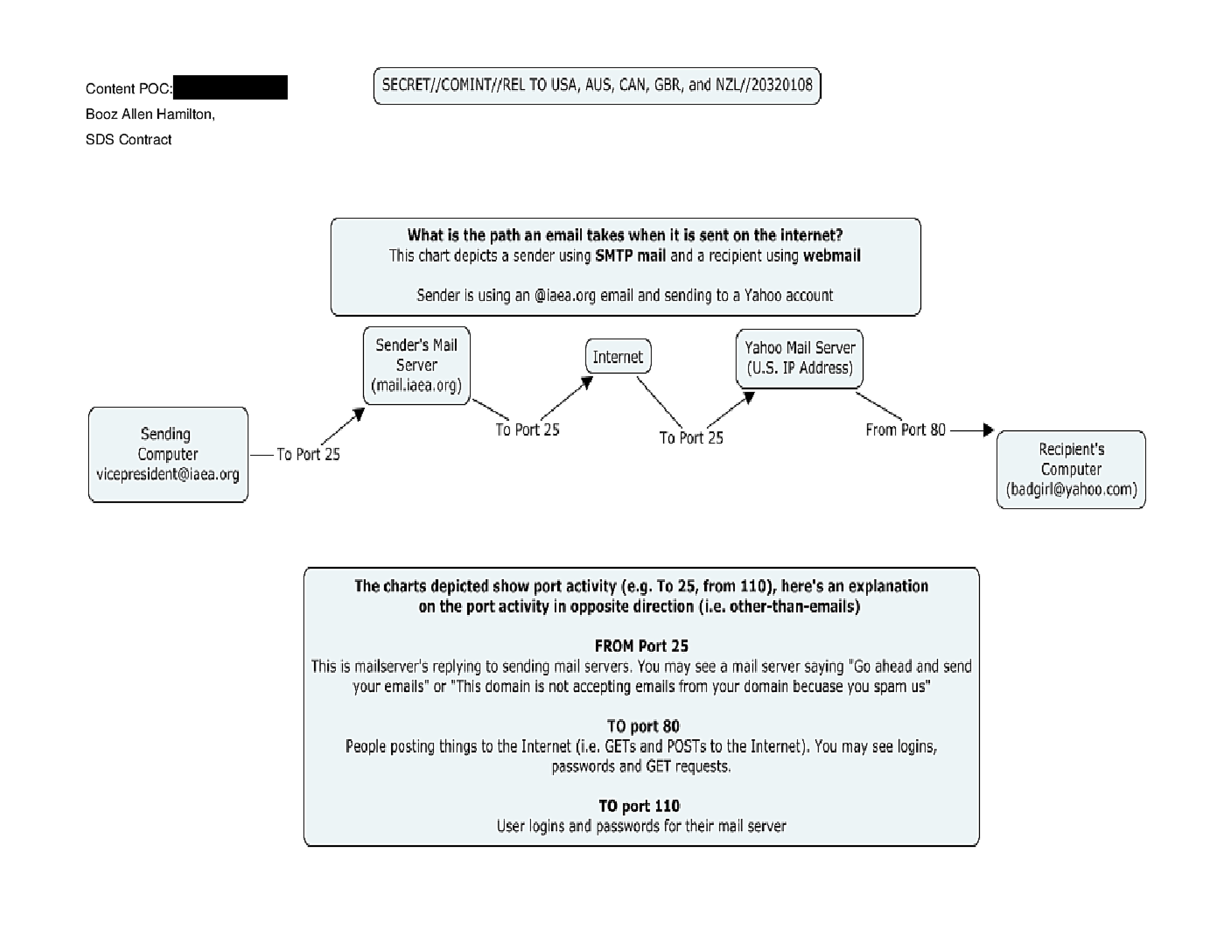
What is the path an email takes when it is sent on the internet?
This chart depicts a sender using SMTP mail and a recipient using webmail
Sender is using an @iaea.org email and sending to a Yahoo account
Sender's Mail Server
(mail.iaea.org)
Internet
Yahoo Mail Server
(U.S. IP Address)
Sending Computer
vicepresident@iaea.org
To Port 25
To Port 25
To Port 25
From Port 80
Recipient's Computer
(badgirl@yahoo.com)
The charts depicted show port activity (e.g. To 25, from 110), here's an explanation on the port activity in opposite direction (i.e. other-than-emails)
FROM Port 25
This is mailserver's replying to sending mail servers. You may see a mail server saying "Go ahead and send your emails" or "This domain is not accepting emails from your domain because you spam us"
TO port 80
People posting things to the Internet (i.e. GETs and POSTs to the Internet). You may see logins, passwords and GET requests.
TO port 110
User logins and passwords for their mail server
Content POC: [REDACTED]
Booz Allen Hamilton,
SDS Contract
SECRET//COMINT//REL TO USA, AUS, CAN, GBR, and NZL//20320108
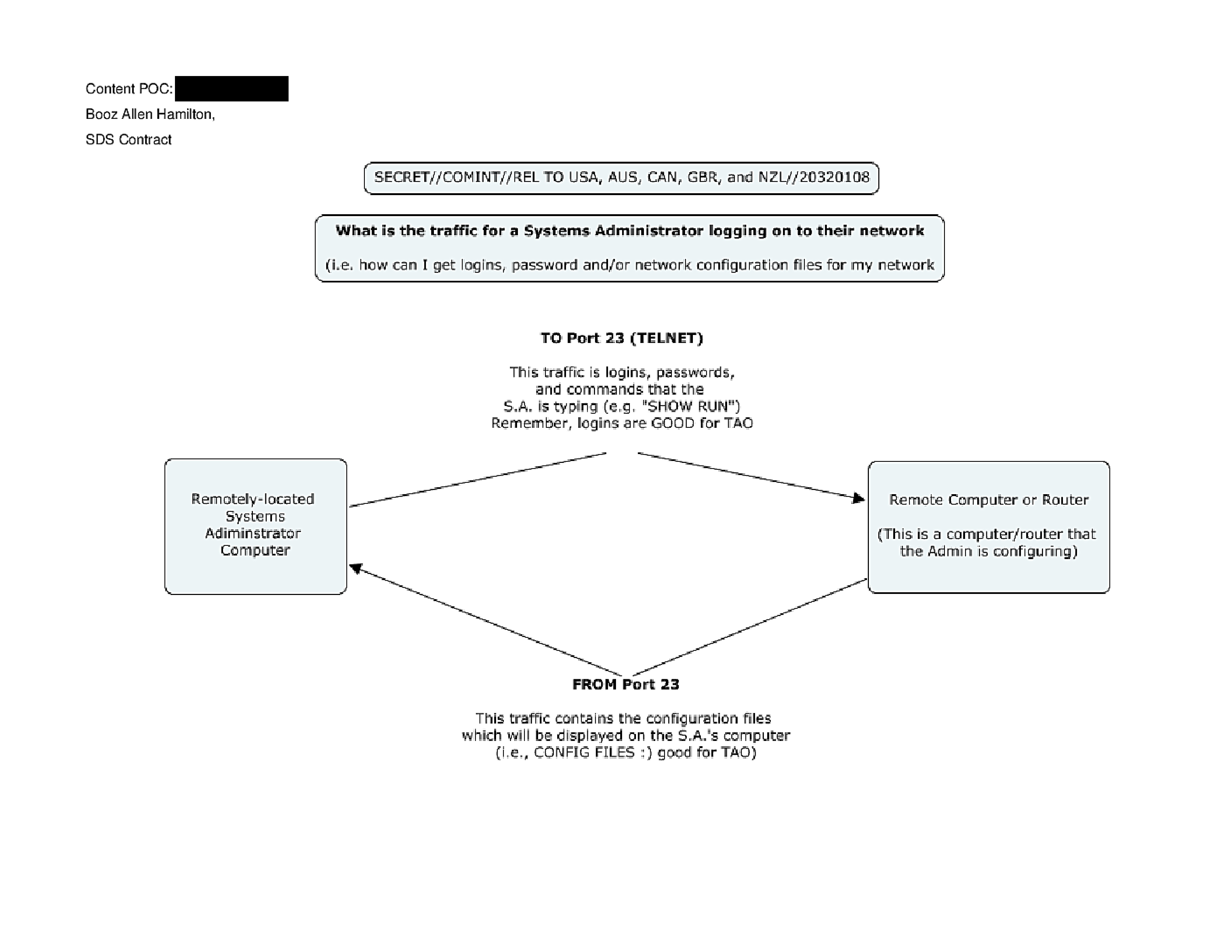
What is the traffic for a Systems Administrator logging on to their network
(i.e. how can I get logins, password and/or network configuration files for my network
TO Port 23 (TELNET)
This traffic is logins, passwords, and commands that the S.A. is typing (e.g. "SHOW RUN")
Remember, logins are GOOD for TAO
Remotely-located Systems Adiministrator Computer
Remote Computer or Router
(This is a computer/router that the Admin is configuring)
FROM Port 23
This traffic contains the configuration files which will be displayed on the S.A.'s computer (i.e., CONFIG FILES :) good for TAO)
Related Documents
-
Using XKEYSCORE to Enable TAO [pdf]
A TOP SECRET training presentation from 2009, authored by a Booz Allen Hamilton contractor, teaching NSA analysts how to use XKeyscore to harvest the login credentials, router configurations, browser versions and server software details that the Tailored Access Operations hacking unit needs to break into foreign computer networks — with worked examples stealing Cisco router passwords, Iranian government webmail logins and jihadi web forum credentials directly from intercepted internet traffic.
-
Mobile Networks in My NOC World [pdf]
This TOP SECRET STRAP 2 GCHQ document outlines the “MyNOC” operations, a specialized Network Operations Centre used by the UK’s GCHQ to coordinate cyber exploitation of international mobile and telecom infrastructure, with a particular focus on Belgacom’s GRX network under “Operation Socialist” (OP SOCIALIST). It details operational planning, toolsets, personnel roles, network mapping, QUANTUM INSERT targeting, and successful infiltration strategies that enabled CNE (Computer Network Exploitation) access to key Belgacom systems and staff infrastructure.
Programs: HIGHNOTE · COPPERHEAD · NEXUS · CADDIS · BRENT · RUSSETT PHONE · CERBERUS · E-BEAM · PIA · JEDI · WYLEKEY · INTERACTION · EREPO · QUANTUM · WOODCUTTER · MUTANT BROTH · QUANTUM INSERT · NRTA · MERION ZETA · JTRIG · A-SPACE · GEOFUSION“Operation Socialist: The Inside Story of How British Spies Hacked Belgium’s Largest Telco” - The Intercept ↗ (2014-12-13) · “Lees hier hoe de Britse geheime dienst GCHQ Belgacom aanviel” - NRC ↗ (2014-12-13) · “Britse geheime dienst bespioneerde jarenlang Belgacom-klanten” - De Standaard ↗ (2014-12-13) · “Britain's GCHQ Hacked Belgian Telecoms Firm” - Der Spiegel ↗ (2013-09-20) · Gallagher, Ryan · Modderkolk, Huib · Vanhecke, Nikolas · Eeckhaut, Mark -
What is HACIENDA? [pdf]
This document details HACIENDA, a large-scale reconnaissance tool used by GCHQ and the Five Eyes alliance to perform automated port scanning and vulnerability mapping across entire nations. It outlines the technical process of identifying and exploiting network infrastructure, specifically for the purpose of discovering Operational Relay Boxes (ORBs) to facilitate covert "Computer Network Exploitation" (CNE).
-
Tailored Access Operations, FOXACID, QUANTUM [pdf]
These NSA presentation slides detail "QUANTUM," a sophisticated system that allows the agency to intercept internet traffic and inject malware onto target computers with up to 80% success rates, far exceeding traditional spam-based methods. The system works by monitoring internet traffic for specific identifiers (like Yahoo or Facebook cookies), then racing to inject malicious code before legitimate web servers can respond, thereby compromising targets' computers without their knowledge and establishing persistent backdoor access.
Programs: FOXACID · QUANTUM · QUANTUMTHEORY · QUANTUMBISCUIT · VALIDATOR · OLYMPUS · UNITEDRAKE · OLYMPUSFIRE · SSO · FORESTPLACE -
CNE Analysis in XKEYSCORE [pdf]
This document is an NSA training presentation from October 2009 demonstrating how XKEYSCORE integrates with Computer Network Exploitation (CNE) operations, allowing analysts to search and analyze data extracted from compromised computers including keystrokes, browser history, registry files, documents, emails, and directory structures collected through implants like UNITEDRAKE and OLYMPUS.
Programs: XKEYSCORE · OLYMPUS · UNITEDRAKE · PINWALE · TUNINGFORK · TURBOCHASER · MARINA · JOLLYROGER · TREASUREMAP · TURBINE · PRESSUREWAVE · MAD · TUCKER · EXPANDINGPULLY · UNIX · SEARCHLIGHT · KEYLOGGER · PILBEAM · FOXACID · WAYTIDE · SHADOWQUEST · SEAGULLFARO · DARKHELMET · LUTEUSICARUS · FOGGYBOTTOM · GREENCHAOS · RADIUS · NKB · VALIDATOR