GCHQ - OPTIC NERVE
Open PDFDocument date: 2008-12-01
Pages: 4
Genre: other
Banner: SECRET STRAP1
Classification: SECRET STRAP 1
Dissemination: -
GCHQ’s OPTIC NERVE project built a web interface to display images from Yahoo webcam sessions captured via bulk, unselected interception, then used that stream for “proportionate” target discovery. The system sampled one frame every five minutes per feed, flagged the prevalence of nudity, and bolted on imperfect face-detection “censoring” alongside warnings about handling offensive material.
My notes
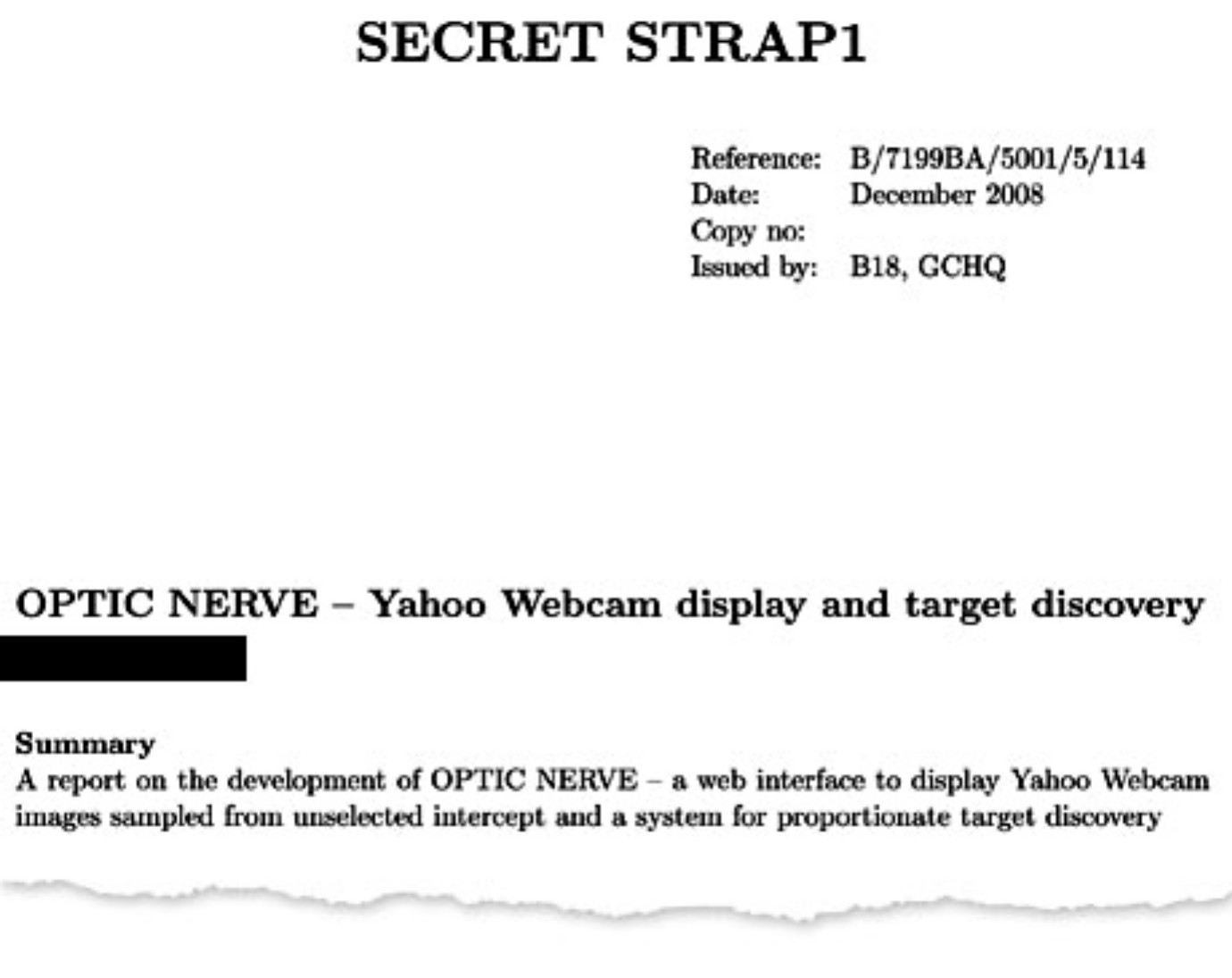
SECRET STRAP1
Reference: B/7199BA/5001/5/114
Date: December 2008
Copy no:
Issued by: B18, GCHQ
OPTIC NERVE - Yahoo Webcam display and target discovery
[REDACTED]
Summary
A report on the development of OPTIC NERVE – a web interface to display Yahoo Webcam images sampled from unselected intercept and a system for proportionate target discovery
Metadata:
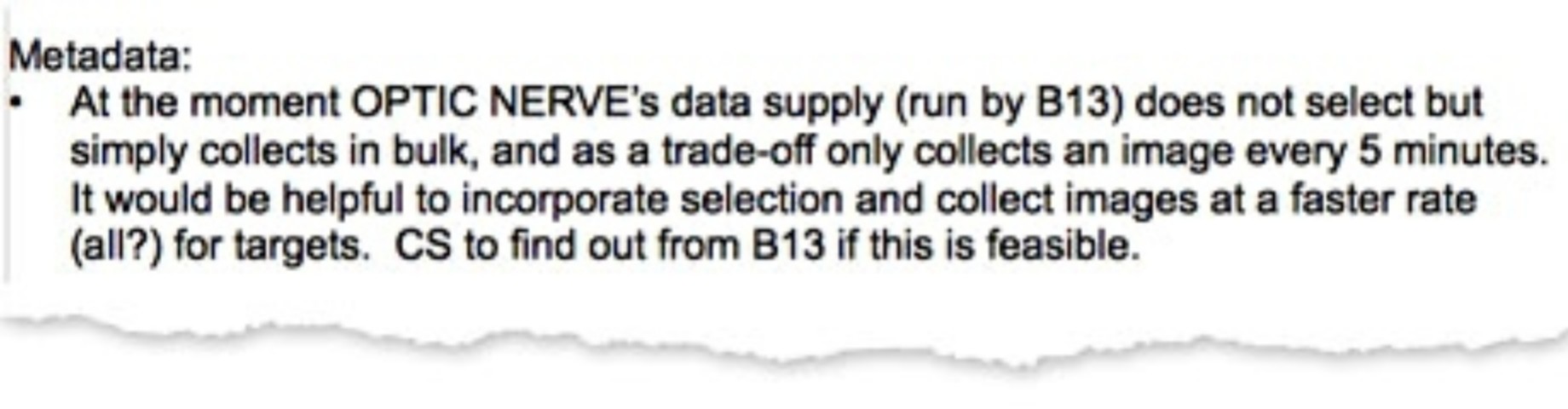
- At the moment OPTIC NERVE's data supply (run by B13) does not select but simply collects in bulk, and as a trade-off only collects an image every 5 minutes. It would be helpful to incorporate selection and collect images at a faster rate (all?) for targets. CS to find out from B13 if this is feasible.
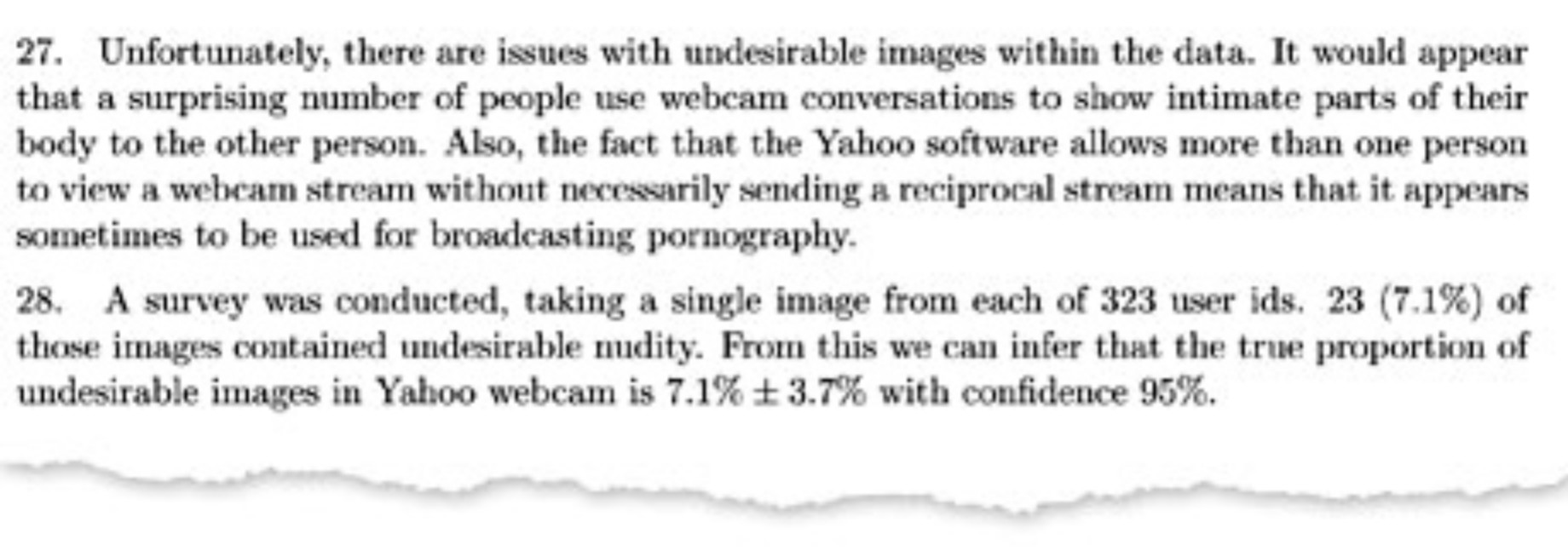
- Unfortunately, there are issues with undesirable images within the data. It would appear that a surprising number of people use webcam conversations to show intimate parts of their body to the other person. Also, the fact that the Yahoo software allows more than one person to view a webcam stream without necessarily sending a reciprocal stream means that it appears sometimes to be used for broadcasting pornography.
- A survey was conducted, taking a single image from each of 323 user ids. 23 (7.1%) of those images contained undesirable nudity. From this we can infer that the true proportion of undesirable images in Yahoo webcam is 7.1% ±3.7% with confidence 95%.
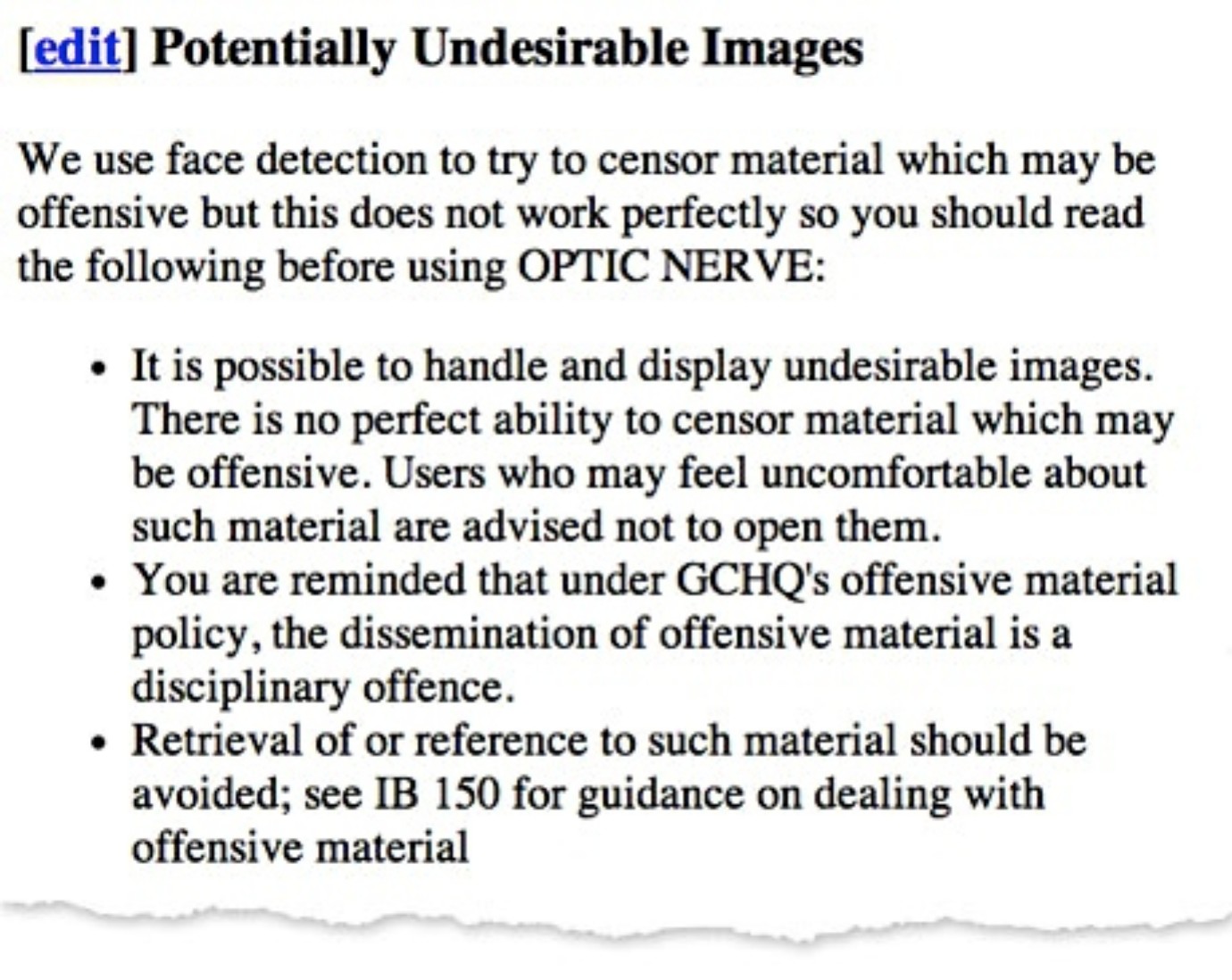
[edit] Potentially Undesirable Images
We use face detection to try to censor material which may be offensive but this does not work perfectly so you should read the following before using OPTIC NERVE:
- It is possible to handle and display undesirable images. There is no perfect ability to censor material which may be offensive. Users who may feel uncomfortable about such material are advised not to open them.
- You are reminded that under GCHQ's offensive material policy, the dissemination of offensive material is a disciplinary offence.
- Retrieval of or reference to such material should be avoided; see IB 150 for guidance on dealing with offensive material
Related Documents
-
ICTR Cloud Efforts [pdf]
A GCHQ presentation details how the agency developed cloud-based big data analytics to achieve "population scale" surveillance—processing trillions of internet events to build geographic and behavioral profiles on every online identifier worldwide, enabling discovery of unknown targets through pattern analysis rather than traditional keyword searches.
Programs: EVERYASSOC · PROBABILITYCLOUD · SILVERLINING · CULTWEAVE · KARMAPOLICE · EVERYPOLICE · AWKWARDTURTLE · GORDIANKNOT · SANDIA · BLOODHOUND · FIVEALIVE · NGE · MAPREDUCE -
GCHQ Analytic Cloud Challenges [pdf]
The 2012 GCHQ Analytic Cloud document outlines a sophisticated data processing infrastructure handling approximately 50 billion daily events across multiple sites, utilizing QFD databases and HADOOP clusters for various analytic capabilities targeting intelligence gathering and analysis. It describes architectural components, challenges in scaling and enabling analysts to cope with data complexity, and proposes future technology options including consolidation approaches and new cloud architectures to enhance capabilities.
Programs: EVOLVEDMUTANTBROTH · MUTANTBROTH · HARDASSOC · HRMAP · KARMAPOLICE · SOCIALANTHROPOID · AUTOASSOC · GEOFUSION · MVR · TERRAIN · SALAMANCA · BLACKHOLE · SAMUELPEPYS · BROKER · VAIL · GUIDINGLIGHT · FIRSTCONTACT · CLOUDYCOBRA · RUMOURMILL · EVERYASSOC · EVERYPOLICE · EVERYCREATURE · EVERYEAD · EVERYCIPHER · GREYFOX · SILVERFOX · GOLDENAXE · TRIBALCARNEM · PUBLICANEMONE · EPICFAIL · STERLINGMOTH · FOGHORN · LOOKINGGLASS · FIREENGINE · NGGEO · ALPHACENTAURI · CLOUDBASE · ACCUMULO · ASEM · SEM · HAKIM · STREAMING · HBASE · LAUREL · SKINNYCLOUD · HARDY · GCHQCORE -
GCHQ - PCS Harvesting [pdf]
A TOP SECRET STRAP1 report details how GCHQ industrialized the theft of GSM subscriber authentication keys (Ki) by automating trawls of bulk “C2C” content to extract IMSI/Ki pairs from emails and FTP transfers between SIM personalisation centers and mobile operators. It shows the program scaling key harvesting across networks and countries, complementing computer network exploitation against core mobile infrastructure to suppress billing and lift authentication secrets.
-
GCHQ Report on the Technical Capabilities of the Powerful Espionage Program TEMPORA, which Allows for Full Take. [pdf]
In May 2012, GCHQ introduced the TEMPORA internet buffer capability, enabling full take collection of internet communications. This innovation provides NSA and GCHQ analysts access to extensive amounts of data, enhancing their analytical capabilities significantly.
-
Email from GCHQ to NSA about targeting realms in MONKEY PUZZLE [pdf]
Email from GCHQ's MONKEY PUZZLE development team to NSA clarifying that the system only supports deploying targeting for four specific selector realms: emailAddr, google, msnpassport, and yahoo, while still accepting other realms into the system pool.
Marking: SECRET