Quadrennial Intelligence Review Final Report, 2009
Open PDFDocument date: 2009-04-01
Pages: 32
Genre: report
Banner: SECRET//REL TO USA, FVEY
Classification: SECRET
Dissemination: REL TO USA, FVEY
This 2009 strategic review from the Director of National Intelligence outlines potential future operating concepts for the US Intelligence Community, including "safe bets" like mass data analysis (Sentient Enterprise) and controversial "strategic hedges" such as using clandestine cyber operations to acquire proprietary technology from foreign corporations to benefit US industry (Technology Acquisition by All Means).
My notes








SECRET//REL TO USA, FVEY
QICR
Quadrennial Intelligence Community Review
FINAL REPORT
April 2009
UNITED STATES INTELLIGENCE COMMUNITY
OFFICE OF THE DIRECTOR OF NATIONAL INTELLIGENCE
UNITED STATES OF AMERICA
Office of the Director of National Intelligence
SECRET//REL TO USA, FVEY
Derived From: ODNI POL-08
Declassify On: 20340306
SECRET//REL TO USA, FVEY
SECRET//REL TO USA, FVEY
SECRET//REL TO USA, FVEY
QICR
Quadrennial Intelligence Community Review
FINAL REPORT
April 2009
SECRET//REL TO USA, FVEY
SECRET//REL TO USA, FVEY
Q
SECRET//REL TO USA, FVEY
(U) FOREWORD
(U) If one does not consider the long-range future, one will never cease to be surprised. The Director of
National Intelligence (DNI) has an annualized planning/programming process to guide short-term (1-5 years)
perspectives. The National Intelligence Strategy (NIS) and Vision 2015 provide mid-term (5-10 years) perspec-
tives. The Quadrennial Intelligence Community Review (QICR) provides an essential long-term piece, looking
out between 10 and 20 years. This longer term view complements shorter term assessments, challenges basic
assumptions, exposes the potential risks of extrapolating tomorrow's needs from today's conditions, and
examines missions and capabilities in light of alternative futures.
(U) This report describes the results of the 10-month QICR. Building on the National Intelligence Council's
Global Trends 2025: A Transformed World, experts from across the Intelligence Community (IC), other U.S.
departments and agencies, academia, think tanks, and industry assessed the implications of the year 2025 for
the IC.
(U) QICR 2009 developed alternative future scenarios based on Global Trends 2025 to explore concepts and
capabilities the IC may need to fulfill critical missions in support of U.S. national security. It does not purport
that any one future will materialize, but rather outlines a range of plausible futures so that the IC can best
posture itself to meet the range of challenges it may face.
(S//REL) This Final Report summarizes six concepts for how the IC may need to operate by 2025. Of particular
note, QICR 2009 identifies three concepts that are critical to the success of the IC across a wide range of future
scenarios ("safe bets") and suggests that these concepts merit attention in the IC's longer term planning
efforts, including the NIS, Intelligence Planning Guidance, and other guidance documents. The first concept
is the development of a sensing and learning environment capable of handling massive amounts of infor-
mation (Sentient Enterprise). The second is the adoption of a more dynamic and tailored customer-services
model (Segmented Customers, Differentiated Services). The third is the adoption of an expeditionary mindset
that can project operational capability and enhanced analytic connectivity in both physical and virtual
venues (Responsive Presence).
(U) We hope this report will stimulate spirited debate and rigorous thinking as to how the IC can best posture
and prepare for a range of future environments.
David R. Shedd
Deputy Director of National Intelligence
Policy, Plans & Requirements
April 21, 2009
Quadrennial Intelligence Community Review Final Report 2009
SECRET//REL TO USA, FVEY
i
SECRET//REL TO USA, FVEY
(U) EXECUTIVE SUMMARY
(U) Introduction. The Quadrennial Intelligence Community Review (QICR) 2009 used scenario-based analysis to help the Intel-
ligence Community (IC) consider how to best minimize strategic surprise and manage institutional risk to meet challenges that
may emerge by 2025.
(C//REL) Drawing on the National Intelligence Council's Global Trends 2025: A World Transformed, QICR made three key assump-
tions about the future landscape for intelligence. First, other actors will increase in power and relevance relative to the United
States. Second, the information environment will radically transform in scope, complexity, and intensity, with intelligence targets
operating seamlessly and simultaneously between the physical and virtual worlds. Third, customers and the IC workforce will be
"digital natives" with different operating models and expectations for how to perform and leverage the business of intelligence.
(U) Concepts for Intelligence in 2025. In this landscape, certain organizing principles for performing intelligence functions-
"concepts" in this report-could help turn future challenges into opportunities. QICR identified three concepts ("safe bets") that
appear critical to the success of the IC across a wide range of possible futures and therefore merit consideration in today's long-
term planning activities.
- (C//REL) Sentient Enterprise is an IC that creates a sensing and learning environment for humans and intelligent machines to
analyze "exabytes" of data in near-real time to generate and test hypotheses, autonomously process and evaluate insights to
cue collection, and self-update/self-correct. - (C//REL) Segmented Customers, Differentiated Services envisions an IC postured to provide more customized tools, products,
and services to an expanding set of customers with different styles and end uses. - (C//REL) In Responsive Presence, the IC has an expeditionary intelligence capacity to deploy small teams to hostile (physical or
virtual) environments with minimal infrastructure, while readily drawing on more diverse and instantly collaborative analytic
expertise to guide operations and directly leverage the insights gained.
(U) "Strategic hedges" are concepts deemed highly relevant in some possible futures but less relevant in others, which the IC may
need to develop as circumstances warrant.
- (C//REL) Technology Acquisition by All Means envisions the IC aggressively employing a mix of overt means, clandestine
penetration, and counterintelligence tactics to address severe U.S. technological erosion vis-à-vis near-peer competitors and
global corporations. - (C//REL) In Human Terrain in the Virtual World, the IC confronts environments dominated by non-state actors, requiring uncon-
ventional human collection methods with more flexible sets of analytic partners to track highly empowered, cyber-immersed
individuals and groups. - (C//REL) Money Mastery describes an operating concept that requires the IC to compensate for the possible loss of access to
reliable financial and economic data (at the global, national, and sector levels) by penetrating corporations, foreign finance
ministries, central banks, and market participants to create an "economic operating picture."
(S//REL) Conclusion. Four broader implications arise from the QICR 2009. First, the IC will have to manage highly fluid relation-
ships to deal with the dynamism of a more competitive national security environment. Second, it will need to manage a singular
operational architecture to deal with the new ways that a greater volume of information will flow. Third, the IC will need to main-
tain strong information and identity assurance to address the likely erosion in its technological advantage and the new dynamics
of the digital medium. Fourth, the IC will need to change the role of the intelligence officer to deal with a dynamic external envi-
ronment and adapt to new customer needs. To posture the IC to deal with these implications, QICR suggests the value of further
study by appropriate IC elements in the areas of policy, regulation, and law; organization and structure; workforce management;
and information and identity assurance.
ii
SECRET//REL TO USA, FVEY
SECRET//REL TO USA, FVEY
(U) TABLE OF CONTENTS
(U) INTRODUCTION .....................................................................................1
(U) Methodology...............................................................................................................1
(U) Key Assumptions........................................................................................................2
(U) CONCEPTS FOR INTELLIGENCE IN 2025...................................................5
(U) Safe Bet: Sentient Enterprise......................................................................................6
(U) Safe Bet: Segmented Customers, Differentiated Services..........................................8
(U) Safe Bet: Responsive Presence..................................................................................10
(U) Strategic Hedge: Technology Acquisition by All Means...........................................12
(U) Strategic Hedge: Human Terrain in the Virtual World..............................................14
(U) Strategic Hedge: Money Mastery..............................................................................16
(U) CONCLUSION ........................................................................................19
Quadrennial Intelligence Community Review Final Report 2009
SECRET//REL TO USA, FVEY
iii
SECRET//REL TO USA, FVEY
Q
SECRET//REL TO USA, FVEY
SECRET//REL TO USA, FVEY
(U) INTRODUCTION
(U) Every 4 years, the Intelligence Community (IC)
assesses the most challenging issues it could face
beyond the standard planning cycle. This process is
known as the Quadrennial Intelligence Community
Review (QICR).
(U) QICR 2009 was a scenario-based strategic planning
activity that looked out to the year 2025 and consid-
ered alternative future environments (i.e., "scenarios"),
missions the IC might be called on to perform, and the
concepts and some illustrative capabilities that would
be needed to fulfill those missions. This Final Report
summarizes the key findings and recommends next
steps to help position the IC to address the challenges
of the future.
(U) Methodology
(U) The QICR 2009 applied best practices of scenario
planning used in both industry and government. Using
as a starting point Global Trends 2025: A Transformed
World, produced by the National Intelligence Council
(NIC), QICR developed four scenarios that were de-
signed to be divergent, plausible, challenging, and rel-
evant to the IC. These scenarios are not predictive, but
illustrate the range of possible challenges we might
confront. QICR organized the scenarios along two key
dimensions of uncertainty-the relative importance
of the nation-state and the extent of global coop-
eration-and then incorporated additional relevant
features of possible future environments gleaned
from seven recognized geo-strategic scenario sets
developed by public, private, U.S., and foreign sources.
(See the QICR Scenarios Report, January 2009, for a full
discussion of the scenarios.)
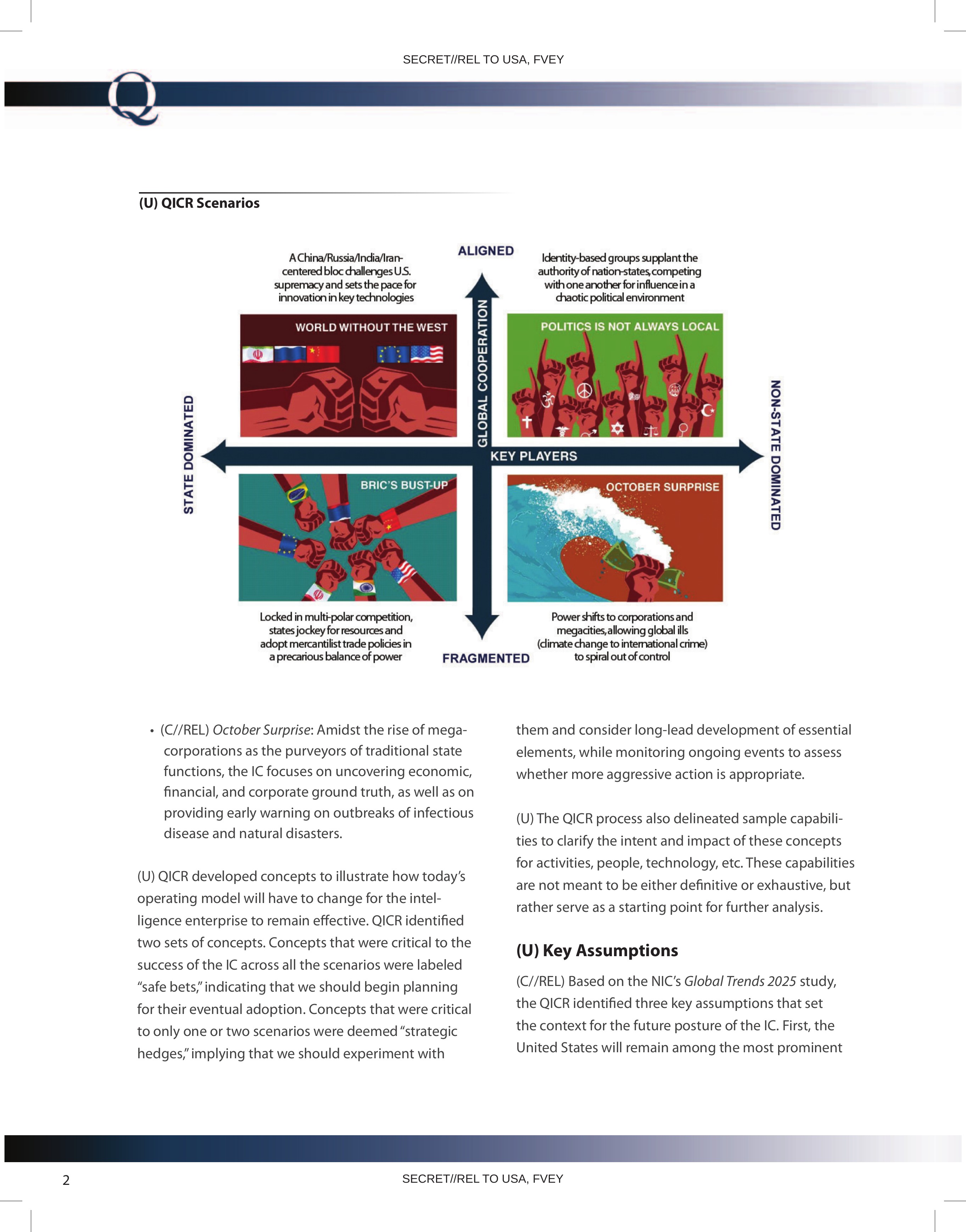
(U) The scenarios served as the basis for analysis of
missions the IC might be asked to perform in support
of national objectives and the concepts and capabili-
ties the IC would need to perform these missions. (The
four scenarios are summarized in the figure on page
2.) Each scenario implied a core set of missions for the
IC that was not exhaustive but highlighted the key de-
mands customers would likely place on the IC in 2025
beyond the array of established intelligence activities:
- (C//REL) World Without the West: Although a coali-
tion of four well-armed competitor states calls for
continued robust military analysis, understanding
energy, natural resources, and technological inno-
vation emerges as a critical mission for the IC. - (C//REL) BRIC's* Bust-Up: As the United States
struggles to maintain its world standing amidst
competing and insular blocs, the IC is predomi-
nantly focused on economics and commercial
science and technology (S&T) missions. - (C//REL) Politics Is Not Always Local: With non-state
affinity groups driving international politics, the
IC is focused on transnational threats, particularly
crime and cyber attack.
* (U) The acronym BRIC refers to Brazil, Russia, India, and
China, or more generally, the big developing economies.
Quadrennial Intelligence Community Review Final Report 2009
SECRET//REL TO USA, FVEY
1
SECRET//REL TO USA, FVEY
(U) QICR Scenarios
STATE DOMINATED
ALIGNED
GLOBAL COOPERATION
NON-STATE DOMINATED
KEY PLAYERS
FRAGMENTED
A China/Russia/India/Iran-centered bloc challenges U.S. supremacy and sets the pace for innovation in key technologies
WORLD WITHOUT THE WEST
Identity-based groups supplant the authority of nation-states, competing with one another for influence in a
chaotic political environment
POLITICS IS NOT ALWAYS LOCAL
BRIC'S BUST-UP OCTOBER SURPRISE
Locked in multi-polar competition, states jockey for resources and adopt mercantilist trade policies in a precarious balance of power
Power shifts to corporations and megacities, allowing global ills (climate change to international crime) to spiral out of control
- (C//REL) October Surprise: Amidst the rise of mega-
corporations as the purveyors of traditional state
functions, the IC focuses on uncovering economic,
financial, and corporate ground truth, as well as on
providing early warning on outbreaks of infectious
disease and natural disasters.
(U) QICR developed concepts to illustrate how today's
operating model will have to change for the intel-
ligence enterprise to remain effective. QICR identified
two sets of concepts. Concepts that were critical to the
success of the IC across all the scenarios were labeled
"safe bets," indicating that we should begin planning
for their eventual adoption. Concepts that were critical
to only one or two scenarios were deemed "strategic
hedges," implying that we should experiment with
them and consider long-lead development of essential
elements, while monitoring ongoing events to assess
whether more aggressive action is appropriate.
(U) The QICR process also delineated sample capabili-
ties to clarify the intent and impact of these concepts
for activities, people, technology, etc. These capabilities
are not meant to be either definitive or exhaustive, but
rather serve as a starting point for further analysis.
(U) Key Assumptions
(C//REL) Based on the NIC's Global Trends 2025 study,
the QICR identified three key assumptions that set
the context for the future posture of the IC. First, the
United States will remain among the most prominent
2
SECRET//REL TO USA, FVEY
SECRET//REL TO USA, FVEY
forces in world politics, but the relative ascent of
other state and non-state actors across the full range
of power dimensions-military, economic, technologi-
cal, and social-will place new and different demands
on the IC.
- (C//REL) The proliferation, differentiation, and
sophistication of actors in global politics will
make it far more difficult to access targets
(whether in the physical or virtual world),
maintain a consistent and continuous presence,
and influence populations.
- (S//REL) With more tenuous U.S. technological
leadership in key sectors such as biotechnology,
nanotechnology, and computing, the IC may have
less unilateral advantage in critical intelligence
capabilities (e.g., penetrating encrypted informa-
tion networks).
- (S//REL) The IC will increasingly rely on information
and communication technology that is at least
partly of foreign origin, rendering critical IC func-
tions more vulnerable to attack or manipulation in
increasingly hard-to-detect ways.
(C//REL) The second key assumption about the world in
2025 is the transformation in the information (and
thus cyber) environment, specifically in the volume,
velocity, and variability with which information flows
between and among individuals, groups, and states.
This new environment will be enabled by two paral-
lel and reinforcing phenomena: the incorporation of
sensors and processors into many more items (from
weaponry to foodstuffs) and almost universal access to
inexpensive networked computing and communica-
tions technologies. As such, there will be an exponen-
tial increase in the amount of data of all types poten-
tially available to the IC, its U.S. Government customers,
hostile governments, and adversary non-state actors.
Information will also move at ever increasing speeds,
and it will exist in greater ranges of formats that
change more frequently.
- (C//REL) Most intelligence targets will increasingly
operate simultaneously in the physical and virtual
worlds, requiring the IC to adopt a seamless ap-
proach between the two domains as well.
- (C//REL) Balancing intelligence with the protection
of privacy and civil liberties will be even more chal-
lenging in 2025. The IC will need socially, constitu-
tionally, and politically acceptable ways to handle
exponentially more information no matter what
future comes to pass. In many cases, meeting the
challenge will come down to more effective data
management. Automated analysis of "anonymized"
data could detect threats much earlier without
infringing upon privacy. Role-based access could
help mitigate the risk of abuse.
(C//REL) The third key assumption about the operating
environment of 2025 is that IC customers and part-
ners will be "digital natives" and will have a signifi-
cantly different set of expectations of the IC. They will
tend to behave in two fundamentally different ways,
both of which contravene current orthodoxy.
- (U) Having grown up with the likes of Wikipedia,
Facebook, Flickr, and Google Earth, customers will
be accustomed to building their own context, un-
derstanding, and in many cases, technical details. - (U) Customers will be much less reliant on official
intermediaries and much more comfortable reach-
ing out directly to networks of experts and data
(whether or not they are inside the IC).
Quadrennial Intelligence Community Review Final Report 2009
SECRET//REL TO USA, FVEY
3
SECRET//REL TO USA, FVEY
Q
SECRET//REL TO USA, FVEY
SECRET//REL TO USA, FVEY
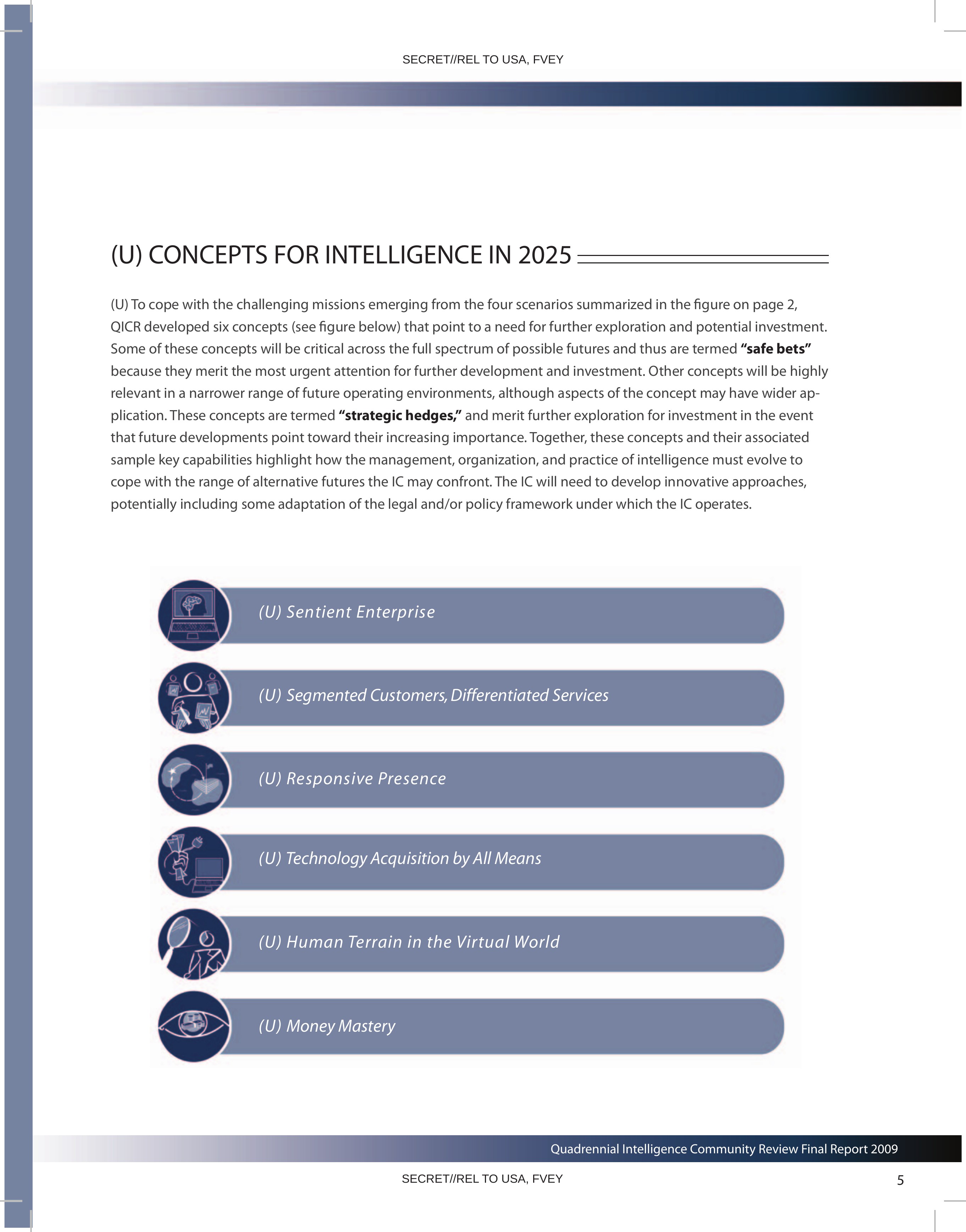
(U) CONCEPTS FOR INTELLIGENCE IN 2025
(U) To cope with the challenging missions emerging from the four scenarios summarized in the figure on page 2,
QICR developed six concepts (see figure below) that point to a need for further exploration and potential investment.
Some of these concepts will be critical across the full spectrum of possible futures and thus are termed "safe bets"
because they merit the most urgent attention for further development and investment. Other concepts will be highly
relevant in a narrower range of future operating environments, although aspects of the concept may have wider ap-
plication. These concepts are termed "strategic hedges," and merit further exploration for investment in the event
that future developments point toward their increasing importance. Together, these concepts and their associated
sample key capabilities highlight how the management, organization, and practice of intelligence must evolve to
cope with the range of alternative futures the IC may confront. The IC will need to develop innovative approaches,
potentially including some adaptation of the legal and/or policy framework under which the IC operates.
(U) Sentient Enterprise
(U) Segmented Customers, Differentiated Services
(U) Responsive Presence
(U) Technology Acquisition by All Means
(U) Human Terrain in the Virtual World
(U) Money Mastery
Quadrennial Intelligence Community Review Final Report 2009
SECRET//REL TO USA, FVEY
5
SECRET//REL TO USA, FVEY
(U) Safe Bet:
Sentient Enterprise
(U) In 2025, electronic data will have increased ex-
ponentially as massive amounts of stored data have
accumulated and access to mobile communications
and networked sensors have become ubiquitous.
The volume, velocity, and variability of data will pose
enormous search and knowledge-management chal-
lenges, driving the IC toward non-linear processing
and autonomous organization of critical information.
Virtual interactions will be integral to daily communica-
tions for millions of benign purposes, but hostile actors
will also use this medium as a means to build ideologi-
cal and financial support and for planning and execu-
tion of operations. In addition, signals of threats may
be few, weak, or conflicting because of the ability to
shelter activity from domains that require a signature.
(C//REL) The concept of Sentient Enterprise postures the
IC for this circumstance, creating a sensing and learn-
ing environment capable of identifying and respond-
ing to voluminous, simultaneous, and continuous
inputs. The Sentient Enterprise will track and manage
thousands of exabytes of data every day (1 exabyte is
the equivalent of 100,000 times the Library of Con-
gress, which holds 19 million books), enabling iterative
assessments in real time, not days or weeks. The data
it manages will be universally discoverable, accessible,
and usable by humans and machines equally. Indeed,
the human-machine interface will allow the individual
to interact directly with a unified information architec-
ture. The enterprise will be able to continuously and
autonomously process, evaluate, and act on new data
without regard to structure or format. The enterprise
will log expert users' interactions with the data, while
gleaning new insights from more generalist users. By
so doing, the entire enterprise will create, share, and
advance corporate knowledge in a rich and seamless
interplay where machines and humans learn together.
(U//FOUO) The Sentient Enterprise will have the ad-
ditional benefit of freeing intelligence professionals
from mundane tasks so that they can focus on activi-
ties reliant on human judgment. Analysts will be able
to allocate much more of their time to the front and
back ends of the intelligence cycle, focusing much
more energy on scoping problems with customers,
driving collection, and helping customers understand
the implications of different courses of action. More
seasoned officers will be able to more ably mentor
novices, collaborate with other experts, and influence
decision-makers.
(U) Sample Key Capabilities
- (C//REL) Automation. The IC would emplace
sensors and monitor applications that run autono-
mous collection of the most relevant data, trigger
pattern recognition sequences, and process raw
feeds. This would require supercomputer-like
capabilities at every "computational point-of-pres-
ence," from computer terminal to digital handheld
device. Automation (e.g., in language translation,
gisting, relational analysis, and trend assessment)
would allow verification and validation of the ac-
curacy of information. - (U) Artificial Intelligence (AI). Application of
advanced AI techniques would make it possible to
continuously improve understanding of complex
threat environments, discern the relative impor-
tance of data, and adapt quickly to changes indi-
cated by sensor data and automated analysis (thus
providing indication and warning). This would
allow the experts to focus on translating critical
information to decision-makers in an effective and
time-efficient manner.
6
SECRET//REL TO USA, FVEY
SECRET//REL TO USA, FVEY
- (S//REL) Self-Learning. The institutional knowl-
edge of the Sentient Enterprise would increase the
user's ability to recall events and significant facts
to build relational awareness. Simultaneously, the
human-machine interface would enable the user
to continuously refine the "algorithms" that trans-
late human judgments into machine language so
that the system actively learns. - (U) Human Interface. The Sentient Enterprise
would employ dashboards and similar interfaces
to provide continuous, real-time visualization of
the operational environment. Interfaces would in-
clude interactive touch-screen mapping of a large
variety of data types that enables zoom and pan
capabilities to scan the physical, virtual, and social
environments. - (U) Collaborative Features. The Sentient Enter-
prise would employ social-networking tools and
virtual models of the real world to monitor the
threat environment, enable collaboration, and
test alternative hypotheses. This would include
social-networking tools that allow outside experts
to be tapped quickly so they could make contribu-
tions in a crisis and provide input into the analytic
process. - (S//REL) Protection. The continuously updated,
multilayered, and changing boundaries of Sentient
Enterprise would be selectively permeable, requir-
ing innovative system or data-specific protection
capabilities for flow of data into and out of the
data stream.
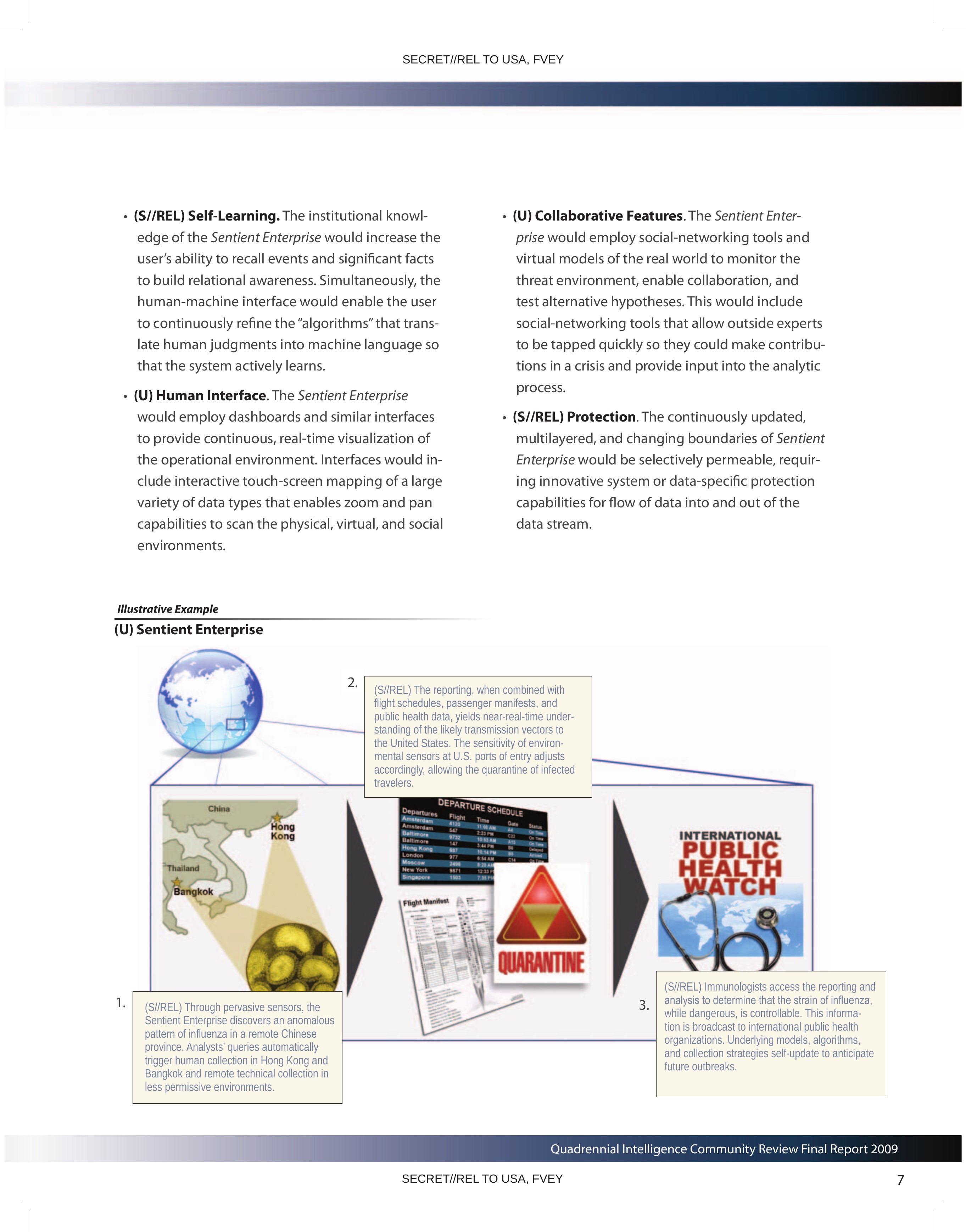
Illustrative Example
(U) Sentient Enterprise
- (S//REL) Through pervasive sensors, the
Sentient Enterprise discovers an anomalous
pattern of influenza in a remote Chinese
province. Analysts' queries automatically
trigger human collection in Hong Kong and
Bangkok and remote technical collection in
less permissive environments. - (S//REL) The reporting, when combined with
flight schedules, passenger manifests, and
public health data, yields near-real-time under-
standing of the likely transmission vectors to
the United States. The sensitivity of environ-
mental sensors at U.S. ports of entry adjusts
accordingly, allowing the quarantine of infected
travelers. - (S//REL) Immunologists access the reporting and
analysis to determine that the strain of influenza,
while dangerous, is controllable. This informa-
tion is broadcast to international public health
organizations. Underlying models, algorithms,
and collection strategies self-update to anticipate
future outbreaks.
China
Hong Kong
Thailand
Bangkok
Quadrennial Intelligence Community Review Final Report 2009
SECRET//REL TO USA, FVEY
7
SECRET//REL TO USA, FVEY
(U) Safe Bet:
Segmented Customers, Differentiated Services
(U) The expectations of digitally native users and a
much more diverse set of partners will drive a differ-
ent conceptualization of the customer. First, the IC will
engage its customers with greater responsiveness,
employing highly iterative customer segmentation,
requirements, and satisfaction analyses to understand
their working styles and decision-making needs.
Second, the IC will focus its efforts on more tailored
services (e.g., visualization techniques and tabletop
role-play exercises), vice products, to meet the full
spectrum of customer needs. Third, the IC will provide
data and analyses anywhere (in U.S.-based offices or
in the field), in more dynamic ways (from interactive
streams available via wireless devices to immersive,
three-dimensional presentations), and at multiple clas-
sifications.
(U) The concept of Segmented Customers, Differentiated
Services synthesizes these conclusions with a construct
of three categories of customers. These categories are
not dissimilar to today, but their needs will be met with
different capabilities. At one end of the spectrum, "do-
it-yourself" customers will want data and analytic tools
from the IC so they can answer their own questions. In
the middle of the spectrum are users of analytic prod-
ucts who will expect to see-and work with-the un-
derlying data and models, frequently in collaboration
with the IC. At the other end of the customer spectrum
are users who will turn to analysts for tailored analy-
sis and products that they can apply without further
refinement or context.
(U) Sample Key Capabilities
- (C//REL) Interactive Visualization. The IC would
deploy dashboards, datastreams, and other
interfaces that allow customers to continuously
monitor the operational environment, rather than
rely on static judgments. - (C//REL) Interactive Tools. Interactive decision-
support tools would allow customers to conduct
their own sensitivity analyses, test hypotheses, and
discover new insights from underlying data, either
with or without an intelligence officer assisting. - (C//REL) Customization. Customer interfaces
would enable users to enter specific requirements,
update them dynamically, and build tailored prod-
ucts in various forms and for various media.
8
SECRET//REL TO USA, FVEY
SECRET//REL TO USA, FVEY
Illustrative Example
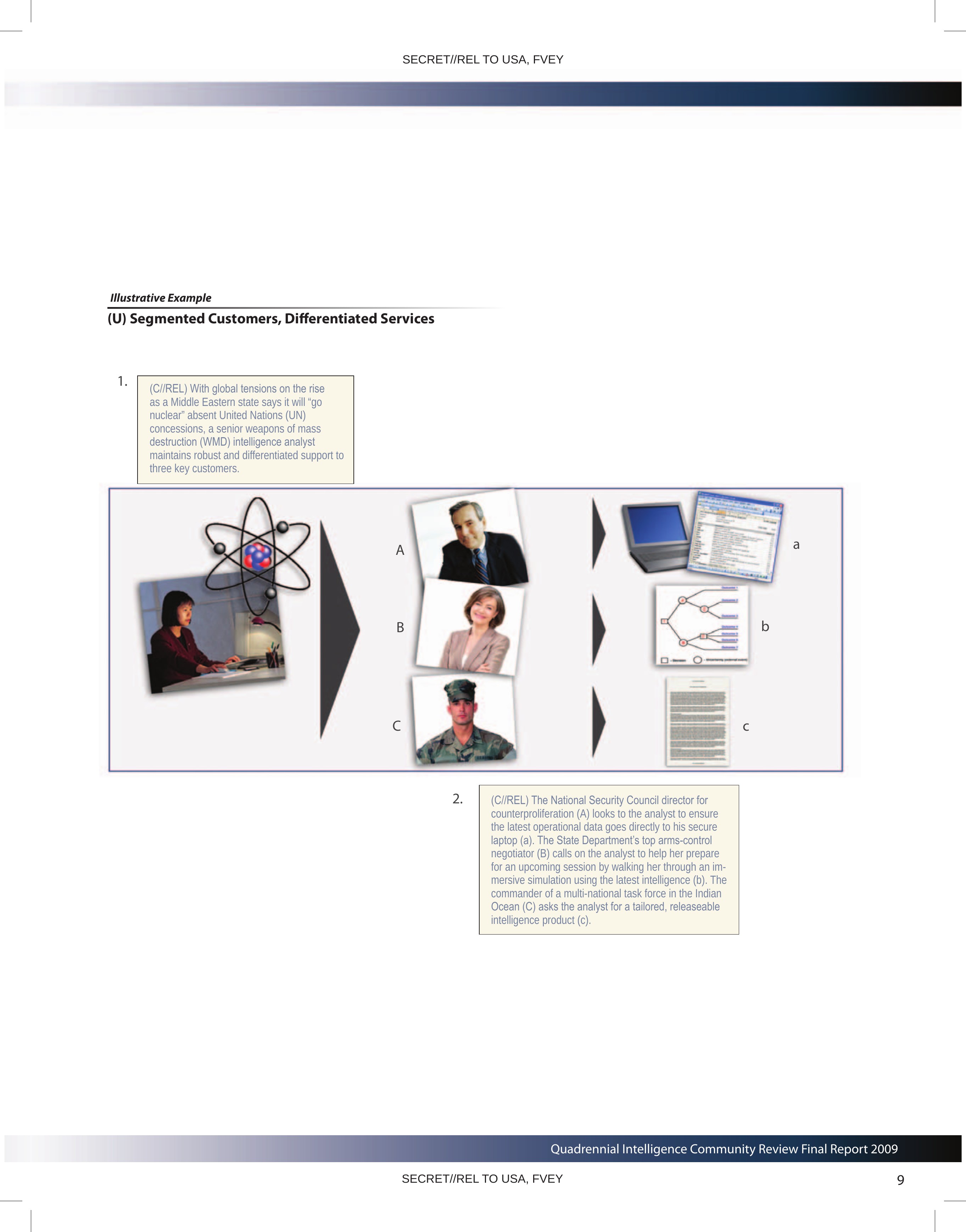
(U) Segmented Customers, Differentiated Services
- (C//REL) With global tensions on the rise
as a Middle Eastern state says it will "go
nuclear" absent United Nations (UN)
concessions, a senior weapons of mass
destruction (WMD) intelligence analyst
maintains robust and differentiated support to
three key customers. - (C//REL) The National Security Council director for
counterproliferation (A) looks to the analyst to ensure
the latest operational data goes directly to his secure
laptop (a). The State Department's top arms-control
negotiator (B) calls on the analyst to help her prepare
for an upcoming session by walking her through an im-
mersive simulation using the latest intelligence (b). The
commander of a multi-national task force in the Indian
Ocean (C) asks the analyst for a tailored, releaseable
intelligence product (c).
Quadrennial Intelligence Community Review Final Report 2009
SECRET//REL TO USA, FVEY
9
SECRET//REL TO USA, FVEY
(U) Safe Bet:
Responsive Presence
(C//REL) In 2025, the United States will face much
greater difficulty penetrating key states that suddenly
emerge as areas of national security interest. It may
have neither an extensive forward military presence
nor much of a physical diplomatic and intelligence
presence, depriving it of an understanding of the
socio-cultural environment. Adding to the challenge,
despite the transformation in the information environ-
ment, nation-states in some scenarios may try to cor-
don off their information infrastructures into national
intranets. In such a world, the IC will need a way to
rapidly deploy suites of intelligence capability (collec-
tion, analysis, security, communications, etc.) over the
horizon to theaters of political-military competition
where U.S. Government presence and infrastructure
are minimal or have been withdrawn. In addition, the
IC will need to be prepared to deploy its resources in
cyberspace to meet quickly emerging challenges.
(C//REL) Responsive Presence addresses this challenge
by applying the expeditionary model developed in the
military context, bringing the capability of an overseas
station to bear when and where necessary. It builds on
today's deployable organizational models and rests on
several principles: development of small tactical teams
capable of rapid deployment and long, autonomous
operation in a variety of environments; a small logisti-
cal and communications footprint that is largely carry-
in/carry-out; and a robust, self-sufficient communica-
tions capability. Similarly, the intelligence enterprise
will need a cyber architecture that can rapidly move
into IT network "clouds" undetected and maintain that
presence with few additional resources.
(U) Sample Key Capabilities
- (S//REL) Data Exfiltration and Covert Communi-
cations. Exfiltrating intelligence from non-permis-
sive environments will be crucial. A critical enabler
would be covert communications with a negligible
forward footprint. U.S. intelligence officers and
sensitive sources will need to move data in an
unattributable and undetected way, sometimes
from within commercial entities possessing great
technical prowess and robust cyber and electronic
security protective procedures. Although the likely
advent of transnational, high-bandwidth wireless
communications services will offer an environ-
ment with "lots to hide behind," it will also contain
many highly competent, and potentially antago-
nistic, actors. - (S//REL) Expanded Reachback. Deployed units
would have ready reachback to a heterogeneous
set of expert analysts from IC elements, other
U.S. Government departments, academia, and
non-governmental organizations. They would
have trusted and secure means to communicate
with these partners that would enable real-time
exchange while protecting the most sensitive
operational details.
10
SECRET//REL TO USA, FVEY
SECRET//REL TO USA, FVEY
Illustrative Example
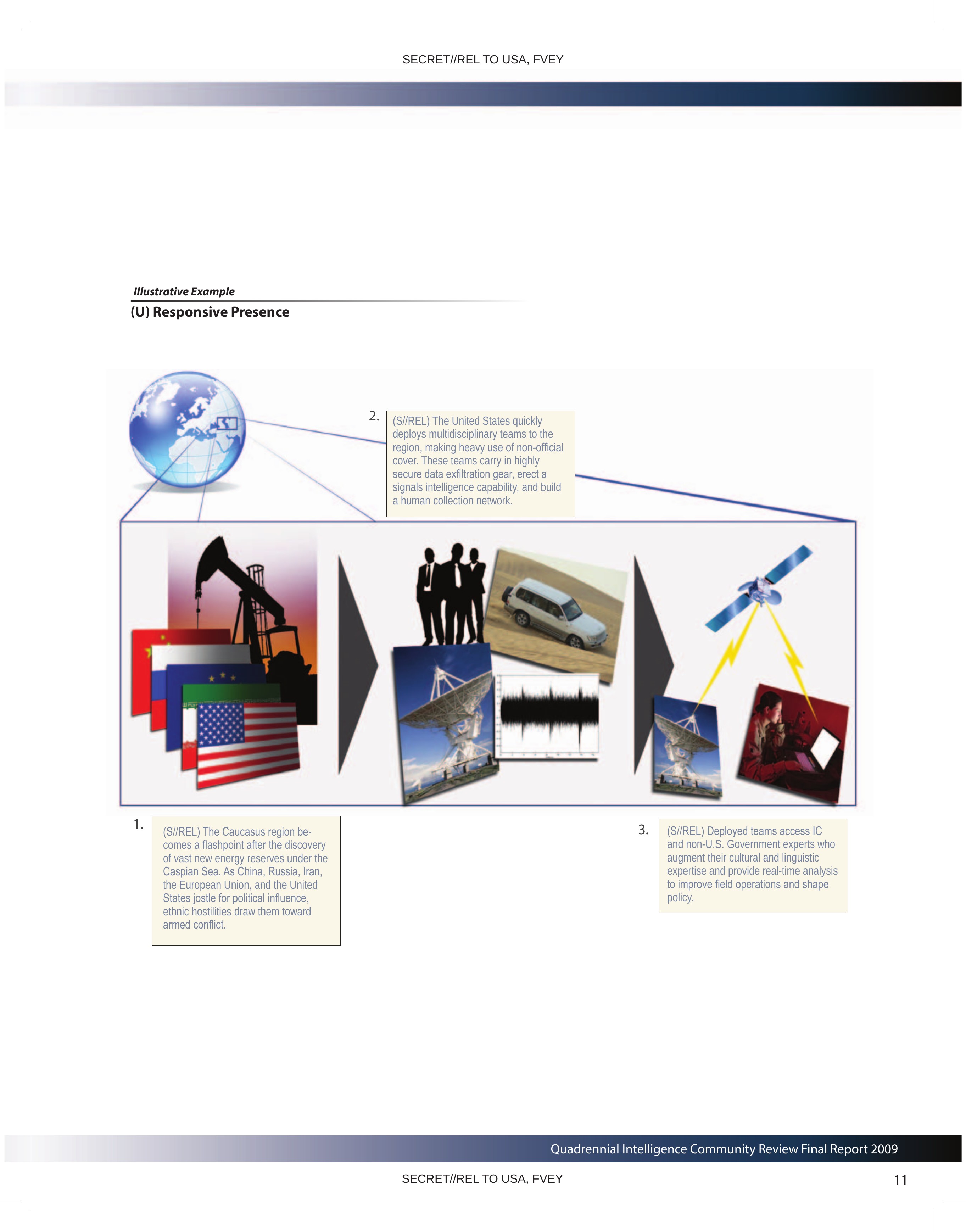
(U) Responsive Presence
- (S//REL) The Caucasus region be-
comes a flashpoint after the discovery
of vast new energy reserves under the
Caspian Sea. As China, Russia, Iran,
the European Union, and the United
States jostle for political influence,
ethnic hostilities draw them toward
armed conflict. - (S//REL) The United States quickly
deploys multidisciplinary teams to the
region, making heavy use of non-official
cover. These teams carry in highly
secure data exfiltration gear, erect a
signals intelligence capability, and build
a human collection network. - (S//REL) Deployed teams access IC
and non-U.S. Government experts who
augment their cultural and linguistic
expertise and provide real-time analysis
to improve field operations and shape
policy.
Quadrennial Intelligence Community Review Final Report 2009
SECRET//REL TO USA, FVEY
11
SECRET//REL TO USA, FVEY
(U) Strategic Hedge:
Technology Acquisition by All Means
(C//REL) QICR identified two scenarios in 2025 in which
the United States' technological and innovative edge
slips-despite our countervailing efforts and shifts
to denied areas. Under one scenario, a bloc of states
actively seeking to undermine U.S. geostrategic leader-
ship could deny access to key emerging technologies.
Another possibility is that the technological capacity
of foreign multinational corporations could outstrip
that of U.S. corporations. The IC would be challenged
to understand technological innovation outside its
traditional competencies (e.g., weapons systems) and
in domains where it traditionally has focused less effort
(e.g., commercial research and development (R&D)).
Because technological advancement tends to be ex-
ponential rather than linear, either development could
put the United States at a growing-and potentially
permanent-disadvantage in crucial areas such as
energy, nanotechnology, medicine, and information
technology.
(C//REL) To offset risk in these particular futures, the IC
would need to deploy a set of entrepreneurial tactics
to maintain a technological advantage. This concept
rests on a multi-pronged, systematic effort to gather
open source and proprietary information through
overt means, clandestine penetration (through physi-
cal and cyber means), and counterintelligence.
(U) Sample Key Capabilities
- (S//REL) S&T Analysis. The IC would monitor sci-
entific and trade journals, patent filings, and other
"gray material" datastreams, enabled by technolo-
gies associated with Sentient Enterprise, to discover
latent patterns that precede technological innova-
tion. Thus, the IC would be better able to manage
the problem of "tens of analysts" sifting through
"thousands of pages." - (S//REL) "Thousands of Conversations." The
IC would need the ability to access proprietary
sources of information in permissive environ-
ments such as foreign universities, industry trade
shows, and government conferences. This could
include cooperating U.S. students, professors, and
researchers reporting bits of non-public informa-
tion that by themselves are not sensitive, but
in aggregate could help the IC make inferences
about breakthrough technological innovations.
The key challenge would be working closely with
the academic and scientific communities (which
would include non-U.S. persons), gaining trust,
and monitoring potential "threats" while continu-
ing to advance U.S. scientific progress. - (S//REL) Direct Penetration. In denied or more
restrictive environments such as state-supported
R&D centers, the IC would continue to apply hu-
man intelligence (HUMINT) tradecraft and employ
HUMINT-enabled close access collection. This
would include recruitment of sources and assets,
and provision of appropriate technical means to
acquire and exfiltrate sensitive information.
12
SECRET//REL TO USA, FVEY
SECRET//REL TO USA, FVEY
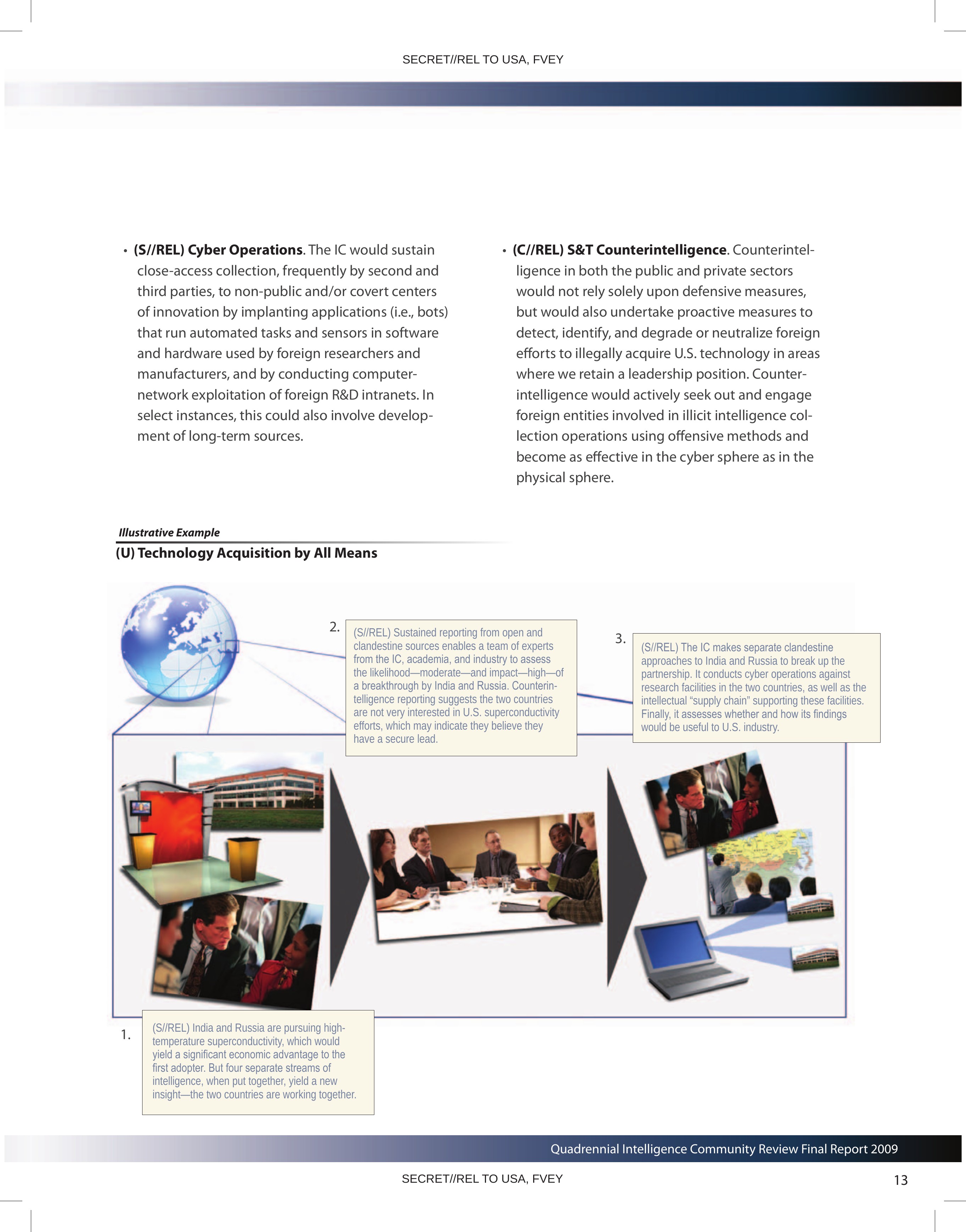
- (S//REL) Cyber Operations. The IC would sustain
close-access collection, frequently by second and
third parties, to non-public and/or covert centers
of innovation by implanting applications (i.e., bots)
that run automated tasks and sensors in software
and hardware used by foreign researchers and
manufacturers, and by conducting computer-
network exploitation of foreign R&D intranets. In
select instances, this could also involve develop-
ment of long-term sources. - (C//REL) S&T Counterintelligence. Counterintel-
ligence in both the public and private sectors
would not rely solely upon defensive measures,
but would also undertake proactive measures to
detect, identify, and degrade or neutralize foreign
efforts to illegally acquire U.S. technology in areas
where we retain a leadership position. Counter-
intelligence would actively seek out and engage
foreign entities involved in illicit intelligence col-
lection operations using offensive methods and
become as effective in the cyber sphere as in the
physical sphere.
Illustrative Example
(U) Technology Acquisition by All Means
- (S//REL) India and Russia are pursuing high-
temperature superconductivity, which would
yield a significant economic advantage to the
first adopter. But four separate streams of
intelligence, when put together, yield a new
insight-the two countries are working together. - (S//REL) Sustained reporting from open and
clandestine sources enables a team of experts
from the IC, academia, and industry to assess
the likelihood-moderate-and impact-high-of
a breakthrough by India and Russia. Counterin-
telligence reporting suggests the two countries
are not very interested in U.S. superconductivity
efforts, which may indicate they believe they
have a secure lead. - (S//REL) The IC makes separate clandestine
approaches to India and Russia to break up the
partnership. It conducts cyber operations against
research facilities in the two countries, as well as the
intellectual "supply chain" supporting these facilities.
Finally, it assesses whether and how its findings
would be useful to U.S. industry.
Quadrennial Intelligence Community Review Final Report 2009
SECRET//REL TO USA, FVEY
13
SECRET//REL TO USA, FVEY
(U) Strategic Hedge:
Human Terrain in the Virtual World
(C//REL) In 2025, non-state identity and affinity groups
operating seamlessly across physical and virtual worlds
could be the key players in global politics. Some of
these groups could pose a grave challenge to U.S. po-
litical legitimacy and physical security. In virtual worlds,
individuals could tailor multiple personas for different
settings, and both individuals and groups could have
many overlapping or non-obvious relationships. There-
fore, understanding the different roles an individual or
group might play in multiple contexts would represent
the central challenge around which the IC would be
oriented.
(S//REL) In this circumstance, the IC would increasingly
need to employ a virtual presence to complement
its physical presence. That presence would include
maintaining a forward position inside unconventional
partner and target entities by routinely embedding
officers not only in foreign intelligence services, as it
does today, but also in cooperative non-state groups.
The IC would also routinely employ private citizens
as proxies for sensitive analytic and collection tasks.
Academics, business people, and others would form an
IC-led standing dialogue, participating in collaborative
analytic teams when and as their expertise warranted.
(U) Sample Key Capabilities
- (S//REL) The Virtual IC. The IC would require
collection approaches and counterintelligence
capabilities such as online techniques for human
collection. Developing and protecting online cover
personas and authenticating the identity of online
sources and data would continue to be critical
elements of HUMINT and counterintelligence
tradecraft. - (S//REL) Bridging Domains. An automated cross-
cueing of collection platforms, including distrib-
uted sensors, would maintain a seamless approach
to monitoring and understanding individuals and
groups as they move between and operate across
the physical and virtual worlds. - (S//REL) Identity Assurance. As it builds a web of
complex and shifting partnerships, the IC would
need fail-safe means to authenticate its partners'
identities, conduct counterintelligence, and con-
trol access to its most sensitive intelligence, which
will be more challenging in 2025 than today due
to the proliferation of key technologies. - (S//REL) Counterintelligence. The IC would de-
velop increasingly effective methods for detecting,
deterring, and exploiting hidden foreign manipu-
lation of IC activities, and recognizing the trusted
insiders who are threats. Offensively, the counter-
intelligence target of choice would shift to persons
14
SECRET//REL TO USA, FVEY
SECRET//REL TO USA, FVEY
who have access to identity or affinity groups
assessed as a threat to U.S. national security. These
targets would be more likely to be located in com-
mercial or private establishments and might have
no discernible affiliation with a nation-state actor.
- (C//REL) Trusted, Deployable, Diverse Work-
force. Organizationally, the IC would need to more
aggressively recruit and maintain a more diverse
workforce capable of penetrating and analyzing
affinity-based groups. In many cases, this would
require hiring from such groups-and dealing
creatively with the counterintelligence challenges
presented by the multiple loyalties that such
recruits would be likely to have.
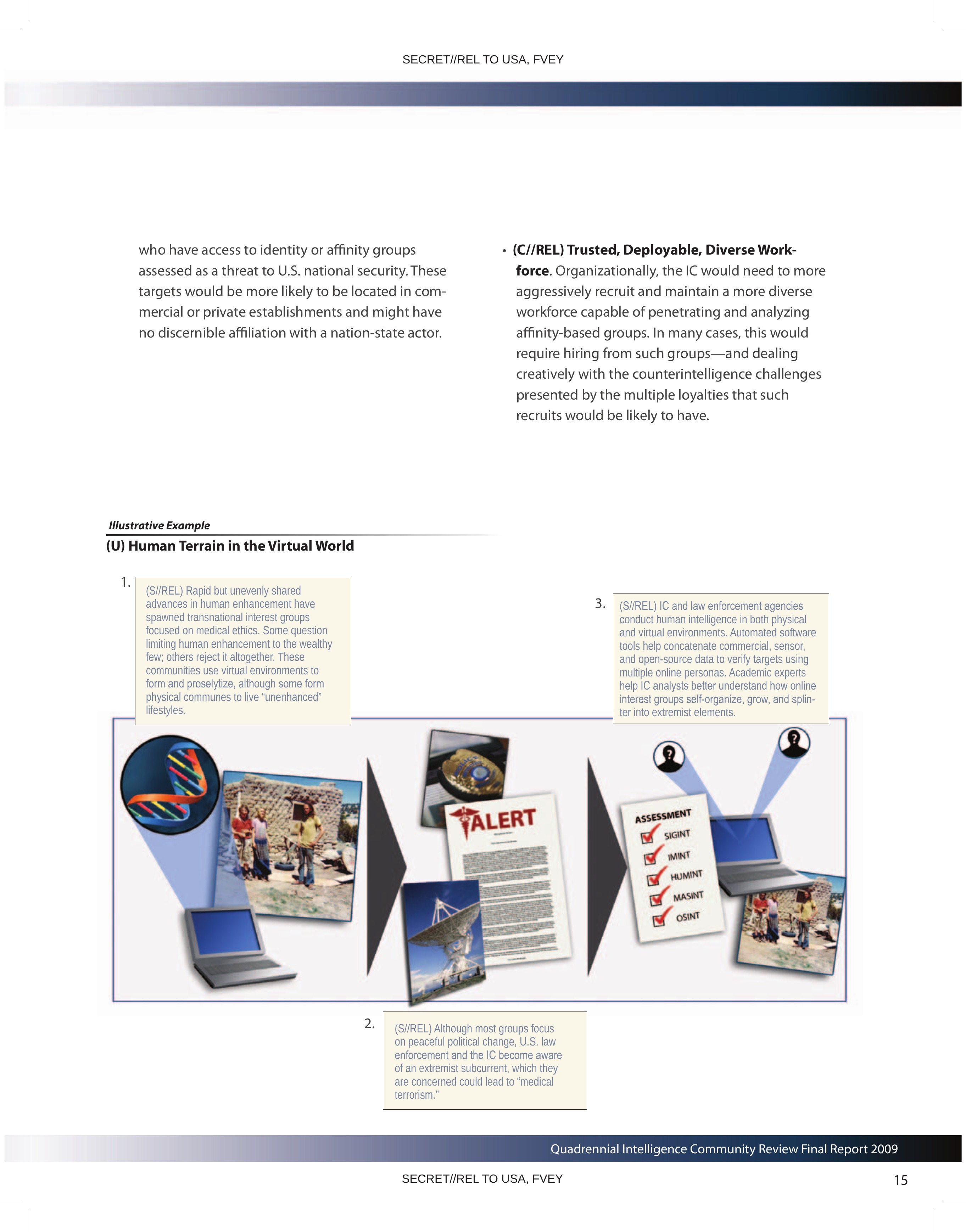
Illustrative Example
(U) Human Terrain in the Virtual World
- (S//REL) Rapid but unevenly shared
advances in human enhancement have
spawned transnational interest groups
focused on medical ethics. Some question
limiting human enhancement to the wealthy
few; others reject it altogether. These
communities use virtual environments to
form and proselytize, although some form
physical communes to live "unenhanced"
lifestyles. - (S//REL) Although most groups focus
on peaceful political change, U.S. law
enforcement and the IC become aware
of an extremist subcurrent, which they
are concerned could lead to "medical
terrorism." - (S//REL) IC and law enforcement agencies
conduct human intelligence in both physical
and virtual environments. Automated software
tools help concatenate commercial, sensor,
and open-source data to verify targets using
multiple online personas. Academic experts
help IC analysts better understand how online
interest groups self-organize, grow, and splin-
ter into extremist elements.
Quadrennial Intelligence Community Review Final Report 2009
SECRET//REL TO USA, FVEY
15
SECRET//REL TO USA, FVEY
(U) Strategic Hedge:
Money Mastery
(C//REL) If corporations, megacities, and foreign
governments were to limit access to data critical to
the provision of global public goods such as macro-
economic stability, U.S. policymakers could come to
rely on the IC to assist in efforts to collect and analyze
this closely held financial and economic information
and create an "economic operating picture" similar to
the "common operating picture" the military strives for
today. Basic elements of today's financial intelligence
(e.g., international datasets maintained by the Interna-
tional Monetary Fund and others, government reports,
and industry analyses) would be unavailable, unreli-
able, or misleading.
(C//REL) In this case, the IC would need a concept of
Money Mastery to penetrate corporations, markets, for-
eign central banks, and foreign finance ministries and
organizations so that it could gather and analyze pro-
prietary data. The IC also would need to track critical
commodities markets in much greater detail as well as
the full range of illicit financial markets and economies.
This concept would far exceed today's approach to
financial and economic intelligence in scale and scope
and would require increasingly sophisticated targeting
expertise, even more aggressive HUMINT collection,
and processing tools.
(U) Sample Key Capabilities
- (S//REL) "White/Grey/Black” Literature Exploita-
tion. Overtly, the IC would monitor open markets
in stocks, commodities, and currencies. To acquire
non-public but unprotected data such as propri-
etary business information, it would use two-way
information sharing with trusted and cooperative
corporations and foreign governments. Clan-
destinely, the IC would use human and technical
means, including sophisticated tracking soft-
ware, to access closely held market, financial, and
business data, be it inside corporations, foreign
governments, or other institutions. - (C//REL) Geoeconomic Analysis. Intelligence pro-
fessionals would monitor the stability of the global
economic system (not just single nation-state
economies) for early warning of disruptions and
would help policymakers understand the implica-
tions of different policy interventions. - (S//REL) Verify and Validate. The IC would assume
an even greater validation function to discern the
truth in official economic data issued by nation-
states and multilateral organizations. To do this,
the IC would employ a standing collaborative
network of economic experts-drawn from many
sectors of the economy, business, and governmen-
tal bodies, foreign and domestic-while mitigat-
ing the potential insider threat.
16
SECRET//REL TO USA, FVEY
SECRET//REL TO USA, FVEY
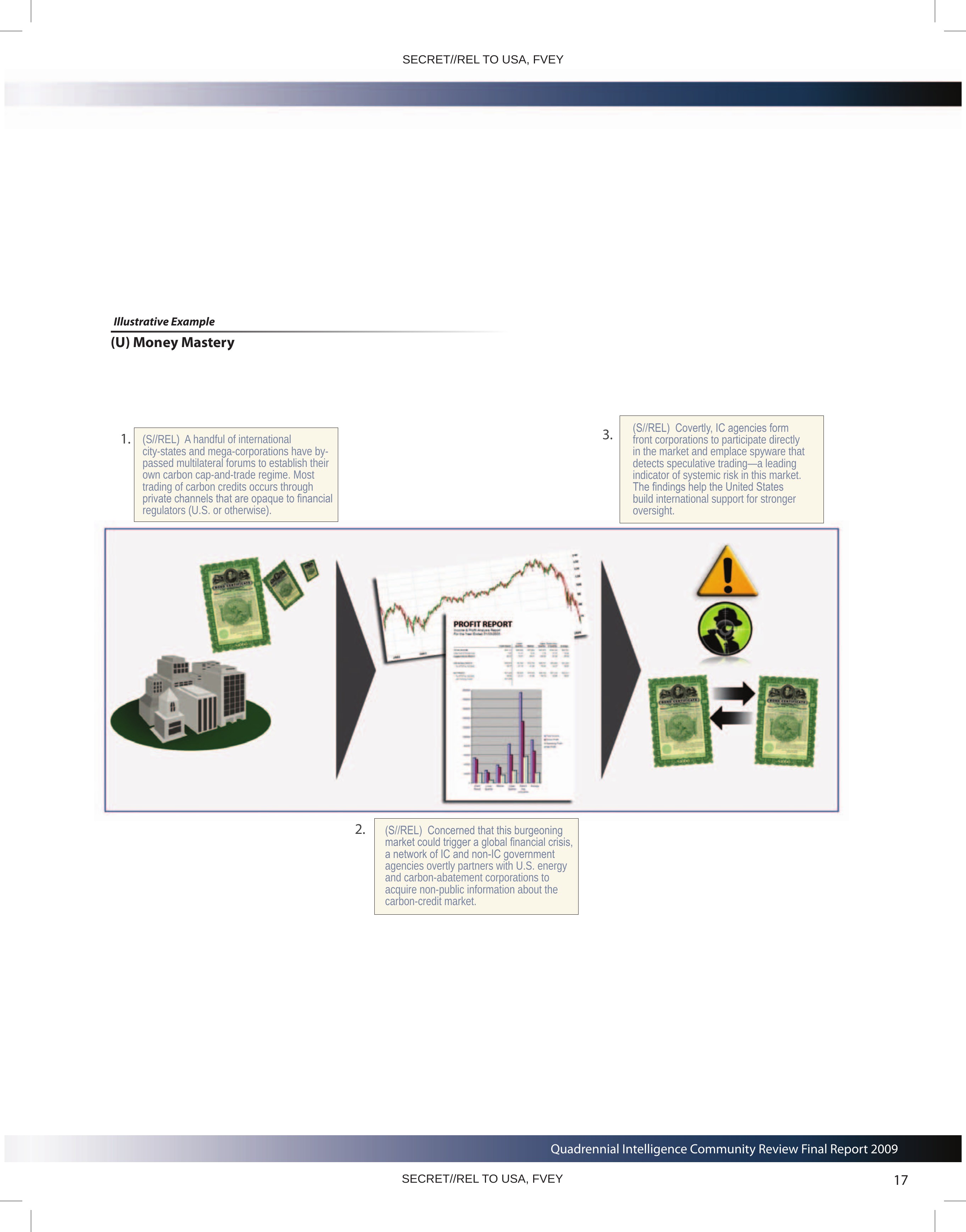
Illustrative Example
(U) Money Mastery
- (S//REL) A handful of international
city-states and mega-corporations have by-
passed multilateral forums to establish their
own carbon cap-and-trade regime. Most
trading of carbon credits occurs through
private channels that are opaque to financial
regulators (U.S. or otherwise). - (S//REL) Concerned that this burgeoning
market could trigger a global financial crisis,
a network of IC and non-IC government
agencies overtly partners with U.S. energy
and carbon-abatement corporations to
acquire non-public information about the
carbon-credit market. - (S//REL) Covertly, IC agencies form
front corporations to participate directly
in the market and emplace spyware that
detects speculative trading-a leading
indicator of systemic risk in this market.
The findings help the United States
build international support for stronger
oversight.
Quadrennial Intelligence Community Review Final Report 2009
SECRET//REL TO USA, FVEY
17
SECRET//REL TO USA, FVEY
Q
SECRET//REL TO USA, FVEY
SECRET//REL TO USA, FVEY
(U) CONCLUSION
(U) QICR 2009's charge was to build on and distill the
implications of the NIC's Global Trends 2025 so that IC
leadership could begin to manage the risks associated
with plausible alternative future environments chal-
lenging to the nation and the IC. This Final Report high-
lights six concepts (three "safe bets" and three "strategic
hedges") and identifies a number of illustrative capa-
bilities that would enable these concepts. IC elements
are strongly encouraged to deepen and broaden the
discussion of safe bets and strategic hedges begun
here, and to begin to consider whether and how stron-
ger foundations for these concepts might be laid into
the next several planning and programming cycles.
(C//REL) Collectively, these findings imply four broader
implications for how to posture the IC to deal with the
range of uncertainty in 2025. First, the IC will have to
manage highly fluid relationships to deal with the
dynamism of a more competitive security environment
and the fluidity among partners, sources, and targets.
This will require the IC to accept more risk despite
increasingly complex counterintelligence and security
challenges.
- (C//REL) Varying Patterns. The IC will need to
maintain both enduring partnerships grounded in
deep trust and shared interests as well as marriag-
es of convenience that are ephemeral and ad hoc.
Relationships with foreign partners, in particular,
will have to be much more variegated and extend
to unorthodox allies, be they states or non-state
actors. - (C//REL) Range of Partners. The IC will need to
more aggressively leverage outside expertise
(foreign and domestic, governmental and non-
governmental) across all facets of the intelligence
enterprise (from collection to security to technol-
ogy development). Reliance on outside expertise
will require a commensurate level of vigilance
in the form of effective counterintelligence to
ensure the integrity of information and systems
are protected. Equally important, the IC will have
to recruit, train, educate, mentor, and retain a suf-
ficiently sized cadre of intelligence professionals
capable of sustaining a rigorous dialogue with ex-
ternal experts. Finally, the IC will need to continue
developing products and services for state, local,
and tribal governments as well as the private sec-
tor, recognizing that these customers have special-
ized information needs and generally do not have
access to classified information systems. - (C//REL) Changing Roles, Unknown Attributes.
The IC will need ways to deal with partners whose
roles vis-à-vis U.S. security interests change rapidly.
Partners or sources in one dimension may very
well be intelligence targets in another. Addition-
ally, the IC will have to deal with actors who more
actively conceal their physical locations, nationali-
ties, true identities, and true purposes. The IC's
operating and management model (to include
tradecraft) will have to work across jurisdictions
and domains to deal with these challenges, which
probably will mandate a more robust collection
and analytic posture inside the United States.
(S//REL) Recommendation: Appropriate elements of the
IC should conduct a policy, regulatory, and legal review to
ensure the IC can meet the challenges of highly fluid rela-
tionships in ways that respect the desire of the American
people for privacy and civil liberty.
Quadrennial Intelligence Community Review Final Report 2009
SECRET//REL TO USA, FVEY
19
SECRET//REL TO USA, FVEY
(S//REL) Second, the IC will need to manage a singular
operational architecture that allows for the discov-
ery and tracking of targets across domains, be they
physical or virtual, foreign or domestic, in order to deal
with the new ways that a greater volume of informa-
tion will flow. Continued access to, and effective use
of, space will likely serve as a critical enabler to provide
important collection and communication capability to
work across this divide, although it may be challenged
in scenarios where states or corporations compete for
primacy in space. Achieving such an architecture will
be more difficult if and when U.S. rivals attempt to mili-
tarize space and/or endeavor to increase significantly
the risk to U.S. space-based intelligence assets. At the
same time, the IC will need to maintain visibility into
"off-the-grid" activity that has no digital signature or
a very ambiguous physical signature but that can still
have disproportionately large effects.
- (C//REL) Dynamic Interaction. The IC will need an
architecture capable of adapting quickly as threats
and issues emerge and readily cueing collection
and operations, often across the physical and
virtual domains. - (C//REL) Few, Conflicting, or Weak Signals. The IC
will need to synthesize data from multiple, often
novel, sources to identify threats or opportunities.
In particular, the IC will need to anticipate, detect,
understand, and place into context digital signals
that have few, if any, physical manifestations.
(S//REL) Recommendation: Appropriate elements of the
IC should assess the organization and structure of the
intelligence enterprise to ensure it will support the kind
of operational architecture necessary to deal with the
transformed information environment of 2025.
(U) Third, the IC will need to change the role of the
intelligence officer to deal with a dynamic external
environment and adapt to new customer needs. The
IC will need officers trained in multiple fields, from
technology to methodology to all-source analysis,
with many filling multiple roles at the same time. The
workforce model will need profound reassessment in
at least two dimensions:
- (C//REL) Building Well-Rounded Experts. IC
personnel will still need specialized training, in-
cluding in languages, but they will require deeper
understanding of context to perform their jobs.
Initiatives like joint duty will need to be greatly
expanded and complemented with an array of de-
velopmental, educational, and training activities. - (C//REL) Cross-Training. The IC will need to
prepare intelligence professionals for careers in
which the distinction between analyst and collec-
tor is increasingly irrelevant, particularly in virtual
worlds. At the same time, the IC will need to build
teams to bring a range of skills to bear on complex
problems, because some degree of individual
specialization will persist.
(U) Recommendation: Appropriate elements of the IC
should review how to adapt the workforce management
model to promote flexibility, responsiveness, collabora-
tion, and appropriate incentives and rewards.
(S//REL) Fourth, the IC will need to maintain strong
information and identity assurance to address the
likely erosion in our technological advantage and
the new dynamics of the digital medium, which will
introduce new risks to our IT infrastructure and new
methods of denial, deception, and misdirection.
20
SECRET//REL TO USA, FVEY
SECRET//REL TO USA, FVEY
- (S//REL) Declining IT Security. The IC will have to
operate in an environment where computing infra-
structure is more difficult to secure, advanced en-
cryption is far more pervasive, and our cryptologic
advantages may persist only in niches where we
have focused resources to achieve breakthroughs.
Indeed, the IC may not be able to provide compre-
hensive security for its entire IT infrastructure and
may have to use such offsetting strategies as "hide
in plain sight." - (S//REL) Digital Deception. The IC will need to op-
erate in an increasingly virtual operational environ-
ment where denial, deception, disinformation, and
hostile collection will intensify the risks posed to
collection systems and analytical methodologies.
Recognizing the difference between clandestine
adversaries and non-threatening interlocutors will
require new sets of knowledge, skills, and abilities
from our HUMINT, security, and counterintelli-
gence cadres. - (S//REL) Identity Assurance. The IC will need ro-
bust ways to discover, manage, and protect identi-
ties as many more people use multiple online
personas and leverage increasingly sophisticated
anonymizing techniques. It will need approaches
to mitigate this challenge by taking advantage of
linked identities and entities providing a web of
potentially identifying information to cue social-
network analysis.
(C//REL) Recommendation: Appropriate elements of the
IC should assess the information and identity assurance
capabilities of the IC to ensure it will be able to meet the
digital challenges of 2025.
(U) In conclusion, QICR 2009 highlights the urgency to
begin developing new approaches to prepare for an
uncertain future. Elements of the National Intelligence
Program, foreign intelligence services, state, local,
and tribal governments, and industry are encouraged
to consider these insights in conducting their own
long-term planning efforts. The rigor with which QICR
2009 developed these ideas to mitigate strategic and
institutional risk must now be translated into meaning-
ful agenda items for the IC and its partners to carry
forward.
Quadrennial Intelligence Community Review Final Report 2009
SECRET//REL TO USA, FVEY
21
SECRET//REL TO USA, FVEY
(U) For additional reading:
- (U) National Intelligence Council, Global Trends 2025: A Transformed World, December 2008, available at
http://www.dni.gov/nic/NIC_2025_project.html. - (U) Office of the Director of National Intelligence, Quadrennial Intelligence Community Review Scenarios:
Alternative Futures the IC Could Face, January 2009.
22
SECRET//REL TO USA, FVEY
SECRET//REL TO USA, FVEY
SECRET//REL TO USA, FVEY
SECRET//REL TO USA, FVEY
UNITED STATES INTELLIGENCE COMMUNITY
OFFICE OF THE DIRECTOR OF NATIONAL INTELLIGENCE
UNITED STATES OF AMERICA
Office of the Director of National Intelligence
09065903
SECRET//REL TO USA, FVEY
Related Documents
-
NATO Civilian Intelligence Council – Cyber Panel – US Talking Points [pdf]
This 2011 US intelligence assessment for NATO identifies cyber espionage as the principal threat to Alliance networks, ranking Russia and China as the most significant nation-state actors and advocating for a shift to a consequence-based defense model that prioritizes the protection of NATO's most critical data.
-
FINAL Agenda SWEDUSA [pdf]
Detailed list of points and participants in the summit meeting between the top brass of the FRA and the NSA in April 2013.
Programs: TURTLEPOWER · TURMOIL · XKEYSCORE · WINTERLIGHT · QUANTUM · PARTNERMALL · VIVIAN · NAPA-3 · GCE · SSO -
CNE Analysis in XKEYSCORE [pdf]
This document is an NSA training presentation from October 2009 demonstrating how XKEYSCORE integrates with Computer Network Exploitation (CNE) operations, allowing analysts to search and analyze data extracted from compromised computers including keystrokes, browser history, registry files, documents, emails, and directory structures collected through implants like UNITEDRAKE and OLYMPUS.
Programs: XKEYSCORE · OLYMPUS · UNITEDRAKE · PINWALE · TUNINGFORK · TURBOCHASER · MARINA · JOLLYROGER · TREASUREMAP · TURBINE · PRESSUREWAVE · MAD · TUCKER · EXPANDINGPULLY · UNIX · SEARCHLIGHT · KEYLOGGER · PILBEAM · FOXACID · WAYTIDE · SHADOWQUEST · SEAGULLFARO · DARKHELMET · LUTEUSICARUS · FOGGYBOTTOM · GREENCHAOS · RADIUS · NKB · VALIDATOR -
CSEC Cyber Threat Detection [pdf]
This document details the Communications Security Establishment’s (CSEC) cyber threat detection and intelligence infrastructure, including systems like EONBLUE, CROSSBOW, CRUCIBLE, and LODESTONE, which enable passive monitoring, anomaly detection, and botnet identification through metadata and deep packet inspection. It outlines how CSEC integrates SIGINT, cryptanalysis, and network forensics to detect and mitigate cyber intrusions using both SIGINT and domestic sensors, while collaborating with Five Eyes partners to enhance Canada’s cyber defense and situational awareness. The presentation is duplicated from page 7 onwards - one of the duplicated slide has internal CSE comments.
Programs: EONBLUE · SPECIALSOURCE · WARRANTEDACCESS · COVENANT · SEEDSPHERE · DIESELRATTLE · SIENNABLUE · DOWNGRADE · CROSSBOW · CRUCIBLE · LODESTONE -
CNO Core Secrets Security Structure [pdf]
A 3-slide NSA presentation outlining the classification architecture of Sentry Eagle, a national cyber operations initiative, showing how its most sensitive components — covering network hacking, encryption sabotage, and covert industry relationships — are locked behind ECI and SAP designations accessible only to a tiny circle of government officials.
Programs: SENTRYEAGLE · SENTRYHAWK · SENTRYFALCON · SENTRYOSPREY · SENTRYRAVEN · SENTRYCONDOR · SENTRYOWL