Tag: Nokia 10 documents
Search documents matching “Nokia” →Free-text subjects the curators added. Unlike the other axes these are not necessarily from the documents' own vocabulary, so they are the loosest thing to browse by (and the most forgiving).
Graphs
By Banner
By Classification
Refine (combine with another filter, via search)
Sort: Title
Documents
-
3G: impact and update - SDF Nov 09 [pdf]
This 2009 top-secret presentation from Australia’s Defence Signals Directorate (DSD) detailing 3G mobile network rollouts in Southeast Asia and identifying Indonesian President Susilo Bambang Yudhoyono, his wife, and senior officials as surveillance targets. It includes handset information, call data records, intercepted call attempts, and outlines plans for continued interception of Indonesian leadership communications.
-
Analyzing Mobile/Cellular DNI in XKEYSCORE, May 2009 [pdf]
The XKEYSCORE document explains how the agency analyzes mobile/cellular device internet usage by collecting and processing both converged DNI/DNR data within cellular networks and traditional internet traffic, using various tools and indicators to identify mobile users even when their device type isn't immediately evident. The document demonstrates how the system can track mobile internet activity across applications like Yahoo Mail and identifies devices through various technical "hints" including MSISDN codes, browser fingerprints, and user agent strings.
-
AND THEY SAID TO THE TITANS: « WATCH OUT OLYMPIANS IN THE HOUSE! » [pdf]
This Top Secret CSEC “Olympia” document details a Canadian intelligence program that analyzed and tracked the Brazilian Ministry of Mines and Energy’s telecommunications, mapping IPs, servers, proxies, and mobile devices while automating data collection and network analysis to develop actionable intelligence. It outlines tools, workflows, and contacts used for surveillance, though the presentation does not explain the specific purpose of the operation.
Programs: OLYMPIA · QUOVA · PROMETHEUS · PEITHO · SLINGSHOT · LEVITATE · STRATOS · EVILOLIVE · GCHQ Geofusion · ATLAS · HYPERION · ATHENA · DANAUS · TIDALSURGE · BLACKPEARL · MARINA · STARSEARCH · PEPPERBOX · TRITON · PACKAGEDGOODS · ARK · TOYGRIPPE · FRIARTUCK · MASTERSHAKE · COEUS · STALKER · MAINWAY · FASCIA · SEDB · OCTSKYWARD · FASTBAT · TWINSERPENT · EONBLUE · DISHFIRE · GNDB“Read a CSEC document that was first acquired by Edward Snowden” - The Globe and Mail ↗ (2013-11-30) · “Ministério de Minas e Energia está na mira de espiões americanos e canadenses” - O Globo ↗ (2013-10-06) · “No Place to Hide” - Metropolitan Books ↗ (2014-05-13) · Freeze, Colin · Bridi, Sônia · Greenwald, Glenn -
Exploiting Foreign Lawful Intercept (LI) Roundtable [pdf]
Top-secret PowerPoint presentation, "Exploiting Foreign Lawful Intercept Roundtable," highlights the agency’s strategy to exploit vulnerabilities in lawful intercept systems from telecom companies, such as Ericsson, Motorola, and Nokia, in countries like Mexico, Indonesia, and Egypt. The presentation also discusses NSA's use of various "Fingerprints" for identifying data and its collaboration with industry players and foreign lawful intercept systems.
“A Death in Athens” - The Intercept ↗ (2015-09-28) · “Americans and Greeks started the 2004 wiretaps together” - Kathimerini ↗ (2015-09-29) · Bamford, James · Petropoulos, Aggelos -
Graph theory in the operational environment – GCHQ [pdf]
This document details GCHQ’s research on identifying “closed loops” of communication, where targets use a small set of phones to communicate exclusively among themselves, often with cheap, disposable handsets like the Nokia 1100. It explains the methodology for analyzing anonymized metadata, constructing contact graphs, and extracting non-giant, non-tree components to discover operationally relevant closed loops for intelligence and counterterrorism purposes.
Programs: VOICESAILPeople: Rumsfeld, Donald -
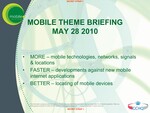
Mobile Theme Briefing (May 28, 2010) [pdf]
This 2010 GCHQ briefing document outlines the “Mobile Applications Project,” which aims to expand intelligence capabilities to exploit the growing shift from fixed to mobile internet usage. It details objectives for targeting mobile apps and roaming network traffic (GRX), enabling converged analysis of voice, text, command-and-control, and geolocation data across multiple mobile platforms such as iPhone, Symbian, Android, and Windows Mobile. See also: EFF_-_20140128-guard-leaky_phone_apps_0 (includes other slides from the same slideset)
Programs: Mobile Applications Project -
Phone Number Extractor [pdf]
A top secret XKEYSCORE training document from October 2009 describing the Phone Number Extractor capability, which automatically identifies and extracts telephone numbers from intercepted internet traffic including website content, email signature blocks, HTTP GET requests from mobile devices, HTTP POST submissions, and converged DNR/DNI collection — with operational examples targeting Iran, Lebanon, and Pakistan.
-
Using XKEYSCORE to Enable TAO [pdf]
A TOP SECRET training presentation from 2009, authored by a Booz Allen Hamilton contractor, teaching NSA analysts how to use XKeyscore to harvest the login credentials, router configurations, browser versions and server software details that the Tailored Access Operations hacking unit needs to break into foreign computer networks — with worked examples stealing Cisco router passwords, Iranian government webmail logins and jihadi web forum credentials directly from intercepted internet traffic.
-
XKEYSCORE Tech Strings in Documents (aka Tech Extractor) 2009 [pdf]
A December 2009 TOP SECRET XKeyscore training presentation on the Tech Extractor (Tech Strings in Documents) — an early context-aware scanning capability that tags keywords only when they appear inside email, chat and document bodies rather than anywhere in raw internet traffic, letting analysts find technically interesting documents by terms too generic for traditional content selection, with an example flagging a Pakistani document mentioning WiMAX and DVB satellite technology by scanning inside the file.
-
XKEYSCORE Tech Strings in Documents (aka Tech Extractor) 2010 [pdf]
An April 2010 TOP SECRET XKeyscore training presentation on the Tech Extractor — an expanded version of the December 2009 briefing — teaching analysts to find intelligence by tagging keywords inside email, chat and document bodies, with new detail on tasking rules (including that terms hit as substrings so "ricin" matches "pricing"), its non-retrospective operation, its limitations versus the 65+ context fingerprint language, and confirmation that the capability was operated jointly with GCHQ, whose Cheltenham analysts submitted tasking via an Excel template and wiki.