Tag: network analysis 53 documents
Search documents matching “network analysis” →Free-text subjects the curators added. Unlike the other axes these are not necessarily from the documents' own vocabulary, so they are the loosest thing to browse by (and the most forgiving).
Graphs
By Banner
By Classification
Refine (combine with another filter, via search)
Sort: Title
Documents
-
SIGINT Target Package Leads to USMC Capture of al-Qa'ida Weapons Procurer SIDtoday [pdf]
This SIDtoday document details the capture of Abu Sayf, an Al-Qa'ida weapons procurer, by the U.S. Marine Corps in Iraq in May 2007, facilitated by SIGINT targeting from Menwith Hill Station and NSA Georgia. The operation disrupted weapons and insurgent smuggling into Iraq and may yield critical intelligence on Al-Qa'ida operations in Iraq, Syria, and Lebanon.
Programs: GHOSTHUNTER -
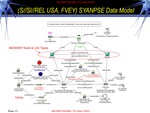
SYANPSE Data Model [pdf]
This document outlines the NSA’s SYANPSE Data Model, a classified metadata framework used for mapping relationships between people, organizations, devices, and intelligence designators. It details how various entities (e.g., phone numbers, email addresses, reports, and organizational units) are linked through structured graph relationships to support SIGINT analysis and tasking across the Five Eyes intelligence alliance.
-
The Answer Is... Peer to Peer File Sharing SIDtoday [pdf]
In 2004, BitTorrent traffic was responsible for two-thirds of all traffic on the internet, and BitTorrent wasn't even the most popular peer-to-peer file-sharing tool. The File-sharing Analysis and Vulnerability Assessment (FAVA) pod began researching P2P tools and protocols, such as BitTorrent, DirectConnect, eDonkey, KaZaA, and several others, to develop methods to search this traffic for intelligence. "We have developed the capability to decrypt and decode both KaZaA and eDonkey traffic to determine which files are being shared, and what queries are being performed."
Marking: TOP SECRETPeople: Spears, BritneyThe Intercept ↗ (2017-09-13) -
The Intelligent SIGINT Network of the Future SIDtoday [pdf]
An overview of TRAFFICTHIEF, a service that connects several different collection systems, "from active, passive, and warranted SIGINT accesses via a central messaging service" to provide near real-time alerts about targets. It started in July 2003 as a prototype and has been deployed since February 2004. It "has helped enable the capture of several high-priority Counter-terrorism targets." There are several major enhancements that TRAFFICTHIEF could also do in the future, and the TRAFFICTHIEF team is hard at work making them a reality.
The Intercept ↗ (2017-04-24) -
The NAC's Advanced Network Development & Analysis (ANDA) Division SIDtoday [pdf]
Profile of the Network Analysis Center's ANDA division, which helped capture suspected al Qaeda operative Husam al-Yemeni, improved understanding of the Pakistani Army Defense Network, and spied on a network associated with the leader of Venezuela (erroneously referred to as "Victor Chavez").
The Intercept ↗ (2016-12-07) -
The NAC's Data/Network Operations Center (DNOC) SIDtoday [pdf]
Understanding and analyzing digital networks that the NSA has hacked is labor intensive, and there aren't enough analysts to effectively monitor everything. The Data/Network Operations Center is developing an automated system to monitor changes on targeted networks.
People: Schepens, WayneThe Intercept ↗ (2016-12-07) -
The TAC's Metadata Analysis Cell (MAC) SIDtoday [pdf]
Description of the Metadata Analysis Cell, starting with a success story about a counterterrorism analyst using tools MAC provided to discover six terrorism-related phone numbers. MAC specializes in contact chaining procedures.
The Intercept ↗ (2016-12-07) -
Three Named as Focal Points for Connecting Analysts, TURBULENCE Developers SIDtoday [pdf]
As the agency moves to the unified TURBULENCE IT system, each of the analysis-focused SID branches will have a point person to represent their needs to the system's developers and to oversee the transition.
The Intercept ↗ (2019-05-29) -
Tracking Targets Through Proxies & Anonymizers [pdf]
This NSA presentation details methods for tracking and de-anonymizing internet users who employ privacy tools like Tor, proxies, and VPN services such as AnchorFree's Hotspot Shield. The document explains how the agency reverse-engineers anonymization tools, creates "fingerprints" to identify their traffic in surveillance systems, and correlates encrypted connections to reveal users' real IP addresses and locations—acknowledging this work "makes for sad analysts" when targets successfully obscure their identities.
-
TREASUREMAP Announces a New Release SIDtoday [pdf]
A January 2011 NSA SIDtoday announcement from NTOC's Office of Technology Development detailing a new release of TREASURE MAP — the global internet mapping system — and confirming it is accessible to all NSANet, JWICS, and SIPRNet users with valid PKI certificates, with new features including router configuration exports, traceroute improvements, wireless access point visualization, and enhanced target identification tools.
Programs: TREASUREMAP -
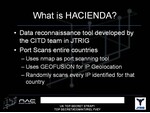
What is HACIENDA? [pdf]
This document details HACIENDA, a large-scale reconnaissance tool used by GCHQ and the Five Eyes alliance to perform automated port scanning and vulnerability mapping across entire nations. It outlines the technical process of identifying and exploiting network infrastructure, specifically for the purpose of discovering Operational Relay Boxes (ORBs) to facilitate covert "Computer Network Exploitation" (CNE).
-
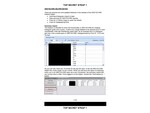
XKEYSCORE Helper Notes [pdf]
This GCHQ document describes new features in the XKEYSCORE Palantir helper tool, including summary/histogram import capabilities that reduce large datasets by aggregating connection data rather than creating individual events for each entry, and data sourcing features that track which XKEYSCORE queries imported specific data into Palantir. The document provides step-by-step screenshots showing how analysts can histogram network traffic by source IP, destination IP, and ports, then import aggregated results showing metadata like total session sizes and connection counts.
Programs: XKEYSCORE -
Yemen backhaul comms collected (Jan 2011) [pdf]
This brief GCHQ document from January 2011 describes intelligence collection operations against Yemen's microwave telecommunications infrastructure, where overhead (OH) tasking confirmed tower activity and analyzed GSM and CDMA backhaul communications using the ICS2 tool, yielding voice intercepts, SMS messages, and at least one dial number recognition (DNR) hit that significantly contributed to counterterrorism work.