Tag: cryptanalysis 78 documents
Search documents matching “cryptanalysis” →Free-text subjects the curators added. Unlike the other axes these are not necessarily from the documents' own vocabulary, so they are the loosest thing to browse by (and the most forgiving).
Graphs
By document date (11 years)
By Banner
By Classification
Refine (combine with another filter, via search)
Sort: Title
Documents
-
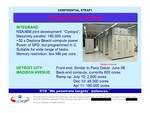
Excerpt from Hpc Overview 1011 [pdf]
This document outlines the development of a highly advanced, massively parallel computing system, referred to as "Cyclops", a joint project between NSA and IBM. It is designed to perform complex tasks related to signals intelligence and code-breaking, with significant computing power, ramping up to 180,000 cores, and is referenced as a critical tool in penetrating target defenses.
-
Finding Genetic Sequences in SIGINT SIDtoday [pdf]
A cryptoanalysis intern describes her experience working for the Office of Tradecraft for Analysis, developing algorithms to answer specific questions from a haystack of metadata -- an entirely new type of problem than what cryptoanalysts typically tackle. The goal of her specific tour was to "gain general knowledge about genetic engineering research activity by foreign entities and to identify laboratories and/or individuals who may be involved in nefarious use of genetic research."
The Intercept ↗ (2017-04-24) -
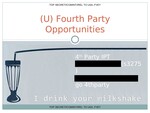
Fourth Party Opportunities [pdf]
This presentation document explains how NSA identifies, prioritizes, and exploits “fourth party” opportunities by passively or actively leveraging foreign computer network exploitation operations, including victim stealing and tool repurposing, to collect intelligence without initiating original intrusions.
Programs: VOYEUR · UIS · PINWALE · YNKE · TUNINGFORK · DIRTSHED · SEEKER · CLOUD · ABR · SILVERBOLT · DEADSEA · XKEYSCORE · BYZANTINERAPTOR · HAWALA · ZEBEDEE · DATAFLURRY · ECLECTICPLOT · HAPPYFOOT · BLUESMOKE · CROSSBONES2 · CYBERQUEST · VICDB · PLAIDDIANA · TRANSGRESSION -
Giving Answers, Keeping Secrets SIDtoday [pdf]
The technical details of how NSA exploits virtual private networks (VPNs) are "held closely and generally not available to field sites." VIVIDDREAM is a query tool that allows analysts who discover new VPNs to test whether or not NSA has the capability to exploit them, without having to share the secret exploits themselves with these analysts.
Programs: VIVIDDREAM -
Guidelines for the classification of NSA SIGINT details (1945-1967) [pdf]
This document is an NSA classification guide that defines how and why historical SIGINT material from 1945–1967 remains classified, in many cases for 75 years. It systematically explains which intelligence activities, targets, partnerships, and technical methods must stay protected because they still reveal sensitive sources, methods, and diplomatic equities.
-
Have You Considered Joining a Learned Organization? SIDtoday [pdf]
A brief introduction to the 2005 series on the NSA's Learned Organizations.
Marking: UNCLASSIFIEDPrograms: KRYPTOSThe Intercept ↗ (2017-09-13) -
Innov8 Experiment Profile Template [pdf]
A TOP SECRET STRAP1 joint NSA/GCHQ experiment profile documenting a 2010-2011 Joint Capability Experiment to test hardware-accelerated bulk decryption of common internet encryption technologies at scale, integrating TURMOIL's passive collection with NSA's LONGHAUL key recovery service via the ISLANDTRANSPORT messaging system, as part of the broader BULLRUN assault on internet encryption.
“Prying Eyes: Inside the NSA's War on Internet Security” - Der Spiegel ↗ (2014-12-28) · “Revealed: how US and UK spy agencies defeat internet privacy and security” - The Guardian ↗ (2013-09-05) · Appelbaum, Jacob · Gibson, Aaron · Grothoff, Christian · Müller-Maguhn, Andy · Poitras, Laura · Sontheimer, Michael · Stöcker, Christian · Ball, James · Borger, Julian · Greenwald, Glenn -
Intern Wargamer Peers Into Crystal Ball SIDtoday [pdf]
A war game event presented teams of NSA and other intelligence community staff with a set of scenarios for the year 2020 and asked them to assess how effective the NSA's current strategic plan would be in defending against potential threats, such as a series of terrorist attacks or an invasion of a strategically important country. The author of this post notes that the scenarios did not consider the effect that major changes in cryptology could have on the NSA's capacity to gather signals intelligence.
People: Black, BillThe Intercept ↗ (2017-09-13) -
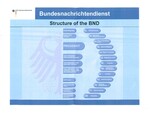
Internal NSA presentation on the BND's organization [pdf]
These six organizational charts and briefing slides detail the structure of Germany's BND foreign intelligence service, specifically its SIGINT Directorate (Abteilung Technische Aufklärung) and new Cyber Intelligence division (T4), along with a cooperation model showing intelligence sharing between BND, domestic intelligence service BfV, and the Federal Office for Information Security (BSI).
-
Interview with ... REDACTED, Chief, SIGINT Development - Strategy and Governance (SSG) SIDtoday [pdf]
In this interview with a SIGINT Development chief, the subject describes his time aboard the USS Observation Island launch ship as his most memorable moment. He was collecting telemetry related to Soviet missile systems as he watched small Soviet boats with people collecting intelligence back. He also talks about his history at NSA, that he would like tools to be designed with simpler user interfaces for beginners as well as advanced users, and that he's excited about Global Network Development Activity, a new system that is "bringing about close cross-organizational collaboration on high priority targets and SSO access programs."
Programs: SSOThe Intercept ↗ (2017-04-24) -
Interview with... Charlie Meals, Signals Intelligence Deputy Director SIDtoday [pdf]
In an interview, the deputy director describes his early days in the NSA's "weather shop," decrypting Soviet weather reports.
The Intercept ↗ (2017-04-24) -
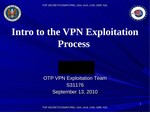
Intro to the VPN Exploitation Process [pdf]
NSA introduction to the VPN exploitation process from September 2010, presented by the OTP VPN Exploitation Team, covering the full workflow from initial collection through to sustained decryption of IPSec, PPTP, SSL and SSH traffic, with named exploitation successes including airlines, diplomatic missions, banks and intelligence services across Iran, Jordan, Russia, Turkey, Pakistan, Afghanistan, Somalia, Indonesia and Mexico.
Programs: BLEAKINQUIRY · TOYGRIPPE · XKEYSCORE · MAILORDER · CORALREEF · VULCANDEATHGRIP · SCISSORS · TURTLEPOWER · PINWALE · FOURSCORE · CADENCE · UTT · VULCANMINDMELD · CAPRIOS · AGILITY · NKB · FOLLOWTHEMONEY -
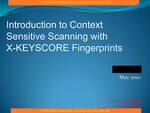
Introduction to Context Sensitive Scanning with X-KEYSCORE Fingerprints [pdf]
This May 2010 NSA training document introduces XKEYSCORE's context-sensitive scanning capabilities using "fingerprints"—customizable detection rules that allow analysts to surgically target specific types of Internet traffic without needing prior knowledge of email addresses or other strong selectors, using over 70 unique contexts to identify patterns in communications and behaviors.
-
Is there "fifth party" collection? [pdf]
This NSA internal Q&A forum discussion reveals "fifth party collection"—where the NSA passively intercepts data from one intelligence service (South Korea) that has compromised another service's (North Korea) computer network exploitation operations, creating a three-layer chain where NSA exploits Actor One's access to Actor Two's CNE activities against shared targets. The thread provides concrete examples including NSA leveraging South Korean implants on North Korean officials' computers (who themselves were conducting CNE operations) and stealing zero-day exploits from unidentified foreign intelligence services by passively monitoring their successful attacks.
-
Join a Learned Organization SIDtoday [pdf]
Introduction to SIDtoday's "annual roundup" of NSA Learned Organizations.
Marking: UNCLASSIFIEDThe Intercept ↗ (2016-12-07) -
Kaspersky User-Agent Strings [pdf]
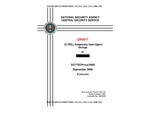
This September 2008 NSA technical report reveals that the agency discovered Kaspersky antivirus software's user-agent strings contain encoded serial numbers and can function as unique machine identifiers, allowing tracking of individual computers running the Russian security software across intercepted network traffic collected through the YACHTSHOP surveillance program.
-
Mathematician: An Insider's View SIDtoday [pdf]
A mathematician describes work in the field of “diagnosis,” doing cryptanalysis on new types of encryption. Projects include working as part of a close-knit team looking for weaknesses in new cryptosystems, using a variety of tools to find patterns in ciphertext, and programming new tools that don’t yet exist.
The Intercept ↗ (2016-05-16) -
N.S.A. Memo Expands Access to FISA Information [pdf]
In 2006, the National Security Agency sought to expand access to Foreign Intelligence Surveillance Act information — previously limited to its headquarters in Fort Meade, Md. — to its code-breakers in Georgia, Texas and Hawaii. Part of the deliberations focused on a problem that raised the possibility that the agency had violated rules the surveillance court established for handling the information.
-
NBOVBM DSZQUBOBMZTJT GPSVN -- 8-12 NBZ 2006 SIDtoday [pdf]
Five eyes “cryppies” meet at GCHQ to discuss ciphers that can be cracked without the use of a machine or computer. Spoiler alert: The title translates to “MANUAL CRYPTANALYSIS FORUM -- 8-12 MAY 2006.”
The Intercept ↗ (2018-08-15) -
NSA CSEC Partnership [pdf]
This NSA paper outlines the long-standing intelligence partnership between the U.S. and Canada’s Communications Security Establishment Canada (CSEC), dating back to WWII. It highlights mutual SIGINT cooperation, shared technological resources, and the role of CSEC in cryptography, cyber defense, and intelligence sharing, particularly in high-priority global and transnational targets.