Tag: Human Language Technology 23 documents
Search documents matching “Human Language Technology” →Free-text subjects the curators added. Unlike the other axes these are not necessarily from the documents' own vocabulary, so they are the loosest thing to browse by (and the most forgiving).
Graphs
By Banner
By Classification
Refine (combine with another filter, via search)
Sort: Title
Documents
-
Establishment of a Human Language Technology IPT SIDtoday [pdf]
NSA analysts need more advanced tools and technology to handle the mass of text data collected by the agency. A team has been established to determine solutions for language technology issues.
Programs: HLTThe Intercept ↗ (2016-12-07) -
SIGINTers Use Human Language Technology to Great Advantage, Isolate Conversation about Threat to US Official SIDtoday [pdf]
In 2010, the Special Collection Service in Mexico City began using Human Language Technology (HLT) to streamline voice collection and analysis, significantly improving efficiency. By rapidly filtering through large volumes of audio data, HLT helped isolate critical intelligence, such as identifying a conversation related to a bomb threat targeting a U.S. Embassy official, all within minutes instead of hours.
Programs: HLT -
Alert: Voice Masking Is Discovered in SIGINT SIDtoday [pdf]
This March 2007 post from the internal NSA newsletter SIDToday draws attention to voice-masking technology used by subjects of surveillance to frustrate the agency’s voice-recognition efforts.
-
Alvin, Simon, and... Al Qaeda? Finding Modified Voice in SIGINT Traffic SIDtoday [pdf]
This SIDtoday article discusses the use of voice modification technology by Al-Qaeda and other extremist groups to evade identification in SIGINT traffic. It highlights the development of the HLT Lite software by R64, which can automatically detect modified voices in intercepted communications, enabling the identification of targets even when traditional voice recognition fails.
-
“Black Budget” — FY 2013 Congressional Budget Justification/National Intelligence Program, p. 262 (February 2012) [pdf]
This excerpt from the Fiscal Year 2013 Congressional Budget Justification (the "Black Budget") details the NSA's financial and performance metrics for "Analytics Modernization," specifically focusing on the transition to high-volume, automated speech-to-text systems. It records the decommissioning of legacy voice processing systems (VoiceRT) in favor of more robust, scalable capabilities aimed at rendering millions of intercepted voice files searchable via text queries and paired dialogue transcription.
Programs: VoiceRT -
“Black Budget” — FY 2013 Congressional Budget Justification/National Intelligence Program, pp. 360-364 (February 2012) [pdf]
The "Human Language Technology (HLT) Research" section of the FY 2013 "Black Budget" details a specialized research project focused on creating "force multipliers" for the NSA workforce through automated speech-to-text, machine translation, and content extraction. With a requested budget of $29.4 million, the project aims to bridge the gap between foundational academic research (via Johns Hopkins University) and the practical exploitation of the volume and velocity of global SIGINT.
Programs: HLT -
Building Human-Language Technology SIDtoday [pdf]
Human Language Technology relies on corpora--collections of linguistic data. For the NSA's linguistic tools to analyze SIGINT accurately, their datasets need to include analysis of specific terms from classified materials, meaning that the corpora themselves must be classified and the analysts who work on them must have security clearance.
Programs: HLTThe Intercept ↗ (2019-05-29) -
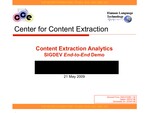
Center for Content Extraction - Content Extraction Analytics, SIGDEV End-to-End Demo [pdf]
This document is a technical showcase demonstrating the capabilities of an NSA content‑extraction program, using political leaders and diplomatic figures (such as Angela Merkel) as illustrative examples. It presents how automated language technology can extract, organize, and scale intelligence data from intercepted material.
Programs: MARINA · CYBERTRANS · PAINTBALL · SYNAPSE · NYMROD · THUNDERCLOUD · JOURNEYMAN · GOLDENRETRIEVER · SOCIOPATH · LEXHOUND · HERESYITCH · HLT · TKB · EKS -
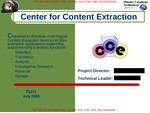
Center for Content Extraction - Nymrod Mission [pdf]
This top-secret NSA document outlines the mission and capabilities of NYMROD, a system developed by the Center for Content Extraction (CCE). It explains how NYMROD addresses analytic challenges such as linguistic variation in entity names, especially for person names, and the resolution of entity coreference problems using contextual evidence. The document discusses the multilingual content extraction services provided by NYMROD, which support various NSA enterprise applications and enhance analytic functions like selection, translation, analysis, investigative research, retrieval, and storage.
People: Ban, Ki-moon -
Dealing With a 'Tsunami' of Intercept SIDtoday [pdf]
As part of NSAs efforts to implement Human Language Technology, prototype processors located at collection sites will soon be able to query content at "line speed" based on the language, it is written in.
People: Kulman, Anita H.The Intercept ↗ (2019-05-29) · “Inside NSA, Officials Privately Criticize "Collect It All" Surveillance” - The Intercept ↗ (2015-05-28) · Maass, Peter -
Finding Nuggets -- Quickly -- in a Heap of Voice Collection, From Mexico to Afghanistan SIDtoday [pdf]
A 2011 article by an NSA Texas analyst describing the deployment of Human Language Technology analytics — including speech-to-text, speaker identification, gender recognition and language identification — to Special Collection Service sites in the Americas and to the Afghanistan Remote Operations Cryptologic Center, with operational examples ranging from tunnel detection in Tijuana to intelligence support in Kandahar.
Programs: HLT -
For Media Mining, the Future Is Now! SIDtoday [pdf]
A number of new "media mining" tools allow analysts to search intercepted content in near-real time, no matter if text, audio or visual. This includes retroactive word-search in intercepted communications.
People: Picone, Joseph -
For Media Mining, the Future Is Now! (conclusion) SIDtoday [pdf]
In the future, thanks to Human Language Technology (HLT), an analyst will be able to sort through millions on intercepted phone calls each day "and focus on only the small percentage that is relevant". He or she will also be able to get precise answers to queries such as "Where is the mayor of Baghdad?"
People: Picone, Joseph“How the NSA Converts Spoken Words Into Searchable Text” - The Intercept ↗ (2015-05-05) · The Intercept ↗ (2019-05-29) · Froomkin, Dan -
GCHQ Visit to NSA on Voice Analytics Systems [pdf]
This document is a GCHQ report detailing a late-November (2007?) visit to NSA’s R64 division focused on collaboration in language identification (LID) and speaker identification (SID) systems, including sharing models and research insights. It also describes NSA tools like Hotzone and Voice RT for real-time voice analysis, and mentions an upcoming visit from the CLEAR consortium to address challenges in speech intelligibility and audio recovery for intercepted communications.
-
'GWOT Language Forums' Strive to Overcome Shortage of Capacity in Key Languages SIDtoday [pdf]
Four years into the war on terror, the demand for language analysts continues to exceed the supply. A newly held forum yielded eight action plans aimed at improving efficiency and better using existing language analysts.
Programs: HLTThe Intercept ↗ (2018-08-15) -
Human-Language Technology -- Everywhere SIDtoday [pdf]
The best Human Language Technology (HLT) functions "behind the desktop" making sure the analyst receives relevant, filtered information. In the near future, analysts will have more and better HLT at their disposal.
People: Kulman, AnitaThe Intercept ↗ (2019-05-29) -
Human-Language Technology in Your Future SIDtoday [pdf]
A look into nine new Human Language Technologies that will likely assist NSA analysts in the near future. These include automated translation, transcription and language-based pattern recognition / identification.
Programs: HLT -
Machines Translating Arabic SIDtoday [pdf]
Seeking NSA volunteers to test Arabic machine translation software at the Center for Advanced Study of Language at the University of Maryland.
Marking: UNCLASSIFIEDThe Intercept ↗ (2016-12-07) -
Strangers in a Strange Land? SIDtoday [pdf]
Some language analysts spend several hours a week in the Human Language Technology branch, where they apply their expert knowledge of specific languages to help the HLT team create automated tools that do language analysis and speech-to-text.
People: Kulman, Anita H.The Intercept ↗ (2019-05-29) -
Tips for a Successful Quick Reaction Capability SIDtoday [pdf]
In response to Iranian President Ahmadinejad’s 2007 visit to New York, the NSA’s Iran Government and Leadership branches launched a Quick Reaction Capability (QRC) to gather time-sensitive intelligence. The QRC focused on enhanced collection techniques, collaboration across departments, and efficient data management to analyze the extensive communications traffic during the event, resulting in valuable leads on Iranian leadership activities and diplomatic plans.
People: Ahmadinejad, Mahmoud