For Media Mining, the Future Is Now!
Open PDFDocument date: 2006-08-01
Type: SIDtoday
Pages: 2
Genre: newsletter
Banner: DYNAMIC PAGE -- HIGHEST POSSIBLE CLASSIFICATION IS TOP SECRET // SI / TK // REL TO USA AUS CAN GBR NZL
Classification: UNCLASSIFIED
Dissemination: FOUO
A number of new "media mining" tools allow analysts to search intercepted content in near-real time, no matter if text, audio or visual. This includes retroactive word-search in intercepted communications.
My notes
DYNAMIC PAGE -- HIGHEST POSSIBLE CLASSIFICATION IS
TOP SECRET // SI / TK // REL TO USA AUS CAN GBR NZL
SIDtoday
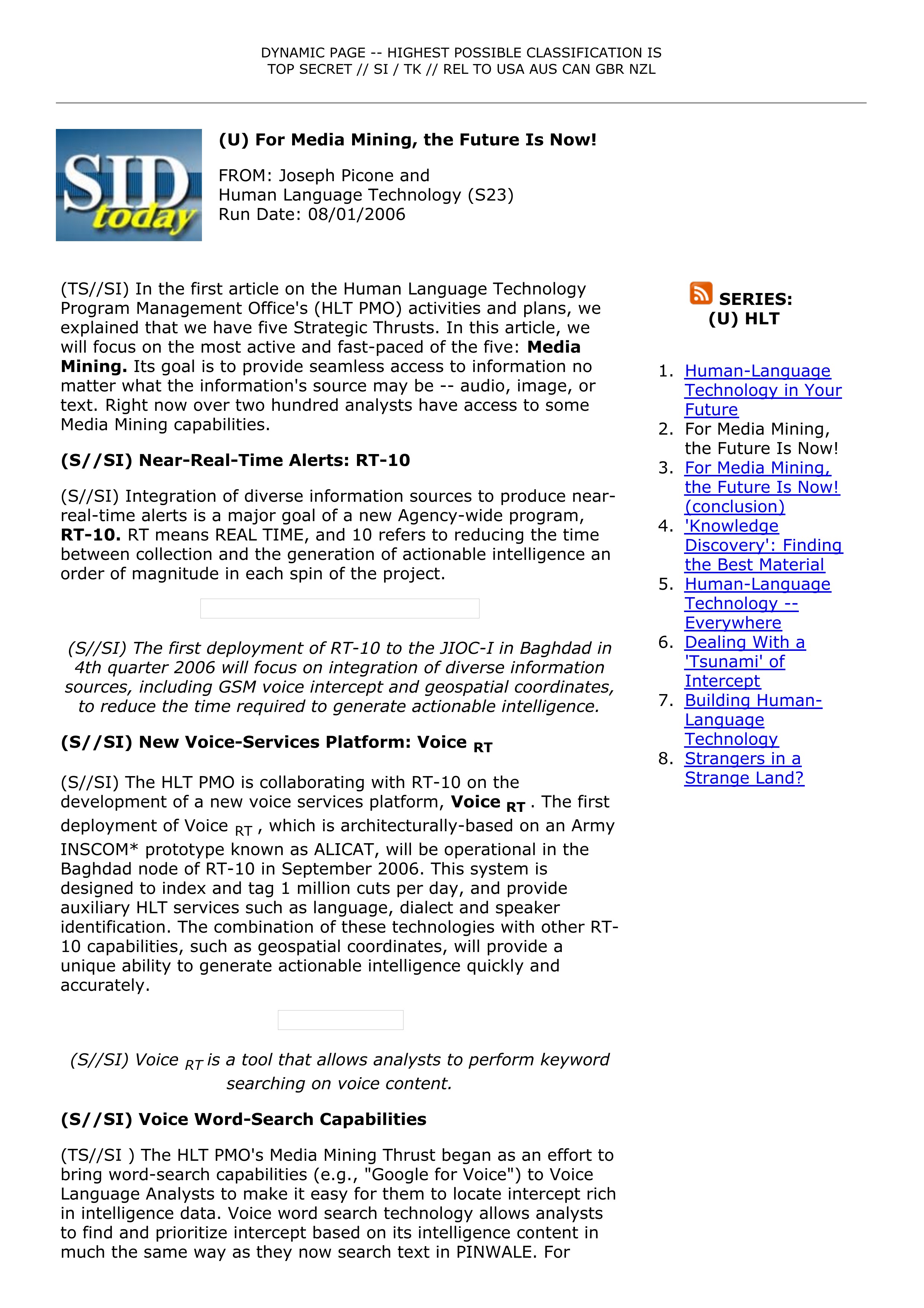
(U) For Media Mining, the Future Is Now!
FROM: Joseph Picone and
Human Language Technology (S23)
Run Date: 08/01/2006
(TS//SI) In the first article on the Human Language Technology
Program Management Office's (HLT PMO) activities and plans, we
explained that we have five Strategic Thrusts. In this article, we
will focus on the most active and fast-paced of the five: Media
Mining. Its goal is to provide seamless access to information no
matter what the information's source may be -- audio, image, or
text. Right now over two hundred analysts have access to some
Media Mining capabilities.
(S//SI) Near-Real-Time Alerts: RT-10
(S//SI) Integration of diverse information sources to produce near-
real-time alerts is a major goal of a new Agency-wide program,
RT-10. RT means REAL TIME, and 10 refers to reducing the time
between collection and the generation of actionable intelligence an
order of magnitude in each spin of the project.
(S//SI) The first deployment of RT-10 to the JIOC-I in Baghdad in
4th quarter 2006 will focus on integration of diverse information
sources, including GSM voice intercept and geospatial coordinates,
to reduce the time required to generate actionable intelligence.
(S//SI) New Voice-Services Platform: Voice RT
(S//SI) The HLT PMO is collaborating with RT-10 on the
development of a new voice services platform, Voice RT . The first
deployment of Voice RT, which is architecturally-based on an Army
INSCOM* prototype known as ALICAT, will be operational in the
Baghdad node of RT-10 in September 2006. This system is
designed to index and tag 1 million cuts per day, and provide
auxiliary HLT services such as language, dialect and speaker
identification. The combination of these technologies with other RT-
10 capabilities, such as geospatial coordinates, will provide a
unique ability to generate actionable intelligence quickly and
accurately.
(S//SI) Voice RT is a tool that allows analysts to perform keyword
searching on voice content.
(S//SI) Voice Word-Search Capabilities
(TS//SI) The HLT PMO's Media Mining Thrust began as an effort to
bring word-search capabilities (e.g., "Google for Voice") to Voice
Language Analysts to make it easy for them to locate intercept rich
in intelligence data. Voice word search technology allows analysts
to find and prioritize intercept based on its intelligence content in
much the same way as they now search text in PINWALE. For
SERIES:
(U) HLT
- Human-Language
Technology in Your
Future - For Media Mining,
the Future Is Now! - For Media Mining,
the Future Is Now!
(conclusion) - 'Knowledge
Discovery': Finding
the Best Material - Human-Language
Technology --
Everywhere - Dealing With a
'Tsunami' of
Intercept - Building Human-
Language
Technology - Strangers in a
Strange Land?
example, in the Global War on Terrorism (GWOT), analysts can
locate intercept dealing with explosive devices by searching for
common terms such as " operation " or " detonator," as well as
more subtle terms about materials (" hydrogen peroxide "), place
names (" Baghdad "), or people (" Musharaf ").
(S//SI) The first generation of this technology has been centered
around Commercial-off-the-Shelf (COTS) software, NEXminer,
developed by a startup company, Nexidia. The system is designed
to support both real-time searches, in which incoming data is
automatically searched by a designated set of dictionaries, and
retrospective searches, in which analysts can repeatedly search
over months of past traffic. The former capability allows the tool to
function as a near real-time tipper. The latter capability allows
analysts to rediscover important intelligence information and to
refine their search strategies. This can be especially important in
cases where pieces of a SIGINT "puzzle" become apparent and an
analyst needs to go back to previous messages to see if other
unnoticed pieces can be found.
(S//SI) This tool is very effective because it integrates high-
performance speech processing technology with a most important
agency resource, analyst knowledge of targets and missions. This
technology was initially introduced to the analyst community in
2004 as a prototype, RHINEHART, which had been developed by
SIGDEV Strategy and Governance (SSG).
(S//SI) RHINEHART now operates across a wide variety of missions
and languages, and is used throughout the NSA/CSS Enterprise.
One recent example of RHINEHART success occurred when Persian
GWOT analysts searched for the words "negotiations" or "America"
in their traffic, and RHINEHART located a very important call that
was transcribed verbatim providing information on an important
Iranian target's discussion of the formation of the new Iraqi
government.
*Notes: (U) INSCOM = US Army Intelligence and Security
Command
(U) Watch for the conclusion of this look at media mining, coming
soon...
"(U//FOUO) SIDtoday articles may not be republished or reposted outside NSANet
without the consent of S0121 (DL sid_comms)."
DYNAMIC PAGE -- HIGHEST POSSIBLE CLASSIFICATION IS
TOP SECRET // SI / TK // REL TO USA AUS CAN GBR NZL
DERIVED FROM: NSA/CSSM 1-52, DATED 08 JAN 2007 DECLASSIFY ON: 20320108
Published in the Same Report
(10 of 29 documents)
-
For Media Mining, the Future Is Now! (conclusion) SIDtoday [pdf]
In the future, thanks to Human Language Technology (HLT), an analyst will be able to sort through millions on intercepted phone calls each day "and focus on only the small percentage that is relevant". He or she will also be able to get precise answers to queries such as "Where is the mayor of Baghdad?"
People: Picone, Joseph“How the NSA Converts Spoken Words Into Searchable Text” - The Intercept ↗ (2015-05-05) · The Intercept ↗ (2019-05-29) · Froomkin, Dan -
“Black Budget” — FY 2013 Congressional Budget Justification/National Intelligence Program, p. 262 (February 2012) [pdf]
This excerpt from the Fiscal Year 2013 Congressional Budget Justification (the "Black Budget") details the NSA's financial and performance metrics for "Analytics Modernization," specifically focusing on the transition to high-volume, automated speech-to-text systems. It records the decommissioning of legacy voice processing systems (VoiceRT) in favor of more robust, scalable capabilities aimed at rendering millions of intercepted voice files searchable via text queries and paired dialogue transcription.
Programs: VoiceRT -
“Black Budget” — FY 2013 Congressional Budget Justification/National Intelligence Program, pp. 360-364 (February 2012) [pdf]
The "Human Language Technology (HLT) Research" section of the FY 2013 "Black Budget" details a specialized research project focused on creating "force multipliers" for the NSA workforce through automated speech-to-text, machine translation, and content extraction. With a requested budget of $29.4 million, the project aims to bridge the gap between foundational academic research (via Johns Hopkins University) and the practical exploitation of the volume and velocity of global SIGINT.
Programs: HLT -
Classification Guide for Human Language Technology (HLT) Models (May 18, 2011) [pdf]
This document is an NSA administrative policy document that establishes the rules for what information regarding speech analytics remains public versus what must be kept secret. It explicitly confirms that the NSA possesses automated tools for gender, language, dialect, and speaker recognition, as well as speech-to-text and phonetic tokenization. While the existence of these capabilities is unclassified, the specific data used to "train" the models and the actual identity of targeted speakers are protected at the SECRET level.
Programs: HLT -
RT10 Overview [pdf]
This RT10 overview document is a high-level briefing on the implementation of a real-time SIGINT architecture designed to modernize intelligence operations in the Iraq theater, specifically Baghdad. The project aims to replace legacy, "manual-intensive" processes with a "SIGINT Brain"—a distributed database and automated analytic framework capable of processing over 50 million GSM metadata events per day.
Programs: RT10 · OBELISK · WISPYKNIT · VICTORYUNIFORM · JUGGERNAUT · COBRAFOCUS · MATTERHORN · EXPIATION · VoiceRT · GREENDRAGON · TAREX · KEYCARD -
Finding Nuggets -- Quickly -- in a Heap of Voice Collection, From Mexico to Afghanistan SIDtoday [pdf]
A 2011 article by an NSA Texas analyst describing the deployment of Human Language Technology analytics — including speech-to-text, speaker identification, gender recognition and language identification — to Special Collection Service sites in the Americas and to the Afghanistan Remote Operations Cryptologic Center, with operational examples ranging from tunnel detection in Tijuana to intelligence support in Kandahar.
Programs: HLT -
How Is Human Language Technology (HLT) Progressing? SIDtoday [pdf]
This document provides an operational update on the deployment of "HLT Labs"—a specialized suite of voice analytics designed to automate the discovery of intelligence "nuggets" within massive volumes of audio collection. The document highlights successful field applications in Afghanistan, Georgia, Texas, and Latin America, noting that these tools are becoming "force multipliers" that allow linguists to bypass manual listening in favor of automated keyword searching and speaker recognition.
-
Coming Soon! A Tool that Enables Non-Linguists to Analyze Foreign-TV News Programs SIDtoday [pdf]
This document introduces eViTAP (Enhanced Video Text and Audio Processing), a fully automated system designed to monitor and translate international television broadcasts. Primarily aimed at analysts who do not possess specific foreign language skills, the tool leverages automated processing to transform open-source media into actionable intelligence.
-
SIRDCC Speech Technology WG assessment of current STT technology [pdf]
This secret document from the SIRDCC Speech Technology Working Group provides a technical assessment of Speech-to-Text (STT) capabilities for the Security Service (MI5) and GCHQ. The report acknowledges that while automated transcription of intercepted speech remains highly challenging, the technology offers immediate "force multiplier" benefits for specific tasks like identifying spoken telephone numbers or keywords. The Working Group recommends continued investment in bespoke training and a transition toward a common system—specifically the BBN Byblos engine—to facilitate the sharing of classified linguistic models between UK and US agencies.
Programs: BYBLOS -
RT10 Initiative Overview [pdf]
Overview document for RT10, "Real-time, distributed architecture for mobile (tactical) and fixed (national) operational environments"
Programs: RT10 · COBRA FOCUS · GREENDRAGON · GOLDMINER · JUGGERNAUT · MATTERHORN · OBELISK · SORTINGHAT · INFOVIS · SHARPFOCUS2 · TOGA · SORTINGLEAD · GLOBALREACH · VOICERT · QUADRASPECTRE · RENOIR · ANALYSTSNOTEBOOK · OCTAVE · HLT · DRT · GEOT · InnoVisions

See all 10 documents published with “How the NSA Converts Spoken Words Into Searchable Text” →
Related Documents
-
For Media Mining, the Future Is Now! (conclusion) SIDtoday [pdf]
In the future, thanks to Human Language Technology (HLT), an analyst will be able to sort through millions on intercepted phone calls each day "and focus on only the small percentage that is relevant". He or she will also be able to get precise answers to queries such as "Where is the mayor of Baghdad?"
People: Picone, Joseph“How the NSA Converts Spoken Words Into Searchable Text” - The Intercept ↗ (2015-05-05) · The Intercept ↗ (2019-05-29) · Froomkin, Dan -
GCHQ Visit to NSA on Voice Analytics Systems [pdf]
This document is a GCHQ report detailing a late-November (2007?) visit to NSA’s R64 division focused on collaboration in language identification (LID) and speaker identification (SID) systems, including sharing models and research insights. It also describes NSA tools like Hotzone and Voice RT for real-time voice analysis, and mentions an upcoming visit from the CLEAR consortium to address challenges in speech intelligibility and audio recovery for intercepted communications.
-
Human-Language Technology in Your Future SIDtoday [pdf]
A look into nine new Human Language Technologies that will likely assist NSA analysts in the near future. These include automated translation, transcription and language-based pattern recognition / identification.
Programs: HLT -
How Is Human Language Technology (HLT) Progressing? SIDtoday [pdf]
This document provides an operational update on the deployment of "HLT Labs"—a specialized suite of voice analytics designed to automate the discovery of intelligence "nuggets" within massive volumes of audio collection. The document highlights successful field applications in Afghanistan, Georgia, Texas, and Latin America, noting that these tools are becoming "force multipliers" that allow linguists to bypass manual listening in favor of automated keyword searching and speaker recognition.
-
Human-Language Technology -- Everywhere SIDtoday [pdf]
The best Human Language Technology (HLT) functions "behind the desktop" making sure the analyst receives relevant, filtered information. In the near future, analysts will have more and better HLT at their disposal.
People: Kulman, AnitaThe Intercept ↗ (2019-05-29)