Publisher: The Intercept 489 documents
Search documents matching “The Intercept” →Who published each document. Mostly a news outlet, but sometimes a book. A partner outlet that reported the story without publishing the documents keeps its byline and its article, but is not a publisher here.
Graphs
By document date (14 years)
By Banner
By Classification
Refine (combine with another filter, via search)
Sort: Title
Documents
-
The SIGINT Philosopher Is Back -- with a New Face! SIDtoday [pdf]
The inaugural column of the second SIGINT Philosopher series, in which the new columnist uses a personal polygraph experience and the ethical tension of spying on diplomatic targets to argue — somewhat counterintuitively — that thorough, comprehensive surveillance is more ethical than partial or halfhearted monitoring of non-adversarial targets.
Programs: SCQAWK -
The SIGINT Philosopher: Cognitive Overflow? SIDtoday [pdf]
A 2011 NSA SIDtoday opinion column reflecting on whether the SIGINT Directorate's collective analytical capacity has a finite "channel capacity" — borrowing from cognitive psychology to ask whether SID's ever-expanding mission, tools, and information load risks exceeding the combined cognitive limits of its workforce.
Marking: UNCLASSIFIED -
The SIGINT Philosopher: Descartes Would Have Been a Lousy SIGINT Reporter SIDtoday [pdf]
A 2012 SIDtoday SIGINT Philosopher column using Cartesian epistemology to examine the fundamental reliability problem in SIGINT reporting — arguing that by the time raw intercepts pass through collection, translation, interpretation, and reporting, the finished intelligence product is several steps removed from ground truth and risks becoming little more than an analyst's painting of a scene described to them secondhand.
Programs: SCQAWK -
The SIGINT Philosopher: In Praise of Not Knowing SIDtoday [pdf]
A 2012 NSA SIDtoday opinion column in the "SIGINT Philosopher" series arguing that the Intelligence Community — and NSA in particular — too rarely admits the limits of its knowledge, using the misappropriation of the word "agnostic" as a springboard to critique the institutional pressure to produce intelligence reports even when genuine understanding of a target is absent.
People: Kim, Jong-un -
The SIGINT Philosopher: Lessons for Civil Servants from the American Civil War (That Don't Concern Killing Vampires) SIDtoday [pdf]
The final 2012 SIDtoday SIGINT Philosopher column using the American Civil War as a lens to examine how intelligence professionals should reconcile expert disagreement with national policy, arguing that good civil servants can find peace in the possibility that they might simply be wrong — and that committed execution of even imperfect policy can sometimes produce better outcomes than principled dissent.
Programs: SCQAWK -
The SIGINT Philosopher: The Fallacies Behind the Scenes SIDtoday [pdf]
A 2011 NSA SIDtoday opinion column in the "SIGINT Philosopher" series examining four cognitive fallacies — the Texas Sharpshooter, Gambler's, Sunk-Cost, and Appeal to Probability fallacies — and their implications for how analysts unconsciously distort intelligence assessments and decision-making.
-
The SIGINT Philosopher: Too Many Choices SIDtoday [pdf]
The inaugural 2011 NSA SIDtoday "SIGINT Philosopher" column by a Russian language analyst, using the everyday paralysis of grocery shopping to introduce the concept of "analysis paralysis" and argue that the SIGINT enterprise's greatest challenge is not a lack of access or information but the cognitive difficulty of prioritizing among an overwhelming abundance of choices.
People: Simon, Herbert -
The SIGINT Philosopher: Unlike All My Terrible Teammates, I Am a SIDtoday [pdf]
A 2012 SIDtoday SIGINT Philosopher column using the annual ACE performance review process as a springboard to examine the structural tension between individual competition and collaborative teamwork at NSA, arguing that the agency's promotion and awards system inadvertently incentivizes analysts to hoard work rather than mentor colleagues or enable others.
Programs: SCQAWK -
The SIGINT Philosopher: When Brevity Is Just the Soul of "Huh?" SIDtoday [pdf]
A 2012 SIDtoday SIGINT Philosopher column arguing that the NSA culture of brevity in writing — while generally valuable — can be taken too far, with excessively terse communications creating confusion, follow-up cycles, and ultimately more lost time than a slightly more complete message would have cost in the first place.
Marking: UNCLASSIFIEDPrograms: SCQAWK -
The Tale of Two Sources [pdf]
Programs: SUPERDRAKE · CROUCHINGSQUIRREL · HALTERHITCH · MVR · PPF · GORDIANKNOT · XKEYSCORE · SAMUELPEPYS · ALPINEBUTTERFLY · TRYST · FRACTALJOKER · TM · SPAY · BLACKHOLE · RAPIDTAPIR · HIDDENOTTER · SALTYOTTER · 8BALL · SORCERER · PACMAN · SNORT · WAFTER · CRIMSON · SHORTFALL · GCNET · BROADOAK · RAPTOR · GEOFUSION · MUGSHOT · HACIENDA · FOXTRAIL · FANNER · GLOBALSURGE · PENSIVEGIRAFFE · HRMAP · MUTANTBROTH · SAMPEPYS · INTEGERSPIN · MWX · MARBLEPOLLS · MOONRAKER · RT · DISTILLERY · SQUEAL · DEADSEA · GTE · WDM · TKB · TRAFFIC MASTER · CHOKEPOINT · CONTENT CLOUD · MAPREDUCE · EVENTS · CLOUD · AGILITY · PALANTIR -
The Unofficial XKEYSCORE User Guide [pdf]
A TOP SECRET XKeyscore user guide written by a Booz Allen Hamilton consultant, providing step-by-step instructions for 32 classic search types — including email address queries, password extraction from mail server IPs, phone number extraction, HTTP activity analysis, document metadata fingerprinting and workflow automation — with worked examples targeting counterterrorism subjects in Afghanistan, Pakistan, Iran and Sweden, viewed through an Agility instance bearing the ECI RAGTIME classification banner confirming the tool was accredited for FISA-authorised collection.
Programs: XKEYSCORE · PINWALE · RAGTIME · AGILITY · METAFRAME · TIMBERLINE · YAKIMA · REDMINE · TUNINGFORK · FOGGYBOTTOM · FOXTRAIL · CADENCE · UTT · NKB · AIRGAP · DOPHONEPeople: bin Laden, Osama“XKEYSCORE: NSA’s Google for the World’s Private Communications” - The Intercept ↗ (2015-07-01) · “No Place to Hide” - Metropolitan Books ↗ (2014-05-13) · “FRA has access to controversial surveillance system” - SVT Nyheter ↗ (2013-12-11) · Marquis-Boire, Morgan · Greenwald, Glenn · Lee, Micah · Bergman, Sven · Dyfvermark, Joachim · Gallagher, Ryan · Laurin, Fredrik · Struwe, Filip -
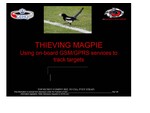
THIEVING MAGPIE: Using on-board GSM/GPRS services to track targets [pdf]
A GCHQ capability-development presentation on THIEVING MAGPIE, which uses the on-board GSM/GPRS services airlines offer to track targets in flight: comms backhauled over Inmarsat BGAN and collected via SOUTHWINDS, registration events tied to a flight number or callsign in near real time, events for BlackBerry handsets with their PINs and associated e-mail addresses, and content tasked into datastores with unselected traffic to XKEYSCORE.
“US and Britain refine their ability to tap into airline passenger’s mobile phones while they are in the air” - Le Monde ↗ (2016-12-07) · “American and British Spy Agencies Targeted In-Flight Mobile Phone Use” - The Intercept ↗ (2016-12-07) · “No Place to Hide” - Metropolitan Books ↗ (2014-05-13) · Follorou, Jacques · Greenwald, Glenn -
Third Party Relationships SIDtoday [pdf]
A 2009 NSA SIDtoday interview with a Foreign Affairs Directorate official explaining the strategic rationale behind NSA's third-party intelligence partnerships — revealing that these relationships are deliberately insulated from democratic oversight because most elected officials in partner countries are kept entirely unaware of their governments' SIGINT cooperation with the NSA.
-
TINT External July 2009 [pdf]
A GCHQ TINT external document from July 2009 describing the BLACKHOLE bulk metadata repository — designed to export unselected metadata in SLR format to enable higher-order analytics — noting anticipated very high volumes expected to exceed MAILORDER transport capacity and proposing a direct connection instead.
-
Tips for a Successful Quick Reaction Capability SIDtoday [pdf]
In response to Iranian President Ahmadinejad’s 2007 visit to New York, the NSA’s Iran Government and Leadership branches launched a Quick Reaction Capability (QRC) to gather time-sensitive intelligence. The QRC focused on enhanced collection techniques, collaboration across departments, and efficient data management to analyze the extensive communications traffic during the event, resulting in valuable leads on Iranian leadership activities and diplomatic plans.
People: Ahmadinejad, Mahmoud -
Tony Fullman NSA file [pdf]
This document, a series of TOP SECRET intelligence reports from 2012, details the extensive surveillance of Anthony Fullman, a Fiji-born New Zealand citizen and pro-democracy activist. This document shows how the NSA and the New Zealand Government Communications Security Bureau (GCSB) utilized the PRISM program (SIGAD: US-984XN) to intercept Fullman’s private communications under a FISA Amendments Act (FAA) certification. The gathered intelligence includes personal photographs with embedded metadata, detailed credit card transaction records, private emails regarding job opportunities, and Westpac bank statements. This document serves as a case study in how "Five Eyes" partners share intelligence derived from FAA collection to monitor individuals for political or security reasons.
Programs: PRISMPeople: Fullman, Anthony -
TPM Vulnerabilities to Power Analysis and An Exposed Exploit to Bitlocker [pdf]
A secret abstract from the Trusted Computing Base Jamboree describing research by Sandia National Laboratories into power analysis attacks against Trusted Platform Modules from five manufacturers — extracting RSA private keys non-invasively via wired power analysis and electromagnetic emissions, including a novel unpublished single-trace attack against a Chinese Remainder Theorem RSA implementation — and a case study demonstrating how the extracted TPM key enables circumvention of Microsoft BitLocker's root-of-trust system by modifying BIOS digest values without software-level detection.
“The CIA Campaign to Steal Apple's Secrets” - The Intercept ↗ (2015-03-10) · Scahill, Jeremy · Begley, Josh -
Tracking Targets on Online Social Networks [pdf]
A TOP SECRET NSA presentation from September 2009 describing XKeyscore techniques for tracking targets across online social networks — covering OSN selector types, six categories of target OSN activity ranked by intelligence value, username and HTTP activity query methods, and specific XKeyscore AppIDs for Facebook and Twitter — noting that counterterrorism targets had been observed using over 50 social networks as of late 2008.
Programs: XKEYSCORE“XKEYSCORE: NSA’s Google for the World’s Private Communications” - The Intercept ↗ (2015-07-01) · “No Place to Hide” - Metropolitan Books ↗ (2014-05-13) · Marquis-Boire, Morgan · Greenwald, Glenn · Lee, Micah -
Tracking Targets Through Proxies & Anonymizers [pdf]
This NSA presentation details methods for tracking and de-anonymizing internet users who employ privacy tools like Tor, proxies, and VPN services such as AnchorFree's Hotspot Shield. The document explains how the agency reverse-engineers anonymization tools, creates "fingerprints" to identify their traffic in surveillance systems, and correlates encrypted connections to reveal users' real IP addresses and locations—acknowledging this work "makes for sad analysts" when targets successfully obscure their identities.
-
Traffic Series: Is Your Collection Surveyed or Sustained? SIDtoday [pdf]
This NSA internal newsletter article explains how analysts can determine whether their collected signals intelligence traffic comes from sustained, ongoing collection (tasked through formal requirements) or temporary "survey" activities where satellite collection sites scan for new targets. The article teaches analysts how to read "case notations" (CASNs) to identify whether traffic spikes are from permanent collection or just temporary surveys—warning that valuable intelligence can suddenly disappear when survey activities end unless analysts formally request sustained collection through the SURREY system.