Country: North Korea 95 documents
Search documents matching “North Korea” →Countries mentioned in each document. A country may be mentioned directly (e.g., France) or inferred from a related reference, such as a city (Paris -> France) or a domain name (.fr -> France).
Graphs
By document date (11 years)
By Banner
By Classification
Refine (combine with another filter, via search)
Sort: Title
Documents
-
Friedman Presentation: The US in Asia: The White House Roadmap SIDtoday [pdf]
The National Security Council senior director for Asia, a special assistant to the president, will speak about the administration's perspective on Asia.
The Intercept ↗ (2017-09-13) -
FY 2013 Congressional Budget Justification, Volume I, National Intelligence Program Summary, February 2012 [pdf]
This document outlines the $52.6 billion “black budget,” detailing the structure, priorities, successes, and shortcomings of the 16 U.S. intelligence agencies. It reveals unprecedented insight into funding allocations, operations, and intelligence gaps—including the CIA’s dominant role, expanding cyber operations, and persistent challenges in areas such as North Korea and counterterrorism—while emphasizing the tension between secrecy and public accountability.
-
-
GCHQ Intelligence Production Head Outlines Present and Future Priorities SIDtoday [pdf]
According to a talk recently given at NSA's UK base in Menwith Hill, counterterrorism absorbs most (30%) of GCHQ's resources. Afghanistan and China are given increasing attention, while Russia gets less. Long term, GCHQ foresees challenges in keeping up with the internet and "huge amounts of data", while peace is expected in Iraq.
People: Ashton, JonThe Intercept ↗ (2019-05-29) -
Guidelines for the classification of NSA SIGINT details (1945-1967) [pdf]
This document is an NSA classification guide that defines how and why historical SIGINT material from 1945–1967 remains classified, in many cases for 75 years. It systematically explains which intelligence activities, targets, partnerships, and technical methods must stay protected because they still reveal sensitive sources, methods, and diplomatic equities.
-
IAI Essay Contest Winners SIDtoday [pdf]
Winners of the annual essay contest of the International Affairs Institute, one of NSA's learned organizations, are announced.
The Intercept ↗ (2017-04-24) -
IAI Presentation: Ambassador Wendy Sherman, Albright Group, 27 April SIDtoday [pdf]
Ambassador Wendy Sherman will speak to staff on North Korea and non-proliferation. The discussion will be unclassified as the speaker is not cleared.
The Intercept ↗ (2016-12-07) -
InSIDer's View of History: Resourceful NCOs at Goodfellow SIDtoday [pdf]
A funny anecdote about over-preparing for a general's visit.
The Intercept ↗ (2016-12-07) -
Intellipedia -- It's for Analysts SIDtoday [pdf]
Only 20 NSA staff members have registered for Intellipedia, the intelligence community's wiki, compared to 200 CIA staffers. Intellipedia represents one of the new resources available through Intelink, which also allows IC employees to create blogs and to instant message with each other.
The Intercept ↗ (2019-05-29) -
International Incident Avoided, Thanks to Intelligence SIDtoday [pdf]
Israel was concerned that a North Korean ship was carrying missile-related cargo for Syria or Iran. The U.S. arranged for Egyptians to inspect the cargo and convinced Israel that the ship wasn’t worth boarding, averting a “politically sensitive incident.”
The Intercept ↗ (2018-08-15) -
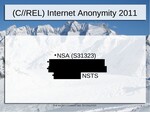
Internet Anonymity 2011 [pdf]
A TOP SECRET NSA presentation from 2011 providing a comprehensive survey of Internet Anonymity Technologies (IAT) — covering HTTP proxies, VPN anonymity providers, multi-hop networks including Tor and JAP, anonymous remailers and circumvention tools — alongside NSA's capabilities and limitations against each, including XKEYSCORE fingerprints for VPN identification, the PARTNERSNIPPET Tor deanonymisation team, GOLDENFORTIN Netflow data, and a candid assessment that Tor offers "no passive exploitation."
Programs: FOXTRAIL · NKB · NACIRONIN · PONTENTPOTABLES · RONIN · XKEYSCORE · PARTNERSNIPPET · GOLDENFORTIN · SNAPEPeople: Heap, Austin -
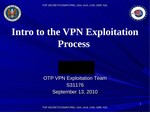
Intro to the VPN Exploitation Process [pdf]
NSA introduction to the VPN exploitation process from September 2010, presented by the OTP VPN Exploitation Team, covering the full workflow from initial collection through to sustained decryption of IPSec, PPTP, SSL and SSH traffic, with named exploitation successes including airlines, diplomatic missions, banks and intelligence services across Iran, Jordan, Russia, Turkey, Pakistan, Afghanistan, Somalia, Indonesia and Mexico.
Programs: BLEAKINQUIRY · TOYGRIPPE · XKEYSCORE · MAILORDER · CORALREEF · VULCANDEATHGRIP · SCISSORS · TURTLEPOWER · PINWALE · FOURSCORE · CADENCE · UTT · VULCANMINDMELD · CAPRIOS · AGILITY · NKB · FOLLOWTHEMONEY -
Introducing Carl Johnson as Assistant Deputy Director for Customer Relationships SIDtoday [pdf]
The assistant deputy director for customer relationships describes his first month on the job.
The Intercept ↗ (2016-05-16) -
Introduction to the Korean Issue Management Team SIDtoday [pdf]
The Korean Issue Management Team identifies North Korean SIGINT gaps, prioritizes them, and challenges the enterprise to respond with solutions.
People: Fleisch, FranThe Intercept ↗ (2016-05-16) -
Iran Day - Aiming for High-Hanging Iranian 'Fruit' SIDtoday [pdf]
A one-day conference on Iran, identified as one of the NSA’s four missions “warranting a specific Mission Manager,” touched on Iran’s view of itself as the leader of Shia Islam, its nuclear proliferation, and its support to terrorism.
The Intercept ↗ (2018-08-15) -
Is NSA Correctly Postured Against the Most Critical Missions? SIDtoday [pdf]
Signals Intelligence Directorate leadership decides where to expend the most resources based on the SIGINT Mission List. The list includes 15 critical functional missions -- each of which has an area of focus and an area in which SID decides not to devote as much attention, thus accepting some amount of risk. China, North Korea, Iraq, Iran, and Russia are "regarded as 'trump cards'" and can take priority over any one of these missions.
People: Quirk, RichardThe Intercept ↗ (2017-09-13) -
Is there "fifth party" collection? [pdf]
This NSA internal Q&A forum discussion reveals "fifth party collection"—where the NSA passively intercepts data from one intelligence service (South Korea) that has compromised another service's (North Korea) computer network exploitation operations, creating a three-layer chain where NSA exploits Actor One's access to Actor Two's CNE activities against shared targets. The thread provides concrete examples including NSA leveraging South Korean implants on North Korean officials' computers (who themselves were conducting CNE operations) and stealing zero-day exploits from unidentified foreign intelligence services by passively monitoring their successful attacks.
-
Israel targets the U.S. government for invasive electronic surveillance [pdf]
Israel targets the U.S. government for invasive electronic surveillance, and does so more aggressively and threateningly than almost any other country in the world. Indeed, so concerted and aggressive are Israeli efforts against the U.S. that some key U.S. government documents — including the top secret 2013 intelligence budget — list Israel among the U.S.’s most threatening cyber-adversaries and as a “hostile” foreign intelligence service.
-
Israel's Post-Sharon Policy Prospects: Part 2 -- Iran SIDtoday [pdf]
Given the developments in Iran’s nuclear program in spring 2004, “rumors abound in international political circles” that Israel will attempt to destroy Iranian nuclear facilities unilaterally, as it did with an Iraqi reactor in 1981. A SIGINT national intelligence officer deems this possibility unlikely, because of the risks from Iran’s strengthened defense capabilities and the political implications of such an action.
The Intercept ↗ (2018-08-15) -
Israel-US 1999 Agreement [pdf]
This July 1999 top secret agreement between the U.S. Defense Intelligence Agency and Israel's Directorate of Military Intelligence establishes comprehensive intelligence-sharing arrangements covering Middle Eastern threats, terrorism, weapons of mass destruction, and foreign materiel exploitation, superseding previous agreements dating back to 1968 and including specific provisions for conferences, written requests, face-to-face analyst meetings, and security protocols.