Country: Japan 57 documents
Search documents matching “Japan” →Countries mentioned in each document. A country may be mentioned directly (e.g., France) or inferred from a related reference, such as a city (Paris -> France) or a domain name (.fr -> France).
Graphs
By Banner
By Classification
Refine (combine with another filter, via search)
Sort: Title
Documents
-
Cyber Paper Japan NSA DFS [pdf]
This January 2013 NSA memo from SUSLAJ (Special U.S. Liaison Activity Japan) details Japan’s effort to rapidly launch a SIGINT-enabled cyber defense initiative and a new 100-person “Cybercom” by April 2013. It describes tensions between reformist elements like CIRO (Cabinet Intelligence and Research Office) and more conservative ones like the DFS (Directorate for SIGINT) and MOD Internal Bureau, with struggles in policy, information sharing, and workforce training. The memo shows Japan seeking NSA’s technical help — including at the MALLARD FORNSAT site — while rushing to deliver malware signatures and sign new information-sharing agreements. The NSA viewed Japan as responsive but too focused on short-term results rather than long-term cyber workforce development.
Programs: MALLARD“The Untold Story of Japan's Secret Spy Agency” - The Intercept ↗ (2018-05-19) · “日本の諜報 スクープ 最高機密ファイル” - NHK ↗ (2018-05-19) · Gallagher, Ryan -
Japan official NSA visit, cyber briefing [pdf]
This document outlines cooperation between the NSA and Japan’s Directorate for SIGINT (DFS) to develop Japan’s capabilities for providing signals intelligence (SIGINT) support to cyber defense operations, particularly against Chinese cyber activities. It details meetings, training, and data-sharing efforts from 2012–2013 aimed at enhancing Japan’s cyber intelligence capacity under U.S. guidance.
“Japan Made Secret Deals With the NSA That Expanded Global Surveillance” - The Intercept ↗ (2017-04-24) · “アメリカに監視される日本 ~スノーデン“未公開ファイル”の衝撃” - NHK ↗ (2017-04-24) · Gallagher, Ryan · Ikegami, Akira -
Japan official NSA visit, HF briefing [pdf]
The document describes ongoing NSA efforts to renew high-frequency direction-finding (HFDF) collaboration with Japan’s Directorate for SIGINT (DFS) after Japan withdrew from the CROSSHAIR network in 2009. By 2012–2013, both sides were manually exchanging HFDF data, and the NSA sought to advance toward automated data sharing via its BORESIGHT system while reassuring Japan that it would not replace or override its existing technology.
“Japan Made Secret Deals With the NSA That Expanded Global Surveillance” - The Intercept ↗ (2017-04-24) · “アメリカに監視される日本 ~スノーデン“未公開ファイル”の衝撃” - NHK ↗ (2017-04-24) · Gallagher, Ryan · Ikegami, Akira -
Japan provided with XKEYSCORE [pdf]
This document outlines a request for approval to provide training to the Japanese Directorate for SIGINT (DFS) on using advanced SIGINT systems, including XKEYSCORE, to enhance Japan's cyber network defense capabilities. This training, scheduled for April 2013, aligns with U.S. strategic goals to bolster the cyber defense abilities of allied nations, highlighting ongoing NSA collaboration with Japan on surveillance and cybersecurity.
“Japan Made Secret Deals With the NSA That Expanded Global Surveillance” - The Intercept ↗ (2017-04-24) · “アメリカに監視される日本 ~スノーデン“未公開ファイル”の衝撃” - NHK ↗ (2017-04-24) · Gallagher, Ryan · Ikegami, Akira -
Japan: Eternal Land of the Rising Sun SIDtoday [pdf]
This document contains the NSA's SIGINT Deputy Director's reflections on his experiences in Japan, both during and after the devastating 2011 earthquake and tsunami. It highlights the resilience of the Japanese people, the swift recovery of U.S. personnel stationed in Japan, and their contributions to humanitarian efforts. The author also emphasizes the importance of SIGINT operations in the region and encourages others to consider field assignments in Japan, praising the country’s cultural richness and the strong sense of community among U.S. personnel stationed there.
Programs: SCQAWK -
NSA SIGINT Site Relocated in Japan: The Story Behind the Move SIDtoday [pdf]
This NSA SIDtoday newsletter article describes Project CAMELUS, a decade-long effort to relocate the agency's HANZA HF signals intelligence collection facility on Okinawa to a new site at Camp Hansen, with the Japanese government paying over $500 million for construction and new collection systems under political pressure to return occupied land. The article reveals tense negotiations where NSA leveraged Japanese funding to maintain surveillance capabilities while the Japanese government—notably not NSA's intelligence partners—pursued purely political objectives of land return, with disagreements escalating to cabinet-level discussions between the U.S. Secretary of Defense and Japanese Defense Minister.
People: Rumsfeld, Donald“Japan Made Secret Deals With the NSA That Expanded Global Surveillance” - The Intercept ↗ (2017-04-24) · “アメリカに監視される日本 ~スノーデン“未公開ファイル”の衝撃” - NHK ↗ (2017-04-24) · Gallagher, Ryan · Ikegami, Akira -
US, Japan Now Exchanging Collection from Reconnaissance Missions SIDtoday [pdf]
This SIDtoday document describes a successful effort by NSA and Japan to exchange SIGINT from airborne reconnaissance missions, enhancing bilateral intelligence cooperation in East Asia. The exchange, which covers a range of SIGINT types beyond just ELINT, allows both countries to share reconnaissance mission summaries, including intelligence on Chinese, North Korean, and Russian military activities, with extensive sanitization and coordination efforts involved to ensure security and compliance with agreed parameters.
“Japan Made Secret Deals With the NSA That Expanded Global Surveillance” - The Intercept ↗ (2017-04-24) · “アメリカに監視される日本 ~スノーデン“未公開ファイル”の衝撃” - NHK ↗ (2017-04-24) · Gallagher, Ryan · Ikegami, Akira -
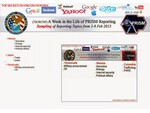
A Week in the Life of PRISM Reporting [pdf]
A slide from the "PRISM/US-984XN Overview" deck, showing different reporting topics from one week in the early February 2013.
“EUA espionaram milhões de e-mails e ligações de brasileiros” - O Globo ↗ (2013-07-12) · “NSA targets Indian politics, space & n-programmes” - The Hindu ↗ (2013-09-24) · Greenwald, Glenn · Kaz, Roberto · Casado, José · Saxena, Shobhan -
APPARITION Becomes a Reality: New Corporate VSAT-Geolocation Capability Sees Its First Deployment SIDtoday [pdf]
This document provides an update to the APPARITION system, which is designed to provide precision geolocation information for VSAT terminals. APPARITION, as contrasted with GHOSTHUNTER, is designed to proactively target and geolocate VSATs and for that information to be populated in MASTERSHAKE. The result is that any location will be able to combine VSAT information with FORNSAT information to geolocate targets.
-
Approved SIGINT Partners [pdf]
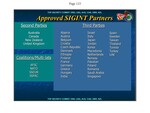
A Foreign Affairs Directorate slide listing NSA's approved SIGINT partners: the four Second Parties, 33 Third Parties from Algeria to the United Arab Emirates, and the coalitions AFSC, NATO, SSEUR and SSPAC. This is document is from Fiscal Year 2013 "Foreign Partner Review."
-
Assessment of Intelligence Opportunity - Juniper [pdf]
This document reveals that GCHQ, with NSA cooperation, developed capabilities to exploit vulnerabilities in 13 Juniper NetScreen firewall models and was expanding efforts to target Juniper’s broader JUNOS-based products for intelligence collection. It highlights the agencies’ strategic focus on maintaining access to critical network infrastructure globally, leveraging Juniper’s widespread use in high-priority countries.
Programs: HEADRESSNU -
Bad guys are everywhere, good guys are somewhere! [pdf]
A classified NSA NTOC presentation describing TREASURE MAP — the agency's near real-time global internet mapping platform — which combines open source, commercial, covert, and SIGINT data to chart every device, router, and autonomous system on the internet, including through 13 covert servers secretly planted in unwitting data centers across 18 countries spanning Asia, Europe, Russia, Africa, and South America, with networks marked in red indicating active SIGINT collection access points across at least 20 major telecommunications providers on three continents including allied nations' state-owned carriers.
Programs: TREASUREMAP · PACKAGEDGOODS · SOCIALSTAMP · SEASIDEFERRY · ARK · CAIDA · RUSTICBAGGAGE · PACKAGEDGOODS-GTR · PACKAGEDGOODS-SERVER · BLACKPEARL · LEAKYFAUCET · HYDROCASTLE · MASTERSHAKE · S-TRICKLER · TOYGRIPPE · DISCOROUTE · VITALAIR2 · IPGEOTRAP · JOLLYROGER · TUTELAGE · BYZANTINEHADES · XKEYSCORE · RADIUS · TACACS -
Broadcast/Internet Radio Exploitation and Analysis, 6th November 2009, GCHQ [pdf]
This GCHQ report analyzes 6.68 million internet radio listening events collected over three months in 2009, detailing global broadcasting patterns, user behaviors, and specifically examining Islamic radio stations and Pakistan-UK connections for potential radicalization intelligence, while recommending integration with bulk surveillance databases like KARMA POLICE for enhanced user profiling.
-
BYZANTINE HADES: An Evolution of Collection [pdf]
A classified NSA SIGINT briefing from 2010 describes “BYZANTINE HADES,” a collection of Chinese computer network exploitation activities, with a focus on the BYZANTINE CANDOR actor set and U.S. efforts to analyze, attribute, and counter those intrusions. The document details targeting patterns, technical tradecraft, and a TAO-led counterintelligence operation that successfully penetrated the attackers’ infrastructure and personal systems.
Programs: BYZANTINEHADES · BYZANTINECANDOR · BYZANTINERAPTOR · BYZANTINEANCHOR · BISHOPKNIGHT · BYZANTINEVIKING · MAVERICKCHURCH · BISHOP · BYZANTINETRACE · DIESELRATTLE · BYZANTINEFOOTHOLD · BYZANTINEPRAIRIE · SEEDSPHERE · CARBONPEPTIDE · TITANRAIN · PINWALE · XKEYSCORE · CROSSBONES · TUNINGFORK · ARROWECLIPSE · CUTEBOY · POPROCKS · BYZANTINE -
Close Access SIGADS [pdf]
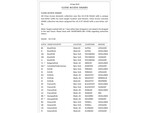
A 10 September 2010 NSA reference list of Close Access SIGADs revealing the codenames, locations and collection methods used to bug the embassies and UN missions of 38 targets — including US allies France, Italy, Greece, Japan, India, Mexico, South Korea and the EU — through implants, computer-screen capture, hard-drive imaging and electromagnetic emanation collection, most conducted against diplomatic facilities in Washington DC and New York.
Programs: KATEEL · POCOMOKE · MERCED · BANISTER · PERDIDO · MAGOTHY · BLACKFOOT · WABASH · NAVARRO · POWELL · KLONDIKE · NASHUA · OSAGE · OSWAYO · BRUNEAU · HEMLOCK · MULBERRY · ALAMITO · FLEMING · DOBIE · SULPHUR · REQUETTE · YUKON · WESTPORT · NAVAJO · PANTHER · LIFESAVER · HIGHLANDS · VAGRANT · MINERALIZ · DROPMIRE · PBX · MAGNETIC · OCEAN · GENIE · BLACKHEART · CRYPTOENABLED · CUSTOMS · DEWSWEEPER · RADON · MINERALIZE · COOP · STARRUBY · TRASHINT“No Place to Hide” - Metropolitan Books ↗ (2014-05-13) · “Espionnage de la NSA : la diplomatie française était sur écoute aux Etats-Unis” - Le Monde ↗ (2013-10-22) · “Da qui ci spiano gli americani” - L'Espresso ↗ (2013-12-05) · Greenwald, Glenn · Follorou, Jacques · Maurizi, Stefania -
Cover slide NSA/CSS Threat Operations Center, February 2013 [pdf]
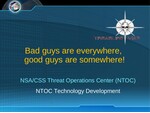
Cover slide of a February 2013 NSA/CSS Threat Operations Center (NTOC) briefing prepared for release to Japan. Only this title slide is public, captured from an NDR news video; the substance of the brief has never been published.
-
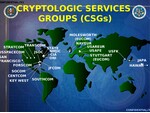
CRYPTOLOGIC SERVICES GROUPS (CSGs) [pdf]
Worldwide locations of the Cryptologic Services Groups (CSGs). The visual is a world map annotated with the locations of CSGs embedded in or supporting major U.S. combatant commands and agencies. These groups act as NSA’s cryptologic arms inside military commands. Cryptologic operations are co-located with military command authority and signals intelligence is structurally tied to every major U.S. warfighting domain.
-
CSEC Cyber Threat Capabilities [pdf]
This document details CSEC’s full-spectrum cyber operations architecture, integrating SIGINT and IT Security to conduct both defensive and offensive activities under the guise of “information superiority.” While early sections emphasize detection, anomaly analysis, and collaboration with Five Eyes partners, later portions reveal active measures including network infiltration (implant deployment), command-and-control tracking, traffic manipulation and redirection, DNS interference, and potential disruption or deception operations—illustrating CSEC’s capacity not only to defend Canadian networks but also to surveil, exploit, and influence foreign and domestic digital infrastructure.
Programs: EONBLUE · CYBERDMZ · SEEDSPHERE · PHOTONICPRISM · SPECIALSOURCE · SUPERDRAKE · DARKSPACE · QUANTUM · MANDATE · STREAMING SENTRY · SSO · TKB · COVENANT -
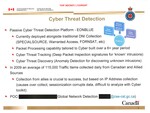
CSEC Cyber Threat Detection [pdf]
This document details the Communications Security Establishment’s (CSEC) cyber threat detection and intelligence infrastructure, including systems like EONBLUE, CROSSBOW, CRUCIBLE, and LODESTONE, which enable passive monitoring, anomaly detection, and botnet identification through metadata and deep packet inspection. It outlines how CSEC integrates SIGINT, cryptanalysis, and network forensics to detect and mitigate cyber intrusions using both SIGINT and domestic sensors, while collaborating with Five Eyes partners to enhance Canada’s cyber defense and situational awareness. The presentation is duplicated from page 7 onwards - one of the duplicated slide has internal CSE comments.
Programs: EONBLUE · SPECIALSOURCE · WARRANTEDACCESS · COVENANT · SEEDSPHERE · DIESELRATTLE · SIENNABLUE · DOWNGRADE · CROSSBOW · CRUCIBLE · LODESTONE -
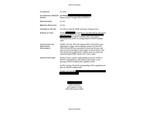
DFS and NSA partnership [pdf]
DFS the NSA Sister Organization. This document outlines a high-level visit by Japan’s Directorate for Signals Intelligence (DFS), described as NSA’s “sister organization,” to the NSA/CSS headquarters in early 2013. The purpose was to strengthen their decades-long partnership, focusing on SIGINT-enabled cyber capabilities, training, and mutual understanding of each agency’s role in cyber defense.
People: Alexander, Keith B.“The Untold Story of Japan's Secret Spy Agency” - The Intercept ↗ (2018-05-19) · “日本の諜報 スクープ 最高機密ファイル” - NHK ↗ (2018-05-19) · Gallagher, Ryan