Classification: TOP SECRET 536 documents
Search documents matching “TOP SECRET” →Each document's classification level, as component values. If a document contains multiple classifications, the highest is used here.
Graphs
By document date (14 years)
By Banner
Refine (combine with another filter, via search)
Sort: Title
Documents
-
2013 Black Budget - SSO Project Description [pdf]
This excerpt from the 2013 Congressional Budget Justification for the National Intelligence Program details the administrative and logistical backbone of the Special Source Operations (SSO). The document outlines how the SSO manages high-priority access programs, specifically MYSTIC, RAMPART-I, and RAMPART-X. It confirms that MYSTIC utilizes "partner-enabled" accesses to intercept communications from both cellular (GSM) and traditional landline (PSTN) networks. The budget highlights a strategic push to exploit Next-Generation Wireless (NGW) technologies and identifies the Caribbean, Mexico, Kenya, and the Philippines as primary regions for sustained, comprehensive metadata and content collection.
“NSA surveillance program reaches ‘into the past’ to retrieve, replay phone calls” - The Washington Post ↗ (2014-03-18) · “The NSA Is Recording Every Cell Phone Call in the Bahamas” - The Intercept ↗ (2014-05-19) · Gellman, Barton · Soltani, Ashkan · Devereaux, Ryan · Greenwald, Glenn · Poitras, Laura -
3G: impact and update - SDF Nov 09 [pdf]
This 2009 top-secret presentation from Australia’s Defence Signals Directorate (DSD) detailing 3G mobile network rollouts in Southeast Asia and identifying Indonesian President Susilo Bambang Yudhoyono, his wife, and senior officials as surveillance targets. It includes handset information, call data records, intercepted call attempts, and outlines plans for continued interception of Indonesian leadership communications.
-
A Behind-the-Scenes Look at the NSA-Ethiopian Relationship SIDtoday [pdf]
This SIDtoday article details the NSA's growing collaboration with Ethiopian security agencies, particularly through the Operation Lion's Pride SIGINT program. It highlights a successful training session where Ethiopian soldiers and civilians learned traffic analysis, strengthening the relationship between the NSA, Ethiopian National Defense Forces (ENDF), and the Information Network Security Agency (INSA).
Programs: LIONSPRIDE -
A Week in the Life of PRISM Reporting [pdf]
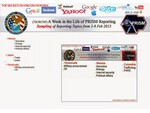
A slide from the "PRISM/US-984XN Overview" deck, showing different reporting topics from one week in the early February 2013.
“EUA espionaram milhões de e-mails e ligações de brasileiros” - O Globo ↗ (2013-07-12) · “NSA targets Indian politics, space & n-programmes” - The Hindu ↗ (2013-09-24) · Greenwald, Glenn · Kaz, Roberto · Casado, José · Saxena, Shobhan -
Access to the future [pdf]
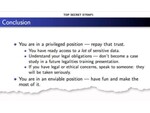
The conclusion slide excerpt of a GCHQ presentation on TEMPORA, telling analysts they are in a "privileged" and "enviable" position with ready access to a great deal of sensitive data, and to "have fun and make the most of it".
Programs: TEMPORA -
Advanced HTTP Activity Analysis [pdf]
This NSA training document from 2009 teaches intelligence analysts how to analyze HTTP internet traffic and exploit it using the XKEYSCORE surveillance system to monitor and identify internet users globally.
“XKEYSCORE: NSA’s Google for the World’s Private Communications” - The Intercept ↗ (2015-07-01) · “No Place to Hide” - Metropolitan Books ↗ (2014-05-13) · Marquis-Boire, Morgan · Greenwald, Glenn · Lee, Micah -
Afghanistan 30 enemy killed (Jan-Feb 2012) [pdf]
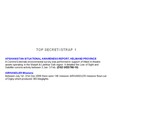
Taliban high-value targets in Afghanistan shifted to VSAT-based communications, which NSA and GCHQ analysts in Menwith Hill linked to known phone numbers. This intelligence enabled military operations that killed about 30 enemy fighters.
Marking: TOP SECRET -
Afghanistan Coalition Dissemination Brief to Senior Leadership Forum [pdf]
This document ooutlines the structure, goals, and challenges of multinational signals intelligence (SIGINT) collaboration in Afghanistan as of 2009. It reveals how the U.S. and its intelligence-sharing allies (notably the 5 Eyes, 9 Eyes, and 14 Eyes) coordinated SIGINT collection, decryption, analysis, and dissemination across NATO and coalition forces.
“Mission Creep: How the NSA’s Game-Changing Targeting System Built for Iraq and Afghanistan Ended Up on the Mexico Border” - The Intercept ↗ (2019-05-29) · “Norges hemmelige krig i Afghanistan” - NRK ↗ (2019-05-29) · Moltke, Henrik · Skille, Øyvind Bye · Døvik, Olav · Hansen, Ståle Ellingsgard · Fjørtoft, Martin -
AIRHANDLER missions Feb 2010 [pdf]
A communications survey in Helmand Province (Jan–Feb 2010) mapped line-of-sight and satellite activity to support allied operations. Between July and December 2009, RAF Digby conducted 148 AIRHANDLER drone surveillance missions, generating 363 intelligence reports.
Programs: AIRHANDLER -
Alert: Voice Masking Is Discovered in SIGINT SIDtoday [pdf]
This March 2007 post from the internal NSA newsletter SIDToday draws attention to voice-masking technology used by subjects of surveillance to frustrate the agency’s voice-recognition efforts.
-
Alvin, Simon, and... Al Qaeda? Finding Modified Voice in SIGINT Traffic SIDtoday [pdf]
This SIDtoday article discusses the use of voice modification technology by Al-Qaeda and other extremist groups to evade identification in SIGINT traffic. It highlights the development of the HLT Lite software by R64, which can automatically detect modified voices in intercepted communications, enabling the identification of targets even when traditional voice recognition fails.
-
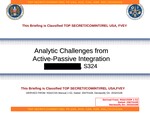
Analytic Challenges from Active-Passive Integration [pdf]
This NSA presentation examines metadata attribution challenges arising when active TAO implants exfiltrate traffic through passive TURMOIL collection infrastructure, creating conflicts where intercepted data carries dual classification markings, case notations, and legal authorities from both collection systems. The briefing highlights how existing databases and analytic tools were not designed to handle traffic with two simultaneous sets of metadata parameters, requiring enterprise-wide solutions to consistently attribute and track actively-shaped intelligence collection.
Programs: BRAVENICKEL · HAMMERMILL · APEX · MARINA · TURMOIL · PRESSUREWAVE · METROTUBE · TOYGRIPPE · HAMMERSTEIN · HAMMERSTONE · METAWAVE · TURBULENCE · SSO -
Analytic Challenges from Active-Passive Integration [pdf]
This NSA briefing addresses the technical and administrative friction caused by "shaping" operations. Shaping occurs when an active malware implant, typically situated on network infrastructure like a router, copies specific data streams and redirects them past a passive surveillance sensor such as TURMOIL. While this ensures the capture of data that might otherwise be missed, it creates a "double metadata" conflict where a single piece of intelligence carries two competing sets of identifiers: one from the active Tailored Access Operations (TAO) implant and another from the passive collection site. The document tasks analysts with finding a way to reconcile these source notations to ensure the data remains searchable and legally compliant within legacy databases.
Programs: BRAVENICKEL · HAMMERMILL · APEX · TURMOIL · HAMMERSTONE · PRESSUREWAVE · METROTUBE · TOYGRIPPE · TURBULENCE · METAWAVE · MARINA · SSO · CONVEYANCE · NUCLEON · FASCIA · HAMMERCHANT -
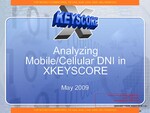
Analyzing Mobile/Cellular DNI in XKEYSCORE, May 2009 [pdf]
The XKEYSCORE document explains how the agency analyzes mobile/cellular device internet usage by collecting and processing both converged DNI/DNR data within cellular networks and traditional internet traffic, using various tools and indicators to identify mobile users even when their device type isn't immediately evident. The document demonstrates how the system can track mobile internet activity across applications like Yahoo Mail and identifies devices through various technical "hints" including MSISDN codes, browser fingerprints, and user agent strings.
-
"Anarchist" Image Index [pdf]
Images collected through ANARCHIST, the GCHQ covername for a joint GCHQ/NSA SIGINT collection site on Mt. Troodos, Cyprus, drawn from imagery and pages in GCHQ's internal GCWiki.
Programs: ANARCHIST -
AND THEY SAID TO THE TITANS: « WATCH OUT OLYMPIANS IN THE HOUSE! » [pdf]
This Top Secret CSEC “Olympia” document details a Canadian intelligence program that analyzed and tracked the Brazilian Ministry of Mines and Energy’s telecommunications, mapping IPs, servers, proxies, and mobile devices while automating data collection and network analysis to develop actionable intelligence. It outlines tools, workflows, and contacts used for surveillance, though the presentation does not explain the specific purpose of the operation.
Programs: OLYMPIA · QUOVA · PROMETHEUS · PEITHO · SLINGSHOT · LEVITATE · STRATOS · EVILOLIVE · GCHQ Geofusion · ATLAS · HYPERION · ATHENA · DANAUS · TIDALSURGE · BLACKPEARL · MARINA · STARSEARCH · PEPPERBOX · TRITON · PACKAGEDGOODS · ARK · TOYGRIPPE · FRIARTUCK · MASTERSHAKE · COEUS · STALKER · MAINWAY · FASCIA · SEDB · OCTSKYWARD · FASTBAT · TWINSERPENT · EONBLUE · DISHFIRE · GNDB“Read a CSEC document that was first acquired by Edward Snowden” - The Globe and Mail ↗ (2013-11-30) · “Ministério de Minas e Energia está na mira de espiões americanos e canadenses” - O Globo ↗ (2013-10-06) · “No Place to Hide” - Metropolitan Books ↗ (2014-05-13) · Freeze, Colin · Bridi, Sônia · Greenwald, Glenn -
Anna Politkovskaya (Intellipedia) [pdf]
This document, retrieved from the internal U.S. Intelligence Community wiki Intellipedia, provides a comprehensive intelligence profile on the life, work, and assassination of Russian journalist Anna Politkovskaya. This document details her biography as a dual U.S.-Russian citizen, her career as a vocal critic of the Kremlin and the war in Chechnya, and the high-level signals intelligence (SIGINT) confirming that Russian Federal Intelligence Services (RFIS) targeted her digital communications prior to her death. This document also examines the subsequent murder investigation, the potential links to the poisoning of Alexander Litvinenko, and the geopolitical fallout following her October 2006 assassination in Moscow.
-
APPARITION Becomes a Reality: New Corporate VSAT-Geolocation Capability Sees Its First Deployment SIDtoday [pdf]
This document provides an update to the APPARITION system, which is designed to provide precision geolocation information for VSAT terminals. APPARITION, as contrasted with GHOSTHUNTER, is designed to proactively target and geolocate VSATs and for that information to be populated in MASTERSHAKE. The result is that any location will be able to combine VSAT information with FORNSAT information to geolocate targets.
-
APPARITION/GHOSTHUNTER TASKING INFO [pdf]
The document details how the NSA’s and GCHQ’s GHOSTHUNTER and APPARITION systems, based primarily at Menwith Hill Station, are used to geolocate VSAT satellite modems for both real-time operational support and strategic intelligence. It explains tasking priorities, coordination processes, and how geolocation results are shared through systems like Mastershake to support surveillance and capture/kill missions.
Programs: APPARITION · GHOSTHUNTER · SOUNDER · CARD · LADYLOVE · JACKNIFE · MOONPENNY · CARBOY · MASTERSHAKE · TRYST -
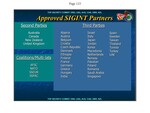
Approved SIGINT Partners [pdf]
A Foreign Affairs Directorate slide listing NSA's approved SIGINT partners: the four Second Parties, 33 Third Parties from Algeria to the United Arab Emirates, and the coalitions AFSC, NATO, SSEUR and SSPAC. This is document is from Fiscal Year 2013 "Foreign Partner Review."