2013 Black Budget - SSO Project Description
Open PDF +1 other copyDocument date: 2013-01-01
Pages: 1
Genre: report
Classification: TOP SECRET SI
Dissemination: NOFORN
This excerpt from the 2013 Congressional Budget Justification for the National Intelligence Program details the administrative and logistical backbone of the Special Source Operations (SSO). The document outlines how the SSO manages high-priority access programs, specifically MYSTIC, RAMPART-I, and RAMPART-X. It confirms that MYSTIC utilizes "partner-enabled" accesses to intercept communications from both cellular (GSM) and traditional landline (PSTN) networks. The budget highlights a strategic push to exploit Next-Generation Wireless (NGW) technologies and identifies the Caribbean, Mexico, Kenya, and the Philippines as primary regions for sustained, comprehensive metadata and content collection.
My notes
(U) Project Description
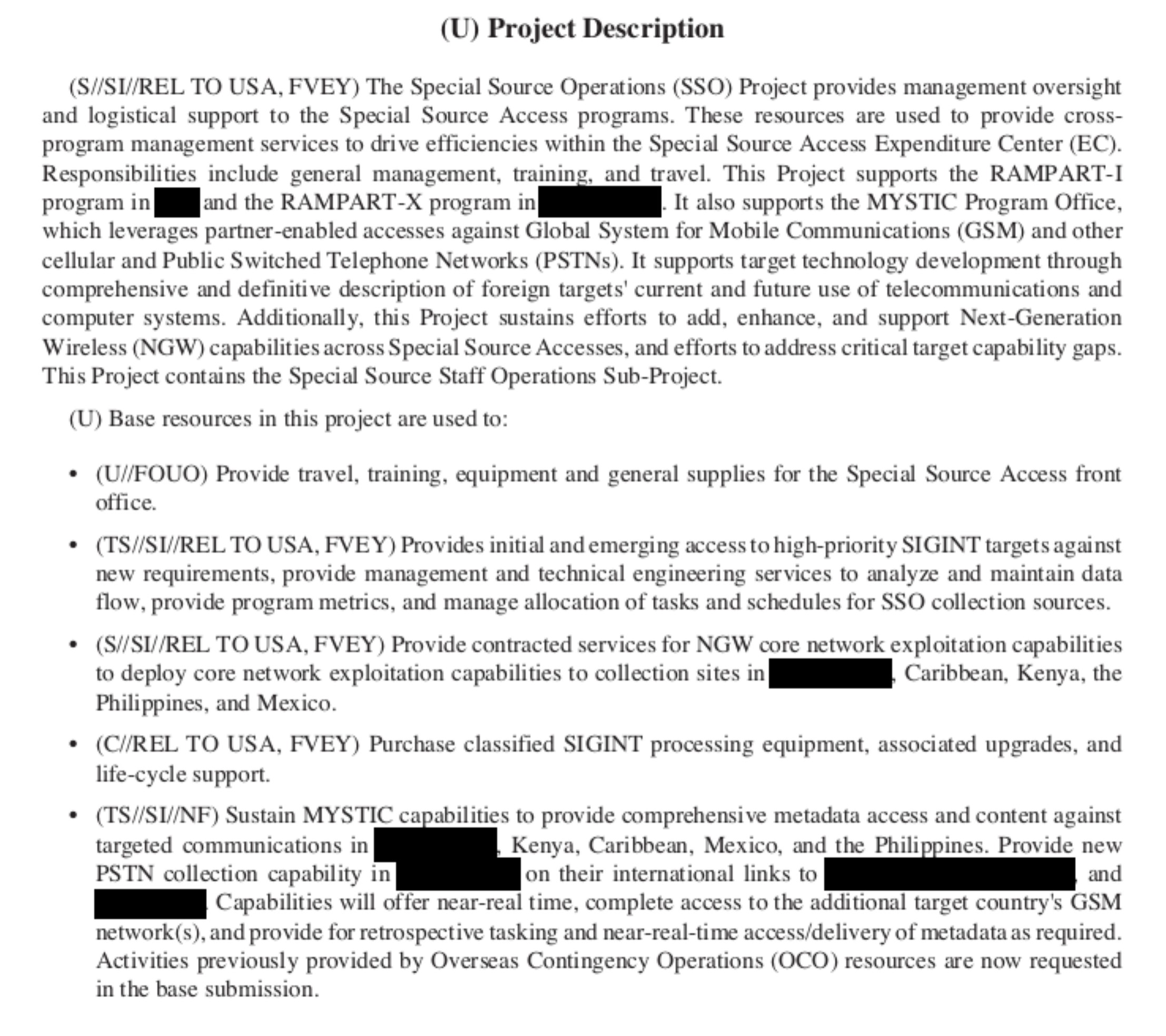
(S//SI//REL TO USA, FVEY) The Special Source Operations (SSO) Project provides management oversight and logistical support to the Special Source Access programs. These resources are used to provide cross-program management services to drive efficiencies within the Special Source Access Expenditure Center (EC). Responsibilities include general management, training, and travel. This Project supports the RAMPART-I program in [REDACTED] and the RAMPART-X program in [REDACTED]. It also supports the MYSTIC Program Office, which leverages partner-enabled accesses against Global System for Mobile Communications (GSM) and other cellular and Public Switched Telephone Networks (PSTNs). It supports target technology development through comprehensive and definitive description of foreign targets' current and future use of telecommunications and computer systems. Additionally, this Project sustains efforts to add, enhance, and support Next-Generation Wireless (NGW) capabilities across Special Source Accesses, and efforts to address critical target capability gaps. This Project contains the Special Source Staff Operations Sub-Project.
(U) Base resources in this project are used to:
- (U//FOUO) Provide travel, training, equipment and general supplies for the Special Source Access front office.
- (TS//SI//REL TO USA, FVEY) Provides initial and emerging access to high-priority SIGINT targets against new requirements, provide management and technical engineering services to analyze and maintain data flow, provide program metrics, and manage allocation of tasks and schedules for SSO collection sources.
- (S//SI//REL TO USA, FVEY) Provide contracted services for NGW core network exploitation capabilities to deploy core network exploitation capabilities to collection sites in [REDACTED], Caribbean, Kenya, the Philippines, and Mexico.
- (C//REL TO USA, FVEY) Purchase classified SIGINT processing equipment, associated upgrades, and life-cycle support.
- (TS//SI//NF) Sustain MYSTIC capabilities to provide comprehensive metadata access and content against targeted communications in [REDACTED], Kenya, Caribbean, Mexico, and the Philippines. Provide new PSTN collection capability in [REDACTED] on their international links to [REDACTED], and [REDACTED]. Capabilities will offer near-real time, complete access to the additional target country's GSM network(s), and provide for retrospective tasking and near-real-time access/delivery of metadata as required. Activities previously provided by Overseas Contingency Operations (OCO) resources are now requested in the base submission.
Published in the Same Report
(5 documents)
-
SSO - MYSTIC [pdf]
This collection of SSO slides details the NSA's MYSTIC program, a massive signals intelligence (SIGINT) operation capable of recording and archiving 100% of a country's mobile phone calls. The slides reveal the program's reach across several nations, using colorful codenames for specific collection sites.
Programs: MYSTIC · SCALAWAG · ACIDWASH · OILYRAG · VENATOR · RANCIDRINSE · LOLLYGAG · EVENINGEASEL · DUSKPALLET · BASECOAT · PERMANENTPRESS · ETCHINGSPIN“NSA surveillance program reaches ‘into the past’ to retrieve, replay phone calls” - The Washington Post ↗ (2014-03-18) · “The NSA Is Recording Every Cell Phone Call in the Bahamas” - The Intercept ↗ (2014-05-19) · Gellman, Barton · Soltani, Ashkan · Devereaux, Ryan · Greenwald, Glenn · Poitras, Laura -
MYSTIC [pdf]
These excerpts provide foundational details on the MYSTIC program, including its inception in 2009 and its structural organization. It defines MYSTIC as a program managed by the Special Source Operations (SSO) division, focusing on "embedded collection systems" within foreign wireless and mobile networks. The document confirms a deceptive operational model: the equipment is overtly installed to provide "commercial services" for telecommunications companies, while its secret purpose is to provide SIGINT (Signals Intelligence) to U.S. agencies.
-
DEA - The "Other" Warfighter SIDtoday [pdf]
NSA SIGINT helped the Drug Enforcement Administration achieve "major successes" in the war on drugs. This role is little known. Examples are provided.
People: Hinojosa, Gonzalo“The NSA Is Recording Every Cell Phone Call in the Bahamas” - The Intercept ↗ (2014-05-19) · The Intercept ↗ (2016-12-07) · Devereaux, Ryan · Greenwald, Glenn · Poitras, Laura -
SOMALGET (2012) [pdf]
This 2012 document provides an internal overview of SOMALGET, a sub-program of the MYSTIC surveillance project. It describes a radical shift in telephony intelligence: the move from "targeted" wiretapping to "full-take" nation-scale buffering. SOMALGET allows analysts to record 100% of a country's mobile phone audio and store it for a rolling period of 30 days. This capability, known as "retrospective retrieval," allows the NSA to listen to conversations that occurred before a person was even identified as a target. At the time of this writing, the program was fully operational in the Bahamas and one other redacted location(s).
-
SSO Dictionary Excerpt [pdf]
This SSO dictionary excerpt provides a technical glossary of the MYSTIC program's operational infrastructure. The document confirms that MYSTIC is a global cellular interception network that uses both "overt" law enforcement pathways (via the DEA) and "clandestine" signals intelligence pathways to monitor foreign mobile networks. The entries detail specific regional collection sites, the multi-million dollar contracts supporting the technology (specifically with General Dynamics), and the startling fact that host countries are generally unaware of the NSA's secondary SIGINT mission occurring through these systems.
Programs: BASECOAT · DUSKPALLET · EVENINGEASEL · LOCKSTOCK · SOMALGET · VENATOR · MYSTIC · LAUNDROMAT · RAMPART-M · SCALAWAG · OILYRAG · LOLLYGAG
Related Documents
-
Special Source Operations [pdf]
This document provides an overview of the NSA’s Special Source Operations (SSO), characterizing the division as the premier "Cryptologic Provider" for intelligence derived from global high-capacity telecommunications. It outlines a three-tiered access portfolio—Corporate, Foreign, and Unilateral—designed to manage the "incredible challenge" of intercepting target communications across undersea fiber-optic cables that carry millions of simultaneous sessions.
Programs: RAMPART-A · WINDSTOP · BLARNEY · FAIRVIEW · STORMBREW · OAKSTAR · PRISM · RAMPART-I · RAMPART-T · SSO · RAMPART-X · ClanSIG · MYSTIC · LOPERS · WEALTHYCLUSTER-2 · DEEPDIVE · TURMOIL · FASCIA · PINWALE · MARINA · TRAFFICTHIEF · TWISTEDPATH · BLACKPEARL · ACS“How Secret Partners Expand NSA’s Surveillance Dragnet” - The Intercept ↗ (2014-06-18) · “NSA ‘third party’ partners tap the Internet backbone in global surveillance program” - Dagbladet Information ↗ (2014-06-19) · Gallagher, Ryan · Geist, Anton · Gjerding, Sebastian · Moltke, Henrik · Poitras, Laura -
MYSTIC [pdf]
These excerpts provide foundational details on the MYSTIC program, including its inception in 2009 and its structural organization. It defines MYSTIC as a program managed by the Special Source Operations (SSO) division, focusing on "embedded collection systems" within foreign wireless and mobile networks. The document confirms a deceptive operational model: the equipment is overtly installed to provide "commercial services" for telecommunications companies, while its secret purpose is to provide SIGINT (Signals Intelligence) to U.S. agencies.
-
Special Source Collection - March 2013 [pdf]
A March 2013 NSA Special Source Operations briefing for the NSA Threat Operations Center outlining SSO's portfolio of surveillance programs, their legal authorities, and operational constraints — revealing that SSO accounts for approximately 60% of NSA content collection and 75% of metadata collection, and mapping all major collection programs across three access categories: foreign partner, corporate, and unilateral.
-
Special Source Operations corporate overview [pdf]
A classified NSA training presentation providing an in-depth operational overview of the FAIRVIEW program — the agency's largest corporate partner surveillance program — detailing its collection capabilities, legal authorities, TAO shaping operations, targeting tools, and productivity statistics, while revealing that BLARNEY/PRISM was the single most productive SSO program in 2012 with 806 serialized product reports.
Programs: FAIRVIEW · BLARNEY · PRISM · RAMPART-A · RAMPART-I · RAMPART-X · RAMPART-T · RAMPART-M · DGO · WINDSTOP · MYSTIC · PINWALE · XKEYSCORE · TURMOIL · STORMBREW · OAKSTAR · OCTAVE · UTT · CADENCE · COWBOY · YANKEE · MAINWAY · TOYGRIPPE · BLACKPEARL · TWISTEDPATH · NUCLEON · DISHFIRE · SPYDER · CARBONFURY · NATIVEFLORA · UNICORNSANDWICH · CROSSEYEDBEAR · SCORCHERSIX · TROPICTHUNDER · DARKTHUNDER · STEELFLAUTA · RAGTIME · SWEETSMACK2 · SOURSMACK2 · EVILOLIVE · SCALEABLE · FLEXIBLE · MONKEYROCKET · SHIFTINGSHADOW · ORANGECRUSH · YACHTSHOP · ORANGEBLOSSOM · SILVERZEPHYR · BLUEZEPHYR · COBALTFALCON · RAGTIME-A · RAGTIME-C · SSO · SURREY“NSA Spying Relies on AT&T’s ‘Extreme Willingness to Help’” - ProPublica ↗ (2015-08-15) · “AT&T Helped U.S. Spy on Internet on a Vast Scale” - The New York Times ↗ (2015-08-15) · “The Wiretap Rooms: The NSA’s Hidden Spy Hubs in Eight U.S. Cities” - The Intercept ↗ (2018-06-25) · Angwin, Julia · Larson, Jeff · Savage, Charlie · Moltke, Henrik · Poitras, Laura · Risen, James · Gallagher, Ryan -
SSO - MYSTIC [pdf]
This collection of SSO slides details the NSA's MYSTIC program, a massive signals intelligence (SIGINT) operation capable of recording and archiving 100% of a country's mobile phone calls. The slides reveal the program's reach across several nations, using colorful codenames for specific collection sites.
Programs: MYSTIC · SCALAWAG · ACIDWASH · OILYRAG · VENATOR · RANCIDRINSE · LOLLYGAG · EVENINGEASEL · DUSKPALLET · BASECOAT · PERMANENTPRESS · ETCHINGSPIN“NSA surveillance program reaches ‘into the past’ to retrieve, replay phone calls” - The Washington Post ↗ (2014-03-18) · “The NSA Is Recording Every Cell Phone Call in the Bahamas” - The Intercept ↗ (2014-05-19) · Gellman, Barton · Soltani, Ashkan · Devereaux, Ryan · Greenwald, Glenn · Poitras, Laura