Classification: COMINT 287 documents
Search documents matching “COMINT” →Each document's classification level, as component values. If a document contains multiple classifications, the highest is used here.
Graphs
By document date (13 years)
By Banner
Refine (combine with another filter, via search)
Sort: Title
Documents
-
FASHIONCLEFT - Interface Control Document (15 June 2009) [pdf]
This 2009 NSA Interface Control Document provides comprehensive technical specifications for FASHIONCLEFT, the protocol that acts as a covert shipping system enabling TAO malware implants to send stolen network data back to NSA collection servers with minimal computer processing requirements—using multiple encryption layers (RSA-1024 and RC6-128) to disguise the traffic as it travels across the internet while allowing NSA's Common Data Receptor to reassemble and authenticate the original intercepted packets. The document details how implants make modified copies of captured network traffic (changing destination addresses to point toward NSA instead of legitimate recipients), apply various levels of encryption or scrambling ("munging") depending on how powerful the infected computer is, attach metadata instructions explaining how to reconstruct the original packets, and use pattern-matching algorithms to ensure NSA systems can identify which stolen packets belong to which collection operation.
Programs: FASHIONCLEFT · FLAXENPRECEPT · SHELLGREY · SURPASSPIN · SEAGULLFARO · ROOTKNOT · FIGBUILD · OPTICPINCH · VINYLSEAT · OLYMPUS · UNITEDRAKE · HOGTECH · SWEEPFORWARD · CONVEY · PINWALE · TREBLECLEF · FOGYNULL · FUNNELAPS · FLASHHANDLE -
Finding and Querying Document Metadata [pdf]
This 2009 NSA training guide, created by Booz Allen Hamilton, explains how analysts can use the XKEYSCORE system to track targets by searching for "non-traditional selectors" embedded within documents, such as author names, company information, or even the hash values of company logos.
Programs: XKEYSCORE · TUNINGFORK · PINWALE · FOXACID · FOXBASE · CARBOY · CARDAMON · UNITEDRAKE · CADENCE -
FININT Tasking [pdf]
This document outlines GCHQ's financial intelligence (FININT) operations, detailing the use of tools like LUCKY STRIKE and LUCKY ESCAPE to search and fuse datasets from financial and travel sources. It also describes procedures for requesting financial checks on individuals and mentions the collection of bulk banking and credit card data from specific regions.
Programs: TRACFIN · LUCKY STRIKE · LUCKY ESCAPE · TAPERLAY · TMM · MOON RAKER · BROADOAK · FININTTRACKER · FINTOOLS · FOLLOWTHEMONEY · PLATINUMPLUS · RUSSETT -
FISA Amendments Act of 2008 Section 702 summary document [pdf]
This document summarizes the way the law works and describes the three types of certifications used to permit the surveillance, as well as targeting and minimization procedures. The three certification are for foreign governments, counterterrorism and WMD/proliferation.
-
FISA recap [pdf]
This document is a Top Secret NSA "FISA Recap" spreadsheet detailing electronic surveillance conducted between 2005 and 2008. It tracks specific email accounts targeted under the Foreign Intelligence Surveillance Act, listing the responsible agencies (NSA, FBI, and CIA), their legal "Case Notation," and the duration of collection. Notably, the log includes prominent U.S. Persons and organizations, such as the Council on American-Islamic Relations (CAIR), and features a 2005 formatting guide that uses a racial slur as a placeholder for a target's identity.
Programs: SQF -
FORNSAT technologies [pdf]
This document outlines a Foreign Satellite Communication Exploitation Model targeting satellite systems such as Intelsat, Iridium, Hughes, ND SatCom, and Inmarsat, using both fixed and mobile satellite services. It describes specific collection and geolocation systems—SEADIVER, ZODIACARRAY, and CANYONDUST—that capture and process voice, fax, data, and terminal location information across global coverage areas.
Programs: SHAREDVISION · DARKQUEST · EKB · GLOBALVIEW · TRYST · ZODIACARRAY · CANYONDUST · IRIDIUM · SEADIVER -
Fourth Party Opportunities [pdf]
This presentation document explains how NSA identifies, prioritizes, and exploits “fourth party” opportunities by passively or actively leveraging foreign computer network exploitation operations, including victim stealing and tool repurposing, to collect intelligence without initiating original intrusions.
Programs: VOYEUR · UIS · PINWALE · YNKE · TUNINGFORK · DIRTSHED · SEEKER · CLOUD · ABR · SILVERBOLT · DEADSEA · XKEYSCORE · BYZANTINERAPTOR · HAWALA · ZEBEDEE · DATAFLURRY · ECLECTICPLOT · HAPPYFOOT · BLUESMOKE · CROSSBONES2 · CYBERQUEST · VICDB · PLAIDDIANA · TRANSGRESSION -
FOXACID Overall Briefing [pdf]
FOXACID is the NSA's exploit server infrastructure designed to gain "initial access" to target computers by tricking them into visiting malicious websites through spam emails, man-in-the-middle attacks, or split-second packet injection techniques that redirect legitimate web traffic. The document reveals how the agency has evolved from low-success spam operations (less than 1% success rate) to sophisticated "QUANTUM" techniques that achieve up to 80% success rates by exploiting web browsers through services like Yahoo and Facebook, allowing the NSA to compromise any target whose web traffic passes through monitored network chokepoints—with the chilling assessment that "if we can get the target to visit us in some sort of web browser, we can probably own them."
Programs: FOXACID · WILLOWVIXEN · GENUINEDRAFT · SECONDDATE · QUANTUMTHEORY · TURMOIL · TURBINE · WEBSNIPER · QUANTUMINSERT · QUANTUMBISCUIT · QUANTUMDIRK · QUANTUM · VALIDATOR · OLYMPUS · MISTYVEAL · SSO · STRAIGHTBIZARRE · ISLANDTRANSPORT -
FOXACID SOP for Operational Management of FOXACID Infrastructure (Draft) [pdf]
This document is an NSA standard operating procedure (SOP) manual detailing how to manage and operate the FOXACID system, which delivers malware to targets through tools like SECONDDATE and BADDECISION. It provides technical instructions for tracking, deploying, and maintaining covert web-based infections used in global cyber operations.
Programs: FOXACID · FOXSEARCH · WAITAUTO · RAISEBED · FORRESTPLACE · FOXHelp · PUZZLECUBE · YACHTSHOP · SECONDDATE · MAGIC SQUIRREL · MAGICBEAN · FINKCOAT · FRUGALSHOT · QUANTUM · FERRETCANNON · BEACHHEAD · OLYMPUS · UNITERAKE · DIRESCALLOP · DEEPFREEZE · FINKDIFFERENT · DISABLEVALOR · VALIDATOR · MISTYVEAL · UNITEDRAKE · PEDDLE CHEAP · PKTWENCH · FORESTPLACE · FOXCONTACT · EASYHOOKUP · DEMENTIAWHEEL · CASTLECREEK · ROCHELP · QUANTUMINSERT · FABULOUSFABLE · WATCHER · FROZENGAZE · FABFAB · DARKFIRE · CRYPTICSENTINEL · DARKHELMET · PSP · WILLOWVIXEN -
Free File Uploaders [pdf]
This 2009 NSA training presentation for the XKEYSCORE system details how analysts can monitor Free File Uploader (FFU) websites like Zshare and RapidShare, which are difficult to track due to a lack of strong selectors. The guide introduces the "Web File Transfer" plug-in, a specialized tool designed to extract key metadata like original filenames and download/delete links from FFU web traffic.
-
Full Log vs HTTP [pdf]
This 2009 NSA training presentation explains the difference between using the "Full Log" and "HTTP Activity" queries in the XKEYSCORE surveillance system, showing analysts how to use both in tandem to gain a complete picture of a target's online activities, including identifying the use of anonymizing proxies.
-
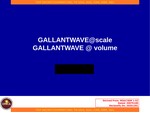
GALLANTWAVE [pdf]
NSA presentation describing GALLANTWAVE — a LONGHAUL capability for VPN decryption — specifically its scaling architecture to handle increased collection volumes and a peering mechanism allowing partner agencies to share single-sided VPN key exchange events so that LONGHAUL can complete decryption attempts that would otherwise fail due to one-sided collection.
-
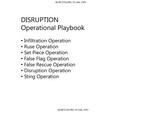
GCHQ - DISRUPTION Operational Playbook [pdf]
A JTRIG “Disruption Operational Playbook” outlines GCHQ’s online covert action toolkit to discredit people and companies, manipulate narratives, and execute false flag, sting, and infiltration operations across targets. It’s a blunt handbook for the four D’s—deny, disrupt, degrade, deceive—translating psychological warfare into clickable tactics on social platforms and forums.
Programs: JTRIG -
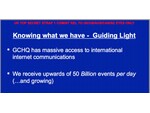
GCHQ access to international internet communications [pdf]
This document describes the scale of the agency's access to international internet communications, stating that GCHQ receives upwards of 50 billion events per day and that this volume is growing.
Programs: GUIDINGLIGHT“The US/UK Campaign to Demonize Social Media Companies as Terrorist Allies” - The Intercept ↗ (2014-11-26) · “No Place to Hide” - Metropolitan Books ↗ (2014-05-13) · Greenwald, Glenn -
GCHQ Cyber Operations Against Anonymous and Hacktivist Groups [pdf]
The leaked 2012 GCHQ presentation reveals that the agency’s JTRIG unit conducted offensive cyber operations against Anonymous and other hacktivist groups, including DDOS attacks (codenamed “Rolling Thunder”), online infiltration, and covert intelligence collection to disrupt their communications and identify key members.
-
GCHQ VisWeek 2008 Conference Report [pdf]
This GCHQ document summarizes key findings from the VisWeek 2008 visualization conference in Ohio, highlighting techniques and tools relevant to SIGINT analysis including collaborative analysis capabilities, graph visualization methods, and the Palantir Government platform. The report recommends incorporating features like analyst notebooks for tracking investigations, collaborative workspaces for multiple analysts, and various graph layout algorithms into GCHQ's MONTE VISTA visualization system.
Programs: MONTE VISTA · MAMBA · CHARTBREAKER · PIGS EAR · KNIME · RAPTOR · BROAD OAK · HAUSTORIUM · SALAMANCA · IIB · INFOVIS · PALANTIR -
GCSB access, XKEYSCORE [pdf]
4 p.These documents confirm that GCSB's Waihopai base (IRONSAND) provides Five Eyes partners, including the UK, with both "strong selected data" and a "full-take feed" of communications from the South Pacific via the NSA's XKEYSCORE system, confirming New Zealand's deep integration into the U.S.-led surveillance network despite facing internal issues with GCSB analysts accessing their own national data within NSA databases.
-
GCSB monitoring candidates for WTO director general via XKEYSCORE fingerprint [pdf]
GCSB used XKEYSCORE to intercept emails mentioning other candidates for WTO job and paid close attention to Indonesian contender.
Programs: XKEYSCOREPeople: Azevêdo, Roberto · Bark, Taeho · Blanco, Herminio · González, Anabel · Groser, Tim · Hindawi, Ahmad Thougan · Kyerematen, Alan · Mohamed, Amina · Pangestu, Mari“How spy agency homed in on Groser's rivals” - The New Zealand Herald ↗ (2015-03-23) · “New Zealand Spied on WTO Director Candidates” - The Intercept ↗ (2015-03-22) · Hager, Nicky · Gallagher, Ryan -
GCSB SIGINT Development Quarterly Report [pdf]
This GCSB quarterly report from July 2009 provides a Top Secret review of major telecommunications developments in the South West Pacific, focusing on the intelligence challenges posed by competitive deregulation and new infrastructure projects, while also detailing GCSB's efforts to enhance its collection capabilities, including the fine-tuning of GSM collection in the Solomon Islands, supporting DSD analyses in Fiji, and preparing for full-take XKEYSCORE data sharing with allies.
“New Zealand Spies on Neighbors in Secret "Five Eyes" Global Surveillance” - The Intercept ↗ (2015-03-04) · “Snowden revelations / The price of the Five Eyes club: Mass spying on friendly nations” - The New Zealand Herald ↗ (2015-03-04) · “New Zealand Spy Data Shared With Bangladeshi Human Rights Abusers” - The Intercept ↗ (2015-04-15) · “Secret documents shine light on GCSB spying in Bangladesh” - The New Zealand Herald ↗ (2015-04-16) · Gallagher, Ryan · Hager, Nicky -
GCSB Update - 21 March 2012 [pdf]
This GCSB briefing from March 2012 reviews key developments at the IRONSAND (Waihopai) base, including senior management changes, ongoing legal challenges, the crucial satellite target shift from IS-701 to IS-18 which altered the coverage beams, and the introduction of new technologies like SILVER PEAK WAN optimization and Huawei VoIP systems impacting South Pacific collection.
Programs: IRONSAND · SHAREDQUEST · SILVERPEAK · SPEARGUN · DARKQUEST · FALLOWHAUNT · KEYCARD · APPARITION · SHADOWCATPeople: Fletcher, Ian