Research & Technology – Penetrating Hard Targets
Open PDFDocument date: -
Pages: 3
Genre: report
Classification: TOP SECRET SI
Dissemination: REL TO USA, FVEY
The NSA’s “Penetrating Hard Targets” program aims at developing a cryptologically useful quantum computer capable of breaking strong encryption systems, including those protecting global financial and government communications. Conducted under the U.S. intelligence “black budget,” the program focuses on quantum physics research, engineering studies, and experimental milestones such as achieving dynamical decoupling and quantum control on semiconductor qubits, which are foundational for scaling to larger systems. A related initiative, “Owning the Net,” explores quantum communication technologies to develop new Quantum Key Distribution (QKD) attacks and assess the security of emerging encryption methods.
My notes
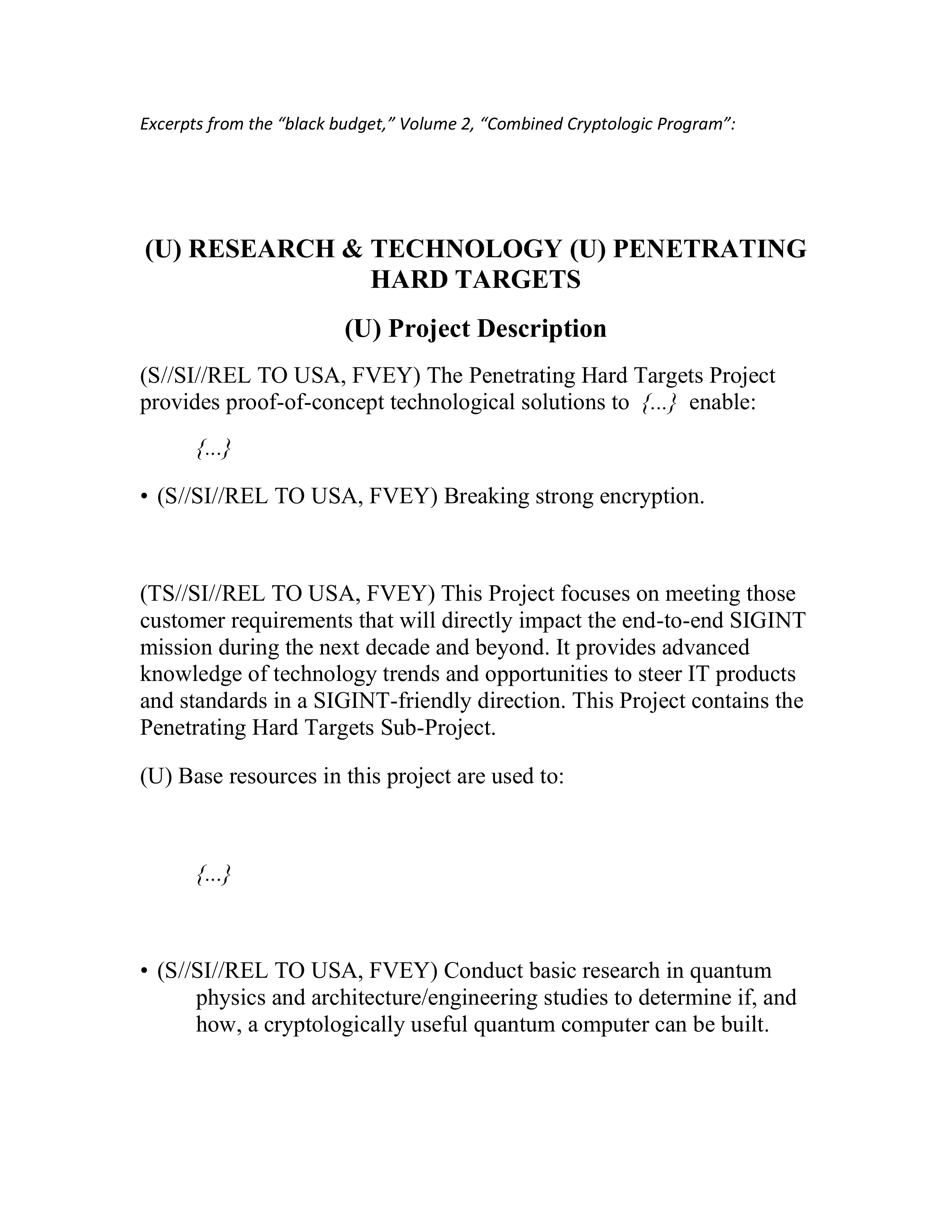
Excerpts from the “black budget,” Volume 2, “Combined Cryptologic Program”:
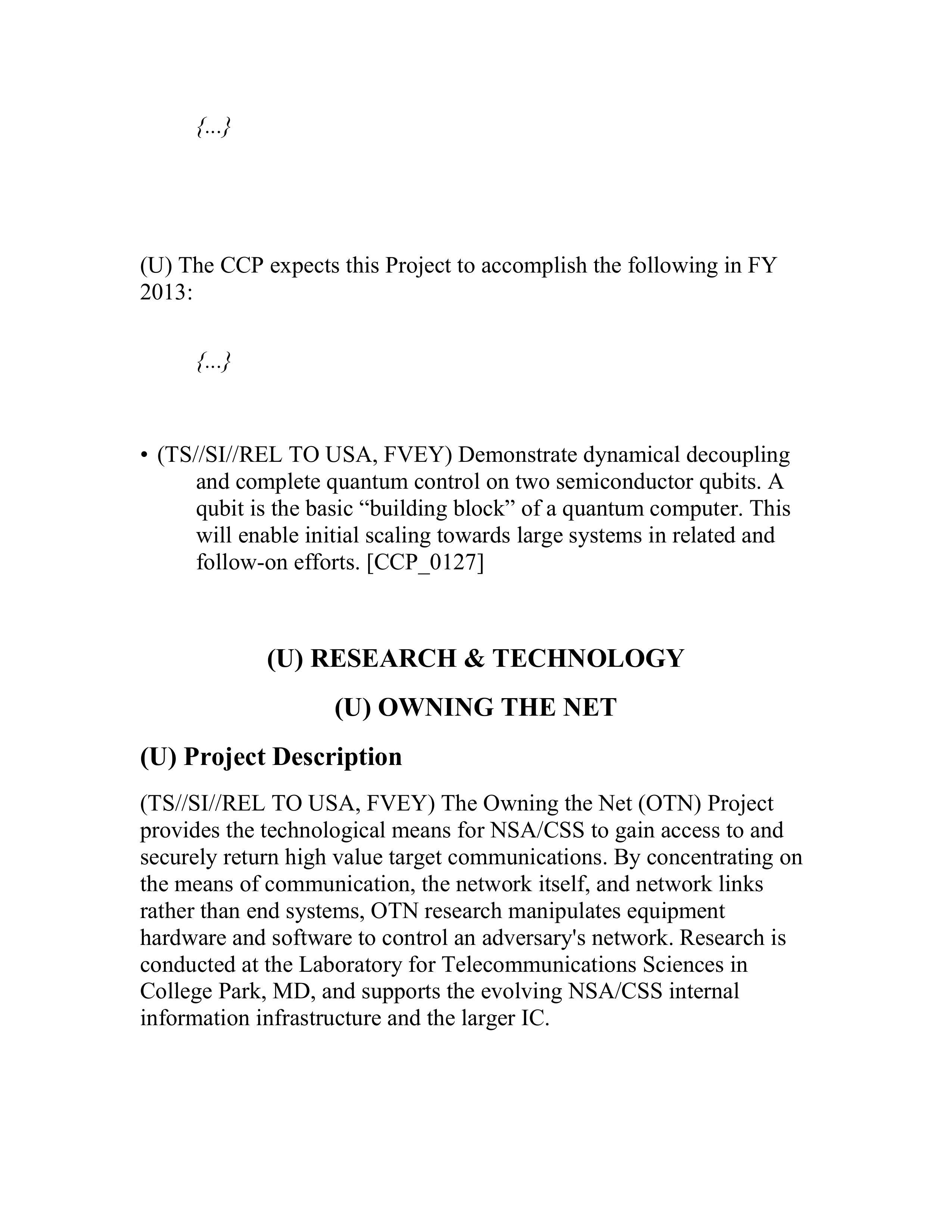
(U) RESEARCH & TECHNOLOGY (U) PENETRATING HARD TARGETS
(U) Project Description
(S//SI//REL TO USA, FVEY) The Penetrating Hard Targets Project
provides proof-of-concept technological solutions to {...} enable:
{...}
- (S//SI//REL TO USA, FVEY) Breaking strong encryption.
(TS//SI//REL TO USA, FVEY) This Project focuses on meeting those customer requirements that will directly impact the end-to-end SIGINT mission during the next decade and beyond. It provides advanced knowledge of technology trends and opportunities to steer IT products and standards in a SIGINT-friendly direction. This Project contains the Penetrating Hard Targets Sub-Project.
(U) Base resources in this project are used to:
{...}
- (S//SI//REL TO USA, FVEY) Conduct basic research in quantum physics and architecture/engineering studies to determine if, and how, a cryptologically useful quantum computer can be built.
{...}
(U) The CCP expects this Project to accomplish the following in FY 2013:
{...}
- (TS//SI//REL TO USA, FVEY) Demonstrate dynamical decoupling and complete quantum control on two semiconductor qubits. A qubit is the basic "building block" of a quantum computer. This will enable initial scaling towards large systems in related and follow-on efforts. [CCP_0127]
(U) RESEARCH & TECHNOLOGY
(U) OWNING THE NET
(U) Project Description
(TS//SI//REL TO USA, FVEY) The Owning the Net (OTN) Project provides the technological means for NSA/CSS to gain access to and securely return high value target communications. By concentrating on the means of communication, the network itself, and network links rather than end systems, OTN research manipulates equipment hardware and software to control an adversary's network. Research is conducted at the Laboratory for Telecommunications Sciences in College Park, MD, and supports the evolving NSA/CSS internal information infrastructure and the larger IC.
{...}
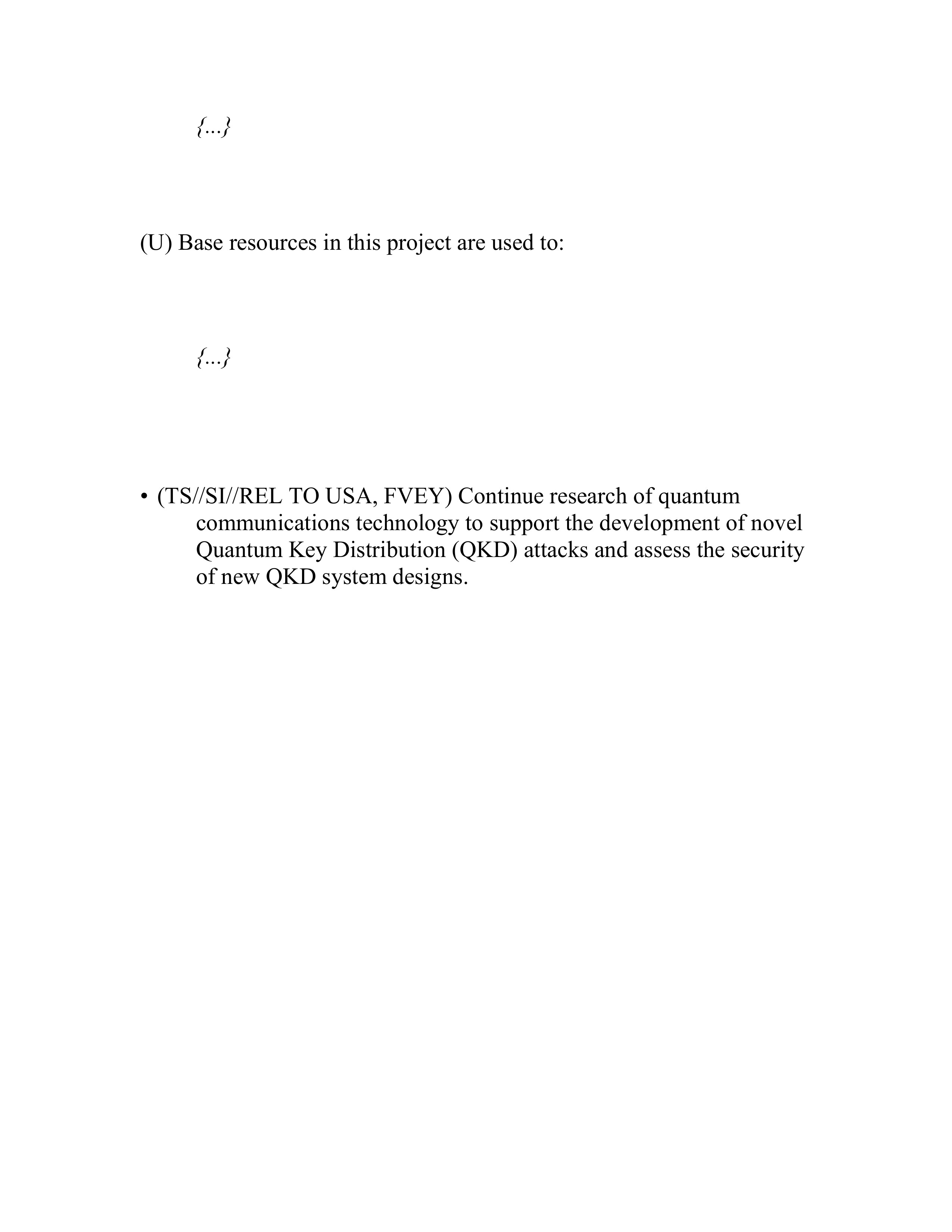
(U) Base resources in this project are used to:
{...}
- (TS//SI//REL TO USA, FVEY) Continue research of quantum communications technology to support the development of novel Quantum Key Distribution (QKD) attacks and assess the security of new QKD system designs.
Related Documents
-
Classification guide for NSA/CSS Quantum Computing Research (10-25) [pdf]
The NSA/CSS Quantum Computing Research Classification Guide (10-25) outlines how information related to the NSA’s quantum computing research should be classified, distinguishing between unclassified academic work and classified cryptanalytic programs. It defines classification levels for research activities, breakthroughs, algorithms, collaborations, and materials, with the goal of protecting U.S. cryptographic systems while advancing the agency’s offensive capabilities in quantum cryptanalysis.
-
PROJECT BULLRUN Classification Guide [pdf]
This BULLRUN classification guide outlines the NSA’s highly secretive methods for undermining and exploiting encryption technologies through a combination of cryptanalysis, industry collaboration, covert implants, and network exploitation. It specifies strict classification protocols for capabilities against protocols like TLS/SSL, VPNs, VoIP, and webmail, emphasizing secrecy around sources, methods, and industry partnerships that make commercial encryption systems deliberately vulnerable.
Programs: BULLRUN · APERIODIC · AMBULANT · AUNTIE · PAINTEDEAGLE · PAWLEYS · PITCHFORD · PENDLETON · PICARESQUE · PIEDMONT“Revealed: how US and UK spy agencies defeat internet privacy and security” - The Guardian ↗ (2013-09-05) · “N.S.A. Able to Foil Basic Safeguards of Privacy on Web” - The New York Times ↗ (2013-09-05) · “Revealed: The NSA's Secret Campaign to Crack, Undermine Internet Security” - ProPublica ↗ (2013-09-05) · Ball, James · Borger, Julian · Greenwald, Glenn · Perlroth, Nicole · Larson, Jeff · Shane, Scott -
SKIDROWE [pdf]
This document reveals the extensive surveillance capabilities of the NSA's SKIDROWE program at TITANPOINTE, specifically designed to intercept and analyze satellite communications and internet data. It highlights how intercepted data is processed and filtered through advanced systems like XKEYSCORE, which enables real-time intelligence gathering by sifting through massive amounts of digital content, including emails, calls, and internet activity.
Programs: SKIDROWE · WEALTHYCLUSTER2 · WEALTHYCLUSTER · TURNWEALTHY · VPCS · XKEYSCORE · GENESIS · CONTROLAND · ATM · FITBOY · DARKTHUNDER · FIP · METTLESOME · SKYFRAME · PVOICE · XXPY0012 · AGITATOR · STARPROC · SPELLBINDER · BLACKPEARL · BLACKALCHEMY · BLACKGOLD · BLACKFIRE · MONKEYMIND · BCD · EVVIPER · QUANTUM · MISTYPEAK · VALIANTSURF · GALLANTWAVE · SWINE · BLUESNORT · TOSSSWUNG · GNOMEVISION · GNOMEGOGGLES · HIDDENSALAMANDER · TURMOIL · PSC -
Tor - 2006 CES Summer Program [pdf]
The following document is a 2006 research paper produced for the NSA's "Cryptanalysis and Exploitation Services" office. It lays out the technical features of Tor and proposes a number of theoretical and practical attacks, some of which the NSA developed and used in subsequent years. Among other things, the paper describes an NSA-written adaptation of Tor, "indistinguishable from an original Tor client," which enables the NSA to gather intelligence inside the network. It also describes two kinds of "denial of service" attacks against Tor, code-named Coil and Flower, which are used to divert would-be anonymous communications into open channels.
Programs: MJOLNIR -
SID's 'Hot Pursuit' Targets North Korea SIDtoday [pdf]
SID’s Office of Target Pursuit has redoubled analytic efforts against North Korea, where results are often frustrating. Employing the “Hot Pursuit” idea implemented for the Iraq conflict, a multidisciplinary group within SID has been formed to focus on the target.
The Intercept ↗ (2016-08-10)