SID's 'Hot Pursuit' Targets North Korea
Open PDFDocument date: 2003-08-13
Type: SIDtoday
Pages: 1
Genre: newsletter
Banner: DYNAMIC PAGE -- HIGHEST POSSIBLE CLASSIFICATION IS TOP SECRET // SI / TK // REL TO USA AUS CAN GBR NZL
Classification: SECRET SI
Dissemination: -
SID’s Office of Target Pursuit has redoubled analytic efforts against North Korea, where results are often frustrating. Employing the “Hot Pursuit” idea implemented for the Iraq conflict, a multidisciplinary group within SID has been formed to focus on the target.
My notes
DYNAMIC PAGE -- HIGHEST POSSIBLE CLASSIFICATION IS
TOP SECRET // SI / TK // REL TO USA AUS CAN GBR NZL
SIDtoday
(S//SI) SID's 'Hot Pursuit' Targets North Korea
FROM: [REDACTED]
Asia Target Analysis
Run Date: 08/13/2003
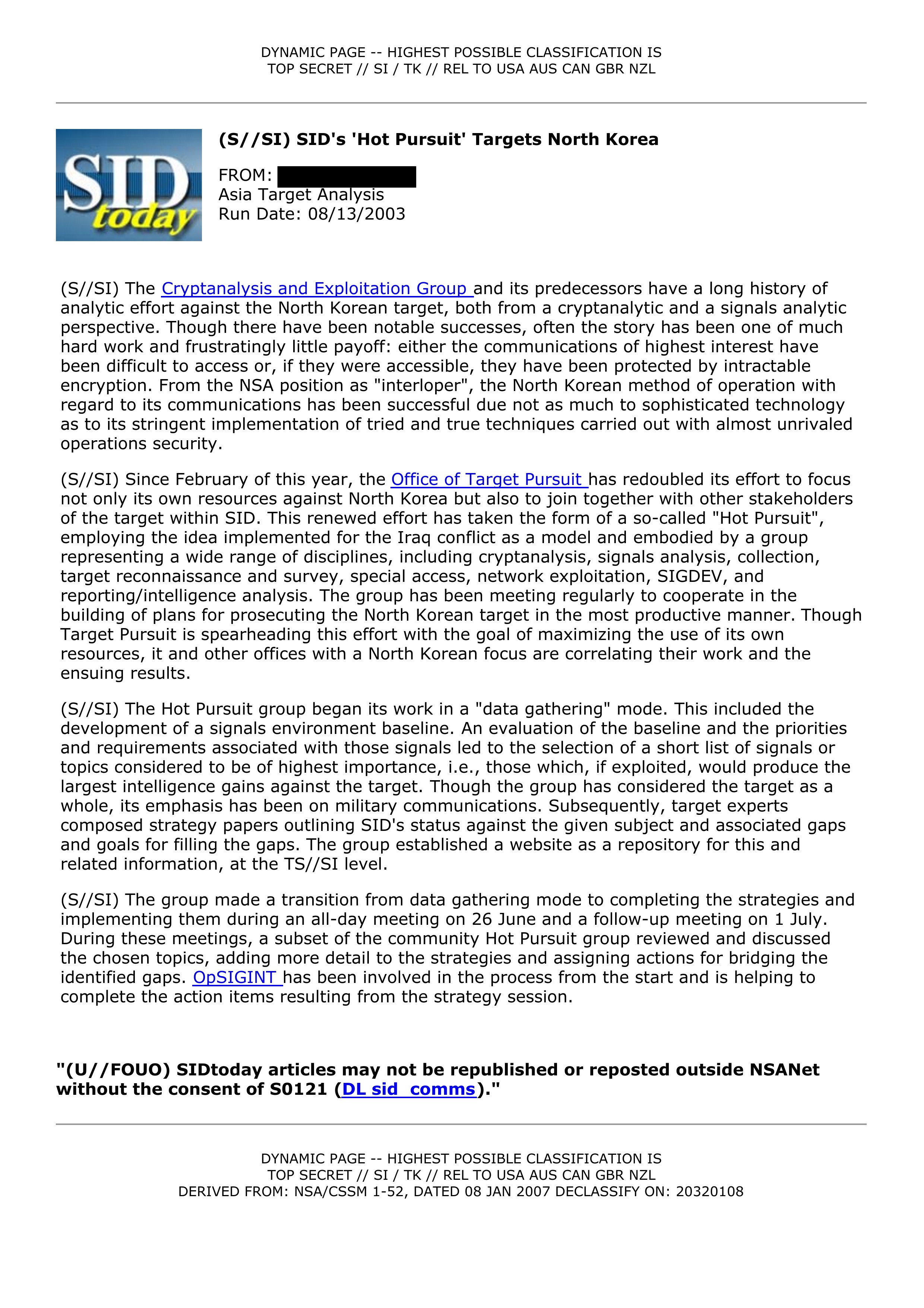
(S//SI) The Cryptanalysis and Exploitation Group and its predecessors have a long history of analytic effort against the North Korean target, both from a cryptanalytic and a signals analytic perspective. Though there have been notable successes, often the story has been one of much hard work and frustratingly little payoff: either the communications of highest interest have been difficult to access or, if they were accessible, they have been protected by intractable encryption. From the NSA position as "interloper", the North Korean method of operation with regard to its communications has been successful due not as much to sophisticated technology as to its stringent implementation of tried and true techniques carried out with almost unrivaled operations security.
(S//SI) Since February of this year, the Office of Target Pursuit has redoubled its effort to focus not only its own resources against North Korea but also to join together with other stakeholders of the target within SID. This renewed effort has taken the form of a so-called "Hot Pursuit", employing the idea implemented for the Iraq conflict as a model and embodied by a group representing a wide range of disciplines, including cryptanalysis, signals analysis, collection, target reconnaissance and survey, special access, network exploitation, SIGDEV, and reporting/intelligence analysis. The group has been meeting regularly to cooperate in the building of plans for prosecuting the North Korean target in the most productive manner. Though Target Pursuit is spearheading this effort with the goal of maximizing the use of its own resources, it and other offices with a North Korean focus are correlating their work and the ensuing results.
(S//SI) The Hot Pursuit group began its work in a "data gathering" mode. This included the development of a signals environment baseline. An evaluation of the baseline and the priorities and requirements associated with those signals led to the selection of a short list of signals or topics considered to be of highest importance, i.e., those which, if exploited, would produce the largest intelligence gains against the target. Though the group has considered the target as a whole, its emphasis has been on military communications. Subsequently, target experts composed strategy papers outlining SID's status against the given subject and associated gaps and goals for filling the gaps. The group established a website as a repository for this and related information, at the TS//SI level.
(S//SI) The group made a transition from data gathering mode to completing the strategies and implementing them during an all-day meeting on 26 June and a follow-up meeting on 1 July. During these meetings, a subset of the community Hot Pursuit group reviewed and discussed the chosen topics, adding more detail to the strategies and assigning actions for bridging the identified gaps. OpSIGINT has been involved in the process from the start and is helping to complete the action items resulting from the strategy session.
"(U//FOUO) SIDtoday articles may not be republished or reposted outside NSANet without the consent of S0121 (DL sid_comms)."
DYNAMIC PAGE -- HIGHEST POSSIBLE CLASSIFICATION IS
TOP SECRET // SI / TK // REL TO USA AUS CAN GBR NZL
DERIVED FROM: NSA/CSSM 1-52, DATED 08 JAN 2007 DECLASSIFY ON: 20320108
Related Documents
-
'Focused Pursuits' Hunt Down SIGINT Targets SIDtoday [pdf]
The Pursuit Operation Staff manages the NSA’s specific plans for hunting a target of intelligence interest. “Focused Pursuits” bring together a working group of people, organizations, and services from across the NSA to join the hunt.
The Intercept ↗ (2018-03-01) -
Efforts Against Virtual Private Networks Bear Fruit SIDtoday [pdf]
Recent progress in exploiting Virtual Private Networks has resulted in access to “hundreds” of secure links, including Al Jazeera’s internal communications.
The Intercept ↗ (2018-08-15) -
Research & Technology – Penetrating Hard Targets [pdf]
The NSA’s “Penetrating Hard Targets” program aims at developing a cryptologically useful quantum computer capable of breaking strong encryption systems, including those protecting global financial and government communications. Conducted under the U.S. intelligence “black budget,” the program focuses on quantum physics research, engineering studies, and experimental milestones such as achieving dynamical decoupling and quantum control on semiconductor qubits, which are foundational for scaling to larger systems. A related initiative, “Owning the Net,” explores quantum communication technologies to develop new Quantum Key Distribution (QKD) attacks and assess the security of emerging encryption methods.
-
Ambassador Wendy Sherman Speaks on North Korea SIDtoday [pdf]
Ambassador Sherman believes that North Korea will continue its nuclear program or may have already succeeded in developing weapons. SIGINT on the issue was "absolutely indispensable" and "critical for arms control and verification."
Marking: UNCLASSIFIEDPeople: Sherman, WendyThe Intercept ↗ (2016-12-07) -
North Korea Rock Drill Held This Week SIDtoday [pdf]
A North Korea “rock drill” featuring experts from across the cryptologic community was held to prepare the cryptologic system to better support policymakers and war fighters.
People: Quirk, RichardThe Intercept ↗ (2016-05-16)