Voice Biometrics Capability Proven During Recent Technology Demonstration
Open PDFDocument date: 2008-09-15
Type: SIDtoday
Pages: 2
Genre: newsletter
Banner: DYNAMIC PAGE -- HIGHEST POSSIBLE CLASSIFICATION IS TOP SECRET // SI / TK // REL TO USA AUS CAN GBR NZL
Classification: SECRET SI
Dissemination: REL
The Coordinate Operational Resources for Voice Exploitation Technology (CORVET) project, managed by the Expeditionary SIGINT Services Office (ESSO), demonstrated a promising capability for voice biometrics that could be used in security operations to identify individuals based on voice characteristics. Similar to the long-established method of fingerprinting, CORVET aims to create a database of voice models that could be used for identification in various contexts, such as detention and force-protection scenarios.
My notes
DYNAMIC PAGE -- HIGHEST POSSIBLE CLASSIFICATION IS
TOP SECRET // SI / TK // REL TO USA AUS CAN GBR NZL
SIDtoday
(U//FOUO) Voice Biometrics Capability Proven During Recent Technology Demonstration
FROM: [REDACTED]
Deputy Chief, Expeditionary Requirements Division (S14R)
Run Date: 09/15/2008
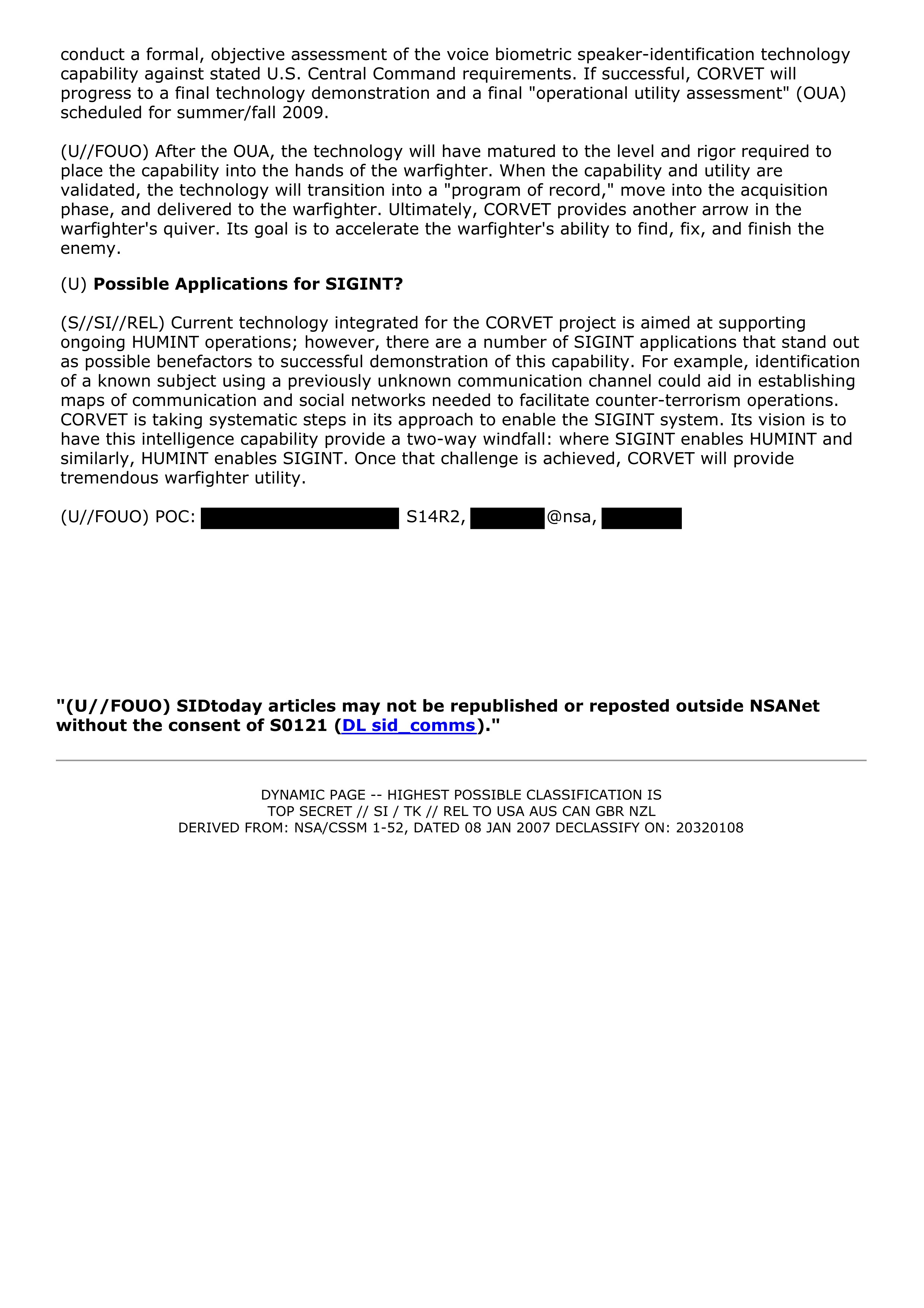
(U//FOUO) If a Crime Scene Investigator can recover forensic evidence, such as a portion of a fingerprint, characterize the patterns that make up that print, compare those fragments to a national database, identify a culprit, solve the crime and wrap-up a conviction in less than an hour-long television show, why couldn't the same occur with a voice snippet recorded at an entry control point or even during a patrol in a hostile area? A Joint Capability Technology Demonstration (JCTD) project, called Coordinate Operational Resources for Voice Exploitation Technology (CORVET), managed by the Expeditionary SIGINT Services Office (ESSO), External Programs Branch, recently demonstrated a solution that promises to do just that.
(U) About Biometrics
(U//FOUO) Over 100 years ago, the Calcutta Anthropometric Bureau in India approved using fingerprints as a means to identify people. The Henry Classification System, developed by Azizul Haque and Hem Chandra Bose, and formalized by the United Kingdom's Edward Richard Henry, was the basis of the world's first accurate method to identify people based on quantifiable physical characteristics. The field of biometrics, which includes fingerprints, has expanded to include iris scans, hand geometry, facial recognition and DNA analysis as methods available for this purpose.
(U//FOUO) CORVET's Goals
(U//FOUO) The External Programs Branch (S14R2) has been involved in establishing a capability for a new method, or modality, of biometrics using voice characteristics to determine the identity of a subject. In CORVET, a model, based on an initial recording taken from a person of interest, is created and associated with other biometric data from that person and stored in a database. Subsequent voice collections can be compared with the stored models and used to identify the person of interest at a later time. Under these circumstances, voice biometrics will play a pivotal role in Department of Defense's goal of attaining "identity dominance." As a result, the adversary will no longer be able to hide behind false representations.
(U//FOUO) CORVET interview station
(U//FOUO) Past and Future Steps for the CORVET Project
(S//REL) S14R2 serves as the Technical Manager (TM) for CORVET. This project integrates present technology to identify a person based on their voice characteristics. Current efforts combine software developed at the Air Force Research Laboratory (AFRL) and existing biometric collection hardware to provide a means for warfighters to identify subjects that have had voice biometrics collected and processed. Under the two-year project, the demonstration focuses on detention operations and force-protection scenarios, where the tools' ability to distinguish among the individuals who come and go can be tested. As the capability refines, other scenarios will be explored.
(U//FOUO) The next step for the CORVET team will be to participate in a "limited utility assessment" (LUA), scheduled to take place at the INSCOM Detainee Training Facility (IDTF) Camp Bullis, San Antonio, Texas, during 22- 26 September 2008. The purpose of the LUA is to conduct a formal, objective assessment of the voice biometric speaker-identification technology capability against stated U.S. Central Command requirements. If successful, CORVET will progress to a final technology demonstration and a final "operational utility assessment" (OUA) scheduled for summer/fall 2009.
(U//FOUO) After the OUA, the technology will have matured to the level and rigor required to place the capability into the hands of the warfighter. When the capability and utility are validated, the technology will transition into a "program of record," move into the acquisition phase, and delivered to the warfighter. Ultimately, CORVET provides another arrow in the warfighter's quiver. Its goal is to accelerate the warfighter's ability to find, fix, and finish the enemy.
(U) Possible Applications for SIGINT?
(S//SI//REL) Current technology integrated for the CORVET project is aimed at supporting ongoing HUMINT operations; however, there are a number of SIGINT applications that stand out as possible benefactors to successful demonstration of this capability. For example, identification of a known subject using a previously unknown communication channel could aid in establishing maps of communication and social networks needed to facilitate counter-terrorism operations.
CORVET is taking systematic steps in its approach to enable the SIGINT system. Its vision is to have this intelligence capability provide a two-way windfall: where SIGINT enables HUMINT and similarly, HUMINT enables SIGINT. Once that challenge is achieved, CORVET will provide tremendous warfighter utility.
(U//FOUO) POC: [REDACTED] S14R2, [REDACTED]@nsa, [REDACTED]
"(U//FOUO) SIDtoday articles may not be republished or reposted outside NSANet without the consent of S0121 (DL_sid_comms)."
DYNAMIC PAGE -- HIGHEST POSSIBLE CLASSIFICATION IS
TOP SECRET // SI / TK // REL TO USA AUS CAN GBR NZL
DERIVED FROM: NSA/CSSM 1-52, DATED 08 JAN 2007 DECLASSIFY ON: 20320108
Published in the Same Report
(10 of 21 documents)
-
RT10 Initiative Overview [pdf]
Overview document for RT10, "Real-time, distributed architecture for mobile (tactical) and fixed (national) operational environments"
Programs: RT10 · COBRA FOCUS · GREENDRAGON · GOLDMINER · JUGGERNAUT · MATTERHORN · OBELISK · SORTINGHAT · INFOVIS · SHARPFOCUS2 · TOGA · SORTINGLEAD · GLOBALREACH · VOICERT · QUADRASPECTRE · RENOIR · ANALYSTSNOTEBOOK · OCTAVE · HLT · DRT · GEOT · InnoVisions -
NSA Georgia Opens New Audio-Forensics Lab SIDtoday [pdf]
The document discusses the launch of a new audio-forensics lab at NSAG (National Security Agency Georgia) designed to enhance the processing and analysis of intercepted voice communications. The lab, funded through the Senior Language Technology Authority (SLTA), will focus on resolving language processing challenges for language analysts by improving the intelligibility and quality of foreign-language voice intercepts.
People: Mercer, Marti Hix -
Alert: Voice Masking Is Discovered in SIGINT SIDtoday [pdf]
This March 2007 post from the internal NSA newsletter SIDToday draws attention to voice-masking technology used by subjects of surveillance to frustrate the agency’s voice-recognition efforts.
-
Tips for a Successful Quick Reaction Capability SIDtoday [pdf]
In response to Iranian President Ahmadinejad’s 2007 visit to New York, the NSA’s Iran Government and Leadership branches launched a Quick Reaction Capability (QRC) to gather time-sensitive intelligence. The QRC focused on enhanced collection techniques, collaboration across departments, and efficient data management to analyze the extensive communications traffic during the event, resulting in valuable leads on Iranian leadership activities and diplomatic plans.
People: Ahmadinejad, Mahmoud -
New RT-RG Overview Video Available on NSANet SIDtoday [pdf]
The NSA's Meade Operations Center released a 10-minute video overview of the Real-Time Regional Gateway (RT-RG), a tool suite designed for forward-deployed analysts. The suite enables faster access to real-time metadata and reporting, improving tactical support for military operations, with new functionalities being developed for use in Afghanistan and beyond.
-
Alvin, Simon, and... Al Qaeda? Finding Modified Voice in SIGINT Traffic SIDtoday [pdf]
This SIDtoday article discusses the use of voice modification technology by Al-Qaeda and other extremist groups to evade identification in SIGINT traffic. It highlights the development of the HLT Lite software by R64, which can automatically detect modified voices in intercepted communications, enabling the identification of targets even when traditional voice recognition fails.
-
Come to SID's Identity Intelligence (I2) Day Conference and See Your Target in a Whole New Light! SIDtoday [pdf]
This SIDtoday article promotes NSA's Identity Intelligence (I2) Day Conference, highlighting the importance of using SIGINT tools and techniques to track individuals across time and space. It emphasizes the growing role of biometrics, biographic data, and digital footprints in identifying and targeting foreign persons of interest, with insights from key speakers and case studies.
-
SIGINTers Use Human Language Technology to Great Advantage, Isolate Conversation about Threat to US Official SIDtoday [pdf]
In 2010, the Special Collection Service in Mexico City began using Human Language Technology (HLT) to streamline voice collection and analysis, significantly improving efficiency. By rapidly filtering through large volumes of audio data, HLT helped isolate critical intelligence, such as identifying a conversation related to a bomb threat targeting a U.S. Embassy official, all within minutes instead of hours.
Programs: HLT -
Innov8 Voice Analytics Experiment Profile [pdf]
This document outlines Phase 1 of a Voice Analytics experiment conducted by GCHQ in partnership with the NSA, testing the ingestion and processing of voice data through the DISTILLERY platform on GHOSTMACHINE hardware. The experiments evaluate independent, parallel, and linked analytics (SAD, GID, LID), as well as dynamic resource management, to ensure accurate, scalable, and compliant voice processing in a Joint Collaboration Environment.
Marking: TOP SECRET -
Voice Fax User Group Minutes December 2010 [pdf]
This GCHQ document is a NSA/GCHQ meeting record from December 2010 detailing the deployment of voice analytics, including speech activity detection, speaker identification, and language identification, integrated with tools like Google Earth to map locations of target communications. It outlines ongoing and planned speaker ID operations against specific targets, including militant leaders and foreign officials, demonstrating the operational use of voice recognition for intelligence collection and geolocation.


Related Documents
-
RAD on the Road -- Technology Demonstration Center SIDtoday [pdf]
Announcing weekly Research Associate Directorate events for the month of August so people can "talk directly with NSA researchers and have a say in the future direction of RAD tools and products."
The Intercept ↗ (2017-04-24) -
Come to SID's Identity Intelligence (I2) Day Conference and See Your Target in a Whole New Light! SIDtoday [pdf]
This SIDtoday article promotes NSA's Identity Intelligence (I2) Day Conference, highlighting the importance of using SIGINT tools and techniques to track individuals across time and space. It emphasizes the growing role of biometrics, biographic data, and digital footprints in identifying and targeting foreign persons of interest, with insights from key speakers and case studies.
-
Alvin, Simon, and... Al Qaeda? Finding Modified Voice in SIGINT Traffic SIDtoday [pdf]
This SIDtoday article discusses the use of voice modification technology by Al-Qaeda and other extremist groups to evade identification in SIGINT traffic. It highlights the development of the HLT Lite software by R64, which can automatically detect modified voices in intercepted communications, enabling the identification of targets even when traditional voice recognition fails.
-
Tips for a Successful Quick Reaction Capability SIDtoday [pdf]
In response to Iranian President Ahmadinejad’s 2007 visit to New York, the NSA’s Iran Government and Leadership branches launched a Quick Reaction Capability (QRC) to gather time-sensitive intelligence. The QRC focused on enhanced collection techniques, collaboration across departments, and efficient data management to analyze the extensive communications traffic during the event, resulting in valuable leads on Iranian leadership activities and diplomatic plans.
People: Ahmadinejad, Mahmoud -
Al-Hakayimah : The Face that Goes with the Voice SIDtoday [pdf]
A new Ayman Al-Zawahiri video contained a "bonus" message from a known Egyptian terror suspect. Using MIT technology, previous voice intercepts were used to confirm his identity. In spite of clipped audio in one intercept, the technology provided "consistent results."
The Intercept ↗ (2019-05-29)