Tag: legal authorities 22 documents
Search documents matching “legal authorities” →Free-text subjects the curators added. Unlike the other axes these are not necessarily from the documents' own vocabulary, so they are the loosest thing to browse by (and the most forgiving).
Graphs
By Banner
By Classification
Refine (combine with another filter, via search)
Sort: Title
Documents
-
CNO Legal Authorities [pdf]
An NSA Office of General Counsel briefing on the legal authorities for computer network operations and the NTOC floor: constitutional and EO 12333 limits, NSCID 6 definitions, Wiretap Act exceptions, NSD 42, service-provider information-assurance rules (DoD 5240.1-R), and oversight and compliance.
-
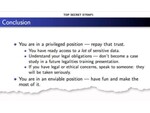
Access to the future [pdf]
The conclusion slide excerpt of a GCHQ presentation on TEMPORA, telling analysts they are in a "privileged" and "enviable" position with ready access to a great deal of sensitive data, and to "have fun and make the most of it".
Programs: TEMPORA -
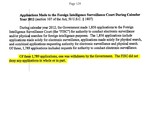
Applications Made to the Foreign Intelligence Surveillance Court During Calendar Year 2012 [pdf]
The statutory report on applications to the Foreign Intelligence Surveillance Court in calendar year 2012: 1,856 applications, 1,789 of them seeking electronic surveillance, one withdrawn by the government and none denied in whole or in part.
-
BLARNEY Team Provides Outstanding Support to Enable UN Security Council Collection [pdf]
An SSO item describing how the BLARNEY team, NSA lawyers and the FBI obtained four FISA court orders in days — for Gabon, Uganda, Nigeria and Bosnia — after Ambassador Susan Rice asked for SIGINT on undecided countries ahead of the June 2010 UN Security Council vote on sanctions against Iran.
Programs: BLARNEYPeople: Rice, Susan -
DNI, attorney general certify surveillance targets 'reasonably believed' to be outside U.S. [pdf]
In this document, the director of national intelligence and the attorney general certify that there are procedures in place to ensure that surveillance conducted under Section 702 of the FISA Amendments Act will be limited to targeting people "reasonably believed to be located outside the United States." They state that the foreign intelligence to be collected "concerns foreign powers" as defined by statute. The list of foreign powers is in Exhibit F.
-
Doing SIGINT Against Public Broadcasts SIDtoday [pdf]
SIGINT is not normally associated with the press or public broadcasts, but "times change." Does the NSA have the authority to conduct SIGINT against such targets? The NSA's Office of General Counsel concludes it can, but only "for the purpose of deriving technical data concerning such signals."
The Intercept ↗ (2016-12-07) -
FISA Amendments Act of 2008 Section 702 summary document [pdf]
This document summarizes the way the law works and describes the three types of certifications used to permit the surveillance, as well as targeting and minimization procedures. The three certification are for foreign governments, counterterrorism and WMD/proliferation.
-
FISA judge's order authorizing surveillance of foreign governments and organizations [pdf]
With this order dated Aug. 19, 2010, John D. Bates, then-Chief Judge of the Foreign Intelligence Surveillance Court, approved an annual certification permitting the National Security Agency to conduct surveillance about 193 foreign governments, foreign factions, foreign-based political organizations and foreign entities such as the World Bank. Each year, a new certification must be approved by the court to permit such surveillance under Section 702 of the FISA Amendments Act.
Marking: SECRETPeople: Bates, John D. -
How the NSA verifies a target's location [pdf]
This is an excerpt from a transcript of National Security Agency training videos that describe how to verify the location of a targeted device. It explains how the NSA monitors different types of mobile signaling information known as HLR and VLR registrations in order to locate individuals. It also makes clear that the agency is able to use location tracking to ascertain whether a target is in the United States.
-
HRA auditing [pdf]
This GCHQ internal wiki page provides detailed procedural guidance for conducting Human Rights Act (HRA) compliance audits of analyst activities using surveillance databases like BROAD OAK and Events, establishing quarterly and six-monthly random sampling schedules, defining compliance metrics (Red <75%, Amber 75-94%, Green ≥95%), and specifying the responsibilities of analysts, auditors, and business unit heads to demonstrate that targeting, tasking, and examination of intercept content or metadata meet legal requirements for necessity and proportionality.
Marking: UK CONFIDENTIAL -
Intelligence Oversight Training -- Register Your Compliance SIDtoday [pdf]
Each year, SID employees must complete Intelligence Oversight training, to be reported to NSA's Inspector General office. As of September 8, 2004, only 60 percent of the workforce completed their training, and that needed to be 100 percent by September 30. The article explains who must complete this process, what reading materials they must review (legal documents that justify NSA's surveillance authorities), where to access this reading material, when it's due, and why. ("The basic principles behind these documents is the right to privacy.")
The Intercept ↗ (2017-04-24) -
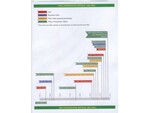
N.S.A. Timeline of Surveillance Law Developments [pdf]
This chart, apparently from an internal N.S.A. presentation, lists milestones in surveillance rules over nearly four decades. The July 2002 “Raw Take” sharing order, whose existence has not previously been disclosed, is just one of three rulings by the Foreign Intelligence Surveillance Court to make the list. The other two were 2004 and 2006 rulings allowing bulk collection of data about emails and phone calls.
-
New Contact-Chaining Procedures to Allow Better, Faster Analysis SIDtoday [pdf]
The SIGINT Management Directive 424 briefing (Jan 2011) announces a major procedural shift at the NSA, allowing analysts to conduct contact chaining and large-scale metadata analysis from any selector, regardless of nationality or location. This change removes prior restrictions on U.S. data, enabling more powerful social network mapping for foreign intelligence purposes.
Programs: GATEKEEPER -
New Intelligence Oversight Training Process SIDtoday [pdf]
Each year, as part of Intelligence Oversight training, all SID employees are required to read the five legal documents that govern SID's mission. "The basic principle behind these documents is the right to privacy. Since the SID mission involves electronic surveillance, it is subject to strict control under the U.S. Constitution."
The Intercept ↗ (2016-12-07) -
NSA document on targeting Five Eyes countries and territories [pdf]
This document states that the National Security Agency is prohibited from conducting foreign surveillance on the "Five Eyes" countries, which include U.S. allies Australia, Canada, New Zealand and the United Kingdom, or their territories.
-
NSA Hosts Conference on Support to Law Enforcement SIDtoday [pdf]
NSA hosted a conference on cryptanalytic support to law enforcement for partners from all Five Eyes countries, including representatives from general counsel, policy, cryptanalytic offices, and representatives of FBI, Royal Canadian Mounted Police, and the UK's National Technical Assistance Center.
Marking: CONFIDENTIALThe Intercept ↗ (2017-04-24) -
PRESTON Business Processes [pdf]
The PRESTON Business Processes document outlines GCHQ’s internal workflows for authorizing, enabling, managing, and terminating communications interception, as well as producing intelligence from intercepted data. It defines the roles, responsibilities, and technical processes that support lawful interception operations within the PRESTON system.
-
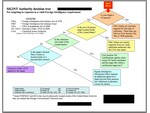
SIGINT Authority decision tree [pdf]
A one-page NSA training chart that walks an analyst from a targeting request to the legal authority that covers it, branching on whether the target is a US person, where the target is, where the collection site is, and whether the target is a Second Party citizen.
-
Special Source Collection - March 2013 [pdf]
A March 2013 NSA Special Source Operations briefing for the NSA Threat Operations Center outlining SSO's portfolio of surveillance programs, their legal authorities, and operational constraints — revealing that SSO accounts for approximately 60% of NSA content collection and 75% of metadata collection, and mapping all major collection programs across three access categories: foreign partner, corporate, and unilateral.
-
The Who, What, When, Where and Why of Oversight Training SIDtoday [pdf]
NSA's annual intelligence oversight training is the required reading of five legal documents that govern the signals intelligence mission. The documents are available on the NSA web.
The Intercept ↗ (2017-09-13)