Publisher: The New York Times 36 documents
Search documents matching “The New York Times” →Who published each document. Mostly a news outlet, but sometimes a book. A partner outlet that reported the story without publishing the documents keeps its byline and its article, but is not a publisher here.
Graphs
By Banner
By Classification
Refine (combine with another filter, via search)
Sort: Title
Documents
-
Ashcroft Memo on Intelligence Sharing Procedures [pdf]
In August 2002, citing a recent surveillance court ruling, then-Attorney General John Ashcroft issued new procedures that lowered safeguards on providing to foreign governments information about Americans that was deemed relevant intelligence about terrorism issues. Under procedures disclosed in a 1984 report on the Foreign Intelligence Surveillance Act, the attorney general had to approve any international dissemination; the new procedures have allowed the National Security Agency to share such information without Justice Department clearance.
People: Ashcroft, John -
BULLRUN CoI - Briefing Sheet [pdf]
A GCHQ briefing sheet introducing the BULLRUN Community of Interest — the access control framework protecting Five Eyes capabilities to defeat encryption across TLS/SSL, HTTPS, SSH, VPNs, IPSec, encrypted chat and encrypted VoIP — covering the classification structure, handling procedures and protective marking guidance for intelligence derived from cryptanalytic exploitation.
“N.S.A. Able to Foil Basic Safeguards of Privacy on Web” - The New York Times ↗ (2013-09-05) · “Revealed: The NSA's Secret Campaign to Crack, Undermine Internet Security” - ProPublica ↗ (2013-09-05) · “Prying Eyes: Inside the NSA's War on Internet Security” - Der Spiegel ↗ (2014-12-28) · Perlroth, Nicole · Larson, Jeff · Shane, Scott · Appelbaum, Jacob · Gibson, Aaron · Grothoff, Christian · Müller-Maguhn, Andy · Poitras, Laura · Sontheimer, Michael · Stöcker, Christian -
Classification Guide for FISA, the Protect America Act and the FISA Amendments Act [pdf]
The Foreign Intelligence Surveillance Act regulates spying for national security purposes on domestic soil. This guide lays out secrecy restrictions for various aspects of those programs. Among other things, it mentions the Large Content FISA order, a term that has not previously been disclosed.
-
CNO Legal Authorities [pdf]
An NSA Office of General Counsel briefing on the legal authorities for computer network operations and the NTOC floor: constitutional and EO 12333 limits, NSCID 6 definitions, Wiretap Act exceptions, NSD 42, service-provider information-assurance rules (DoD 5240.1-R), and oversight and compliance.
-
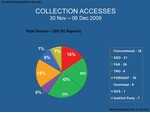
Collection Accesses 30 Nov - 06 Dec 2009 [pdf]
This National Security Agency chart shows the varied sources of 103 “accesses” to communications or computers collected in a single week in 2009 at the N.S.A.’s big station in San Antonio, Texas.
Programs: SSO -
Converged Analysis of Smartphone Devices [pdf]
This 2010 document outlines NSA methods for identifying, processing, and exploiting data from smartphones by targeting both telephony and digital network intelligence (DNI). It details how analysts use tools like XKEYSCORE and metadata extraction to collect geolocation, app data, call logs, unique identifiers, and user activity from popular mobile apps and services (e.g., Google Maps, Facebook, Flickr), emphasizing the intelligence potential of smartphones as rich surveillance targets.
People: Kuruc, Paula -
FAIRVIEW dataflow charts April 2012 [pdf]
This document outlines data flow diagrams that show how various types of sensitive communication, including voice, fax, and modem traffic, are handled through systems operated by the NSA and its partners. These partners include corporations, telecommunications companies, ISPs, and other entities involved in processing and managing the data through secure and classified channels. The document covers processing flows for various data types, metadata, and communications systems under NSA's control, detailing how data is routed, stored, and analyzed across different platforms and sites.
Programs: FAIRVIEW · SAGUARO · TURNSTILE · MESA · TITANPOINT · RIMROCK · MAILORDER · PINECONE · BLARNEY · STONEGATE · TINSEL · CONVEYANCE · FISHWAY · NUCLEON · PINWALE · SCISSORS · COURIERSKILL · DRIFTWOOD · ASDF · FALLOUT · MARINA · LOPERS · WEALTHYCLUSTER · PUPR · CLEARSIGHT · MIDFIELD · CADENCE · BUGCATCHER · WAYLAND · DESOTO · GATEKEEP · HIGHDECIBEL · XKEYSCORE · YANKEE · TOPROCK · FASCIA · DISHFIRE · SEAGULL · BIGDIPPER · CORPORATE · LILDIPPER · HAVASU · WEALTHYCLUSTER2 · RAGTIME · TUMULT · TATTOO · DARKTHUNDER · ICYTWINS · TML-STATUS · WATERFRONT · VULCANDEATHGRIP · STEELFLAUTA · UNITY · KEYCARD · UTT · BTUBE · ISLANDTRANSPORT · SSO · MAINWAY · SSDM · TUBE · TITANPOINTE · TURMOIL · VPCS“NSA Spying Relies on AT&T’s ‘Extreme Willingness to Help’” - ProPublica ↗ (2015-08-15) · “AT&T Helped U.S. Spy on Internet on a Vast Scale” - The New York Times ↗ (2015-08-15) · “Titanpointe: The NSA’s Spy Hub in New York, Hidden in Plain Sight” - The Intercept ↗ (2016-11-16) · Angwin, Julia · Larson, Jeff · Savage, Charlie · Moltke, Henrik · Poitras, Laura · Risen, James · Gallagher, Ryan -
Final Cyberspace Policy Review: Appendices D and E [pdf]
Appendices D and E of a secret, REL FVEY Cyberspace Policy Review. Appendix D evaluates the Comprehensive National Cybersecurity Initiative initiatives and enablers and the status of each. Appendix E argues for an international cybersecurity policy framework, covering internet governance bodies, free speech, supply chains and deterrence.
Programs: EINSTEIN -
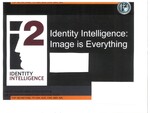
Identity Intelligence: Image Is Everything [pdf]
This document is a highly classified NSA/CSS briefing detailing Identity Intelligence (i2), a comprehensive methodology for exploiting unique fragments of information to track, identify, and exploit targets of interest. It outlines an expansive architecture for data collection that spans Biometric/Biologic, Biographic, and Contextual/Behavioral domains, essentially mapping every conceivable data point of an individual's physical existence and digital/social footprint.
-
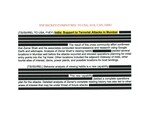
India: Support to Terrorist Attacks in Mumbai [pdf]
A top secret NSA intelligence report on GCHQ's surveillance of Lashkar-e-Taiba technology chief Zarrar Shah before and during the November 2008 Mumbai attacks, documenting how analysis of his internet browsing and viewing habits revealed reconnaissance activity and operational planning against Mumbai targets including the Taj Hotel.
People: Shah, Zarrar“In 2008 Mumbai Attacks, Piles of Spy Data, but an Uncompleted Puzzle” - The New York Times ↗ (2014-12-21) · “In 2008 Mumbai Attacks, Piles of Spy Data, But an Uncompleted Puzzle” - ProPublica ↗ (2014-12-21) · “In 2008 Mumbai Attacks, Piles of Spy Data, but an Uncompleted Puzzle” - PBS ↗ (2014-12-21) · Glanz, James · Rotella, Sebastian · Sanger, David E. · Jennings, Tom · Peevey, Anna Belle · Nieling, Michael -
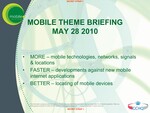
Mobile Theme Briefing (May 28, 2010) [pdf]
This 2010 GCHQ briefing document outlines the “Mobile Applications Project,” which aims to expand intelligence capabilities to exploit the growing shift from fixed to mobile internet usage. It details objectives for targeting mobile apps and roaming network traffic (GRX), enabling converged analysis of voice, text, command-and-control, and geolocation data across multiple mobile platforms such as iPhone, Symbian, Android, and Windows Mobile. See also: EFF_-_20140128-guard-leaky_phone_apps_0 (includes other slides from the same slideset)
Programs: Mobile Applications Project -
N.S.A. Memo Expands Access to FISA Information [pdf]
In 2006, the National Security Agency sought to expand access to Foreign Intelligence Surveillance Act information — previously limited to its headquarters in Fort Meade, Md. — to its code-breakers in Georgia, Texas and Hawaii. Part of the deliberations focused on a problem that raised the possibility that the agency had violated rules the surveillance court established for handling the information.
-
N.S.A. Timeline of Surveillance Law Developments [pdf]
This chart, apparently from an internal N.S.A. presentation, lists milestones in surveillance rules over nearly four decades. The July 2002 “Raw Take” sharing order, whose existence has not previously been disclosed, is just one of three rulings by the Foreign Intelligence Surveillance Court to make the list. The other two were 2004 and 2006 rulings allowing bulk collection of data about emails and phone calls.
-
New Contact-Chaining Procedures to Allow Better, Faster Analysis SIDtoday [pdf]
The SIGINT Management Directive 424 briefing (Jan 2011) announces a major procedural shift at the NSA, allowing analysts to conduct contact chaining and large-scale metadata analysis from any selector, regardless of nationality or location. This change removes prior restrictions on U.S. data, enabling more powerful social network mapping for foreign intelligence purposes.
Programs: GATEKEEPER -
New FAA702 Certification in the Works - Cyber Threat [pdf]
A 23 March 2012 SSO article on a draft FAA 702 certification for cyber threats. It would let analysts task selectors tied to malicious cyber activity without attributing them to a foreign government or terrorist group, and would codify tasking of IP addresses and code strings through PRISM and the upstream accesses.
-
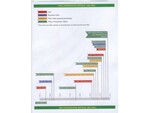
NSA Cyber Timeline (Some Key SSO Cyber Milestone Dates Since Fall 2005) [pdf]
A one-page NSA SSO timeline of cyber-related milestones from fall 2005 to late 2012: CNCI implementation, the Protect America Act and FISA Amendments Act certifications, TURMOIL and XKEYSCORE deployments, and the August 2012 Iranian DDoS attack on Saudi Aramco.
Programs: TURMOIL · SSO · BLUESNORT · DANCINGOASIS · MADCAPOCELOT · TURBULENCE · XKEYSCORE · WEALTHYCLUSTER -
NSA Video Games Paper [pdf]
The NSA paper entitled “Games: A Look at Emerging Trends, Uses, Threats, and Opportunities in Influence Activities” stresses the risk of leaving gaming communities under-monitored and how the NSA and GCHQ are conducting surveillance in various online games, collecting gamers' chat data, and deploying agents into World of Warcraft and Second Life.
People: Garite, Matt · Prasad, Kaira · Castronova, Edward · DeBenedictis, Steven · Robbins, Brian · Dunin, Elonka · Estanislao, Jon · James, Daniel · Valadares, Jeferson · Kushner, David · Ondrejka, Corey · Bonk, Curtis J. · Dennen, Vanessa P. · Lindstrom, Martin · Yee, Nick · Jayaganthan, Rengaswamy · Tawil-Souri, Helga · Soussi, Alasdair · Baertlein, Lisa · Brachman, Jarret M. · Rolston, David · Dille, Flint · Bilson, David S. · Bray, Hiawatha · Morgan, Dan · Henry, Dean · Halper, Keith · Pardew, Leslie A. · Betrus, Anthony D. · Steinkuehler, Constance A. · Gupta, Shankar · Joshi, Mahesh P. · Fong, Gwenda · Andersen, John · Reid, David · Kramer, Stephen E. · Brown, Seely · Thomas, Douglas · Phillips, Andrea · Thompson, Brooke · Alexander, Bryan · Dena, Christy · Barlow, Nova · Weimann, Gabriel · Mace, Michael · Knight, Will · Gibson, Erin · Langley, Hugh · Huang, Shih-Lian · Ruff, Chris · Gibson, Ben · Cialdini, Robert B. · Johnson, Steven · Tulloch, Paul · McLundie, Martin · Galles, Kara · Berkowitz, Jeff · May, William · Leonard, David J. · Williams, Dmitri“World of Spycraft: NSA and CIA Spied in Online Games” - ProPublica ↗ (2013-12-09) · “Spies Infiltrate a Fantasy Realm of Online Games” - The New York Times ↗ (2013-12-09) · “Xbox Live among game services targeted by US and UK spy agencies” - The Guardian ↗ (2013-12-09) · Elliott, Justin · Mazzetti, Mark · Ball, James -
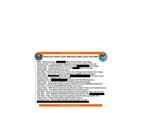
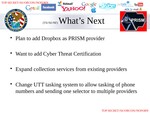
PRISM planning slide (PRISM briefing 1) [pdf]
A PRISM slide headed 'What's Next': plans to add Dropbox as a PRISM provider, add a cyber threat certification, expand collection from existing providers, and change the UTT tasking system to allow phone-number tasking.
-
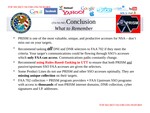
PRISM tasking slide (PRISM briefing 2) [pdf]
A PRISM slide headed 'Conclusion: What to Remember'. It says PRISM is among the most valuable NSA accesses, recommends tasking all DNI and DNR selectors to FAA 702 where they meet the criteria, and recommends Rules-Based Tasking in UTT so that PRISM and upstream SSO accesses both get the selectors.
-
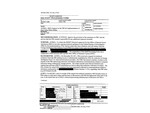
SID concur: SSO's Support to the FBI for Implementation of their Cyber FISA Orders (CATS 2012-704) [pdf]
A 2012 NSA staff processing form (CATS 2012-704) with a four-page SSO memo, concurred by the SIGINT Director on 27 March 2012. SSO would give the FBI technical help implementing FISC cyber orders (docket 11-91, which the FBI calls STYGIAN FLOW), using NSA collection and processing infrastructure (LITHIUM, ARTIFICE, TURMOIL), with the FBI responsible for the costs and for legal compliance.
People: Shea, Teresa H.