Publisher: The Intercept 2631 documents
Search documents matching “The Intercept” →Who published each document. Mostly a news outlet, but sometimes a book. A partner outlet that reported the story without publishing the documents keeps its byline and its article, but is not a publisher here.
Graphs
By document date (14 years)
By Banner
By Classification
Refine (combine with another filter, via search)
Sort: Title
Documents
-
Motivating 'Benched' Language Students SIDtoday [pdf]
In order to motivate students at the National Cryptologic School to stay the course and upgrade their skills to an operational level in much-needed languages such as Arabic, a “Day in the Life of the Levant/North Africa Division” was organized.
Marking: SECRETPrograms: LEPThe Intercept ↗ (2018-08-15) -
Mr. Black Speaks at Intelligence Analysis Off-Site SIDtoday [pdf]
At an off-site gathering of analysts, NSA Deputy Director Bill Black made a remarkable admission: “More and more frequently, our targets are also our partners. We know them personally ... yet we must also continue to anticipate their actions.” This disclosure was classified “top secret.” Black also spoke to the NSA’s need to understand cyberspace and pointed out analysts’ ability to produce “meaningful intelligence without reading the content.”
Marking: TOP SECRETPrograms: IFAThe Intercept ↗ (2018-08-15) -
My Comment SIDtoday [pdf]
Assistant Deputy Director for Analysis & Production Cindy Farkus responds to analysts expressing concerns about adding more insights - not just facts - to intelligence reports.
The Intercept ↗ (2018-08-15) -
My Four-Month Tour in Korea SIDtoday [pdf]
An intelligence analysis intern looks back on his four-month tour to South Korea. Clearest in his memory is mounting an antenna on a deserted island near the North Korean peninsula, perched above barbed wire near a beach covered with landmines, while under surveillance by North Korean “fishing boats.”
The Intercept ↗ (2018-08-15) -
MYSTIC [pdf]
These excerpts provide foundational details on the MYSTIC program, including its inception in 2009 and its structural organization. It defines MYSTIC as a program managed by the Special Source Operations (SSO) division, focusing on "embedded collection systems" within foreign wireless and mobile networks. The document confirms a deceptive operational model: the equipment is overtly installed to provide "commercial services" for telecommunications companies, while its secret purpose is to provide SIGINT (Signals Intelligence) to U.S. agencies.
-
NAC 2Q 2011 Business Review [pdf]
This document, a 2011 business plan review for the Network Analysis Centre (NAC), details GCHQ's progress in developing offensive cyber capabilities. It highlights a shift from "RED" to "GREEN" status following successful network analysis supporting operations against Iran, Argentina, and Libya.
Programs: WHICHED -
NAC BUDE Partnership - SATELLITE TELEPORT KNOWLEDGE (GCHQ) [pdf]
A top secret GCHQ Network Analysis Centre document from GCHQ Bude detailing comprehensive intelligence profiles of three German satellite teleport operators — Stellar, Ce-Tel, and IABG — including their network infrastructure, router configurations, IP ranges, employee identities, satellite customers, and login credentials, compiled to identify access chokepoints for SIGINT collection against German IP transit infrastructure.
People: Steffen, Christian · Sommer, Christoph · Fares, Ali · Grave, Richard · Steffen, Simona · Skaletz, Oliver -
National Intelligence Estimate 2009 Global Cyber Threat – Supply Chain Excerpts [pdf]
These Supply Chain Excerpts from the 2009 National Intelligence Estimate, assesses that the U.S. faces a growing cyber threat from state actors, particularly Russia and China, who have the capability and strategic intent to exploit or disrupt U.S. and allied information systems. It emphasizes vulnerabilities from supply chains, insider threats, and technology trends that favor offensive operations, while noting the difficulty of detecting and fully defending against these sophisticated cyber threats.
-
NATO Civilian Intelligence Council – Cyber Panel – US Talking Points [pdf]
This 2011 US intelligence assessment for NATO identifies cyber espionage as the principal threat to Alliance networks, ranking Russia and China as the most significant nation-state actors and advocating for a shift to a consequence-based defense model that prioritizes the protection of NATO's most critical data.
-
NBOVBM DSZQUBOBMZTJT GPSVN -- 8-12 NBZ 2006 SIDtoday [pdf]
Five eyes “cryppies” meet at GCHQ to discuss ciphers that can be cracked without the use of a machine or computer. Spoiler alert: The title translates to “MANUAL CRYPTANALYSIS FORUM -- 8-12 MAY 2006.”
The Intercept ↗ (2018-08-15) -
NCPAC Personnel Deploy to Support Operation Iraqi Freedom SIDtoday [pdf]
Six NSA personnel returned from tour at CENTCOM headquarters in Tampa where they provided support to Operation Iraqi Freedom (including researching possible locations of stockpiled WMD material).
The Intercept ↗ (2016-05-16) -
NCRs with Foreign Relations Missions Become 'SUSLAs' SIDtoday [pdf]
New titles have been created for four NSA/CSS Representatives (NCRs) to major Third Party partners. Special US Liaisons Advisors (SUSLA) to Italy and Germany were first named, now followed by Special US Liaison Advisors to Turkey (SUSLAT), Thailand (SUSLAB), Japan (SUSLAJ) and Korea (SUSLAK).
People: Schwemin, Sharon“Turkey Is 'Partner and Target' for the NSA” - Der Spiegel ↗ (2014-08-31) · “How the NSA Helped Turkey Kill Kurdish Rebels” - The Intercept ↗ (2014-08-31) · The Intercept ↗ (2019-05-29) · Poitras, Laura · Rosenbach, Marcel · Sontheimer, Michael · Stark, Holger -
NCTC Current Status of Major Terrorism Figures [pdf]
A TOP SECRET joint HUMINT–COMINT status report from June 2008 summarizes the whereabouts and threat posture of senior al‑Qaida leaders, highlighting Usama bin Ladin, Ayman al‑Zawahiri, and a key courier assessed as critical to locating them. The document reflects U.S. intelligence tracking priorities just three years before bin Ladin’s death.
-
NCTC Update SIDtoday [pdf]
An update on the National Counterterrorism Center in McLean, Virginia, “the primary provider of CT information to the national leadership.”
The Intercept ↗ (2018-08-15) -
-
NDIST — GCHQ’s Developing Cyber Defence Mission [pdf]
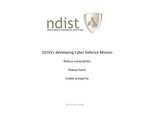
GCHQ’s NDIST sets out a developing cyber defence mission to reduce vulnerability and harm while enabling prosperity, centered on building a global-level picture of strategic threats and sharing intelligence with allies. The team anchors this work in massive telemetry, claiming roughly 100 million malware events collected per day to drive situational awareness.
-
Need Everyone's Help with Accounting for Circuit Cards, Boards, and Modules SIDtoday [pdf]
Going forward, circuit cards, boards, and modules must be bar-coded, tracked, and accounted for.
The Intercept ↗ (2018-08-15) -
Network Shaping 101 [pdf]
An NSA top-secret training presentation that uses Yemen as a case study to explain how to "shape" a nation's Internet traffic by exploiting Autonomous Systems, upstream providers, BGP routing, and physical link topology to redirect or collect communications. The slide deck walks through practical router/IP/link details, passive SIGINT collection points and limitations, and warns that many assumptions are fabricated for the lesson and that real-world capabilities and link behavior can vary.
-
New 'Open-Source Highlights' Webpage SIDtoday [pdf]
The AIRS Main Library is now offering a webpage to share open source articles selected by the NSA research library’s analysts.
The Intercept ↗ (2018-08-15) -
New 'Persian Rapid Response Cell' Aims to Fill Linguistic Gulf SIDtoday [pdf]
A new unit named the Persian Rapid Response Cell was formed to respond to crisis-related issues involving Iran and to mentor new Persian linguists.
The Intercept ↗ (2018-03-01)