Publication year: 2014 265 documents
Search documents matching “2014” →When a publisher first published each document. If a document is published multiple times, only the oldest one is used here.
Graphs
By document date (12 years)
By published date (4 years)
Sort: Title
Documents
-
GCHQ Covert Mobile Phones Policy [pdf]
A 2010 GCHQ policy lays out strict, granular rules for covert mobile phone use by traveling operatives, mandating geofenced device discipline around Cheltenham, non-attributable communications, and hard separations from personal devices to minimize traceability and exposure. It’s a clinical OPSEC playbook for the management plane of human mobility—battery pulls, charging only at the airport or destination, out‑of‑area routing—designed to reduce the digital exhaust that links officers to headquarters.
Marking: SECRETPrograms: TRYST -
GCHQ Cyber Operations Against Anonymous and Hacktivist Groups [pdf]
The leaked 2012 GCHQ presentation reveals that the agency’s JTRIG unit conducted offensive cyber operations against Anonymous and other hacktivist groups, including DDOS attacks (codenamed “Rolling Thunder”), online infiltration, and covert intelligence collection to disrupt their communications and identify key members.
-
GCHQ Hopscotch [pdf]
An internal note argues for consolidating “edges”—summarized contact pairs—into a single cloud to unify relationship graphs, streamline analytics, and simplify management of HOPSCOTCH. It’s a mundane-sounding data-migration pitch with sharp operational teeth: centralize the social graph so surveillance queries run faster and wider.
Programs: HOPSCOTCH“Operation Socialist: The Inside Story of How British Spies Hacked Belgium’s Largest Telco” - The Intercept ↗ (2014-12-13) · “Lees hier hoe de Britse geheime dienst GCHQ Belgacom aanviel” - NRC ↗ (2014-12-13) · “Britse geheime dienst bespioneerde jarenlang Belgacom-klanten” - De Standaard ↗ (2014-12-13) · Gallagher, Ryan · Modderkolk, Huib · Vanhecke, Nikolas · Eeckhaut, Mark -
GCHQ NAC review – April to June (2011) [pdf]
The GCHQ NAC review (Apr–Jun 2011) details the continuation of Operation Socialist, describing how NAC supported mapping Belgacom’s internal network and guided CNE operators to infiltrate key GRX routers. The aim was to establish positions within the network to enable man-in-the-middle (MitM) operations against roaming mobile handsets.
“Operation Socialist: The Inside Story of How British Spies Hacked Belgium’s Largest Telco” - The Intercept ↗ (2014-12-13) · “Lees hier hoe de Britse geheime dienst GCHQ Belgacom aanviel” - NRC ↗ (2014-12-13) · “Britse geheime dienst bespioneerde jarenlang Belgacom-klanten” - De Standaard ↗ (2014-12-13) · Gallagher, Ryan · Modderkolk, Huib · Vanhecke, Nikolas · Eeckhaut, Mark -
GCHQ NAC review – January to March (2011) [pdf]
The GCHQ NAC review (Jan–Mar 2011) highlights a successful MyNOC surge against GRX operators that significantly expanded intelligence on operator networks and traffic during Operation Socialist. This effort facilitated a major CNE operation against Belgacom (MERION ZETA), securing both deep and edge network access, with continued work to build on this infiltration.
“Operation Socialist: The Inside Story of How British Spies Hacked Belgium’s Largest Telco” - The Intercept ↗ (2014-12-13) · “Lees hier hoe de Britse geheime dienst GCHQ Belgacom aanviel” - NRC ↗ (2014-12-13) · “Britse geheime dienst bespioneerde jarenlang Belgacom-klanten” - De Standaard ↗ (2014-12-13) · Gallagher, Ryan · Modderkolk, Huib · Vanhecke, Nikolas · Eeckhaut, Mark -
GCHQ NAC review – January to March (2012) [pdf]
The GCHQ NAC review (Jan–Mar 2012) reports ongoing progress in maintaining CNE access to the Belgacom GRX operator, with the CNE EREPO team issuing new operational requirements to the NAC to further guide and support the hacking operation "OP Socialist".
“Operation Socialist: The Inside Story of How British Spies Hacked Belgium’s Largest Telco” - The Intercept ↗ (2014-12-13) · “Lees hier hoe de Britse geheime dienst GCHQ Belgacom aanviel” - NRC ↗ (2014-12-13) · “Britse geheime dienst bespioneerde jarenlang Belgacom-klanten” - De Standaard ↗ (2014-12-13) · Gallagher, Ryan · Modderkolk, Huib · Vanhecke, Nikolas · Eeckhaut, Mark -
GCHQ NAC review – July to September (2011) [pdf]
The GCHQ NAC review (Jul–Sep 2011) outlines the continued support by NAC following the successful OP SOCIALIST operation, focusing on mapping Belgacom’s internal network and identifying key internal GRX routers to establish man-in-the-middle (MitM) platforms targeting roaming mobile handsets.
“Operation Socialist: The Inside Story of How British Spies Hacked Belgium’s Largest Telco” - The Intercept ↗ (2014-12-13) · “Lees hier hoe de Britse geheime dienst GCHQ Belgacom aanviel” - NRC ↗ (2014-12-13) · “Britse geheime dienst bespioneerde jarenlang Belgacom-klanten” - De Standaard ↗ (2014-12-13) · Gallagher, Ryan · Modderkolk, Huib · Vanhecke, Nikolas · Eeckhaut, Mark -
GCHQ NAC review – October to December (2011) [pdf]
The GCHQ NAC review (Oct–Dec 2011) reports that the Belgacom GRX exploitation was highly successful, enabling both CNE and Crypt Ops by uncovering extensive VPN exploitation opportunities through OP SOCIALIST II. The surge operation focused on mapping mobile operators connecting via VPN, analyzing GTP traffic for target selector extraction, and identifying optimal access points—ultimately strengthening sustained network exploitation under the VERACIOUS Project.
“Operation Socialist: The Inside Story of How British Spies Hacked Belgium’s Largest Telco” - The Intercept ↗ (2014-12-13) · “Lees hier hoe de Britse geheime dienst GCHQ Belgacom aanviel” - NRC ↗ (2014-12-13) · “Britse geheime dienst bespioneerde jarenlang Belgacom-klanten” - De Standaard ↗ (2014-12-13) · Gallagher, Ryan · Modderkolk, Huib · Vanhecke, Nikolas · Eeckhaut, Mark -
GCHQ Report on the Technical Capabilities of the Powerful Espionage Program TEMPORA, which Allows for Full Take. [pdf]
In May 2012, GCHQ introduced the TEMPORA internet buffer capability, enabling full take collection of internet communications. This innovation provides NSA and GCHQ analysts access to extensive amounts of data, enhancing their analytical capabilities significantly.
-
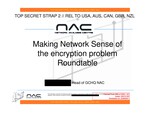
GCHQ – Making network sense of the encryption problem (2011) [pdf]
GCHQ’s Network Analysis Centre convened a 2011 roundtable on “making network sense” of encryption, pushing a metadata-first strategy to triage SSL/TLS, IKE, OpenVPN, and SSH flows, pivot from “seed” indicators, and zero in on targets and subnets worth decrypting. The playbook leans on enrichment, AS-level scoping (explicitly citing Belgacom AS6774 GRX VPNs), and “access optimisation” to collect data pre‑encryption—passively or actively.
Programs: SQUEAL · BEARDEDPIGGY · CLOUD · IRASCIBLEHARE · IRASCIBLERABBIT · IRASCIBLEMOOSE · IRASCIBLEEMITT“Operation Socialist: The Inside Story of How British Spies Hacked Belgium’s Largest Telco” - The Intercept ↗ (2014-12-13) · “Lees hier hoe de Britse geheime dienst GCHQ Belgacom aanviel” - NRC ↗ (2014-12-13) · “Britse geheime dienst bespioneerde jarenlang Belgacom-klanten” - De Standaard ↗ (2014-12-13) · Gallagher, Ryan · Modderkolk, Huib · Vanhecke, Nikolas · Eeckhaut, Mark -
-
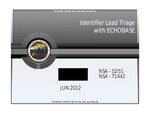
GHOSTMACHINE: Identifier Lead Triage with ECHOBASE [pdf]
This June 2012 presentation introduces ECHOBASE, an NSA analytic architecture designed to automate the triage of massive identifier lead lists (ranging from 50 to 10,000+ entries). By applying behavior-based analytics and "yes/no" behavioral queries against raw SIGINT, the system allows analysts to prioritize high-interest targets and discard irrelevant leads at scale.
Programs: GHOSTMACHINE · ECHOBASE · IDENTIFIERSCOREBOARD · FOREMAN · CONTRAOCTAVE · OCTAVE · UTT · WAVELEGAL · CASPORT · PSC -
Guidelines for the classification of NSA SIGINT details (1945-1967) [pdf]
This document is an NSA classification guide that defines how and why historical SIGINT material from 1945–1967 remains classified, in many cases for 75 years. It systematically explains which intelligence activities, targets, partnerships, and technical methods must stay protected because they still reveal sensitive sources, methods, and diplomatic equities.
-
HOMING PIGEON [pdf]
Slides on a query-focused dataset that would correlate GSM handsets seen on two or more aircraft flights with their subscribers.
“US and Britain refine their ability to tap into airline passenger’s mobile phones while they are in the air” - Le Monde ↗ (2016-12-07) · “American and British Spy Agencies Targeted In-Flight Mobile Phone Use” - The Intercept ↗ (2016-12-07) · “No Place to Hide” - Metropolitan Books ↗ (2014-05-13) · Follorou, Jacques · Greenwald, Glenn -
HR DIETMAR B - Director SIGINT Analysis and Production German Federal Intelligence Service, 30 April - 1 May 2013 [pdf]
This draft agenda outlines scheduled meetings and presentations for a collaboration event between the German Federal Intelligence Service (BND) and the NSA, held from April 30 to May 1, 2013. The agenda details various discussions on SIGINT analysis, data acquisition, and counterterrorism efforts, showcasing the active engagement between the two intelligence communities.
Programs: SSOPeople: Alexander, Keith B. -
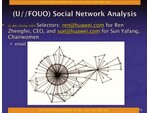
Huawei - Social Network Analysis [pdf]
This document describes Social Network Analysis targeting top leadership at Huawei. By tracking the email selectors of CEO Ren Zhengfei and Chairwoman Sun Yafang, the agency mapped their professional and personal connections.
“NSA: Imperiale Visionen” - Der Spiegel ↗ (2014-03-23) · Rosenbach, Marcel · Stark, Holger · Zand, Bernhard -
I hunt sys admins [pdf]
These internal documents outline the NSA’s strategy for identifying and targeting foreign system administrators to gain "keys to the kingdom" access to global network infrastructure. By correlating disparate datasets—such as passive telnet/SSH metadata and personal social media/webmail logins—the agency identifies personal accounts to facilitate QUANTUM-based hacking operations and network "pwnage."
-
ICREACH Black Budget Extracts [pdf]
This document provides fiscal and strategic justifications for the continued expansion of ICREACH, detailing its role as a primary vehicle for disseminating both telephony and Digital Network Intelligence (DNI) metadata across the Intelligence Community. It outlines the platform's transition to the NSA/CSS cloud architecture, a move intended to enhance data enrichment services and ensure the system remains responsive to the evolving requirements of the National Intelligence Priorities Framework (NIPF).
Programs: ICREACH -
ICREACH Wholesale Sharing (2007) [pdf]
This document serves as an official submission by the SID Technical Director detailing the leadership and collaborative efforts required to transition ICREACH from a conceptual framework into the Intelligence Community's first wholesale metadata-sharing platform. This document emphasizes the role of the SID team in securing critical legal and policy approvals through the NSA's Office of the General Counsel and coordinating with Five Eyes partners to ensure international participation in the system.
Programs: ICREACH -
ICREACH: Sharing SIGINT Comms Metadata with the Intel Community SIDtoday [pdf]
This document serves as an internal announcement marking the 2007 operational launch of ICREACH, a massive signals intelligence (SIGINT) metadata-sharing platform designed to provide real-time access to raw communication records for authorized analysts across the U.S. Intelligence Community. By consolidating telephony, cellular, and satellite data into a "one-stop shop" similar to the NSA’s internal GLOBALREACH tool, the program aimed to fulfill post-9/11 mandates for increased inter-agency collaboration and enhanced target development.