Publication year: 2014-01 9 documents
Search documents matching “2014-01” →When a publisher first published each document. If a document is published multiple times, only the oldest one is used here.
Graphs
By document date (4 years)
By published date (2 years)
Sort: Title
Documents
-
Classification guide for NSA/CSS Quantum Computing Research (10-25) [pdf]
The NSA/CSS Quantum Computing Research Classification Guide (10-25) outlines how information related to the NSA’s quantum computing research should be classified, distinguishing between unclassified academic work and classified cryptanalytic programs. It defines classification levels for research activities, breakthroughs, algorithms, collaborations, and materials, with the goal of protecting U.S. cryptographic systems while advancing the agency’s offensive capabilities in quantum cryptanalysis.
-
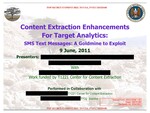
Content Extraction Enhancements For Target Analytics: SMS Text Messages: A Goldmine to Exploit (9 June 2011) [pdf]
The document describes the NSA’s Dishfire program, which collects hundreds of millions of global SMS messages daily, and the PREFER system, which extracts detailed metadata—including contacts, geolocation, travel, and financial information—from these messages for analytic purposes. It highlights the scale, operational processes, and types of data exploited to support intelligence and target analysis.
-
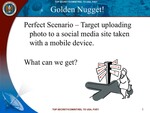
Converged Analysis of Smartphone Devices [pdf]
This 2010 document outlines NSA methods for identifying, processing, and exploiting data from smartphones by targeting both telephony and digital network intelligence (DNI). It details how analysts use tools like XKEYSCORE and metadata extraction to collect geolocation, app data, call logs, unique identifiers, and user activity from popular mobile apps and services (e.g., Google Maps, Facebook, Flickr), emphasizing the intelligence potential of smartphones as rich surveillance targets.
People: Kuruc, Paula -
CSEC Surveillance of Travellers Through Airport Wi-Fi Tracking [pdf]
The leaked 2012 top secret CSEC presentation details a trial program that used airport Wi-Fi metadata to identify and track travellers’ devices across Canada and internationally, developing advanced “IP profiling” techniques to map movements through hotels, airports, and public hotspots. The program, conducted with NSA support, aimed to build powerful analytic tools for surveillance and real-time alerts within the Five Eyes intelligence network.
Marking: TOP SECRET -
Leaky phone apps [pdf]
These GCHQ slides describe the "WARRIOR PRIDE" mobile intrusion capability being ported to iPhone and Android, with plugins for power management, remote microphone, high‑precision geolocation, kernel stealth, and self‑protection. It claims the ability to retrieve almost any content from infected phones (SMS/MMS, email, call records, photos, calendar, etc.). Part of GCHQ's project "Mobile Applications Project".
Programs: Mobile Applications Project · WARRIORPRIDE · DREAMYSMURF · NOSEYSMURF · TRACKERSMURF · PORUS · PARANOIDSMURF -
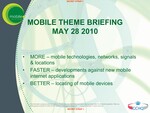
Mobile Theme Briefing (May 28, 2010) [pdf]
This 2010 GCHQ briefing document outlines the “Mobile Applications Project,” which aims to expand intelligence capabilities to exploit the growing shift from fixed to mobile internet usage. It details objectives for targeting mobile apps and roaming network traffic (GRX), enabling converged analysis of voice, text, command-and-control, and geolocation data across multiple mobile platforms such as iPhone, Symbian, Android, and Windows Mobile. See also: EFF_-_20140128-guard-leaky_phone_apps_0 (includes other slides from the same slideset)
Programs: Mobile Applications Project -
NSA Espionage During the UN Climate Change Conference (COP15) in Copenhagen [pdf]
The leaked NSA document reveals that during the 2009 Copenhagen Climate Summit (COP15), the agency and its intelligence partners collected signals intelligence on other countries’ climate negotiation strategies, including advance details of China’s coordination with India and Denmark’s confidential “rescue plan,” to provide U.S. policymakers with a strategic advantage. It underscores how espionage was integrated into diplomatic efforts to influence the outcome of global climate talks.
People: Sarkozy, Nicolas -
Psychology: A New Kind of SIGDEV [pdf]
This document presents a detailed approach to integrating human sciences—such as psychology, sociology, anthropology, economics, and political science—into intelligence operations. It highlights the use of tools like SIGINT, HUMINT, and covert online monitoring to understand and shape human behavior, influence networks, and assess socio-cultural dynamics. The focus is on using real-time data analytics, including tracking social media interactions, to optimize intelligence gathering and strategic influence.
Programs: JTRIG · HSOC · SQUEAKY DOLPHIN · DISTILLERY · AIRWOLF · ANTICRISISGIRL · SPLUNK · STREAMINGANALYTICS · HOLLOWPOINT · FIREANT · GTE“Snowden Documents Reveal Covert Surveillance and Pressure Tactics Aimed at WikiLeaks and Its Supporters” - The Intercept ↗ (2014-02-18) · “Snowden docs reveal British spies snooped on YouTube and Facebook” - NBC News ↗ (2014-01-27) · Greenwald, Glenn · Gallagher, Ryan · Esposito, Richard · Cole, Matthew · Schone, Mark -
Research & Technology – Penetrating Hard Targets [pdf]
The NSA’s “Penetrating Hard Targets” program aims at developing a cryptologically useful quantum computer capable of breaking strong encryption systems, including those protecting global financial and government communications. Conducted under the U.S. intelligence “black budget,” the program focuses on quantum physics research, engineering studies, and experimental milestones such as achieving dynamical decoupling and quantum control on semiconductor qubits, which are foundational for scaling to larger systems. A related initiative, “Owning the Net,” explores quantum communication technologies to develop new Quantum Key Distribution (QKD) attacks and assess the security of emerging encryption methods.