Publication year: 2013-08 10 documents
Search documents matching “2013-08” →When a publisher first published each document. If a document is published multiple times, only the oldest one is used here.
Graphs
By document date (4 years)
Sort: Title
Documents
-
FAA Certification Renewals with Caveats [pdf]
This NSA document shows that after the FISA Court found NSA’s upstream internet collection unconstitutional and illegal, the agency’s response was less about reform and more about finding technical and procedural workarounds to keep surveillance running as usual. While the court ordered changes within 30 days, NSA officials planned to sequester and filter “higher-risk” data to appease the judge—not halt collection—revealing a mindset focused on preserving operations rather than addressing legal violations.
-
FAA702 Glossary - Section 702 of the Fisa Amendments Act (FAA) [pdf]
This document outlines NSA rules under Section 702 of the FISA Amendments Act, which prohibit directly targeting U.S. persons or individuals inside the U.S., but quietly note a 2011 rule change allowing analysts to use U.S. person identifiers to query data already collected under 702—pending internal oversight. This effectively establishes a “backdoor search” capability enabling warrantless searches of Americans’ communications stored in NSA databases. Section 702 also gives the NSA authority to target without warrant the communications of foreign targets.
-
FISA Amendments Act Certifications and Operations [pdf]
This document exposes how, after the FISA Court found flaws in NSA’s upstream surveillance in 2011, the agency pushed through new certifications on schedule the following year and quietly used taxpayer money to cover millions in compliance costs for PRISM companies like Google and Yahoo. Rather than scaling back unconstitutional collection, the NSA treated the ruling as a logistical hurdle to manage with corporate partners, underscoring its deep financial and operational entanglement with major tech firms. Check also the document "FAA Certification Renewals with Caveats"
Programs: PRISM -
FY 2013 Congressional Budget Justification, Volume I, National Intelligence Program Summary, February 2012 [pdf]
This document outlines the $52.6 billion “black budget,” detailing the structure, priorities, successes, and shortcomings of the 16 U.S. intelligence agencies. It reveals unprecedented insight into funding allocations, operations, and intelligence gaps—including the CIA’s dominant role, expanding cyber operations, and persistent challenges in areas such as North Korea and counterterrorism—while emphasizing the tension between secrecy and public accountability.
-
Lesson 4: So you got U.S. Person Information? [pdf]
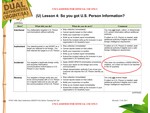
This slide is used in a training course for NSA intelligence collectors and analysts. It tells the trainees what to do if they collect communications "to, from or about" a U.S. citizen, green card holder or company. The slide's revision date is nearly one month after the Foreign Intelligence Surveillance Court ruled on Oct. 3, 2011 that the NSA's handling of some "U.S. Persons" data was unlawful. The highlighted portion of the slide is notable because it shows that "incidentally" acquired U.S. communications, which may account for the highest volume of American content collected, are not purged from NSA databases. Analysts do not need to report "incidental" collection to the NSA Inspector General because it is not deemed a violation of rules. They may use the data routinely in "minimized" form, with identities masked, and with supervisory permission they may unmask the identities of U.S. persons in reports if the "customer set" requires them.
-
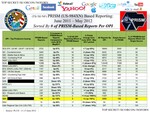
Presentation on the spying program PRISM and ECC's participation [pdf]
This presentation provides statistics on the PRISM surveillance program, detailing intelligence reporting and target tasking across various NSA units and partners from 2011 to 2013. The data reveals that while not the top producer by volume, the European Cryptologic Center (ECC) was the most proportionally reliant on PRISM, which constituted over half of its intelligence output.
-
Report on an XKeyscore training session at the ECC / Dagger Complex [pdf]
This 2012 report details a highly successful XKEYSCORE (XKS) "Circuit Training" event at the European Cryptologic Center (ECC) in Germany, which dramatically increased analyst usage of the powerful SIGINT tool. The training, which used a "speed dating" format and gamification, helped analysts overcome their intimidation and led to significant intelligence discoveries.
-
Report on the changing of the ESOC's name to European Cryptologic Center (ECC) including details on missions launched from there [pdf]
This 2011 document announces the renaming of the European Security Operations Center (ESOC) to the European Cryptologic Center (ECC) to reflect its significant growth and expanded mission. The change signifies NSA's long-term commitment to the center in Germany, which has become a critical partner for counter-terrorism, Africa, and Middle East intelligence.
-
SID Oversight and Compliance [pdf]
Signals Intelligence Directorate (SID) oversight and compliance. A 2012 quarterly audit of the NSA's surveillance activities, which describes 865 violations by the NSA of the surveillance laws and its internal rules and regulations.
-
Targeting Rationale (TAR) [pdf]
An NSA document describing how analysts should explain their targeting decisions under the FISA Amendments Act.