Country: Hungary 14 documents
Search documents matching “Hungary” →Countries mentioned in each document. A country may be mentioned directly (e.g., France) or inferred from a related reference, such as a city (Paris -> France) or a domain name (.fr -> France).
Graphs
By Banner
By Classification
Refine (combine with another filter, via search)
Sort: Title
Documents
-
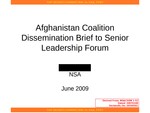
Afghanistan Coalition Dissemination Brief to Senior Leadership Forum [pdf]
This document ooutlines the structure, goals, and challenges of multinational signals intelligence (SIGINT) collaboration in Afghanistan as of 2009. It reveals how the U.S. and its intelligence-sharing allies (notably the 5 Eyes, 9 Eyes, and 14 Eyes) coordinated SIGINT collection, decryption, analysis, and dissemination across NATO and coalition forces.
“Mission Creep: How the NSA’s Game-Changing Targeting System Built for Iraq and Afghanistan Ended Up on the Mexico Border” - The Intercept ↗ (2019-05-29) · “Norges hemmelige krig i Afghanistan” - NRK ↗ (2019-05-29) · Moltke, Henrik · Skille, Øyvind Bye · Døvik, Olav · Hansen, Ståle Ellingsgard · Fjørtoft, Martin -
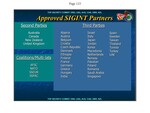
Approved SIGINT Partners [pdf]
A Foreign Affairs Directorate slide listing NSA's approved SIGINT partners: the four Second Parties, 33 Third Parties from Algeria to the United Arab Emirates, and the coalitions AFSC, NATO, SSEUR and SSPAC. This is document is from Fiscal Year 2013 "Foreign Partner Review."
-
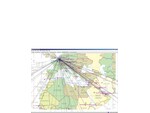
Belgacom connections [pdf]
A "Belgacom connections" map lays out the carrier’s sprawling roaming and backbone interconnects, precisely the arteries GCHQ wanted to get access into. Under Operation Socialist GCHQ successfully gained access to Belgacom’s infrastructure, including internal employee computers and encrypted and unencrypted streams of private communications handled by the company.
Programs: CARBONROD“Operation Socialist: The Inside Story of How British Spies Hacked Belgium’s Largest Telco” - The Intercept ↗ (2014-12-13) · “Lees hier hoe de Britse geheime dienst GCHQ Belgacom aanviel” - NRC ↗ (2014-12-13) · “Britse geheime dienst bespioneerde jarenlang Belgacom-klanten” - De Standaard ↗ (2014-12-13) · Gallagher, Ryan · Modderkolk, Huib · Vanhecke, Nikolas · Eeckhaut, Mark -
Broadcast/Internet Radio Exploitation and Analysis, 6th November 2009, GCHQ [pdf]
This GCHQ report analyzes 6.68 million internet radio listening events collected over three months in 2009, detailing global broadcasting patterns, user behaviors, and specifically examining Islamic radio stations and Pakistan-UK connections for potential radicalization intelligence, while recommending integration with bulk surveillance databases like KARMA POLICE for enhanced user profiling.
-
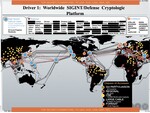
Driver 1: Worldwide SIGINT/Defense Cryptologic Platform [pdf]
A 2012 NSA management presentation slide revealing the agency's global surveillance architecture across five categories of access — covert cable taps, regional collection sites, computer network exploitation implants, foreign satellite collection, and third-party liaison relationships — including a list of cities hosting clandestine collection operations and confirmation of over 50,000 worldwide malware implants.
Programs: STELLAR · SOUNDER · SNICK · MOONPENNY · LADYLOVE · INDRA · IRONSAND · JACKKNIFE · CARBOY · TIMBERLINE“NSA infected 50,000 computer networks with malicious software” - NRC ↗ (2013-11-23) · “No Place to Hide” - Metropolitan Books ↗ (2014-05-13) · Boon, Floor · Derix, Steven · Modderkolk, Huib · Greenwald, Glenn -
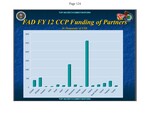
FAD FY 12 CCP Funding of Partners [pdf]
A Foreign Affairs Directorate slide showing Combined Cryptologic Program funding of foreign partners in fiscal year 2012, in thousands of dollars, across fifteen countries including Canada, Israel, Japan, Jordan, Pakistan, Taiwan and Thailand.
-
Guidelines for the classification of NSA SIGINT details (1945-1967) [pdf]
This document is an NSA classification guide that defines how and why historical SIGINT material from 1945–1967 remains classified, in many cases for 75 years. It systematically explains which intelligence activities, targets, partnerships, and technical methods must stay protected because they still reveal sensitive sources, methods, and diplomatic equities.
-
Internet Anonymity 2011 [pdf]
A TOP SECRET NSA presentation from 2011 providing a comprehensive survey of Internet Anonymity Technologies (IAT) — covering HTTP proxies, VPN anonymity providers, multi-hop networks including Tor and JAP, anonymous remailers and circumvention tools — alongside NSA's capabilities and limitations against each, including XKEYSCORE fingerprints for VPN identification, the PARTNERSNIPPET Tor deanonymisation team, GOLDENFORTIN Netflow data, and a candid assessment that Tor offers "no passive exploitation."
Programs: FOXTRAIL · NKB · NACIRONIN · PONTENTPOTABLES · RONIN · XKEYSCORE · PARTNERSNIPPET · GOLDENFORTIN · SNAPEPeople: Heap, Austin -
-
List of foreign governments and organizations authorized for surveillance [pdf]
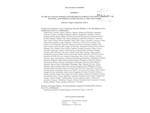
This exhibit lists the 193 foreign governments as well as foreign factions, political organizations and other entities that were part of a 2010 certification approved by the Foreign Intelligence Surveillance Court. These are the entities about which the NSA may conduct surveillance, for the purpose of gathering foreign intelligence. Each year a new certification must be approved by the court to permit such surveillance under Section 702 of the FISA Amendments Act.
-
SCS sites [pdf]
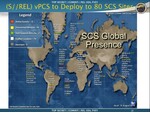
A TOP SECRET map from an SCS SIGDEV briefing, dated 13 August 2010, showing the global presence of the Special Collection Service — the joint CIA/NSA embassy-based interception unit — at some 80 sites worldwide, published (briefly unredacted) by Der Spiegel alongside its Merkel/Berlin embassy reporting, naming the specific cities where covert intercept posts operated, including Berlin, Frankfurt, Moscow, Beijing, Tehran and dozens more.
Programs: VPCS -
SCS SITES [pdf]
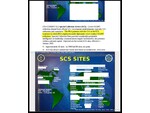
This 2004 NSA document maps the global footprint of the Special Collection Service (SCS), the joint NSA–CIA program that conducts covert signals-intelligence collection from U.S. embassies and consulates abroad under diplomatic cover, prized for intercepting "leadership communications" from within national capitals. Effective January 2002, it lists roughly 65 active, survey, and future SCS sites worldwide.
-
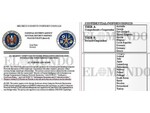
Sharing Computer Network Operations Cryptologic Information with Foreign Partners [pdf]
The document is a secret NSA/CSS policy outlining guidelines for sharing Computer Network Operations (CNO) cryptologic information with foreign partners, including rules for cooperation in CNE and CND within existing intelligence relationships. The “Purpose and Scope” section on the first page appears to be unpublished elsewhere, while the Tier A and Tier B country lists match those publicly revealed in sources like Glenn Greenwald’s No Place to Hide.
“El CNI facilitó el espionaje masivo de EEUU a España” - El Mundo ↗ (2013-10-30) · “No Place to Hide” - Metropolitan Books ↗ (2014-05-13) · Greenwald, Glenn · Aranda, Germán -
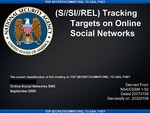
Tracking Targets on Online Social Networks [pdf]
A TOP SECRET NSA presentation from September 2009 describing XKeyscore techniques for tracking targets across online social networks — covering OSN selector types, six categories of target OSN activity ranked by intelligence value, username and HTTP activity query methods, and specific XKeyscore AppIDs for Facebook and Twitter — noting that counterterrorism targets had been observed using over 50 social networks as of late 2008.
Programs: XKEYSCORE“XKEYSCORE: NSA’s Google for the World’s Private Communications” - The Intercept ↗ (2015-07-01) · “No Place to Hide” - Metropolitan Books ↗ (2014-05-13) · Marquis-Boire, Morgan · Greenwald, Glenn · Lee, Micah