Classification: SI 265 documents
Search documents matching “SI” →Each document's classification level, as component values. If a document contains multiple classifications, the highest is used here.
Graphs
By Banner
Refine (combine with another filter, via search)
Sort: Title
Documents
-
Content Acquisition Optimization PowerPoint Slides [pdf]
An NSA presentation on content acquisition optimisation — describing how incidental bulk collection from Yahoo Webmessenger, email address books, buddy lists and webmail inboxes was generating massive unintended collection volumes.
-
Cooperation between the NSA and BND [pdf]
Comprehensive internal summary of the history and current state of cooperation between the NSA and BND
Programs: RT-RGPeople: Schindler, Gerhard -
Counterterrorism Analytic Working Group Meets in Madrid SIDtoday [pdf]
This SIDtoday document details the 11th SIGINT Seniors Counterterrorism (SISECT) Analytic Working Group meeting in Madrid, which focused on enhancing counterterrorism collaboration through topics like terrorist use of the Internet, metadata sharing, and language capabilities. Key outcomes included initiatives for SIGINT exploitation of the Internet, improving language processing and translation via SIGDASYS, and fostering deeper cooperation between nations on counterterrorism efforts.
-
Culture Shock: NSA from the Perspective of Summer Interns SIDtoday [pdf]
Two interns in the 2007 NSA Intelligence Analysis Summer Program share their initial culture shock and misconceptions about the agency, from unrealistic expectations about high-tech tools to the reality of strict regulations and a supportive, collaborative environment.
-
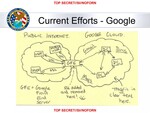
Current Efforts - Google [pdf]
The famous NSA slide from the MUSCULAR program showing where Google's encryption is stripped away — a hand-drawn diagram of Google's cloud architecture annotated with "SSL Added and removed here!" beside a smiley face, marking the exact point where NSA and GCHQ intercepted Google user data flowing unencrypted between Google's data centers.
-
Cyber Paper Japan NSA DFS [pdf]
This January 2013 NSA memo from SUSLAJ (Special U.S. Liaison Activity Japan) details Japan’s effort to rapidly launch a SIGINT-enabled cyber defense initiative and a new 100-person “Cybercom” by April 2013. It describes tensions between reformist elements like CIRO (Cabinet Intelligence and Research Office) and more conservative ones like the DFS (Directorate for SIGINT) and MOD Internal Bureau, with struggles in policy, information sharing, and workforce training. The memo shows Japan seeking NSA’s technical help — including at the MALLARD FORNSAT site — while rushing to deliver malware signatures and sign new information-sharing agreements. The NSA viewed Japan as responsive but too focused on short-term results rather than long-term cyber workforce development.
Programs: MALLARD“The Untold Story of Japan's Secret Spy Agency” - The Intercept ↗ (2018-05-19) · “日本の諜報 スクープ 最高機密ファイル” - NHK ↗ (2018-05-19) · Gallagher, Ryan -
-
Denmark DDIS partnership with NSA (2013) [pdf]
This document provides classified talking points and administrative guidance for the Director of the NSA (DIRNSA) regarding the DENUSA conference and the agency’s strategic partnership with the Danish Defence Intelligence Service (DDIS). It highlights the long-standing collaboration between the two nations on specialized cable access programs and reaffirms the NSA’s commitment to maintaining and expanding access to high-capacity international fiber-optic cables transiting Danish territory.
“How Secret Partners Expand NSA’s Surveillance Dragnet” - The Intercept ↗ (2014-06-18) · “NSA ‘third party’ partners tap the Internet backbone in global surveillance program” - Dagbladet Information ↗ (2014-06-19) · Gallagher, Ryan · Geist, Anton · Gjerding, Sebastian · Moltke, Henrik · Poitras, Laura -
DGSE and ANSSI Delegation to NSA (April 2013), cyberattacks [pdf]
This Top Secret NSA visit précis details the April 12, 2013 meeting between senior French cyber officials Bernard Barbier (DGSE) and Patrick Pailloux (ANSSI) and NSA leadership to discuss and seek U.S. assistance in attributing May 2012 cyberattacks on the French Presidential network. The document outlines the visit agenda, background tensions over French media accusations of U.S. involvement, and NSA’s plan to emphasize cyber defense cooperation while carefully navigating potential diplomatic sensitivities.
-
Did You Know that NSA Has an Arctic Presence? SIDtoday [pdf]
This SIDtoday document describes the NSA's Arctic operations, highlighting its Alaska Mission Operations Center (AMOC) at Point Barrow, Alaska, which monitors Russian military activity in the Arctic. The facility supports U.S. and Canadian defense efforts, tracks Russian air movements, and is involved in upgrades and collaborations with Arctic partners to address emerging intelligence challenges in the region.
-
Discovery SIGINT Targeting Scenarios and Compliance [pdf]
This document is a top-secret NSA guidance manual detailing SIGINT targeting scenarios, compliance procedures, and legal guidance for querying foreign actors, malware, and potentially U.S.-linked systems, including considerations for minimizing incidental collection of U.S. persons’ communications. It outlines specific rules, approvals, and exceptions for using SIGINT tools, foreign intelligence tasks, and cases involving ambiguous or dual-use selectors like WikiLeaks, The Pirate Bay, and foreign actors operating through U.S. infrastructure.
-
Does NSA Look Different from the Outside? What's in Store for SIGINT Analysis and Production? -- An Interview with Wayne Murphy SIDtoday [pdf]
In this SIDtoday interview with Wayne Murphy, the Assistant Deputy Director for Analysis & Production (S2) at NSA, he reflects on his career and vision for the future of SIGINT analysis and production. Having returned to NSA after a stint at the FBI, Murphy provides valuable insights into the importance of collaboration, both within the intelligence community and between intelligence agencies and operational teams.
Programs: ASPACE -
Entry From SSO News [pdf]
This document discusses the initial operational capability of MONKEYROCKET, a non-Western Internet anonymization service developed as part of the OAKSTAR program, aimed at supporting counter-terrorism efforts. As of July 2012, the system was forwarding metadata to backend repositories, with a significant user base of around 16,000, primarily from countries like Iran and China. The service is expected to grow in usage, generating about 2,000 events per day.
-
Entry From SSODictionary v1.0 [pdf]
This document outlines a pending access point for MONKEYROCKET under the OAKSTAR program, focusing on full-take data collection from selected counter-terrorism (CT) targets using a non-Western anonymous browsing service. The collection will include user data, such as billing information and IP addresses, and support NSA's long-term strategy targeting terrorism and other criminal activities, with data gathered under Executive Order 12333. The system used for collection will be vPCS or XKS, and the operation is codenamed "THUNDERISLAND."
-
ESOC: Report on the experiences of one NSA worker [pdf]
A NSA intelligence analysis intern details their 2007 temporary assignment to the European Security Operations Center (ESOC), where they successfully established a new signals intelligence (SIGINT) mission targeting Angola's energy sector. The author describes the end-to-end process from initial research and target development to successful collection and the first intelligence product.
-
Expanding PRISM Sharing With FBI and CIA [pdf]
An SSO item describing two projects that widened PRISM sharing with the FBI and CIA: PRINTAURA software that compiles the tasked-selector list every two weeks for both agencies, and weekly operational PRISM news and guidance from the mission programme manager.
-
Exploiting Facebook traffic in the passive environment to obtain specific information [pdf]
A GCHQ Global Telecommunications Exploitation presentation on extracting information about Facebook users from passively collected traffic: why online social networks are a rich source, how Facebook's use of the Akamai content delivery network exposes a user's ID inside image URLs, and how profile and album images are then obtained through SPRING BISHOP, GODFATHER and JTRIG.
-
Exploiting Foreign Lawful Intercept (LI) Roundtable [pdf]
Top-secret PowerPoint presentation, "Exploiting Foreign Lawful Intercept Roundtable," highlights the agency’s strategy to exploit vulnerabilities in lawful intercept systems from telecom companies, such as Ericsson, Motorola, and Nokia, in countries like Mexico, Indonesia, and Egypt. The presentation also discusses NSA's use of various "Fingerprints" for identifying data and its collaboration with industry players and foreign lawful intercept systems.
“A Death in Athens” - The Intercept ↗ (2015-09-28) · “Americans and Greeks started the 2004 wiretaps together” - Kathimerini ↗ (2015-09-29) · Bamford, James · Petropoulos, Aggelos -
FAA Certification Renewals with Caveats [pdf]
This NSA document shows that after the FISA Court found NSA’s upstream internet collection unconstitutional and illegal, the agency’s response was less about reform and more about finding technical and procedural workarounds to keep surveillance running as usual. While the court ordered changes within 30 days, NSA officials planned to sequester and filter “higher-risk” data to appease the judge—not halt collection—revealing a mindset focused on preserving operations rather than addressing legal violations.
-
FAA702 Glossary - Section 702 of the Fisa Amendments Act (FAA) [pdf]
This document outlines NSA rules under Section 702 of the FISA Amendments Act, which prohibit directly targeting U.S. persons or individuals inside the U.S., but quietly note a 2011 rule change allowing analysts to use U.S. person identifiers to query data already collected under 702—pending internal oversight. This effectively establishes a “backdoor search” capability enabling warrantless searches of Americans’ communications stored in NSA databases. Section 702 also gives the NSA authority to target without warrant the communications of foreign targets.