XKeyscoreTabs XKS Development
Open PDFDocument date: -
Pages: 3
Genre: wiki
Classification: -
Dissemination: -
The document outlines the development and operational procedures for XKeyscore (XKS), detailing its types, upgrades, and the role of microplugins in enhancing data collection capabilities. It describes how different configurations manage data ingestion and the criteria used to filter and store communications for intelligence purposes.
My notes

XKeyscoreTabs XKS Development
Jump to: [navigation, [search
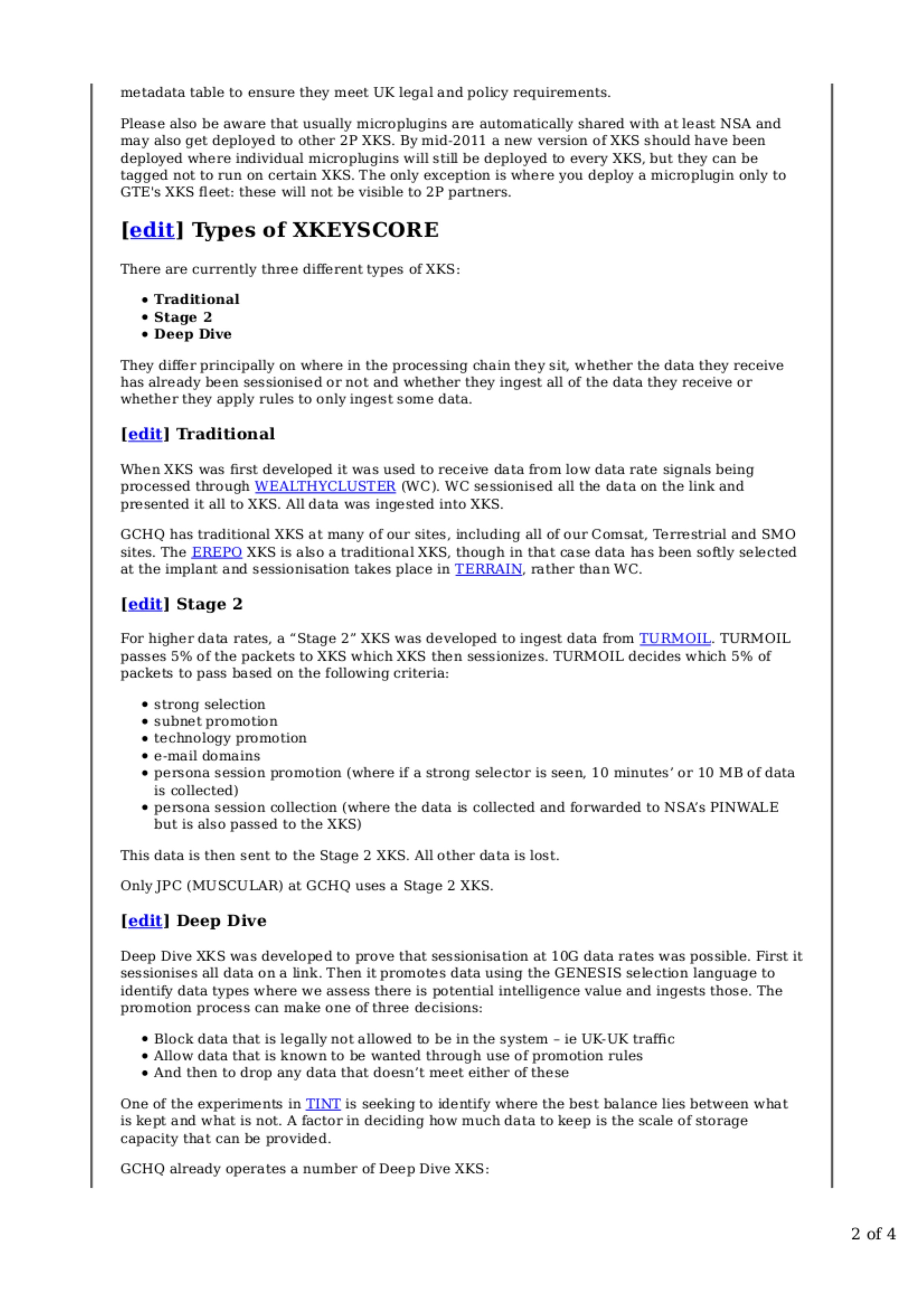
| News | Getting an Account | Using XKeyscore | Training | XKS Development | XKS Contacts | Requirements | News Archive |
|---|
Contents
- 1 XKS Upgrades
- 2 Guidance on microplugins
- 3 Types of XKEYSCORE
- 3.1 Traditional
- 3.2 Stage 2
- 3.3 Deep Dive
- 4 Skinny XKS
Quick Links
- XKEYSCORE Main Page
- XKS @ scale on SSE
- Getting Strong-Selected Content into XKS
- Getting an XKS Account
- Using XKEYSCORE
- XKEYSCORE Training
- XKEYSCORE Development
- XKEYSCORE Contacts
- XKS News Archive
- XKS Requirements
- XKS Searches user guide
- XKS Results user guide
- XKS Approval process
- NFV in XKS
- Promotion from XKS
- Automatic Promotion from XKS
- XKS for CNE
- NSA XKeyscore Using XKS for CNE
- XKS Tech Dictionaries
Useful Links
- Mastering The Internet
- Transforming Analysis
- TINT
- GTE
- SD Home
v • d • e
[edit] XKS Upgrades
XKS is upgraded fortnightly on Thursday mornings between 0900-1100. If you can't log on or use the tool during this period, its because of this.
[edit] Guidance on microplugins
As you know, you can create microplugins to do different things: some perform advanced detection techniques to find types of traffic which can't be detected by keywords or regular expressions alone. Others identify and extract data fields into XKS's metadata table.
In the latter case, the extracted content fragments are stored in the metadata table for 30 days. It will depend on the precision and nature of the search criteria you have used as to how strongly - or weakly - selected that content will be.
If you are going to use search criteria that will extract data about people and store that in the metadata table, please consult OPPLEG before doing so. They will wish to understand the nature and scope of any data being stored in case it includes at least the names of individuals and the majority of the data is not believed to relate to probable intelligence targets. This would make this data particularly sensitive.
In addition, a quarterly check is now being made on all new microplugins which add data to the
1 of 4
metadata table to ensure they meet UK legal and policy requirements.
Please also be aware that usually microplugins are automatically shared with at least NSA and may also get deployed to other 2P XKS. By mid-2011 a new version of XKS should have been deployed where individual microplugins will still be deployed to every XKS, but they can be tagged not to run on certain XKS. The only exception is where you deploy a microplugin only to GTE's XKS fleet: these will not be visible to 2P partners.
[edit] Types of XKEYSCORE
There are currently three different types of XKS:
- Traditional
- Stage 2
- Deep Dive
They differ principally on where in the processing chain they sit, whether the data they receive has already been sessionised or not and whether they ingest all of the data they receive or whether they apply rules to only ingest some data.
[edit] Traditional
When XKS was first developed it was used to receive data from low data rate signals being processed through WEALTHYCLUSTER (WC). WC sessionised all the data on the link and presented it all to XKS. All data was ingested into XKS.
GCHQ has traditional XKS at many of our sites, including all of our Comsat, Terrestrial and SMO sites. The EREPO XKS is also a traditional XKS, though in that case data has been softly selected at the implant and sessionisation takes place in TERRAIN, rather than WC.
[edit] Stage 2
For higher data rates, a "Stage 2" XKS was developed to ingest data from TURMOIL. TURMOIL passes 5% of the packets to XKS which XKS then sessionizes. TURMOIL decides which 5% of packets to pass based on the following criteria:
- strong selection
- subnet promotion
- technology promotion
- e-mail domains
- persona session promotion (where if a strong selector is seen, 10 minutes' or 10 MB of data is collected)
- persona session collection (where the data is collected and forwarded to NSA's PINWALE but is also passed to the XKS)
This data is then sent to the Stage 2 XKS. All other data is lost.
Only JPC (MUSCULAR) at GCHQ uses a Stage 2 XKS.
[edit] Deep Dive
Deep Dive XKS was developed to prove that sessionisation at 10G data rates was possible. First it sessionises all data on a link. Then it promotes data using the GENESIS selection language to identify data types where we assess there is potential intelligence value and ingests those. The promotion process can make one of three decisions:
- Block data that is legally not allowed to be in the system - ie UK-UK traffic
- Allow data that is known to be wanted through use of promotion rules
- And then to drop any data that doesn't meet either of these
One of the experiments in TINT is seeking to identify where the best balance lies between what is kept and what is not. A factor in deciding how much data to keep is the scale of storage capacity that can be provided.
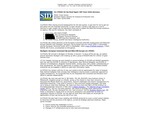
GCHQ already operates a number of Deep Dive XKS:
2 of 4
3 of 4
Published in the Same Report
(10 of 27 documents)
-
SID Around the World: The Rheinland SIDtoday [pdf]
An NSA couple worked at locations in Germany’s Rheinland and enjoyed local cuisine and European travel.
“The NSA in Germany: Snowden's Documents Available for Download” - Der Spiegel ↗ (2014-06-18) · The Intercept ↗ (2016-05-16) -
European Security Center to Begin Operations SIDtoday [pdf]
SIGINT operations in support of U.S. Army Europe and European Command will start at a facility in Darmstadt, Germany, in April 2004.
Marking: SECRET“The NSA in Germany: Snowden's Documents Available for Download” - Der Spiegel ↗ (2014-06-18) · The Intercept ↗ (2016-12-07) -
A Little Bad Aibling Nostalgia SIDtoday [pdf]
With the closing of Bad Aibling Station in Germany, some BA veterans post a list of nostalgic recollections from working there.
“The NSA in Germany: Snowden's Documents Available for Download” - Der Spiegel ↗ (2014-06-18) · The Intercept ↗ (2016-12-07) -
Forward Production at NCEUR — Inside the Customers' Decision Space SIDtoday [pdf]
Beginning in 2003, a team of NSA counterterrorism analysts based at NSA/CSS Europe began a dedicated project to support counterterrorism efforts in North Africa. The team collected signals intelligence, which they distributed to U.S. European Command and U.S. ambassadors, who then transmitted this information to governments in Mali, Algeria, and Mauritania. They believe this effort was "responsible for the capture or kill of over 40 terrorists."
“The NSA in Germany: Snowden's Documents Available for Download” - Der Spiegel ↗ (2014-06-18) · The Intercept ↗ (2017-09-13) -
On the Road Again: SID Team Visits Germany SIDtoday [pdf]
A Signals Intelligence Directorate team visits NSA sites in Germany.
Marking: CONFIDENTIAL“The NSA in Germany: Snowden's Documents Available for Download” - Der Spiegel ↗ (2014-06-18) · The Intercept ↗ (2018-08-15) -
European Technical Center Area Checked for Unexploded WWII Ordnance SIDtoday [pdf]
The European Technical Center area in Mainz, Germany, was closed for a day while investigators checked what seemed to be — but wasn’t — unexploded Word War II ordnance.
“The NSA in Germany: Snowden's Documents Available for Download” - Der Spiegel ↗ (2014-06-18) · The Intercept ↗ (2018-08-15) -
German, NSA SIGINTers Share DNI Processing Knowledge SIDtoday [pdf]
A delegation from Germany’s Federal Intelligence Service visits Fort Meade, Maryland, to learn about the NSA’s “packet level” selection and filtering of internet-based traffic, which is opposite to the approach used by the Germans.
“The NSA in Germany: Snowden's Documents Available for Download” - Der Spiegel ↗ (2014-06-18) · The Intercept ↗ (2018-08-15) -
The European Security Center to Become the 'ESOC' SIDtoday [pdf]
The European Security Center in Darmstadt, Germany will expand to become the European Security Operations Center; additional civilian NSA staff will join existing Army staff. The ESOC's primary responsibilities will be targets in Africa.
“The NSA in Germany: Snowden's Documents Available for Download” - Der Spiegel ↗ (2014-06-18) · The Intercept ↗ (2019-05-29) -
NSAers Make First-Ever Visit to FORNSAT Collection Site in Schöningen, Germany SIDtoday [pdf]
The BND (German Federal Intelligence Service) has a base at Schoningen, where they collect different types of mobile communications (satellite, fax, and GSM), many of which they share with their NSA counterparts. NSA visited to compare notes, and requested copies of some of the Germans' software tools--which had "features that surpass US SIGINT capabilities--for call chaining and metadata analysis.
“The NSA in Germany: Snowden's Documents Available for Download” - Der Spiegel ↗ (2014-06-18) · The Intercept ↗ (2019-05-29) -
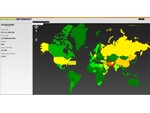
BOUNDLESSINFORMANT Overview [pdf]
World map view from the Boundless Informant program, with "CNE" (Computer Network Exploitation) selected from the dropdown.
Programs: BOUNDLESSINFORMANT

Related Documents
-
SKIDROWE [pdf]
This document reveals the extensive surveillance capabilities of the NSA's SKIDROWE program at TITANPOINTE, specifically designed to intercept and analyze satellite communications and internet data. It highlights how intercepted data is processed and filtered through advanced systems like XKEYSCORE, which enables real-time intelligence gathering by sifting through massive amounts of digital content, including emails, calls, and internet activity.
Programs: SKIDROWE · WEALTHYCLUSTER2 · WEALTHYCLUSTER · TURNWEALTHY · VPCS · XKEYSCORE · GENESIS · CONTROLAND · ATM · FITBOY · DARKTHUNDER · FIP · METTLESOME · SKYFRAME · PVOICE · XXPY0012 · AGITATOR · STARPROC · SPELLBINDER · BLACKPEARL · BLACKALCHEMY · BLACKGOLD · BLACKFIRE · MONKEYMIND · BCD · EVVIPER · QUANTUM · MISTYPEAK · VALIANTSURF · GALLANTWAVE · SWINE · BLUESNORT · TOSSSWUNG · GNOMEVISION · GNOMEGOGGLES · HIDDENSALAMANDER · TURMOIL · PSC -
TURBULENCE - Fielded Capability: End-to-End VPN, SPIN 9 Design Review [pdf]
An NSA SPIN 9 design review presentation describing the transition of TURMOIL's VPN decryption capability from the legacy Red Architecture to the new Blue Architecture — covering the full end-to-end dataflow, component interfaces, test scenarios and detailed processing specifications for each system in the VPN decryption pipeline.
Programs: TURBULENCE · TURMOIL · KEYCARD · WEALTHYCLUSTER · TUBE · XKEYSCORE · PRESSUREWAVE · EXOPUMP · PWV · TOYGRIPPE · PICARESQUE · AGILITY · MAILORDER · ISLANDTRANSPORT · PIQBLADE · PINWALE · TRAFFICTHIEF · IBRIDGE · PPF · METROTUBE · FIP · SSO -
Elegant Chaos: collect it all, exploit it all (plus notes) [pdf]
GCHQ/NSA presentation describing ELEGANT CHAOS — an automated system at the Menwith Hill Station satellite interception facility that scores and ranks thousands of intercepted satellite signals by intelligence value, automatically deciding which ones deserve collection resources based on criteria like geographic location, target network hits, technology type and Computer Network Operations interest — built to implement the station's directive to "Sniff it All, Know it All, Collect it All, Process it All, Exploit it All, Partner it All" as collection capacity scaled from 100 signals to a planned 3,000 simultaneous intercepts.
Programs: ELEGANTCHAOS · ASPHALT · ASPHALT-A · ASPHALT-A-PLUS · STORMFORCE · DARKQUEST · TORUS · XKEYSCORE · MHS CLOUD · TURMOIL · TARMAC · ASDF · SLR · POPQUIZ · WEALTHYCLUSTER2 · TRAVELLINGWAVE · BILBOBADGER · DRINKYBIRD · GLOBETROTTER · MASTERSHAKE · REST · TRAFFICTHIEF · VENUSAFFECT · FOGHORN · MATCHMAKER · ROADBED · MOONPENNY · WHIZBANG · CLOUDBASE · APLUS · MAILORDER · CROSSBONES · AMULET STELLAR · MVR · TINT · WEALTHYCLUSTER · IPGEOTRAP · MARINA · CLOUD · PLUS -
Elegant Chaos: collect it all, exploit it all [pdf]
This document outlines a classified project, "Elegant CHAOS," focused on advanced signals intelligence (SIGINT) collection, processing, and analysis using cutting-edge technologies like automated surveys and modems. It highlights goals such as real-time data analysis, collaboration with international partners, and integration with cloud-based platforms to manage massive data. See also the document with notes (by GCHQ): "Elegant-Chaos-collect-it-all-exploit-it-all-plus"
Programs: ELEGANTCHAOS · ASPHALT · ASPHALT-A · ASPHALT-A-PLUS · STORMFORCE · DARKQUEST · TORUS · XKEYSCORE · MHS CLOUD · TURMOIL · TARMAC · ASDF · SLR · POPQUIZ · WEALTHYCLUSTER2 · TRAVELLINGWAVE · BILBOBADGER · DRINKYBIRD · GLOBETROTTER · MASTERSHAKE · REST · TRAFFICTHIEF · VENUSAFFECT · FOGHORN · MATCHMAKER · ROADBED · MOONPENNY · AMULETSTELLAR · CLOUD · WEALTHYCLUSTER · MVR · TINT · IPGEOTRAP · MARINA · PLUS -
XKEYSCORE System Administration [pdf]
A December 2012 TOP SECRET XKeyscore System Administration training manual — the detailed technical guide for the engineers who ran XKeyscore field-site clusters — covering the system's Red Hat Linux architecture, master/slave cluster design, database and processing pipeline, the GUI (including built-in Tor, botnet and CNE search menus), the DeepDive full-take packet processor, the xks command-line tool, and monitoring and troubleshooting, with live screenshots from the Timberline site (USF-790) and Menwith Hill Station.
Programs: XKEYSCORE · WEALTHYCLUSTER · MAILORDER · CADENCE · ROGUESTITCH · QUANTUMBOT · COTTONCHAINSAW · MPTRII · SCARFACE · ZAMENSIS · MAPREDUCE · GENESIS · REDUCER · DEEPDIVE · ASDF · CYBER · BULKCRYPT · METTLESOME · PACKETSPLAYYER · PROMOTER · DEFRAG · XFIP · TRAFFICTHIEF · ENDACE · TIMBERLINE · MUSCULAR · FIST · STARPROC