Voice/Fax User Group Minutes of September 2008 meeting
Open PDF +1 other copyDocument date: 2008-09
Pages: 1
Genre: report
Banner: TOP SECRET STRAP1
Classification: TOP SECRET STRAP 1
Dissemination: -
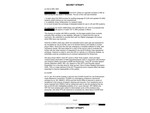
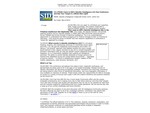
Page 3 of 7 of the minutes of GCHQ's Voice/Fax User Group (VFUG), September 2008: plans for data-quality testing, a request that linguists flag "Pick Your Own Number" calls in the B3M voice database, and the B14/MCS team's update on the Diariser and on speaker and language identification. The Intercept's PDF shows only the speaker ID section; the rest of the page is in the file (see the archive comment).
My notes
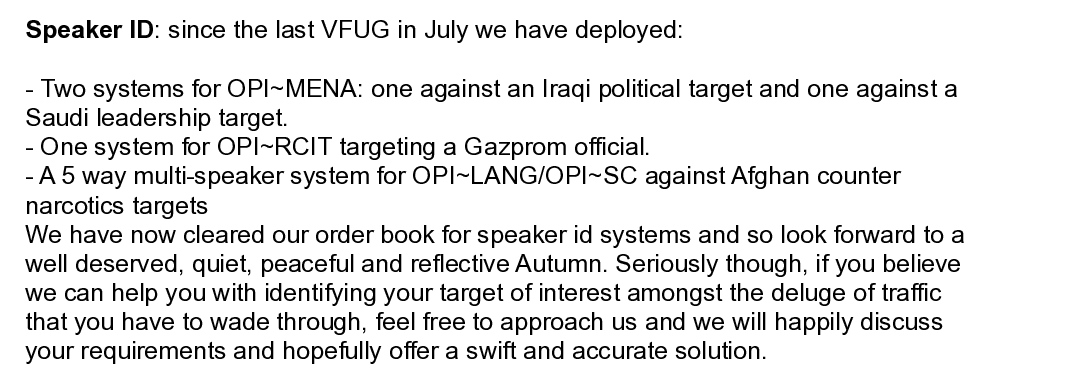
Speaker ID: since the last VFUG in July we have deployed:
- Two systems for OPI~MENA: one against an Iraqi political target and one against a
Saudi leadership target. - One system for OPI~RCIT targeting a Gazprom official.
- A 5 way multi-speaker system for OPI~LANG/OPI~SC against Afghan counter
narcotics targets
We have now cleared our order book for speaker id systems and so look forward to a
well deserved, quiet, peaceful and reflective Autumn. Seriously though, if you believe
we can help you with identifying your target of interest amongst the deluge of traffic
that you have to wade through, feel free to approach us and we will happily discuss
your requirements and hopefully offer a swift and accurate solution.
Published in the Same Report
(10 of 21 documents)
-
RT10 Initiative Overview [pdf]
Overview document for RT10, "Real-time, distributed architecture for mobile (tactical) and fixed (national) operational environments"
Programs: RT10 · COBRA FOCUS · GREENDRAGON · GOLDMINER · JUGGERNAUT · MATTERHORN · OBELISK · SORTINGHAT · INFOVIS · SHARPFOCUS2 · TOGA · SORTINGLEAD · GLOBALREACH · VOICERT · QUADRASPECTRE · RENOIR · ANALYSTSNOTEBOOK · OCTAVE · HLT · DRT · GEOT · InnoVisions -
NSA Georgia Opens New Audio-Forensics Lab SIDtoday [pdf]
The document discusses the launch of a new audio-forensics lab at NSAG (National Security Agency Georgia) designed to enhance the processing and analysis of intercepted voice communications. The lab, funded through the Senior Language Technology Authority (SLTA), will focus on resolving language processing challenges for language analysts by improving the intelligibility and quality of foreign-language voice intercepts.
People: Mercer, Marti Hix -
Alert: Voice Masking Is Discovered in SIGINT SIDtoday [pdf]
This March 2007 post from the internal NSA newsletter SIDToday draws attention to voice-masking technology used by subjects of surveillance to frustrate the agency’s voice-recognition efforts.
-
Tips for a Successful Quick Reaction Capability SIDtoday [pdf]
In response to Iranian President Ahmadinejad’s 2007 visit to New York, the NSA’s Iran Government and Leadership branches launched a Quick Reaction Capability (QRC) to gather time-sensitive intelligence. The QRC focused on enhanced collection techniques, collaboration across departments, and efficient data management to analyze the extensive communications traffic during the event, resulting in valuable leads on Iranian leadership activities and diplomatic plans.
People: Ahmadinejad, Mahmoud -
New RT-RG Overview Video Available on NSANet SIDtoday [pdf]
The NSA's Meade Operations Center released a 10-minute video overview of the Real-Time Regional Gateway (RT-RG), a tool suite designed for forward-deployed analysts. The suite enables faster access to real-time metadata and reporting, improving tactical support for military operations, with new functionalities being developed for use in Afghanistan and beyond.
-
Voice Biometrics Capability Proven During Recent Technology Demonstration SIDtoday [pdf]
The Coordinate Operational Resources for Voice Exploitation Technology (CORVET) project, managed by the Expeditionary SIGINT Services Office (ESSO), demonstrated a promising capability for voice biometrics that could be used in security operations to identify individuals based on voice characteristics. Similar to the long-established method of fingerprinting, CORVET aims to create a database of voice models that could be used for identification in various contexts, such as detention and force-protection scenarios.
-
Alvin, Simon, and... Al Qaeda? Finding Modified Voice in SIGINT Traffic SIDtoday [pdf]
This SIDtoday article discusses the use of voice modification technology by Al-Qaeda and other extremist groups to evade identification in SIGINT traffic. It highlights the development of the HLT Lite software by R64, which can automatically detect modified voices in intercepted communications, enabling the identification of targets even when traditional voice recognition fails.
-
Come to SID's Identity Intelligence (I2) Day Conference and See Your Target in a Whole New Light! SIDtoday [pdf]
This SIDtoday article promotes NSA's Identity Intelligence (I2) Day Conference, highlighting the importance of using SIGINT tools and techniques to track individuals across time and space. It emphasizes the growing role of biometrics, biographic data, and digital footprints in identifying and targeting foreign persons of interest, with insights from key speakers and case studies.
-
SIGINTers Use Human Language Technology to Great Advantage, Isolate Conversation about Threat to US Official SIDtoday [pdf]
In 2010, the Special Collection Service in Mexico City began using Human Language Technology (HLT) to streamline voice collection and analysis, significantly improving efficiency. By rapidly filtering through large volumes of audio data, HLT helped isolate critical intelligence, such as identifying a conversation related to a bomb threat targeting a U.S. Embassy official, all within minutes instead of hours.
Programs: HLT -
Innov8 Voice Analytics Experiment Profile [pdf]
This document outlines Phase 1 of a Voice Analytics experiment conducted by GCHQ in partnership with the NSA, testing the ingestion and processing of voice data through the DISTILLERY platform on GHOSTMACHINE hardware. The experiments evaluate independent, parallel, and linked analytics (SAD, GID, LID), as well as dynamic resource management, to ensure accurate, scalable, and compliant voice processing in a Joint Collaboration Environment.
Marking: TOP SECRET
Related Documents
-
Voice Fax Users Group Minutes October 2008 [pdf]
The document is a TOP SECRET GCHQ report on the deployment of a 5-way speaker identification (SID) system targeting high-level individuals in the Afghan narcotics trade. It highlights operational success, including the identification of new phone numbers for a principal target leading to his arrest in Jakarta, and outlines plans to rebuild the system to target the remaining four narcotics barons.
-
Voice Fax User Group Minutes March 2009 [pdf]
The document is a TOP SECRET GCHQ meeting record from March 2009 detailing updates to B14/MCS voice analytics systems, including new language identification (LID) models for Pashto, Dari, Brahui, and Baluchi languages and a first-pass speaker ID (SID) system for General Kiyani of Pakistan. It also highlights operational successes, such as improved reporting on Iraq's Vice President Adil ’Abd-al-Mahdi, which enhanced GCHQ’s reputation with NSA and reduced unnecessary workload for linguists.
-
Voice Fax User Group Minutes December 2010 [pdf]
This GCHQ document is a NSA/GCHQ meeting record from December 2010 detailing the deployment of voice analytics, including speech activity detection, speaker identification, and language identification, integrated with tools like Google Earth to map locations of target communications. It outlines ongoing and planned speaker ID operations against specific targets, including militant leaders and foreign officials, demonstrating the operational use of voice recognition for intelligence collection and geolocation.
-
GCHQ Visit to NSA on Voice Analytics Systems [pdf]
This document is a GCHQ report detailing a late-November (2007?) visit to NSA’s R64 division focused on collaboration in language identification (LID) and speaker identification (SID) systems, including sharing models and research insights. It also describes NSA tools like Hotzone and Voice RT for real-time voice analysis, and mentions an upcoming visit from the CLEAR consortium to address challenges in speech intelligibility and audio recovery for intercepted communications.
-
Alert: Voice Masking Is Discovered in SIGINT SIDtoday [pdf]
This March 2007 post from the internal NSA newsletter SIDToday draws attention to voice-masking technology used by subjects of surveillance to frustrate the agency’s voice-recognition efforts.