Tag: Android 8 documents
Search documents matching “Android” →Free-text subjects the curators added. Unlike the other axes these are not necessarily from the documents' own vocabulary, so they are the loosest thing to browse by (and the most forgiving).
Refine (combine with another filter, via search)
Sort: Title
Documents
-
Content Acquisition Optimization PowerPoint Slides [pdf]
An NSA presentation on content acquisition optimisation — describing how incidental bulk collection from Yahoo Webmessenger, email address books, buddy lists and webmail inboxes was generating massive unintended collection volumes.
-
Converged Analysis of Smartphone Devices [pdf]
This 2010 document outlines NSA methods for identifying, processing, and exploiting data from smartphones by targeting both telephony and digital network intelligence (DNI). It details how analysts use tools like XKEYSCORE and metadata extraction to collect geolocation, app data, call logs, unique identifiers, and user activity from popular mobile apps and services (e.g., Google Maps, Facebook, Flickr), emphasizing the intelligence potential of smartphones as rich surveillance targets.
People: Kuruc, Paula -
How the NSA Accesses Smartphone Data [pdf]
This document reveals how the NSA and its Five Eyes partners developed sophisticated methods to exploit iPhone location services and BlackBerry communications, framing smartphone users as “zombies” willingly sharing data. It includes examples of intercepted geolocation data and decrypted BlackBerry emails, illustrating targeted surveillance capabilities against both consumer and government communications.
-
Leaky phone apps [pdf]
These GCHQ slides describe the "WARRIOR PRIDE" mobile intrusion capability being ported to iPhone and Android, with plugins for power management, remote microphone, high‑precision geolocation, kernel stealth, and self‑protection. It claims the ability to retrieve almost any content from infected phones (SMS/MMS, email, call records, photos, calendar, etc.). Part of GCHQ's project "Mobile Applications Project".
Programs: Mobile Applications Project · WARRIORPRIDE · DREAMYSMURF · NOSEYSMURF · TRACKERSMURF · PORUS · PARANOIDSMURF -
Mobile apps doubleheader: BADASS Angry Birds [pdf]
A joint GCHQ/GTE/CSEC presentation describing BADASS — the BEGAL Automated Deployment and Survey System for rapidly developing and deploying mobile app exploitation rules — illustrated through detailed analysis of Angry Birds' Dataflurry analytics traffic leaking IMEI, IMSI, cell network metadata and device identifiers, alongside AdMob, Mobclix and Mydas ad network traffic leaking UDIDs and IMEIs across iOS, Android, BlackBerry and Windows Phone 7 platforms.
Programs: BADASS · BEGAL · SEM · UNIQUELYCHALLENGED · BLACKHOLE · MOUNTAINVIEW · VOB · BABELFISH · BISHOP · MVR · PPF · AEG · DATAFLURRY -
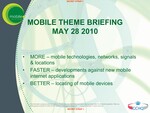
Mobile Theme Briefing (May 28, 2010) [pdf]
This 2010 GCHQ briefing document outlines the “Mobile Applications Project,” which aims to expand intelligence capabilities to exploit the growing shift from fixed to mobile internet usage. It details objectives for targeting mobile apps and roaming network traffic (GRX), enabling converged analysis of voice, text, command-and-control, and geolocation data across multiple mobile platforms such as iPhone, Symbian, Android, and Windows Mobile. See also: EFF_-_20140128-guard-leaky_phone_apps_0 (includes other slides from the same slideset)
Programs: Mobile Applications Project -
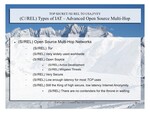
Types of IAT - Advanced Open Source Multi-hop [pdf]
This top-secret NSA/GCHQ document provides a detailed technical overview of the Tor network, including how it works, its strengths as the “king of high secure, low-latency Internet anonymity,” methods for identifying Tor traffic, censorship-driven protocol obfuscation, and ongoing intelligence efforts to analyze, fingerprint, and exploit Tor through passive SIGINT and active research, including collaboration between US and UK agencies.
People: Appelbaum, Jacob -
User-agents: Why and How and How to [pdf]
A TOP SECRET NSA training presentation from 2010 teaching analysts how to use browser user-agent strings — the identifying information your web browser automatically sends to every website you visit — to track surveillance targets across the internet, link their known email activity to their anonymous web browsing, and identify opportunities for hacking their computers based on their operating system and software versions.