What Is a J-2?
Open PDFDocument date: 2005-02-02
Type: SIDtoday
Pages: 2
Genre: newsletter
Banner: DYNAMIC PAGE -- HIGHEST POSSIBLE CLASSIFICATION IS TOP SECRET // SI / TK // REL TO USA AUS CAN GBR NZL
Classification: UNCLASSIFIED
Dissemination: FOUO
An overview of the joint military staff groups, and in particular the J-2 intelligence group that works most closely with the Signals Intelligence Directorate, given by a signals intelligence communications staffer.
My notes

DYNAMIC PAGE -- HIGHEST POSSIBLE CLASSIFICATION IS
TOP SECRET // SI / TK // REL TO USA AUS CAN GBR NZL
SIDtoday
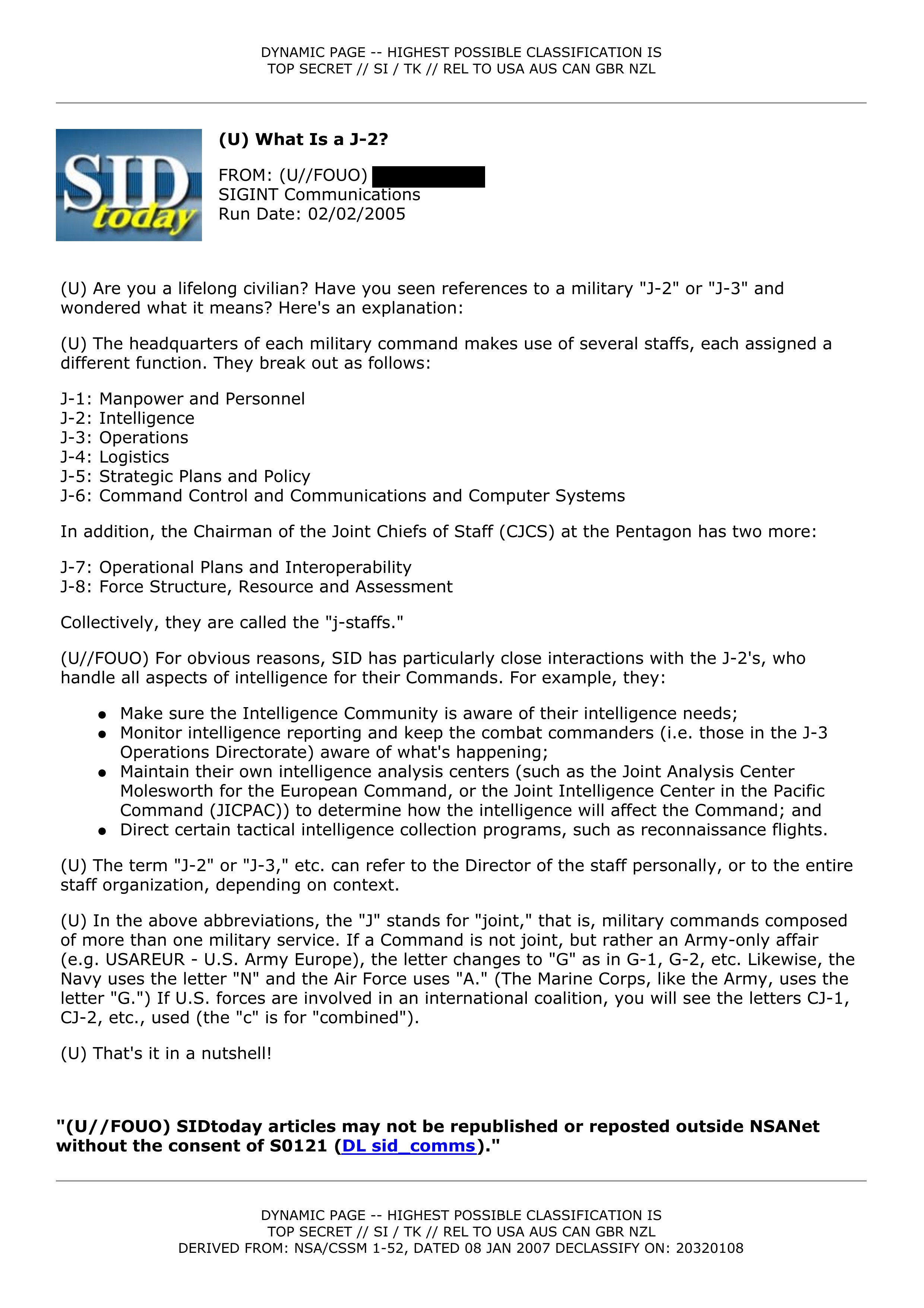
(U) What Is a J-2?
FROM: [REDACTED] (U//FOUO)
SIGINT Communications
Run Date: 02/02/2005
(U) Are you a lifelong civilian? Have you seen references to a military "J-2" or "J-3" and
wondered what it means? Here's an explanation:
(U) The headquarters of each military command makes use of several staffs, each assigned a
different function. They break out as follows:
J-1: Manpower and Personnel
J-2: Intelligence
J-3: Operations
J-4: Logistics
J-5: Strategic Plans and Policy
J-6: Command Control and Communications and Computer Systems
In addition, the Chairman of the Joint Chiefs of Staff (CJCS) at the Pentagon has two more:
J-7: Operational Plans and Interoperability
J-8: Force Structure, Resource and Assessment
Collectively, they are called the "j-staffs."
(U//FOUO) For obvious reasons, SID has particularly close interactions with the J-2's, who
handle all aspects of intelligence for their Commands. For example, they:
- Make sure the Intelligence Community is aware of their intelligence needs;
- Monitor intelligence reporting and keep the combat commanders (i.e. those in the J-3 Operations Directorate) aware of what's happening;
- Maintain their own intelligence analysis centers (such as the Joint Analysis Center Molesworth for the European Command, or the Joint Intelligence Center in the Pacific Command (JICPAC)) to determine how the intelligence will affect the Command; and
- Direct certain tactical intelligence collection programs, such as reconnaissance flights.
(U) The term "J-2" or "J-3," etc. can refer to the Director of the staff personally, or to the entire
staff organization, depending on context.
(U) In the above abbreviations, the "J" stands for "joint," that is, military commands composed
of more than one military service. If a Command is not joint, but rather an Army-only affair
(e.g. USAREUR - U.S. Army Europe), the letter changes to "G" as in G-1, G-2, etc. Likewise, the
Navy uses the letter "N" and the Air Force uses "A." (The Marine Corps, like the Army, uses the
letter "G.") If U.S. forces are involved in an international coalition, you will see the letters CJ-1,
CJ-2, etc., used (the "c" is for "combined").
(U) That's it in a nutshell!
"(U//FOUO) SIDtoday articles may not be republished or reposted outside NSANet
without the consent of S0121 (DL sid_comms)."
DYNAMIC PAGE -- HIGHEST POSSIBLE CLASSIFICATION IS
TOP SECRET // SI / TK // REL TO USA AUS CAN GBR NZL
DERIVED FROM: NSA/CSSM 1-52, DATED 08 JAN 2007 DECLASSIFY ON: 20320108
Related Documents
-
What Is a J-2? (repost) SIDtoday [pdf]
Repost: An overview of the joint military staff groups, in particular the J-2 intelligence group that works most closely with the Signals Intelligence Directorate, given by a SIGINT communications staffer.
Marking: UNCLASSIFIEDThe Intercept ↗ (2018-03-01) -
Announcing the Birth of the JFCC-ISR SIDtoday [pdf]
A new office of U.S. Strategic Command called the Joint Functional Component Command for Intelligence, Surveillance, and Reconnaissance will house representatives of the NSA, National Geospatial Agency, and Defense Intelligence Agency to coordinate intelligence that directly supports global combat missions.
People: Cusick, JimThe Intercept ↗ (2017-09-13) -
NRO SIGINT guide for Pine Gap [pdf]
This classified document outlines the organizational relationships and security classifications related to the Joint Defence Facility Pine Gap (JDFPG) in Australia, identifying it as an Australian Mission Ground Station (AMGS) operated jointly by the U.S. and Australia. It confirms that Pine Gap’s official mission statement serves as a cover story, concealing its secret association with U.S. intelligence agencies like the NRO, NSA, and CIA.
-
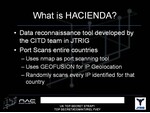
What is HACIENDA? [pdf]
This document details HACIENDA, a large-scale reconnaissance tool used by GCHQ and the Five Eyes alliance to perform automated port scanning and vulnerability mapping across entire nations. It outlines the technical process of identifying and exploiting network infrastructure, specifically for the purpose of discovering Operational Relay Boxes (ORBs) to facilitate covert "Computer Network Exploitation" (CNE).
-
What's a Military Cryptologic Advisor? SIDtoday [pdf]
The outgoing special assistant for military affairs describes his position liaising between the Signals Intelligence Directorate and military cryptologic units. One of his proudest achievements was convincing the military of the importance of retaining military personnel in SID, rather than reassigning all such office work to civilians.
The Intercept ↗ (2018-03-01)