Hold the Spam, Please
Open PDFDocument date: 2005-02-03
Type: SIDtoday
Pages: 1
Genre: newsletter
Banner: DYNAMIC PAGE -- HIGHEST POSSIBLE CLASSIFICATION IS TOP SECRET // SI / TK // REL TO USA AUS CAN GBR NZL
Classification: SECRET SI
Dissemination: -
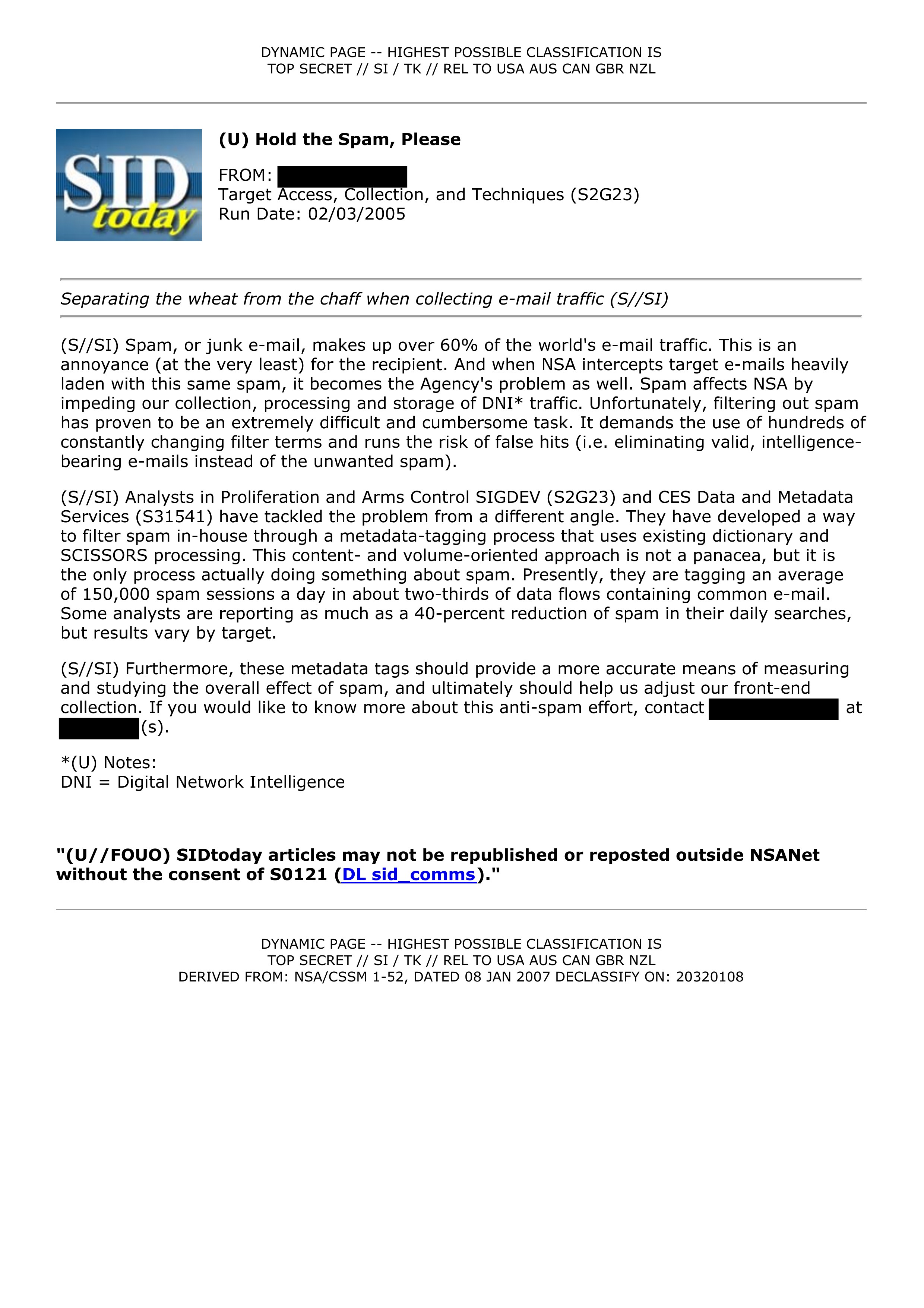
In 2005, the majority of emails sent across the world was spam, which was a major problem for the NSA. "Spam affects NSA by impeding our collection, processing and storage of DNI [digital network intelligence] traffic." The article briefly describes how analysts have tackled the problem to greatly reduce the amount of spam that shows up "in their daily searches."
My notes
DYNAMIC PAGE -- HIGHEST POSSIBLE CLASSIFICATION IS
TOP SECRET // SI / TK // REL TO USA AUS CAN GBR NZL
SIDtoday
(U) Hold the Spam, Please
FROM: [REDACTED]
Target Access, Collection, and Techniques (S2G23)
Run Date: 02/03/2005
Separating the wheat from the chaff when collecting e-mail traffic (S//SI)
(S//SI) Spam, or junk e-mail, makes up over 60% of the world's e-mail traffic. This is an
annoyance (at the very least) for the recipient. And when NSA intercepts target e-mails heavily
laden with this same spam, it becomes the Agency's problem as well. Spam affects NSA by
impeding our collection, processing and storage of DNI* traffic. Unfortunately, filtering out spam
has proven to be an extremely difficult and cumbersome task. It demands the use of hundreds of
constantly changing filter terms and runs the risk of false hits (i.e. eliminating valid, intelligence-
bearing e-mails instead of the unwanted spam).
(S//SI) Analysts in Proliferation and Arms Control SIGDEV (S2G23) and CES Data and Metadata
Services (S31541) have tackled the problem from a different angle. They have developed a way
to filter spam in-house through a metadata-tagging process that uses existing dictionary and
SCISSORS processing. This content- and volume-oriented approach is not a panacea, but it is
the only process actually doing something about spam. Presently, they are tagging an average
of 150,000 spam sessions a day in about two-thirds of data flows containing common e-mail.
Some analysts are reporting as much as a 40-percent reduction of spam in their daily searches,
but results vary by target.
(S//SI) Furthermore, these metadata tags should provide a more accurate means of measuring
and studying the overall effect of spam, and ultimately should help us adjust our front-end
collection. If you would like to know more about this anti-spam effort, contact [REDACTED] at
[REDACTED](s).
*(U) Notes:
DNI = Digital Network Intelligence
"(U//FOUO) SIDtoday articles may not be republished or reposted outside NSANet
without the consent of S0121 (DL sid_comms)."
DYNAMIC PAGE -- HIGHEST POSSIBLE CLASSIFICATION IS
TOP SECRET // SI / TK // REL TO USA AUS CAN GBR NZL
DERIVED FROM: NSA/CSSM 1-52, DATED 08 JAN 2007 DECLASSIFY ON: 20320108
Related Documents
-
FAIRVIEW dataflow charts April 2012 [pdf]
This document outlines data flow diagrams that show how various types of sensitive communication, including voice, fax, and modem traffic, are handled through systems operated by the NSA and its partners. These partners include corporations, telecommunications companies, ISPs, and other entities involved in processing and managing the data through secure and classified channels. The document covers processing flows for various data types, metadata, and communications systems under NSA's control, detailing how data is routed, stored, and analyzed across different platforms and sites.
Programs: FAIRVIEW · SAGUARO · TURNSTILE · MESA · TITANPOINT · RIMROCK · MAILORDER · PINECONE · BLARNEY · STONEGATE · TINSEL · CONVEYANCE · FISHWAY · NUCLEON · PINWALE · SCISSORS · COURIERSKILL · DRIFTWOOD · ASDF · FALLOUT · MARINA · LOPERS · WEALTHYCLUSTER · PUPR · CLEARSIGHT · MIDFIELD · CADENCE · BUGCATCHER · WAYLAND · DESOTO · GATEKEEP · HIGHDECIBEL · XKEYSCORE · YANKEE · TOPROCK · FASCIA · DISHFIRE · SEAGULL · BIGDIPPER · CORPORATE · LILDIPPER · HAVASU · WEALTHYCLUSTER2 · RAGTIME · TUMULT · TATTOO · DARKTHUNDER · ICYTWINS · TML-STATUS · WATERFRONT · VULCANDEATHGRIP · STEELFLAUTA · UNITY · KEYCARD · UTT · BTUBE · ISLANDTRANSPORT · SSO · MAINWAY · SSDM · TUBE · TITANPOINTE · TURMOIL · VPCS“NSA Spying Relies on AT&T’s ‘Extreme Willingness to Help’” - ProPublica ↗ (2015-08-15) · “AT&T Helped U.S. Spy on Internet on a Vast Scale” - The New York Times ↗ (2015-08-15) · “Titanpointe: The NSA’s Spy Hub in New York, Hidden in Plain Sight” - The Intercept ↗ (2016-11-16) · Angwin, Julia · Larson, Jeff · Savage, Charlie · Moltke, Henrik · Poitras, Laura · Risen, James · Gallagher, Ryan -
SSO Collection Optimization [pdf]
This is another presentation on problems with the National Security Agency's overcollection of address books and buddy lists and its efforts to weed out useless content. See also EFF_-_20131104-wapo-optimization_google
-
Content Acquisition Optimization PowerPoint Slides [pdf]
An NSA presentation on content acquisition optimisation — describing how incidental bulk collection from Yahoo Webmessenger, email address books, buddy lists and webmail inboxes was generating massive unintended collection volumes.
-
PRISM/US-984XN Overview [pdf]
A 2013 NSA training presentation revealing that major U.S. tech companies — including Google, Facebook, Apple, Microsoft, and Skype — secretly gave the NSA direct access to their servers, allowing the agency to collect users' emails, chats, photos, and files in real time, with the FBI acting as intermediary.
Programs: PRISM · FAIRVIEW · STORMBREW · BLARNEY · OAKSTAR · UTT · PRINTAURA · PINWALE · NUCLEON · TRAFFICTHIEF · SCISSORS · MARINA · MAINWAY · FALLOUT · CONVEYANCE · REPRISMFISA · SSO“U.S., British intelligence mining data from nine U.S. Internet companies in broad secret program” - The Washington Post ↗ (2013-06-06) · “NSA Prism program taps in to user data of Apple, Google and others” - The Guardian ↗ (2013-06-07) · “L'ampleur de l'espionnage mondial par la NSA” - Le Monde ↗ (2013-10-21) · “NSA files decoded: Edward Snowden's surveillance revelations explained” - The Guardian ↗ (2013-11-01) · “No Place to Hide” - Metropolitan Books ↗ (2014-05-13) · “Dark Mirror: Edward Snowden and the American Surveillance State” - Penguin Press ↗ (2020-05-19) · Gellman, Barton · Poitras, Laura · Greenwald, Glenn · MacAskill, Ewen · Untersinger, Martin · Dance, Gabriel -
Ask Raul: HTML Coding and Email SIDtoday [pdf]
Raul describes, for the benefit of Digital Network Intelligence analysts who run into weird jumbles of characters such as "D", how HTML special characters work.
Marking: SECRETPrograms: LIONHEARTThe Intercept ↗ (2017-04-24)