Tag: port scanning 4 documents
Search documents matching “port scanning” →Free-text subjects the curators added. Unlike the other axes these are not necessarily from the documents' own vocabulary, so they are the loosest thing to browse by (and the most forgiving).
Graphs
By Banner
By Classification
Refine (combine with another filter, via search)
Sort: Title
Documents
-
Automated NOC detection [pdf]
This slide deck lays out how GCHQ and Canada’s CSEC systematically identified and penetrated Network Operations Centers—most notably Belgacom—by automating NOC discovery and weaponizing that mapping for QUANTUM INSERT attacks. It reads like a blueprint for turning router configs, metadata, and bulk scans into cookie-based targeting against telecom engineers inside core networks.
Programs: SURGE · NOCTURNALSURGE · RT · NACSHACK · CHAINGUARD · TIDALSURGE · GLOBALSURGE · PENTAHO · OLYMPIA · HYPERION · TERMINALSURGE · HACIENDA · QUANTUMINSERT · MUTANTBROTH · OPSOCIALIST · SAMUEL PEPYS · GEOFUSION · FIVEALIVE · NRTA · RADIUS“Operation Socialist: The Inside Story of How British Spies Hacked Belgium’s Largest Telco” - The Intercept ↗ (2014-12-13) · “Lees hier hoe de Britse geheime dienst GCHQ Belgacom aanviel” - NRC ↗ (2014-12-13) · “Britse geheime dienst bespioneerde jarenlang Belgacom-klanten” - De Standaard ↗ (2014-12-13) · Gallagher, Ryan · Modderkolk, Huib · Vanhecke, Nikolas · Eeckhaut, Mark -
Introduction to Context Sensitive Scanning with X-KEYSCORE Fingerprints [pdf]
This May 2010 NSA training document introduces XKEYSCORE's context-sensitive scanning capabilities using "fingerprints"—customizable detection rules that allow analysts to surgically target specific types of Internet traffic without needing prior knowledge of email addresses or other strong selectors, using over 70 unique contexts to identify patterns in communications and behaviors.
-
Tor - 2006 CES Summer Program [pdf]
The following document is a 2006 research paper produced for the NSA's "Cryptanalysis and Exploitation Services" office. It lays out the technical features of Tor and proposes a number of theoretical and practical attacks, some of which the NSA developed and used in subsequent years. Among other things, the paper describes an NSA-written adaptation of Tor, "indistinguishable from an original Tor client," which enables the NSA to gather intelligence inside the network. It also describes two kinds of "denial of service" attacks against Tor, code-named Coil and Flower, which are used to divert would-be anonymous communications into open channels.
Programs: MJOLNIR -
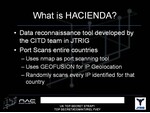
What is HACIENDA? [pdf]
This document details HACIENDA, a large-scale reconnaissance tool used by GCHQ and the Five Eyes alliance to perform automated port scanning and vulnerability mapping across entire nations. It outlines the technical process of identifying and exploiting network infrastructure, specifically for the purpose of discovering Operational Relay Boxes (ORBs) to facilitate covert "Computer Network Exploitation" (CNE).