NSA El Paso Intelligence Center Trip Report 2008
Open PDFDocument date: 2008-02-20
Pages: 3
Genre: report
Banner: CONFIDENTIAL//REL TO USA, AUS, CAN, GBR, NZL//20391123
Classification: CONFIDENTIAL
Dissemination: REL TO USA, AUS, CAN, GBR, NZL
This internal NSA memo summarizes a meeting held on February 20, 2008, regarding the deployment of the Real-Time Regional Gateway (RT-RG) system at the El Paso Intelligence Center (EPIC), a DEA-led facility. It details challenges in funding, staffing, legal policies, and coordination between DEA, DHS, and NSA, with the goal of enhancing intelligence sharing and operational capabilities for law enforcement, and using RT-RG on the U.S.-Mexico border.
My notes
CONFIDENTIAL//REL TO USA, AUS, CAN, GBR, NZL//20391123
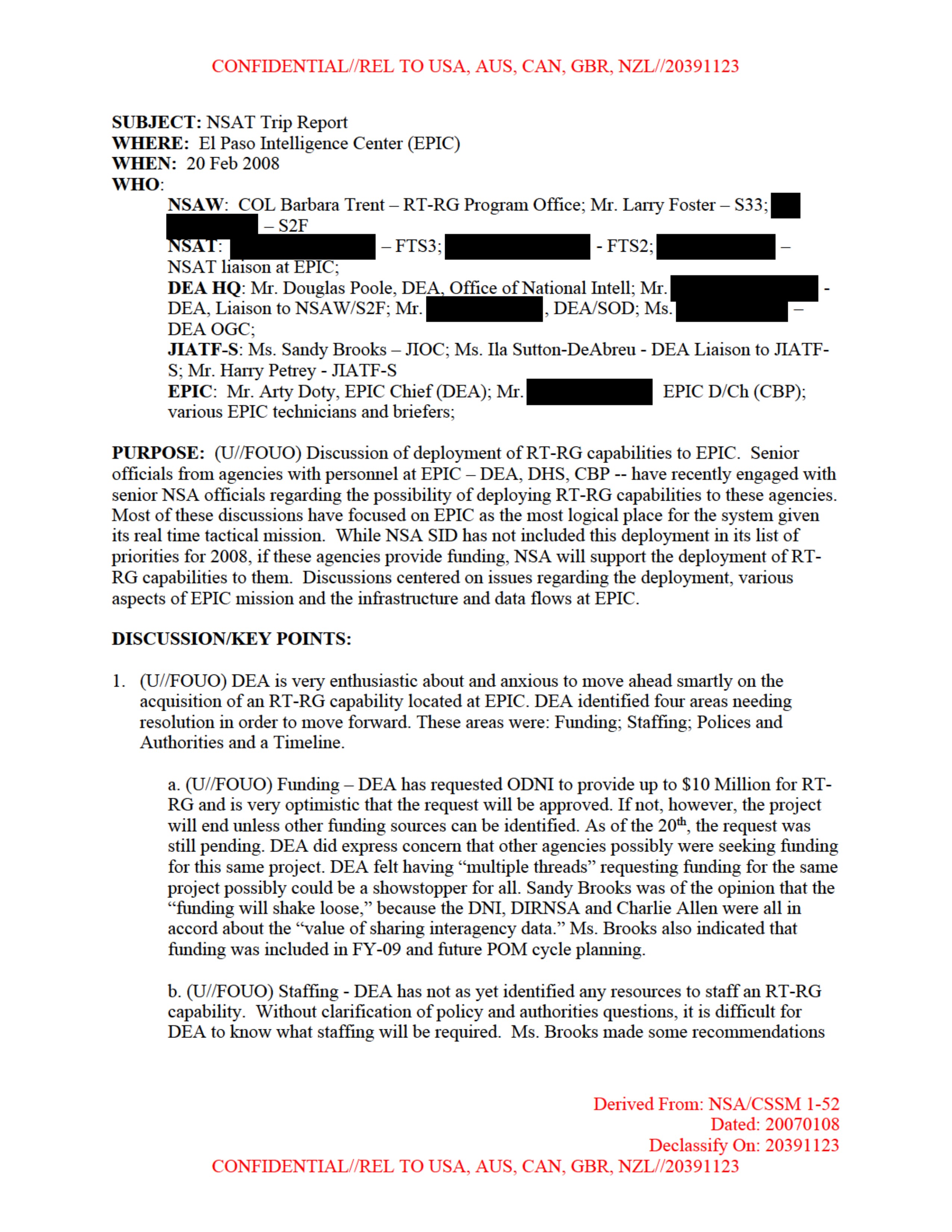
SUBJECT: NSAT Trip Report
WHERE: El Paso Intelligence Center (EPIC)
WHEN: 20 Feb 2008
WHO:
NSAW: COL Barbara Trent – RT-RG Program Office; Mr. Larry Foster – S33; [REDACTED] – S2F
NSAT: [REDACTED] – FTS3; [REDACTED] – FTS2; [REDACTED] – NSAT liaison at EPIC.
DEA HQ: Mr. Douglas Poole, DEA, Office of National Intell; Mr. [REDACTED], DEA, Liaison to NSAW/S2F; Mr. [REDACTED], DEA/SOD; Ms. [REDACTED], DEA OGC.
JIATF-S: Ms. Sandy Brooks – JIOC; Ms. Ila Sutton-DeAbreu – DEA Liaison to JIATF-S; Mr. Harry Petrey – JIATF-S
EPIC: Mr. Arty Doty, EPIC Chief (DEA); Mr. [REDACTED] EPIC D/Ch (CBP); various EPIC technicians and briefers;
PURPOSE: (U//FOUO) Discussion of deployment of RT-RG capabilities to EPIC. Senior officials from agencies with personnel at EPIC – DEA, DHS, CBP – have recently engaged with senior NSA officials regarding the possibility of deploying RT-RG capabilities to these agencies. Most of these discussions have focused on EPIC as the most logical place for the system given its real time tactical mission. While NSA SID has not included this deployment in its list of priorities for 2008, if these agencies provide funding, NSA will support the deployment of RT-RG capabilities to them. Discussions centered on issues regarding the deployment, various aspects of EPIC mission and the infrastructure and data flows at EPIC.
DISCUSSION/KEY POINTS:
- (U//FOUO) DEA is very enthusiastic about and anxious to move ahead smartly on the acquisition of an RT-RG capability located at EPIC. DEA identified four areas needing resolution in order to move forward. These areas were: Funding; Staffing; Polices and Authorities and a Timeline.
a. (U//FOUO) Funding – DEA has requested ODNI to provide up to $10 Million for RT-RG and is very optimistic that the request will be approved. If not, however, the project will end unless other funding sources can be identified. As of the 20th, the request was still pending. DEA did express concern that other agencies possibly were seeking funding for this same project. DEA felt having “multiple threads” requesting funding for the same project possibly could be a showstopper for all. Sandy Brooks was of the opinion that the “funding will shake loose,” because the DNI, DIRNSA and Charlie Allen were all in accord in about the “value of sharing interagency data.” Ms. Brooks also indicated that funding was included in FY-09 and future POM cycle planning.
b. (U//FOUO) Staffing - DEA has not as yet identified any resources to staff an RT-RG capability. Without clarification of policy and authorities questions, it is difficult for DEA to know what staffing will be required. Ms. Brooks made some recommendations
Derived From: NSA/CSSM 1-52
Dated: 20070108
Declassify On: 20391123
CONFIDENTIAL//REL TO USA, AUS, CAN, GBR, NZL//20391123
CONFIDENTIAL//REL TO USA, AUS, CAN, GBR, NZL//20391123
regarding the formation of an RT-RG team at EPIC and the kind of personnel who should
be part of this initiative.
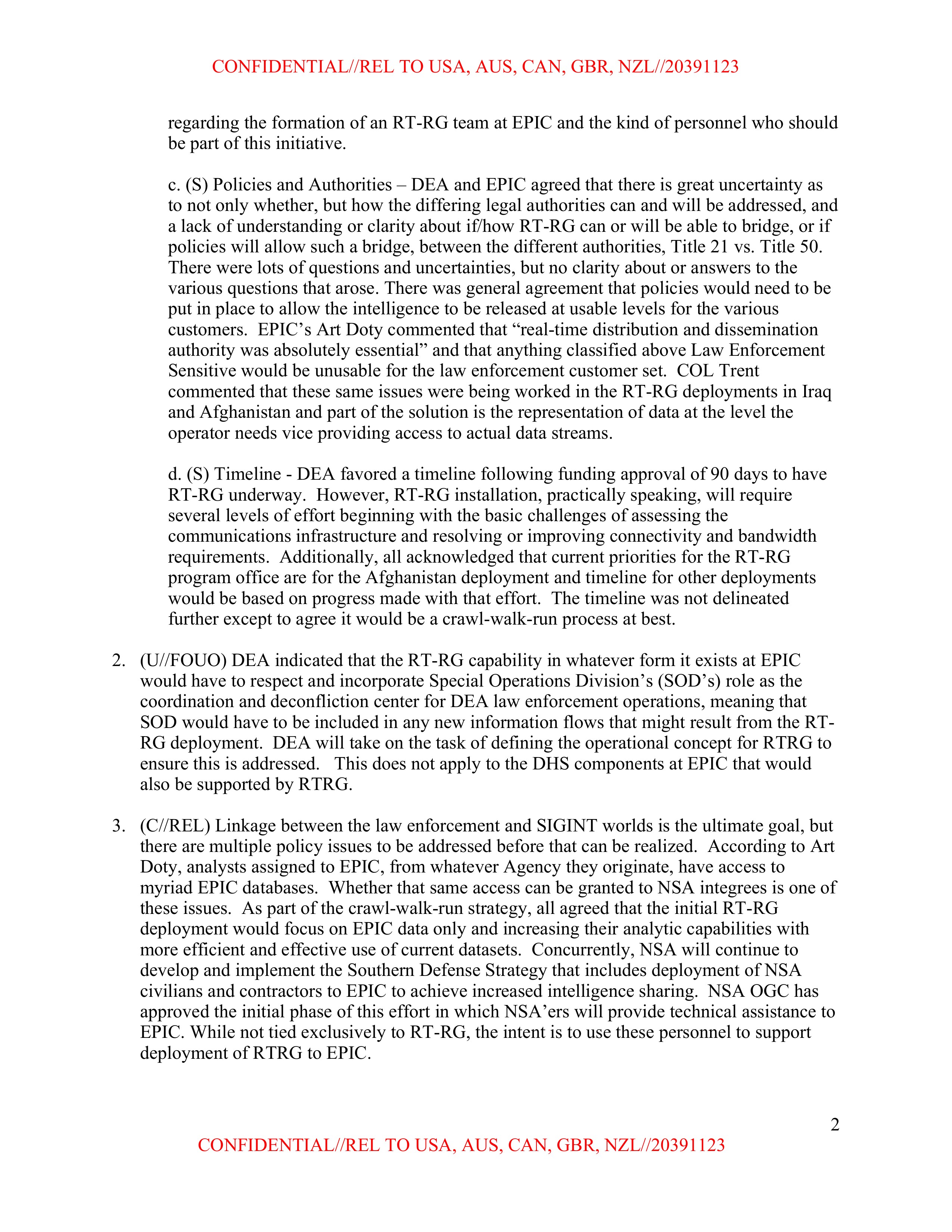
c. (S) Policies and Authorities – DEA and EPIC agreed that there is great uncertainty as
to not only whether, but how the differing legal authorities can and will be addressed, and
a lack of understanding or clarity about if/how RT-RG can or will be able to bridge, or if
policies will allow such a bridge, between the different authorities, Title 21 vs. Title 50.
There were lots of questions and uncertainties, but no clarity about or answers to the
various questions that arose. There was general agreement that policies would need to be
put in place to allow the intelligence to be released at usable levels for the various
customers. EPIC's Art Doty commented that “real-time distribution and dissemination
authority was absolutely essential” and that anything classified above Law Enforcement
Sensitive would be unusable for the law enforcement customer set. COL Trent
commented that these same issues were being worked in the RT-RG deployments in Iraq
and Afghanistan and part of the solution is the representation of data at the level the
operator needs vice providing access to actual data streams.
d. (S) Timeline - DEA favored a timeline following funding approval of 90 days to have
RT-RG underway. However, RT-RG installation, practically speaking, will require
several levels of effort beginning with the basic challenges of assessing the
communications infrastructure and resolving or improving connectivity and bandwidth
requirements. Additionally, all acknowledged that current priorities for the RT-RG
program office are for the Afghanistan deployment and timeline for other deployments
would be based on progress made with that effort. The timeline was not delineated
further except to agree it would be a crawl-walk-run process at best.
- (U//FOUO) DEA indicated that the RT-RG capability in whatever form it exists at EPIC
would have to respect and incorporate Special Operations Division's (SOD's) role as the
coordination and deconfliction center for DEA law enforcement operations, meaning that
SOD would have to be included in any new information flows that might result from the RT-
RG deployment. DEA will take on the task of defining the operational concept for RTRG to
ensure this is addressed. This does not apply to the DHS components at EPIC that would
also be supported by RTRG.
- (C//REL) Linkage between the law enforcement and SIGINT worlds is the ultimate goal, but
there are multiple policy issues to be addressed before that can be realized. According to Art
Doty, analysts assigned to EPIC, from whatever Agency they originate, have access to
myriad EPIC databases. Whether that same access can be granted to NSA integrees is one of
these issues. As part of the crawl-walk-run strategy, all agreed that the initial RT-RG
deployment would focus on EPIC data only and increasing their analytic capabilities with
more efficient and effective use of current datasets. Concurrently, NSA will continue to
develop and implement the Southern Defense Strategy that includes deployment of NSA
civilians and contractors to EPIC to achieve increased intelligence sharing. NSA OGC has
approved the initial phase of this effort in which NSAʼers will provide technical assistance to
EPIC. While not tied exclusively to RT-RG, the intent is to use these personnel to support
deployment of RTRG to EPIC.
CONFIDENTIAL//REL TO USA, AUS, CAN, GBR, NZL//20391123
2
CONFIDENTIAL//REL TO USA, AUS, CAN, GBR, NZL//20391123
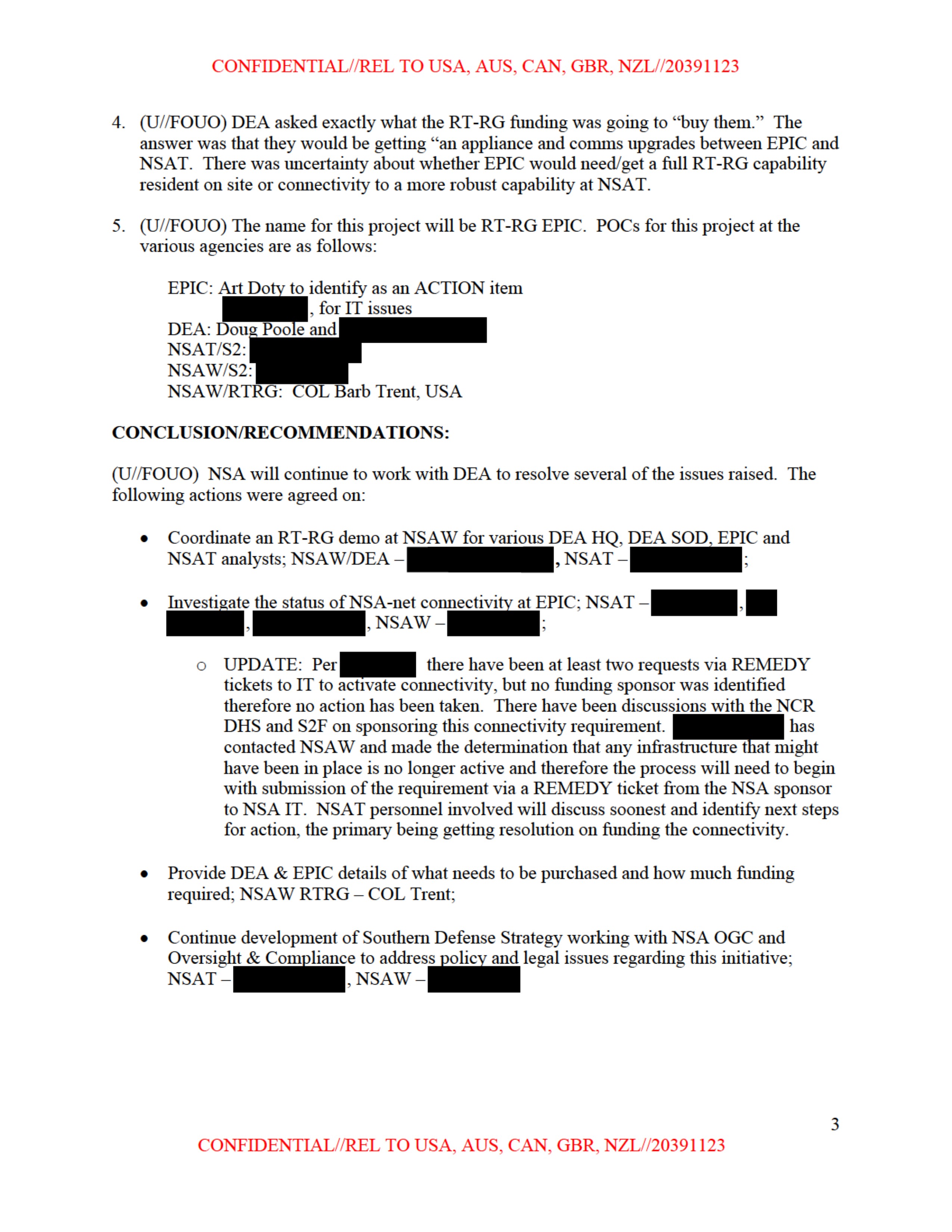
- (U//FOUO) DEA asked exactly what the RT-RG funding was going to "buy them." The
answer was that they would be getting "an appliance and comms upgrades between EPIC and
NSAT. There was uncertainty about whether EPIC would need/get a full RT-RG capability
resident on site or connectivity to a more robust capability at NSAT.
- (U//FOUO) The name for this project will be RT-RG EPIC. POCs for this project at the
various agencies are as follows:
EPIC: Art Doty to identify as an ACTION item
DEA: Doug Poole and [REDACTED] for IT issues
NSAT/S2: [REDACTED]
NSAW/S2: [REDACTED]
NSAW/RTRG: COL Barb Trent, USA
CONCLUSION/RECOMMENDATIONS:
(U//FOUO) NSA will continue to work with DEA to resolve several of the issues raised. The
following actions were agreed on:
- Coordinate an RT-RG demo at NSAW for various DEA HQ, DEA SOD, EPIC and
NSAT analysts; NSAW/DEA – [REDACTED], NSAT – [REDACTED]
- Investigate the status of NSA-net connectivity at EPIC; NSAT – [REDACTED],
NSAW – [REDACTED]- UPDATE: Per [REDACTED] there have been at least two requests via REMEDY
tickets to IT to activate connectivity, but no funding sponsor was identified
therefore no action has been taken. There have been discussions with the NCR
DHS and S2F on sponsoring this connectivity requirement. [REDACTED] has
contacted NSAW and made the determination that any infrastructure that might
have been in place is no longer active and therefore the process will need to begin
with submission of the requirement via a REMEDY ticket from the NSA sponsor
to NSA IT. NSAT personnel involved will discuss soonest and identify next steps
for action, the primary being getting resolution on funding the connectivity.
- UPDATE: Per [REDACTED] there have been at least two requests via REMEDY
- Provide DEA & EPIC details of what needs to be purchased and how much funding
required; NSAW RTRG – COL Trent;
- Continue development of Southern Defense Strategy working with NSA OGC and
Oversight & Compliance to address policy and legal issues regarding this initiative;
NSAT – [REDACTED], NSAW – [REDACTED]
CONFIDENTIAL//REL TO USA, AUS, CAN, GBR, NZL//20391123
3
Published in the Same Report
(10 of 24 documents)
-
Summary of GCHQ Info Wrt OC TSS1 Excerpt [pdf]
GCHQ Summary of RTRG (or RT-TG). The RTRG program provides real-time intelligence support for global operations, particularly in the context of the Global War on Terrorism, using tailored systems that integrate multiple data sources to enhance target identification and analysis. The success of RT-RG in support of Operation Iraqi Freedom led to an expansion of the programme to support operations in Korea and Afghanistan, with new applications for keyword-based selection and alerting on voice intercept being trialled.
“Mission Creep: How the NSA’s Game-Changing Targeting System Built for Iraq and Afghanistan Ended Up on the Mexico Border” - The Intercept ↗ (2019-05-29) · “Norges hemmelige krig i Afghanistan” - NRK ↗ (2019-05-29) · Moltke, Henrik · Skille, Øyvind Bye · Døvik, Olav · Hansen, Ståle Ellingsgard · Fjørtoft, Martin -
SSO News on MYSTIC SHELLTRUMPET for June 20, 2012 [pdf]
Internal NSA memo describing how SHELLTRUMPET, part of the MYSTIC program, works in conjunction with Real Time-Regional Gateway (RT-RG) and various Special Source Operations (SSO) programs to provide metadata access for RT-RG Texas. The system obfuscates source information and filters irrelevant metadata, enabling RT-RG Texas to efficiently process metadata from DANCINGOASIS and SPINNERET.
“Mission Creep: How the NSA’s Game-Changing Targeting System Built for Iraq and Afghanistan Ended Up on the Mexico Border” - The Intercept ↗ (2019-05-29) · “Norges hemmelige krig i Afghanistan” - NRK ↗ (2019-05-29) · Moltke, Henrik · Skille, Øyvind Bye · Døvik, Olav · Hansen, Ståle Ellingsgard · Fjørtoft, Martin -
Excerpt of May 2008 NSA Afghanistan Dataflow Analysis [pdf]
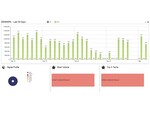
The document outlines how the NSA’s Real Time Regional Gateway (RT-RG) in Afghanistan progressively expanded from late 2007 through 2008 to ingest massive amounts of GSM, VHF, HF, and telephony metadata from dozens of locations across Afghanistan, supplemented by third-party “dirtbox” collection from allied nations such as the Netherlands, Denmark, Norway, Germany, and Spain. It details the specific collection sites, data types, and timelines (SPIN 9, 10, 11, etc.), illustrating how partner contributions and multiple signals sources fed into the RT-RG system to enable real-time intelligence.
Programs: FOURCORNERS · FORTRESS · WARRIOR · ECHIDNA · CASSIEOPIA · KARUS · SOUNDER · SNICK · TEMPOWOLFE · CALYPSO · TATTERAN · AIRBORNE · LEAVEBEHIND · UDEAUS · NELEUS · CROSSHAIR · SSO · DRT · RIVET JOINT · VOICESAIL“Mission Creep: How the NSA’s Game-Changing Targeting System Built for Iraq and Afghanistan Ended Up on the Mexico Border” - The Intercept ↗ (2019-05-29) · “Norges hemmelige krig i Afghanistan” - NRK ↗ (2019-05-29) · Moltke, Henrik · Skille, Øyvind Bye · Døvik, Olav · Hansen, Ståle Ellingsgard · Fjørtoft, Martin -
Afghanistan Coalition Dissemination Brief to Senior Leadership Forum [pdf]
This document ooutlines the structure, goals, and challenges of multinational signals intelligence (SIGINT) collaboration in Afghanistan as of 2009. It reveals how the U.S. and its intelligence-sharing allies (notably the 5 Eyes, 9 Eyes, and 14 Eyes) coordinated SIGINT collection, decryption, analysis, and dissemination across NATO and coalition forces.
“Mission Creep: How the NSA’s Game-Changing Targeting System Built for Iraq and Afghanistan Ended Up on the Mexico Border” - The Intercept ↗ (2019-05-29) · “Norges hemmelige krig i Afghanistan” - NRK ↗ (2019-05-29) · Moltke, Henrik · Skille, Øyvind Bye · Døvik, Olav · Hansen, Ståle Ellingsgard · Fjørtoft, Martin -
Bagram – Area 82 [pdf]
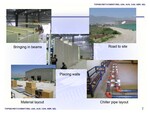
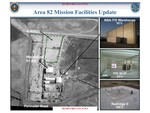
This document is a classified June 2010 progress report on the construction of the NSA’s Real Time Regional Gateway (RT-RG) data center at Area 82, Bagram Airfield, coordination with multiple U.S. and allied agencies, and the eventual deployment of the system after extensive infrastructure work. It emphasizes the transition from temporary container setups to a permanent facility enabling real-time signals intelligence in Afghanistan.
Marking: SECRET“Mission Creep: How the NSA’s Game-Changing Targeting System Built for Iraq and Afghanistan Ended Up on the Mexico Border” - The Intercept ↗ (2019-05-29) · “Norges hemmelige krig i Afghanistan” - NRK ↗ (2019-05-29) · Moltke, Henrik · Skille, Øyvind Bye · Døvik, Olav · Hansen, Ståle Ellingsgard · Fjørtoft, Martin -
NSA Area 82 Update April 2009 [pdf]
Programs: RT-RG“Mission Creep: How the NSA’s Game-Changing Targeting System Built for Iraq and Afghanistan Ended Up on the Mexico Border” - The Intercept ↗ (2019-05-29) · “Norges hemmelige krig i Afghanistan” - NRK ↗ (2019-05-29) · Moltke, Henrik · Skille, Øyvind Bye · Døvik, Olav · Hansen, Ståle Ellingsgard · Fjørtoft, Martin -
NSA BOUNDLESSINFORMANT Chart on Denmark [pdf]
The Denmark BOUNDLESSINFORMANT chart covering Dec 10, 2012 to Jan 8, 2013 shows that Danish intelligence collected and shared about 22.9 million cellphone metadata records with the NSA through DRTBOX systems. These records were gathered in Afghanistan as part of the Afghanistan SIGINT Coalition, not mass surveillance inside Denmark.
“Mission Creep: How the NSA’s Game-Changing Targeting System Built for Iraq and Afghanistan Ended Up on the Mexico Border” - The Intercept ↗ (2019-05-29) · “Norges hemmelige krig i Afghanistan” - NRK ↗ (2019-05-29) · Moltke, Henrik · Skille, Øyvind Bye · Døvik, Olav · Hansen, Ståle Ellingsgard · Fjørtoft, Martin -
Real-Time Regional Gateway Cloud Analytics for Forward Users [pdf]
This document outlines the NSA’s Real-Time Regional Gateway (RT-RG) program, a global cloud-based signals intelligence system designed to provide near real-time data analysis and targeting support for military and intelligence operations. It details the transition to scalable cloud architectures such as GHOSTMACHINE and Cloudbase, enabling massive data retention, exploitation, advanced geolocation, and automated analytics for tracking high-value targets across multiple theaters, including Afghanistan, Iraq, and the Horn of Africa.
Programs: RT-RG · GOLDMINER · GEOT · AGENTLOGIC · SHARKFINN · SKS · PANOPTICON · DRT · CIDNE · JUGGERNAUT · LOPERS · TALIS · MATTERHORN · AIRHANDLER · LYCANTHROPE · VOICESAIL · RETURNSPRING · SORTINGLEAD · GHOSTMACHINE · GMROYALE · GMREGAL · GMGEIST · GMIDEA · GMTOTE · GMPEN · GMPAC · GMCALM · GMMATE · GMAPPLE · GMCAVE · GMPEACH · GMDEN · GMMOUNT · GMALAMO · GMLIGHT · GMBALTIC · GMPLACE · GMPARK · GMHALO · GMCARBON · DRAGONFIRE · DOMEEXPOSE · GIANTSQUID · MAINWAY · FURIOUSCHAINSAW · SHARKFURY · NIAGARAFILES · SHARKQUERY · SHARKDOCS · OCTAVE · UTT · BEDDOWN · CHEEKYMONKEY · LAYERCAKE · CYBERTRANS · GMSEMINOLE · GMGULF · GMZILLA · HLT · JEMA · NEVIS · SEDB · CLOUDBASE · MAPREDUCE · CASPORT · WAVELEGAL“Mission Creep: How the NSA’s Game-Changing Targeting System Built for Iraq and Afghanistan Ended Up on the Mexico Border” - The Intercept ↗ (2019-05-29) · “Norges hemmelige krig i Afghanistan” - NRK ↗ (2019-05-29) · Moltke, Henrik · Skille, Øyvind Bye · Døvik, Olav · Hansen, Ståle Ellingsgard · Fjørtoft, Martin -
Real-Time Regional Gateway (RT-RG) [pdf]
This document from GCHQ details the NSA's Real-Time Regional Gateway (RT-RG), a system designed to provide tactical military users with near-instantaneous SIGINT (signals intelligence) support by integrating and analyzing data from multiple sources. It outlines the system’s applications, benefits, and challenges, particularly in enhancing the speed and efficiency of intelligence delivery to military operations in regions like Afghanistan, and highlights its impact on collaboration with GCHQ.
Programs: RT-RG · RT-10 · GOLDMINER · VOICESAIL · GEOT · SHARKFINN · CELLEX · SORTINGLEAD · GREMIO · IMMERGO · HERRICK · AIRHANDLER · TIPPERS · PASHTOVOICE · VIPERFOCUS · SKS · GEOFUSION · EVENTS“Mission Creep: How the NSA’s Game-Changing Targeting System Built for Iraq and Afghanistan Ended Up on the Mexico Border” - The Intercept ↗ (2019-05-29) · “Norges hemmelige krig i Afghanistan” - NRK ↗ (2019-05-29) · Moltke, Henrik · Skille, Øyvind Bye · Døvik, Olav · Hansen, Ståle Ellingsgard · Fjørtoft, Martin -
New Tool Put Into Play in Afghanistan SIDtoday [pdf]
A new tool that allows for secure information sharing between coalition partners was put to use in Afghanistan. A few weeks in, the tool likely saved a Norwegian squadron from “disaster” by providing timely warning and data about a threat.
Programs: CENTER ICEThe Intercept ↗ (2018-08-15) · “Mission Creep: How the NSA’s Game-Changing Targeting System Built for Iraq and Afghanistan Ended Up on the Mexico Border” - The Intercept ↗ (2019-05-29) · “Norges hemmelige krig i Afghanistan” - NRK ↗ (2019-05-29) · Moltke, Henrik · Skille, Øyvind Bye · Døvik, Olav · Hansen, Ståle Ellingsgard · Fjørtoft, Martin

See all 25 documents published with “Norges hemmelige krig i Afghanistan” →
Related Documents
-
Real-Time Regional Gateway Cloud Analytics for Forward Users [pdf]
This document outlines the NSA’s Real-Time Regional Gateway (RT-RG) program, a global cloud-based signals intelligence system designed to provide near real-time data analysis and targeting support for military and intelligence operations. It details the transition to scalable cloud architectures such as GHOSTMACHINE and Cloudbase, enabling massive data retention, exploitation, advanced geolocation, and automated analytics for tracking high-value targets across multiple theaters, including Afghanistan, Iraq, and the Horn of Africa.
Programs: RT-RG · GOLDMINER · GEOT · AGENTLOGIC · SHARKFINN · SKS · PANOPTICON · DRT · CIDNE · JUGGERNAUT · LOPERS · TALIS · MATTERHORN · AIRHANDLER · LYCANTHROPE · VOICESAIL · RETURNSPRING · SORTINGLEAD · GHOSTMACHINE · GMROYALE · GMREGAL · GMGEIST · GMIDEA · GMTOTE · GMPEN · GMPAC · GMCALM · GMMATE · GMAPPLE · GMCAVE · GMPEACH · GMDEN · GMMOUNT · GMALAMO · GMLIGHT · GMBALTIC · GMPLACE · GMPARK · GMHALO · GMCARBON · DRAGONFIRE · DOMEEXPOSE · GIANTSQUID · MAINWAY · FURIOUSCHAINSAW · SHARKFURY · NIAGARAFILES · SHARKQUERY · SHARKDOCS · OCTAVE · UTT · BEDDOWN · CHEEKYMONKEY · LAYERCAKE · CYBERTRANS · GMSEMINOLE · GMGULF · GMZILLA · HLT · JEMA · NEVIS · SEDB · CLOUDBASE · MAPREDUCE · CASPORT · WAVELEGAL“Mission Creep: How the NSA’s Game-Changing Targeting System Built for Iraq and Afghanistan Ended Up on the Mexico Border” - The Intercept ↗ (2019-05-29) · “Norges hemmelige krig i Afghanistan” - NRK ↗ (2019-05-29) · Moltke, Henrik · Skille, Øyvind Bye · Døvik, Olav · Hansen, Ståle Ellingsgard · Fjørtoft, Martin -
NSA Area 82 Update April 2009 [pdf]
Programs: RT-RG“Mission Creep: How the NSA’s Game-Changing Targeting System Built for Iraq and Afghanistan Ended Up on the Mexico Border” - The Intercept ↗ (2019-05-29) · “Norges hemmelige krig i Afghanistan” - NRK ↗ (2019-05-29) · Moltke, Henrik · Skille, Øyvind Bye · Døvik, Olav · Hansen, Ståle Ellingsgard · Fjørtoft, Martin -
NSA June 2012 SSO Weekly Brief Excerpt [pdf]
This NSA Special Source Operations (SSO) briefing from June 2012 describes SPINNERET, a surveillance program that became the second-largest source of phone calling records and "tips" feeding into SHELLTRUMPET, a system that obscures the origin of collected metadata before forwarding it to NSA's Real-Time Regional Gateway (RT-RG) in Texas. The document indicates SHELLTRUMPET "obfuscates the source designators" and filters metadata to only include call events within NSA-Texas's area of responsibility.
“Mission Creep: How the NSA’s Game-Changing Targeting System Built for Iraq and Afghanistan Ended Up on the Mexico Border” - The Intercept ↗ (2019-05-29) · “Norges hemmelige krig i Afghanistan” - NRK ↗ (2019-05-29) · Moltke, Henrik · Skille, Øyvind Bye · Døvik, Olav · Hansen, Ståle Ellingsgard · Fjørtoft, Martin -
Afghanistan Coalition Dissemination Brief to Senior Leadership Forum [pdf]
This document ooutlines the structure, goals, and challenges of multinational signals intelligence (SIGINT) collaboration in Afghanistan as of 2009. It reveals how the U.S. and its intelligence-sharing allies (notably the 5 Eyes, 9 Eyes, and 14 Eyes) coordinated SIGINT collection, decryption, analysis, and dissemination across NATO and coalition forces.
“Mission Creep: How the NSA’s Game-Changing Targeting System Built for Iraq and Afghanistan Ended Up on the Mexico Border” - The Intercept ↗ (2019-05-29) · “Norges hemmelige krig i Afghanistan” - NRK ↗ (2019-05-29) · Moltke, Henrik · Skille, Øyvind Bye · Døvik, Olav · Hansen, Ståle Ellingsgard · Fjørtoft, Martin -
Summary of GCHQ Info Wrt OC TSS1 Excerpt [pdf]
GCHQ Summary of RTRG (or RT-TG). The RTRG program provides real-time intelligence support for global operations, particularly in the context of the Global War on Terrorism, using tailored systems that integrate multiple data sources to enhance target identification and analysis. The success of RT-RG in support of Operation Iraqi Freedom led to an expansion of the programme to support operations in Korea and Afghanistan, with new applications for keyword-based selection and alerting on voice intercept being trialled.
“Mission Creep: How the NSA’s Game-Changing Targeting System Built for Iraq and Afghanistan Ended Up on the Mexico Border” - The Intercept ↗ (2019-05-29) · “Norges hemmelige krig i Afghanistan” - NRK ↗ (2019-05-29) · Moltke, Henrik · Skille, Øyvind Bye · Døvik, Olav · Hansen, Ståle Ellingsgard · Fjørtoft, Martin