Tag: diplomats 19 documents
Search documents matching “diplomats” →Free-text subjects the curators added. Unlike the other axes these are not necessarily from the documents' own vocabulary, so they are the loosest thing to browse by (and the most forgiving).
Graphs
By Banner
By Classification
Refine (combine with another filter, via search)
Sort: Title
Documents
-
3G: impact and update - SDF Nov 09 [pdf]
This 2009 top-secret presentation from Australia’s Defence Signals Directorate (DSD) detailing 3G mobile network rollouts in Southeast Asia and identifying Indonesian President Susilo Bambang Yudhoyono, his wife, and senior officials as surveillance targets. It includes handset information, call data records, intercepted call attempts, and outlines plans for continued interception of Indonesian leadership communications.
-
BLARNEY program overview [pdf]
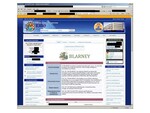
The document is an NSA Special Source Operations (SSO) portal page screenshot for the BLARNEY program, describing it as a top-secret collection initiative established in the 1970s that leverages government and commercial partnerships to intercept foreign intelligence under FISA authority. It highlights BLARNEY’s major intelligence value—contributing heavily to counterterrorism reporting and the President’s Daily Brief—and lists its primary targets as diplomatic, economic, foreign government, and counterterrorism communications.
-
Computer-Network Exploitation Successes South of the Border [pdf]
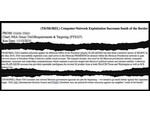
Pena Nieto's predecessor as president, Felipe Calderon, was also targeted. This image shows an excerpt from an NSA document classified as "top secret," from November 2010. The National Security Agency (NSA) has a division for particularly difficult cases. Called "Tailored Access Operations," or TAO for short, this department devises special methods for special targets. In May 2010, the division reported mission accomplished. A report classified as "top secret" said: "TAO successfully exploited a key mail server in the Mexican Presidencia domain within the Mexican Presidential network to gain first-ever access to President Felipe Calderon's public email account." According to the NSA, this email domain was also used by cabinet members, and contained "diplomatic, economic and leadership communications which continue to provide insight into Mexico's political system and internal stability."
Programs: FLATLIQUID -
Customers Can Help SID Obtain Targetable Phone Numbers SIDtoday [pdf]
US officials sometimes supply SID with their rolodexes. Although some of these numbers are public and others are not used to discuss sensitive information, they have lead the NSA to other useful numbers.
Marking: CONFIDENTIALPrograms: OCTAVEThe Intercept ↗ (2019-05-29) · “NSA monitored calls of 35 world leaders after US official handed over contacts” - The Guardian ↗ (2013-10-24) · Ball, James -
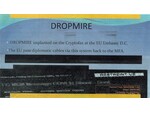
DROPMIRE on the Cryptofax at the EU Embassy D.C. [pdf]
This document reveals that the NSA secretly targeted EU diplomatic communications through a program called DROPMIRE, which involved placing surveillance implants on encrypted fax machines at the EU Embassy in Washington, D.C. This operation was part of a broader effort to spy on 38 foreign embassies and missions—including allies such as France, Italy, and Greece—to gain inside knowledge of policy debates and diplomatic positions.
Programs: DROPMIRE -
Guidelines for the classification of NSA SIGINT details (1945-1967) [pdf]
This document is an NSA classification guide that defines how and why historical SIGINT material from 1945–1967 remains classified, in many cases for 75 years. It systematically explains which intelligence activities, targets, partnerships, and technical methods must stay protected because they still reveal sensitive sources, methods, and diplomatic equities.
-
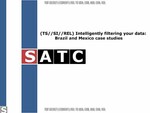
Intelligently filtering your data: Brazil and Mexico case studies [pdf]
These documents reveal that the NSA conducted targeted surveillance operations against high-profile Brazilian and Mexican figures, including President Dilma Rousseff and presidential candidate Enrique Peña Nieto, using advanced contact-graph filtering and data analysis techniques to extract relevant intelligence from intercepted communications. These documents show how NSA analysts systematically developed intelligence on foreign leaders during election periods and diplomatic activities, framing it as “target development,” but in practice enabling deep political espionage under the guise of analytical innovation.
“Veja os documentos ultrassecretos que comprovam espionagem a Dilma” - O Globo ↗ (2013-09-02) · “No Place to Hide” - Metropolitan Books ↗ (2014-05-13) · Greenwald, Glenn -
INTOLERANT – Who Else Is Targeting Your Target? Collecting Data Stolen by Hackers – SIDtoday SIDtoday [pdf]
A TOP SECRET SIDToday article from Menwith Hill Station describing how NSA and CSEC discovered and began exploiting INTOLERANT — a sophisticated email-stealing hacking operation targeting Indian diplomats, Central Asian diplomats, Chinese human rights defenders, Tibetan pro-democracy activists, Uighur activists and European officials — by intercepting the stolen emails as they transited satellite links, a technique internally called "fourth party collection" or "outsourcing SIGINT."
Programs: INTOLERANT -
MHS/GCHQ Projects - Turkey Energy Company Development (GCHQ) [pdf]
This GCHQ project, classified TOP SECRET STRAP1 COMINT, details a focused effort to gain intelligence access to key Turkish energy organizations, including the Ministry of Energy and Natural Resources (MENR) and major state and private corporations. The goal was to understand their communications traffic, improve collection access, and assess the balance of power within the MENR.
Programs: ROADBEDPeople: Güler, Hilmi“Turkey Is 'Partner and Target' for the NSA” - Der Spiegel ↗ (2014-08-31) · “How the NSA Helped Turkey Kill Kurdish Rebels” - The Intercept ↗ (2014-08-31) · Poitras, Laura · Rosenbach, Marcel · Sontheimer, Michael · Stark, Holger -
NSA Lends Support to Upcoming G8 and G20 Summits in Canada SIDtoday [pdf]
This document details how NSA spied the 2010 G8 and G20 summits in Canada, including coordination with Canadian partner CSEC to provide intelligence, threat monitoring, and policy support from a Threat Integration Center at the U.S. Embassy in Ottawa. It outlines operational plans, situational awareness, and reporting structures to assist executive protection and event security during the summits.
Programs: SCQAWKPeople: Obama, Barack -
Real Life Stats from GPRS work [pdf]
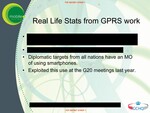
GCHQ’s TOP SECRET briefing touts real-time interception of diplomats’ smartphone traffic at the 2009 G20—especially BlackBerry—feeding live messages and newly discovered selectors to analysts and UK ministers to shape summit outcomes. It’s a snapshot of summit espionage turned into a policy tool: exploit the smartphone dependence of foreign delegations, deliver actionable SIGINT on demand.
“GCHQ intercepted foreign politicians' communications at G20 summits” - The Guardian ↗ (2013-06-16) · “For the NSA, espionage was a means to strengthen the US position in climate negotiations” - Dagbladet Information ↗ (2014-01-30) · MacAskill, Ewen · Davies, Nick · Hopkins, Nick · Borger, Julian · Ball, James · Gjerding, Sebastian · Geist, Anton · Moltke, Henrik · Poitras, Laura -
ROYAL CONCIERGE [pdf]
This document describes GCHQ’s top‑secret “ROYAL CONCIERGE program, an automated SIGINT system that mines hotel reservation emails and links to them from government (gov.xx) addresses to produce daily tip‑offs about diplomats’ travel and hotel stays. Those alerts enable a range of follow‑on options — from technical attacks (network/hotel room exploitation and XKeyScore fingerprinting) to HUMINT, and even attempts to influence or cancel visits.
-
SCS - Embassies and Consulates [pdf]
TOP SECRET Special Collection Service (SCS) documents about covert CIA/NSA spying sites operated from diplomatic facilities worldwide.
-
SI Decrypt [pdf]
This GCSB XKEYSCORE "fingerprint" file defines specific search terms, keywords, and target names used to automatically intercept and extract communications and documents related to the Solomon Islands government, including its cabinet, the Truth and Reconciliation Commission, groups like the Malaita Eagle Force, and the anti-corruption activist Benjamin Afuga.
Programs: XKEYSCOREPeople: Afuga, Benjamin · Anga, Barnabas · Iroga, Robert · Tagini, Philip · Indu, Fiona · Remobatu, James · Qurusu, Rose -
Special Collection Service - Pacific SIGDEV Conference March 2011 [pdf]
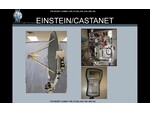
This document is a TOP SECRET briefing describing the Special Collection Service (SCS)—its organizational structure, global posture and strategic partnerships—and how SCS leverages advanced SIGINT and cyber capabilities (microwave, cellular, satellite, VPN/Internet exploitation, tools like INTERQUAKE/Einstein/Castanet/Birdwatcher) from embassy/PoP sites to collect, analyze and support intelligence and covert operations. It also outlines SCS modernization goals (unified IT core, cloud/virtualization, expanded cyber presence), operational authorities and mission advantages for enabling both SIGINT and HUMINT activities. See also Spiegel's 2013 reporting based on the same presentation (back then they only published two slides from this presentation): https://www.spiegel.de/international/germany/cover-story-how-nsa-spied-on-merkel-cell-phone-from-berlin-embassy-a-930205.html
-
Targeting Rationale (TAR) [pdf]
An NSA document describing how analysts should explain their targeting decisions under the FISA Amendments Act.
-
Tips for a Successful Quick Reaction Capability SIDtoday [pdf]
In response to Iranian President Ahmadinejad’s 2007 visit to New York, the NSA’s Iran Government and Leadership branches launched a Quick Reaction Capability (QRC) to gather time-sensitive intelligence. The QRC focused on enhanced collection techniques, collaboration across departments, and efficient data management to analyze the extensive communications traffic during the event, resulting in valuable leads on Iranian leadership activities and diplomatic plans.
People: Ahmadinejad, Mahmoud -
UN Secretary General XKS [pdf]
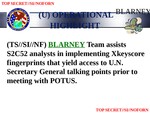
A TOP SECRET SSO BLARNEY operational highlight describing how the BLARNEY team assisted S2C52 analysts in implementing XKeyscore fingerprints that provided access to UN Secretary General Ban Ki-moon's talking points ahead of a meeting with the US President.
People: Ban, Ki-moon“XKEYSCORE: NSA’s Google for the World’s Private Communications” - The Intercept ↗ (2015-07-01) · “No Place to Hide” - Metropolitan Books ↗ (2014-05-13) · Marquis-Boire, Morgan · Greenwald, Glenn · Lee, Micah -
Voice Fax User Group Minutes March 2009 [pdf]
The document is a TOP SECRET GCHQ meeting record from March 2009 detailing updates to B14/MCS voice analytics systems, including new language identification (LID) models for Pashto, Dari, Brahui, and Baluchi languages and a first-pass speaker ID (SID) system for General Kiyani of Pakistan. It also highlights operational successes, such as improved reporting on Iraq's Vice President Adil ’Abd-al-Mahdi, which enhanced GCHQ’s reputation with NSA and reduced unnecessary workload for linguists.