Publisher: The New York Times 9 documents
Search documents matching “The New York Times” →Who published each document. Mostly a news outlet, but sometimes a book. A partner outlet that reported the story without publishing the documents keeps its byline and its article, but is not a publisher here.
Showing the documents The New York Times itself published in 2013 - all years.
Refine (combine with another filter, via search)
Sort: Title
Documents
-
BULLRUN CoI - Briefing Sheet [pdf]
A GCHQ briefing sheet introducing the BULLRUN Community of Interest — the access control framework protecting Five Eyes capabilities to defeat encryption across TLS/SSL, HTTPS, SSH, VPNs, IPSec, encrypted chat and encrypted VoIP — covering the classification structure, handling procedures and protective marking guidance for intelligence derived from cryptanalytic exploitation.
“N.S.A. Able to Foil Basic Safeguards of Privacy on Web” - The New York Times ↗ (2013-09-05) · “Revealed: The NSA's Secret Campaign to Crack, Undermine Internet Security” - ProPublica ↗ (2013-09-05) · “Prying Eyes: Inside the NSA's War on Internet Security” - Der Spiegel ↗ (2014-12-28) · Perlroth, Nicole · Larson, Jeff · Shane, Scott · Appelbaum, Jacob · Gibson, Aaron · Grothoff, Christian · Müller-Maguhn, Andy · Poitras, Laura · Sontheimer, Michael · Stöcker, Christian -
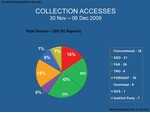
Collection Accesses 30 Nov - 06 Dec 2009 [pdf]
This National Security Agency chart shows the varied sources of 103 “accesses” to communications or computers collected in a single week in 2009 at the N.S.A.’s big station in San Antonio, Texas.
Programs: SSO -
New Contact-Chaining Procedures to Allow Better, Faster Analysis SIDtoday [pdf]
The SIGINT Management Directive 424 briefing (Jan 2011) announces a major procedural shift at the NSA, allowing analysts to conduct contact chaining and large-scale metadata analysis from any selector, regardless of nationality or location. This change removes prior restrictions on U.S. data, enabling more powerful social network mapping for foreign intelligence purposes.
Programs: GATEKEEPER -
NSA Video Games Paper [pdf]
The NSA paper entitled “Games: A Look at Emerging Trends, Uses, Threats, and Opportunities in Influence Activities” stresses the risk of leaving gaming communities under-monitored and how the NSA and GCHQ are conducting surveillance in various online games, collecting gamers' chat data, and deploying agents into World of Warcraft and Second Life.
People: Garite, Matt · Prasad, Kaira · Castronova, Edward · DeBenedictis, Steven · Robbins, Brian · Dunin, Elonka · Estanislao, Jon · James, Daniel · Valadares, Jeferson · Kushner, David · Ondrejka, Corey · Bonk, Curtis J. · Dennen, Vanessa P. · Lindstrom, Martin · Yee, Nick · Jayaganthan, Rengaswamy · Tawil-Souri, Helga · Soussi, Alasdair · Baertlein, Lisa · Brachman, Jarret M. · Rolston, David · Dille, Flint · Bilson, David S. · Bray, Hiawatha · Morgan, Dan · Henry, Dean · Halper, Keith · Pardew, Leslie A. · Betrus, Anthony D. · Steinkuehler, Constance A. · Gupta, Shankar · Joshi, Mahesh P. · Fong, Gwenda · Andersen, John · Reid, David · Kramer, Stephen E. · Brown, Seely · Thomas, Douglas · Phillips, Andrea · Thompson, Brooke · Alexander, Bryan · Dena, Christy · Barlow, Nova · Weimann, Gabriel · Mace, Michael · Knight, Will · Gibson, Erin · Langley, Hugh · Huang, Shih-Lian · Ruff, Chris · Gibson, Ben · Cialdini, Robert B. · Johnson, Steven · Tulloch, Paul · McLundie, Martin · Galles, Kara · Berkowitz, Jeff · May, William · Leonard, David J. · Williams, Dmitri“World of Spycraft: NSA and CIA Spied in Online Games” - ProPublica ↗ (2013-12-09) · “Spies Infiltrate a Fantasy Realm of Online Games” - The New York Times ↗ (2013-12-09) · “Xbox Live among game services targeted by US and UK spy agencies” - The Guardian ↗ (2013-12-09) · Elliott, Justin · Mazzetti, Mark · Ball, James -
SIGINT Enabling Project [pdf]
A classified NSA budget document requesting $254.9 million for FY2013 for the SIGINT Enabling Project — a covert program that works with U.S. and foreign technology companies to deliberately insert backdoors and vulnerabilities into commercial encryption products, networking equipment, and communications systems to make them secretly exploitable for surveillance.
“Revealed: The NSA's Secret Campaign to Crack, Undermine Internet Security” - ProPublica ↗ (2013-09-05) · “N.S.A. Able to Foil Basic Safeguards of Privacy on Web” - The New York Times ↗ (2013-09-05) · “Revealed: how US and UK spy agencies defeat internet privacy and security” - The Guardian ↗ (2013-09-05) · Larson, Jeff · Perlroth, Nicole · Shane, Scott · Ball, James · Borger, Julian · Greenwald, Glenn -
SIGINT Mission Strategic Plan FY2008-2013 [pdf]
This five-year mission plan for the National Security Agency shows how the agency’s leaders view its mission and culture.
-
SIGINT Strategy 2012-2016 [pdf]
This five-page document, written in 2012, is essentially a National Security Agency mission statement with broad goals, including a desire to push for changes in the law to provide the agency with expanded surveillance powers. It was written before Edward J. Snowden’s leaks, so it provides a glimpse at the thinking of agency officials before Mr. Snowden upset their political calculus.
People: Lynn, William J.“A Strategy for Surveillance Powers” - The New York Times ↗ (2013-11-22) · Risen, James · Poitras, Laura -
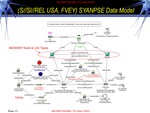
SYANPSE Data Model [pdf]
This document outlines the NSA’s SYANPSE Data Model, a classified metadata framework used for mapping relationships between people, organizations, devices, and intelligence designators. It details how various entities (e.g., phone numbers, email addresses, reports, and organizational units) are linked through structured graph relationships to support SIGINT analysis and tasking across the Five Eyes intelligence alliance.
-
United States SIGINT System January 2007 Strategic Mission List [pdf]
This 2007 list of the National Security Agency’s major missions illustrates the sweep of the agency’s goals for signals intelligence (Sigint) or electronic eavesdropping, which include not only such obvious targets as terrorist groups and Iran’s nuclear program, but the diplomacy and economic policy of friendly countries.