Publisher: The Intercept 54 documents
Search documents matching “The Intercept” →Who published each document. Mostly a news outlet, but sometimes a book. A partner outlet that reported the story without publishing the documents keeps its byline and its article, but is not a publisher here.
Showing the documents The Intercept itself published in 2017 - all years.
Graphs
By Banner
By Classification
Refine (combine with another filter, via search)
Sort: Title
Documents
-
JFK Assassination Records Classification/Declassification Guide Number: 385-00 [pdf]
A 2000 NSA guide setting what may be released from records responsive to the President John F. Kennedy Assassination Records Collection Act of 1992, keeping intercept details classified at SECRET//SI or TOP SECRET//SI while declassifying the fact of Cuban and Soviet collection.
Programs: SERAFINPeople: Kennedy, John F. -
M7600 & M8300 SIGINT guide [pdf]
3 p.This document describes the Mission 7600 and Mission 8300 satellite systems, which are geostationary SIGINT platforms operated by the U.S., U.K., and Australia to collect, process, and forward COMINT, ELINT, FISINT, MASINT, and PROFORMA signals primarily from the Eurasian landmass and Africa. It details orbital characteristics, collection capabilities, geolocation functions, and operational benefits, emphasizing real-time data dissemination to NSA and the integration of multi-mission, cross-site operations for high-priority intelligence targets.
-
-
NRO SIGINT guide for Pine Gap [pdf]
This classified document outlines the organizational relationships and security classifications related to the Joint Defence Facility Pine Gap (JDFPG) in Australia, identifying it as an Australian Mission Ground Station (AMGS) operated jointly by the U.S. and Australia. It confirms that Pine Gap’s official mission statement serves as a cover story, concealing its secret association with U.S. intelligence agencies like the NRO, NSA, and CIA.
-
NSA liaison in Tokyo opens new office SIDtoday [pdf]
This SIDtoday document describes how the NSA liaison to Japan (SUSLAJ) has moved its office from downtown Tokyo to the US Embassy, aiming to strengthen coordination with the US Ambassador and other intelligence representatives. This relocation follows a long-standing SIGINT partnership between NSA and Japan, dating back to the 1950s, and reflects the growing importance of US-Japan intelligence cooperation.
People: Schieffer, Thomas“Japan Made Secret Deals With the NSA That Expanded Global Surveillance” - The Intercept ↗ (2017-04-24) · “アメリカに監視される日本 ~スノーデン“未公開ファイル”の衝撃” - NHK ↗ (2017-04-24) · Gallagher, Ryan · Ikegami, Akira -
NSA posture on Syria [pdf]
This document outlines the NSA’s intelligence assessment and operational posture regarding the Syrian civil war in 2013, emphasizing ongoing SIGINT cooperation with GCHQ to monitor both the Syrian government and its military and opposition forces. It highlights limited insight into communications, stronger access to opposition networks, and joint U.S.–U.K. efforts—particularly from GCHQ sites like Digby and Mt. Troodos—to track regional instability and chemical weapons security.
-
NSA SIGINT Site Relocated in Japan: The Story Behind the Move SIDtoday [pdf]
This NSA SIDtoday newsletter article describes Project CAMELUS, a decade-long effort to relocate the agency's HANZA HF signals intelligence collection facility on Okinawa to a new site at Camp Hansen, with the Japanese government paying over $500 million for construction and new collection systems under political pressure to return occupied land. The article reveals tense negotiations where NSA leveraged Japanese funding to maintain surveillance capabilities while the Japanese government—notably not NSA's intelligence partners—pursued purely political objectives of land return, with disagreements escalating to cabinet-level discussions between the U.S. Secretary of Defense and Japanese Defense Minister.
People: Rumsfeld, Donald“Japan Made Secret Deals With the NSA That Expanded Global Surveillance” - The Intercept ↗ (2017-04-24) · “アメリカに監視される日本 ~スノーデン“未公開ファイル”の衝撃” - NHK ↗ (2017-04-24) · Gallagher, Ryan · Ikegami, Akira -
NSA slide on Saudi ordered attack by Syrian opposition [pdf]
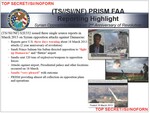
This NSA report revealed that Saudi Prince Salman bin Sultan directly ordered Syrian opposition forces to attack Damascus on the second anniversary of the revolution, providing 120 tons of explosives and weapons, with U.S. surveillance giving advance warning of the assault on the airport, presidential palace, and other targets. The Saudis were reportedly very satisfied with the results, and PRISM collected nearly all intelligence on the opposition’s plans and operations.
Programs: PRISMPeople: Sultan, Salman bin -
NSA’s intelligence relationship with Australia [pdf]
This document summarizes the close intelligence partnership between the U.S. NSA and Australia’s Defence Signals Directorate (DSD), highlighting collaboration on cyber operations, SIGINT collection, and military support. It emphasizes Australia’s contributions through satellite access, geolocation, and terrorism-related communications, particularly in the Pacific region, while noting shared focus on China and joint participation in multinational intelligence coalitions.
-
NSA’s USS Liberty Incident Classification Guide [pdf]
People: Tordella, Louis · Alger, Julie · Blalock, Donald L. · Blue, Allen M. · Wilson, Robert L. · Bennett, Maury H. · Bolstridge, Leslie J. · Connell, John · Cowardin, Charles · Cwalina, Benjamin G. · Deeley, Walter · Deprey, Allan · Durham, Billy · Farley, Robert D. · Gerhard, William D. · Green, Robert T. · Harvey, Richard · Holleran, William · Keller, William · Klumfoot, Clarence R. · Koczak, Edward · Lewis, D. E. · McTighe, Terry L. McFarland John · Millington, Henry W. · Schorreck, Henry · Sheck, Eugene · Way, Clyde Wesley · Wilson, Vincent J. Jr. -
Pages From Denial and Deception Except Redacted [pdf]
This document is a TOP SECRET X1 NSA report listing unauthorized disclosures of signals intelligence over the previous three years, noting that some—including coverage of the 1967 Israeli attack on the USS Liberty—had potential operational impacts but did not change targeting or intelligence priorities. It highlights that such leaks can harm U.S. intelligence capabilities and details one specific instance involving a 2000 Wall Street Journal letter discussing the incident.
-
Perseverance Pays Off: Eight-Year SIGINT Effort Culminates in Arrest of Elusive Colombian Terrorist SIDtoday [pdf]
In 2008, SIGINT from NSA Texas led to the arrest of Doris Adriana, a key FARC member, after eight years of surveillance. NSA's actionable intelligence provided Colombian authorities with crucial details about her border crossing from Venezuela, resulting in her capture and subsequent prosecution for cocaine trafficking and kidnapping U.S. citizens.
-
PHANTOM PARROT [pdf]
This document discusses PHANTOM PARROT, a GTAC tool used for querying mobile phone data collected from individuals stopped at UK ports as part of the ITT Op WILDWAY initiative. The tool allows intelligence analysts to access phonebook, SMS, and call log data from these stops, which can be used for counter-terrorism efforts. Data is obtained under the Terrorism Act 2000, and the tool is part of a broader intelligence-gathering effort, eventually to be integrated into the LUCKY STRIKE project.
Programs: PHANTOM PARROT · WILDWAY · RANNOCH MOOR · LUCKY STRIKE · LOOKING GLASS · DISHFIRE · CORINTH · MOONRAKER · RUSSETT -
Pine Gap classification guide [pdf]
This document is a classification guide for NSA/CSS activities at the Joint Defense Facility Pine Gap (JDFPG) in Australia, outlining which information about the site, its SIGINT missions, organizational structure, and training is classified and at what level. It specifies that sensitive details, including the site’s SIGINT mission, Producer Designator Digraph, SIGAD, and support to military operations, are protected to safeguard national security and allied interests.
-
PINWALE: Transnational DNI Training [pdf]
This presentation is a classified NSA training guide on PINWALE, a SIGINT database used for the storage, retrieval, and analysis of intercepted digital network intelligence (DNI) communications. It outlines system capabilities, query creation, search tools, and interfaces such as NEXUS, UIS, and AGILITY, explaining how analysts search, retrieve, and analyze both content and metadata — including FISA-partitioned data — within the Five Eyes intelligence framework.
-
QUANTUMTHEORY CT Successes [pdf]
This document details a successful NSA counterterrorism cyber operation in which analysts used QUANTUM techniques to deploy the UNITEDRAKE implant—equipped with keylogging and USB collection tools—against Al-Qaeda coordinator Muhsin al-Fadhli in Iran, even after detecting Kaspersky antivirus software on the target system. The operation yielded significant intelligence on Al-Qaeda communications, document forgery activities, and associated operatives.
Programs: QUANTUMTHEORY · ANCIENTBREW · VALIDATOR · QUANTUM · QUANTUMCOWBOY · UNITEDRAKE · GROK · SALVAGERABBITPeople: al-Fadhli, Muhsin -
Re: Ehsanul Sadequee FISA Request [pdf]
This NSA email chain from April 2006 shows NSA analysts urgently requesting FBI FISA authorization documents for Ehsanul Sadequee so they could conduct a "TAO operation" (Tailored Access Operations hack) to retrieve a file he had shared, racing against the FBI's impending arrest which would invalidate their surveillance authority. The emails reveal the NSA's dependence on FBI-obtained FISA warrants to justify their operations and their need to complete the hack before Sadequee's arrest made their authorization "invalid."
Programs: CADENCEPeople: Sadequee, Ehsanul Islam -
SDSG Integrated Analytics Workshop (14 Oct 2011) [pdf]
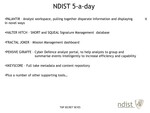
This document is a summary of a workshop held by the SIGINT Development Steering Group (SDSG) on October 14, 2011, evaluating and comparing the strengths, weaknesses, and potential use of advanced analytics tools, specifically Palantir and Mamba, for intelligence analysis. It discusses the tools' capabilities in data integration, collaboration, and visualization, along with concerns about security, usability, and the risks of relying on commercial software.
Marking: SECRET -
SEBACIUM - GCWiki [pdf]
This GCWiki document outlines SEBACIUM, a suite of tools developed for monitoring and exploiting peer-to-peer (P2P) networks, particularly eMule and BitTorrent, to track and target users sharing or downloading specific content, such as extremist material, for intelligence and operational purposes. It also details various tools within the system, including DIRTY RAT for tracking file-sharing activities and PLAGUE RAT for altering search results in P2P networks.
-
Shift to Software Demodulation in Misawa Expands Collection, Saves Money SIDtoday [pdf]
This SIDtoday document details how the Misawa Security Operations Center (MSOC) has implemented a software demodulation system called WORDGOPHER to process low-data-rate satellite signals. This shift to software-based processing allows MSOC to increase SIGINT collection, save millions of dollars by reducing reliance on expensive hardware demodulators, and improve overall mission efficiency.
“Japan Made Secret Deals With the NSA That Expanded Global Surveillance” - The Intercept ↗ (2017-04-24) · “アメリカに監視される日本 ~スノーデン“未公開ファイル”の衝撃” - NHK ↗ (2017-04-24) · “No Place to Hide” - Metropolitan Books ↗ (2014-05-13) · Gallagher, Ryan · Ikegami, Akira · Greenwald, Glenn