Country: Japan 106 documents
Search documents matching “Japan” →Countries mentioned in each document. A country may be mentioned directly (e.g., France) or inferred from a related reference, such as a city (Paris -> France) or a domain name (.fr -> France).
Graphs
By document date (12 years)
By Banner
By Classification
Refine (combine with another filter, via search)
Sort: Title
Documents
-
China: The Near-Term Potential for Economic, Political, and Social Crises SIDtoday [pdf]
The author outlines major issues facing China and explains how they are likely to "dominate Chinese decision-makers' thinking for the next six months," as well as affect the regional and global economy.
Marking: CONFIDENTIALThe Intercept ↗ (2016-12-07) -
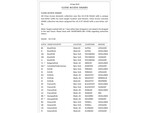
Close Access SIGADS [pdf]
A 10 September 2010 NSA reference list of Close Access SIGADs revealing the codenames, locations and collection methods used to bug the embassies and UN missions of 38 targets — including US allies France, Italy, Greece, Japan, India, Mexico, South Korea and the EU — through implants, computer-screen capture, hard-drive imaging and electromagnetic emanation collection, most conducted against diplomatic facilities in Washington DC and New York.
Programs: KATEEL · POCOMOKE · MERCED · BANISTER · PERDIDO · MAGOTHY · BLACKFOOT · WABASH · NAVARRO · POWELL · KLONDIKE · NASHUA · OSAGE · OSWAYO · BRUNEAU · HEMLOCK · MULBERRY · ALAMITO · FLEMING · DOBIE · SULPHUR · REQUETTE · YUKON · WESTPORT · NAVAJO · PANTHER · LIFESAVER · HIGHLANDS · VAGRANT · MINERALIZ · DROPMIRE · PBX · MAGNETIC · OCEAN · GENIE · BLACKHEART · CRYPTOENABLED · CUSTOMS · DEWSWEEPER · RADON · MINERALIZE · COOP · STARRUBY · TRASHINT“No Place to Hide” - Metropolitan Books ↗ (2014-05-13) · “Espionnage de la NSA : la diplomatie française était sur écoute aux Etats-Unis” - Le Monde ↗ (2013-10-22) · “Da qui ci spiano gli americani” - L'Espresso ↗ (2013-12-05) · Greenwald, Glenn · Follorou, Jacques · Maurizi, Stefania -
Collection Facility Goes Low-Profile on Okinawa SIDtoday [pdf]
NSA is forced to move a Japanese-funded collection facility in Okinawa to a new location 25 miles away to honor the wishes of the neighbors. The new location is more “low-profile,” and the Japanese government will pay for the $150 million move.
The Intercept ↗ (2016-08-10) -
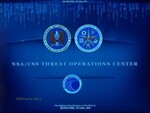
Cover slide NSA/CSS Threat Operations Center, February 2013 [pdf]
Cover slide of a February 2013 NSA/CSS Threat Operations Center (NTOC) briefing prepared for release to Japan. Only this title slide is public, captured from an NDR news video; the substance of the brief has never been published.
-
CROSSHAIR — Foreign Partners Filling HF/DF Gaps for the US SIDtoday [pdf]
The U.S. closed a number of High Frequency Direction-Finding sensor sites in the 1990s. To ensure they're able to track signals in areas that had previously been covered by now-shuttered stations, the Signals Intelligence Directorate worked with Second and Third Party partners to share resources and establish a global direction-finding network.
Programs: CROSSHAIR“Japan Made Secret Deals With the NSA That Expanded Global Surveillance” - The Intercept ↗ (2017-04-24) · “アメリカに監視される日本 ~スノーデン“未公開ファイル”の衝撃” - NHK ↗ (2017-04-24) · The Intercept ↗ (2017-09-13) · Gallagher, Ryan · Ikegami, Akira -
CRYPTOLOGIC SERVICES GROUPS (CSGs) [pdf]
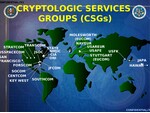
Worldwide locations of the Cryptologic Services Groups (CSGs). The visual is a world map annotated with the locations of CSGs embedded in or supporting major U.S. combatant commands and agencies. These groups act as NSA’s cryptologic arms inside military commands. Cryptologic operations are co-located with military command authority and signals intelligence is structurally tied to every major U.S. warfighting domain.
-
CSEC Cyber Threat Capabilities [pdf]
This document details CSEC’s full-spectrum cyber operations architecture, integrating SIGINT and IT Security to conduct both defensive and offensive activities under the guise of “information superiority.” While early sections emphasize detection, anomaly analysis, and collaboration with Five Eyes partners, later portions reveal active measures including network infiltration (implant deployment), command-and-control tracking, traffic manipulation and redirection, DNS interference, and potential disruption or deception operations—illustrating CSEC’s capacity not only to defend Canadian networks but also to surveil, exploit, and influence foreign and domestic digital infrastructure.
Programs: EONBLUE · CYBERDMZ · SEEDSPHERE · PHOTONICPRISM · SPECIALSOURCE · SUPERDRAKE · DARKSPACE · QUANTUM · MANDATE · STREAMING SENTRY · SSO · TKB · COVENANT -
CSEC Cyber Threat Detection [pdf]
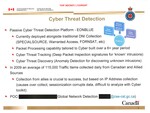
This document details the Communications Security Establishment’s (CSEC) cyber threat detection and intelligence infrastructure, including systems like EONBLUE, CROSSBOW, CRUCIBLE, and LODESTONE, which enable passive monitoring, anomaly detection, and botnet identification through metadata and deep packet inspection. It outlines how CSEC integrates SIGINT, cryptanalysis, and network forensics to detect and mitigate cyber intrusions using both SIGINT and domestic sensors, while collaborating with Five Eyes partners to enhance Canada’s cyber defense and situational awareness. The presentation is duplicated from page 7 onwards - one of the duplicated slide has internal CSE comments.
Programs: EONBLUE · SPECIALSOURCE · WARRANTEDACCESS · COVENANT · SEEDSPHERE · DIESELRATTLE · SIENNABLUE · DOWNGRADE · CROSSBOW · CRUCIBLE · LODESTONE -
Data Acquisition Meets With Extended Enterprise SIDtoday [pdf]
SID's Data Acquisition section held the first "video-teleconference" with its field sites around the world. A common theme of discussion was the need for communication from Data Acquisition and SID.
Marking: CONFIDENTIALThe Intercept ↗ (2016-12-07) -
DFS and NSA partnership [pdf]
DFS the NSA Sister Organization. This document outlines a high-level visit by Japan’s Directorate for Signals Intelligence (DFS), described as NSA’s “sister organization,” to the NSA/CSS headquarters in early 2013. The purpose was to strengthen their decades-long partnership, focusing on SIGINT-enabled cyber capabilities, training, and mutual understanding of each agency’s role in cyber defense.
People: Alexander, Keith B.“The Untold Story of Japan's Secret Spy Agency” - The Intercept ↗ (2018-05-19) · “日本の諜報 スクープ 最高機密ファイル” - NHK ↗ (2018-05-19) · Gallagher, Ryan -
DFS SIGINT-enabled Cyber [pdf]
This February 2013 top-secret DFS presentation outlines how Japan’s Directorate for Signals Intelligence (DFS) developed a SIGINT-enabled cyber program with U.S. NSA support, launching operations in late 2012 using the MALLARD system to collect and analyze satellite-based internet sessions. It details the project’s buildup, early challenges with massive data volumes, reliance on U.S. technical assistance, and plans for expanded antennas, infrastructure, and long-term system upgrades.
Marking: TOP SECRETPrograms: MALLARD“The Untold Story of Japan's Secret Spy Agency” - The Intercept ↗ (2018-05-19) · “日本の諜報 スクープ 最高機密ファイル” - NHK ↗ (2018-05-19) · Gallagher, Ryan -
'Dropping Anchor' in Anchorage SIDtoday [pdf]
The author describes the natural beauty of Alaska and what it's like to live and work in Anchorage.
People: Mitchell, BillyThe Intercept ↗ (2016-12-07) -
'Dropping Anchor' in Anchorage (repost) SIDtoday [pdf]
(Repost) The author describes the natural beauty of Alaska and what it's like to live and work in Anchorage.
People: Mitchell, BillyThe Intercept ↗ (2017-04-24) -
EP-3E Collision: Cryptologic Damage Assessment and Incident Review [pdf]
A joint US Navy and NSA report from July 2001, prepared three months after a US spy plane was forced to land in China, assessing how far surveillance sources and methods were compromised and reviewing the emergency destruction that failed to prevent it. Damage to tactical SIGINT against the PRC is rated medium and overall SIGINT damage low, with the greatest loss the LUNCHBOX PROFORMA processor and MARTES signals analysis tools; COMSEC damage is rated low because keying material was superseded within 15 hours.
Programs: LUNCHBOX · MARTES · NICKELBACK · SENSOR PACER · PROFORMA · HULTEC · STRUM · TEXTA · RASIN · CRITIC · KLIEGLIGHT · XBIT · BLACKMAGIC · NOIWON · ZIRCON · MIDB · EOB-LITE · NIMROD · ARIEL · COBRA BALL · COMBAT SENT · RIVET JOINT · SEABOOT · SETTEE · KAMPUS · DRUID · RORIPA · MARKHAM · FOREJUDGE · SAM HEARTBURN · NOVELETTE · RSBN · BEGGAR HAWK · BEGGAR SHADOW · CAPSULE JACK · DISTANT WIND · DISTANT SENT · CHILING · RIBBED · UNACCENTED · SLIPSTICK · SIERRA ONEPeople: Meals, Charlie -
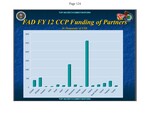
FAD FY 12 CCP Funding of Partners [pdf]
A Foreign Affairs Directorate slide showing Combined Cryptologic Program funding of foreign partners in fiscal year 2012, in thousands of dollars, across fifteen countries including Canada, Israel, Japan, Jordan, Pakistan, Taiwan and Thailand.
-
Flying BEAR Approach Alaska -- SIGINT Is Watching SIDtoday [pdf]
NSA watches from Alaska as the Russians deploy bombers that skirt North American airspace during an exercise. This allows NORAD to react calmly to the incursions.
The Intercept ↗ (2019-05-29) -
'Fourth of July Abroad' Tales (part 2) SIDtoday [pdf]
SIDtoday readers tell more stories about Fourth of July celebrations overseas.
Marking: SECRETThe Intercept ↗ (2017-09-13) -
GCHQ - PCS Harvesting [pdf]
A TOP SECRET STRAP1 report details how GCHQ industrialized the theft of GSM subscriber authentication keys (Ki) by automating trawls of bulk “C2C” content to extract IMSI/Ki pairs from emails and FTP transfers between SIM personalisation centers and mobile operators. It shows the program scaling key harvesting across networks and countries, complementing computer network exploitation against core mobile infrastructure to suppress billing and lift authentication secrets.
-
Guidelines for the classification of NSA SIGINT details (1945-1967) [pdf]
This document is an NSA classification guide that defines how and why historical SIGINT material from 1945–1967 remains classified, in many cases for 75 years. It systematically explains which intelligence activities, targets, partnerships, and technical methods must stay protected because they still reveal sensitive sources, methods, and diplomatic equities.
-
How Japanese SIGINTers Helped NSA SIDtoday [pdf]
Japan’s Directorate for SIGNIT, or DFS, found the replacement for a signal that benefited “many organizations” in the U.S. intelligence community but disappeared in 2002 or 2003. To honor this discovery, the NSA allowed DFS to name the new signal.
The Intercept ↗ (2018-03-01)