Classification: TOP SECRET 536 documents
Search documents matching “TOP SECRET” →Each document's classification level, as component values. If a document contains multiple classifications, the highest is used here.
Graphs
By document date (14 years)
By Banner
Refine (combine with another filter, via search)
Sort: Title
Documents
-
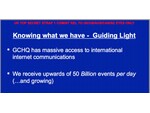
GCHQ access to international internet communications [pdf]
This document describes the scale of the agency's access to international internet communications, stating that GCHQ receives upwards of 50 billion events per day and that this volume is growing.
Programs: GUIDINGLIGHT“The US/UK Campaign to Demonize Social Media Companies as Terrorist Allies” - The Intercept ↗ (2014-11-26) · “No Place to Hide” - Metropolitan Books ↗ (2014-05-13) · Greenwald, Glenn -
GCHQ Analytic Cloud Challenges [pdf]
The 2012 GCHQ Analytic Cloud document outlines a sophisticated data processing infrastructure handling approximately 50 billion daily events across multiple sites, utilizing QFD databases and HADOOP clusters for various analytic capabilities targeting intelligence gathering and analysis. It describes architectural components, challenges in scaling and enabling analysts to cope with data complexity, and proposes future technology options including consolidation approaches and new cloud architectures to enhance capabilities.
Programs: EVOLVEDMUTANTBROTH · MUTANTBROTH · HARDASSOC · HRMAP · KARMAPOLICE · SOCIALANTHROPOID · AUTOASSOC · GEOFUSION · MVR · TERRAIN · SALAMANCA · BLACKHOLE · SAMUELPEPYS · BROKER · VAIL · GUIDINGLIGHT · FIRSTCONTACT · CLOUDYCOBRA · RUMOURMILL · EVERYASSOC · EVERYPOLICE · EVERYCREATURE · EVERYEAD · EVERYCIPHER · GREYFOX · SILVERFOX · GOLDENAXE · TRIBALCARNEM · PUBLICANEMONE · EPICFAIL · STERLINGMOTH · FOGHORN · LOOKINGGLASS · FIREENGINE · NGGEO · ALPHACENTAURI · CLOUDBASE · ACCUMULO · ASEM · SEM · HAKIM · STREAMING · HBASE · LAUREL · SKINNYCLOUD · HARDY · GCHQCORE -
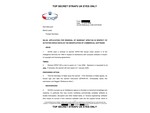
GCHQ Application for Renewal of Warrant GPW/1160 [pdf]
GCHQ’s 2008 application to renew warrant GPW/1160 seeks blanket cover under ISA section 5 to reverse engineer and modify commercial software—explicitly breaching copyright and licensing—to enable CNE, vulnerability research, and even police forensics. It catalogues concrete ops against web forums, routers, and antivirus, and asserts a novel legal theory blessed by the Intelligence Services Commissioner to immunize intellectual‑property interference.
-
GCHQ Cyber Operations Against Anonymous and Hacktivist Groups [pdf]
The leaked 2012 GCHQ presentation reveals that the agency’s JTRIG unit conducted offensive cyber operations against Anonymous and other hacktivist groups, including DDOS attacks (codenamed “Rolling Thunder”), online infiltration, and covert intelligence collection to disrupt their communications and identify key members.
-
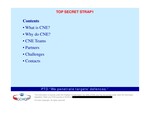
GCHQ – Computer Network Exploitation [pdf]
This document outlines GCHQ’s Computer Network Exploitation (CNE) capabilities, detailing how teams remotely access computers and networks without owners’ consent to gather intelligence, support operations, and conduct effects. It also covers operational tools, techniques, infrastructure, joint working with partners, deconfliction, and challenges such as avoiding detection and meeting increasing intelligence demands.
-
GCHQ – Making network sense of the encryption problem (2011) [pdf]
GCHQ’s Network Analysis Centre convened a 2011 roundtable on “making network sense” of encryption, pushing a metadata-first strategy to triage SSL/TLS, IKE, OpenVPN, and SSH flows, pivot from “seed” indicators, and zero in on targets and subnets worth decrypting. The playbook leans on enrichment, AS-level scoping (explicitly citing Belgacom AS6774 GRX VPNs), and “access optimisation” to collect data pre‑encryption—passively or actively.
Programs: SQUEAL · BEARDEDPIGGY · CLOUD · IRASCIBLEHARE · IRASCIBLERABBIT · IRASCIBLEMOOSE · IRASCIBLEEMITT“Operation Socialist: The Inside Story of How British Spies Hacked Belgium’s Largest Telco” - The Intercept ↗ (2014-12-13) · “Lees hier hoe de Britse geheime dienst GCHQ Belgacom aanviel” - NRC ↗ (2014-12-13) · “Britse geheime dienst bespioneerde jarenlang Belgacom-klanten” - De Standaard ↗ (2014-12-13) · Gallagher, Ryan · Modderkolk, Huib · Vanhecke, Nikolas · Eeckhaut, Mark -
GCSB access, XKEYSCORE [pdf]
4 p.These documents confirm that GCSB's Waihopai base (IRONSAND) provides Five Eyes partners, including the UK, with both "strong selected data" and a "full-take feed" of communications from the South Pacific via the NSA's XKEYSCORE system, confirming New Zealand's deep integration into the U.S.-led surveillance network despite facing internal issues with GCSB analysts accessing their own national data within NSA databases.
-
GCSB has identified an MFA data link [pdf]
A short extract from an April 2013 NSA document recording that GCSB had identified a Chinese Ministry of Foreign Affairs data link between the Chinese Consulate and the Chinese Visa Office in Auckland, and that NSA and GCSB had verbally agreed to mount a joint passive and active operation against it.
“Leaked papers reveal NZ plan to spy on China for US” - The New Zealand Herald ↗ (2015-04-19) · “New Zealand Plotted Hack on China With NSA” - The Intercept ↗ (2015-04-18) · Fisher, David · Gallagher, Ryan · Hager, Nicky -
GCSB monitoring candidates for WTO director general via XKEYSCORE fingerprint [pdf]
GCSB used XKEYSCORE to intercept emails mentioning other candidates for WTO job and paid close attention to Indonesian contender.
Programs: XKEYSCOREPeople: Azevêdo, Roberto · Bark, Taeho · Blanco, Herminio · González, Anabel · Groser, Tim · Hindawi, Ahmad Thougan · Kyerematen, Alan · Mohamed, Amina · Pangestu, Mari“How spy agency homed in on Groser's rivals” - The New Zealand Herald ↗ (2015-03-23) · “New Zealand Spied on WTO Director Candidates” - The Intercept ↗ (2015-03-22) · Hager, Nicky · Gallagher, Ryan -
GCSB SIGINT Development Quarterly Report [pdf]
This GCSB quarterly report from July 2009 provides a Top Secret review of major telecommunications developments in the South West Pacific, focusing on the intelligence challenges posed by competitive deregulation and new infrastructure projects, while also detailing GCSB's efforts to enhance its collection capabilities, including the fine-tuning of GSM collection in the Solomon Islands, supporting DSD analyses in Fiji, and preparing for full-take XKEYSCORE data sharing with allies.
“New Zealand Spies on Neighbors in Secret "Five Eyes" Global Surveillance” - The Intercept ↗ (2015-03-04) · “Snowden revelations / The price of the Five Eyes club: Mass spying on friendly nations” - The New Zealand Herald ↗ (2015-03-04) · “New Zealand Spy Data Shared With Bangladeshi Human Rights Abusers” - The Intercept ↗ (2015-04-15) · “Secret documents shine light on GCSB spying in Bangladesh” - The New Zealand Herald ↗ (2015-04-16) · Gallagher, Ryan · Hager, Nicky -
Getting Close to the Adversary – Forward-based Defense with QFIRE (June 3, 2011) [pdf]
This document describes the QFIRE project which is designed to give the NSA a global, low-latency platform for “forward-based defense”, enabling real-time detection and manipulation of Internet traffic close to its source. By co-locating passive sensors (TURMOIL), decision logic (TURBINE), and injection capabilities, QFIRE can rapidly reset connections, redirect targets for exploitation, inject malicious payloads, and even seize control of botnets. It operates as part of the broader QUANTUMTHEORY architecture, leveraging both cooperative and non-cooperative infrastructure worldwide to enable CNE/CND/CNA effects with minimal delay.
Programs: QFIRE · QUANTUMTHEORY · TURBULENCE · TURMOIL · TURBINE · TUTELAGE · QUANTUM · QUANTUMSKY · QUANTUMINSERT · QUANTUMBOT · QUANTUMCOPPER · STRAIGHTBIZARRE · BLINDDATE · TUMULT · ISLANDTRANSPORT · SURPLUSHANGAR · MIDDLEMAN · SCSnet · WEALTHYCLUSTER · SSO -
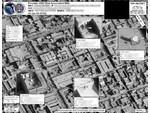
GHOSTHUNTER aerial image (2009) [pdf]
This imagery showcases a real-world application of the GHOSTHUNTER program operated out of Menwith Hill Station in the UK. The document features an aerial satellite photograph used to pinpoint the precise physical location of VSAT (Very Small Aperture Terminal) satellite dishes. By linking a target's digital footprint—specifically their MAC address and IP address—to a specific set of geographic coordinates, the NSA and GCHQ can identify the exact building or compound where a person is using the internet. This capability is a cornerstone of the "find, fix, finish" cycle used to support "covert operations" and targeted killing missions in conflict zones like Yemen, Somalia, and Afghanistan.
Programs: GHOSTHUNTER -
Ghosthunter and the geolocating of internet cafes [pdf]
This document announces an NSA “R Spotlight” webcast introducing GHOSTHUNTER, a multi-agency geolocation program designed to locate Time Division Multiple Access (TDMA) VSAT Internet access points, particularly internet cafés across the Middle East and North Africa in support of U.S. military operations. By mid-2009, GHOSTHUNTER had successfully geolocated over 5,000 VSAT terminals across Middle East demonstrating its operational effectiveness and integration with broader intelligence efforts.
Programs: GHOSTHUNTER -
Ghosthunter future capabilities (2008) [pdf]
This document indicates that Menwith Hill Station (MHS) provides approximately 99% of the FORNSAT data used by GHOSTHUNTER for geolocating targets, while additional FORNSAT sites can be tapped as needed to cover other regions. Although GHOSTHUNTER offers near-global geolocation capabilities, certain areas remain blind spots where coverage is limited.
Programs: GHOSTHUNTER -
GHOSTHUNTER Tasking Process [pdf]
The document outlines the GHOSTHUNTER (GH) tasking process at Menwith Hill Station, describing how geolocation requests for VSAT terminals and internet-connected targets are managed through coordination with the NSA’s Network Analysis Centre (NAC) and other sites. It details priority levels, task submission procedures, use of locational data from MASTERSHAKE, integration with imagery, and how results are shared with GCHQ and other authorized parties.
-
GHOSTMACHINE: Identifier Lead Triage with ECHOBASE [pdf]
This June 2012 presentation introduces ECHOBASE, an NSA analytic architecture designed to automate the triage of massive identifier lead lists (ranging from 50 to 10,000+ entries). By applying behavior-based analytics and "yes/no" behavioral queries against raw SIGINT, the system allows analysts to prioritize high-interest targets and discard irrelevant leads at scale.
Programs: GHOSTMACHINE · ECHOBASE · IDENTIFIERSCOREBOARD · FOREMAN · CONTRAOCTAVE · OCTAVE · UTT · WAVELEGAL · CASPORT · PSC -
Graph theory in the operational environment – GCHQ [pdf]
This document details GCHQ’s research on identifying “closed loops” of communication, where targets use a small set of phones to communicate exclusively among themselves, often with cheap, disposable handsets like the Nokia 1100. It explains the methodology for analyzing anonymized metadata, constructing contact graphs, and extracting non-giant, non-tree components to discover operationally relevant closed loops for intelligence and counterterrorism purposes.
Programs: VOICESAILPeople: Rumsfeld, Donald -
GRIMPLATE - First Steps Toward Identifying Adversarial Use of BitTorrent [pdf]
This document outlines the NSA's GRIMPLATE program, which was developed to monitor and analyze BitTorrent traffic on the Department of Defense's NIPRnet to identify potentially malicious activity. The program focuses on crawling the Distributed Hash Table (DHT) of BitTorrent networks to gather data on file-sharing nodes and peer connections, in order to detect and mitigate threats while building a case for halting unauthorized P2P usage on secure networks.
-
GSM tower geolocation [pdf]
This TOP SECRET STRAP 1 note describes DYMO, a prototype GSM-tower geolocation system that combines RUFIS-bis (which demodulates co-channel GSM ARFCN streams per cell-ID) with WHAMI Fast Image (WFI) to remodulate and correlate signals to produce high-quality tower geolocation and matching metadata. The remodulated “synthetic geolocation” improves accuracy and is under development in the NMDC/Midas studies.
-
GSM tower mapping made easier and more accurate with new tool SIDtoday [pdf]
This document details DYMO, a prototype developed at the NSA’s Menwith Hill Station—the agency’s large British base operated in close cooperation with GCHQ—for highly accurate GSM tower geolocation. It highlights DYMO’s superior performance in mapping accuracy and metadata integrity, its extensive operational use across regions such as Iraq, Iran, and Somalia, and its integration with tools like GOLDENEYE and the Integrated COMINT System (ICS) to streamline analysis and intelligence fusion.