Virtual Teaming Pays Off
Open PDFDocument date: 2008-11-05
Type: SIDtoday
Pages: 2
Genre: newsletter
Banner: DYNAMIC PAGE -- HIGHEST POSSIBLE CLASSIFICATION IS TOP SECRET // SI / TK // REL TO USA AUS CAN GBR NZL
Classification: TOP SECRET SI TK
Dissemination: REL TO USA AUS CAN GBR NZL
This SIDtoday document describes the successful formation of a "virtual team" between NSA Georgia and the UK's Joint Service Signal Unit (JSSU) Digby to enhance surveillance and intelligence collection efforts against Lebanese and Palestinian security forces. This collaboration, initiated in July 2008, allowed for continuous real-time monitoring, with the team providing three reports to national-level policymakers and military commanders, demonstrating the efficiency and effectiveness of cross-national teamwork in intelligence operations.
My notes
DYNAMIC PAGE -- HIGHEST POSSIBLE CLASSIFICATION IS
TOP SECRET // SI / TK // REL TO USA AUS CAN GBR NZL
(U) Virtual Teaming Pays Off
FROM: [REDACTED]
NSA Georgia, Middle East/North Africa shop (FGS2E3)
Run Date: 11/05/2008
(U//FOUO) SIDtoday Editor's comment: The below article is reprinted from NSA Georgia's
"Around NSAG" newsletter (12-25 October edition):
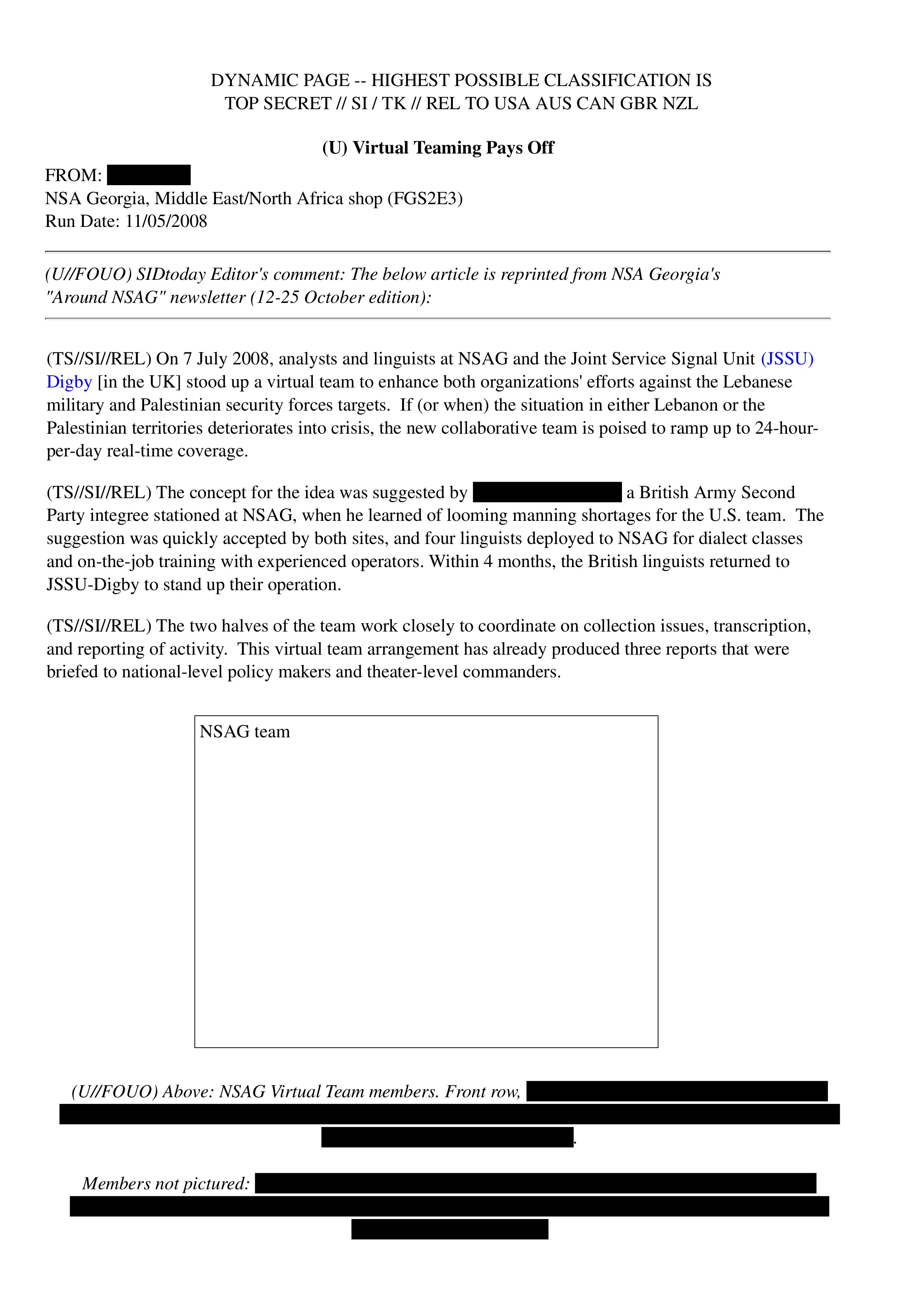
(TS//SI//REL) On 7 July 2008, analysts and linguists at NSAG and the Joint Service Signal Unit (JSSU) Digby [in the UK] stood up a virtual team to enhance both organizations' efforts against the Lebanese military and Palestinian security forces targets. If (or when) the situation in either Lebanon or the Palestinian territories deteriorates into crisis, the new collaborative team is poised to ramp up to 24-hour-per-day real-time coverage.
(TS//SI//REL) The concept for the idea was suggested by [REDACTED] a British Army Second Party integree stationed at NSAG, when he learned of looming manning shortages for the U.S. team. The suggestion was quickly accepted by both sites, and four linguists deployed to NSAG for dialect classes and on-the-job training with experienced operators. Within 4 months, the British linguists returned to JSSU-Digby to stand up their operation.
(TS//SI//REL) The two halves of the team work closely to coordinate on collection issues, transcription, and reporting of activity. This virtual team arrangement has already produced three reports that were briefed to national-level policy makers and theater-level commanders.
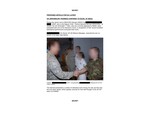
NSAG team
(U//FOUO) Above: NSAG Virtual Team members. Front row, [REDACTED]
Members not pictured: [REDACTED]
Di
(U//FOUO) JSSU Digby Virtual Team members (l-r): [REDACTED] and [REDACTED]
(U//FOUO) Have comments on the topic of virtual teaming? Post them on the SIDtoday Blog.
"(U//FOUO) SIDtoday articles may not be republished or reposted outside NSANet without the consent of S0121 (DL sid_comms)."
Information Owner: [REDACTED]
(email) [REDACTED]
Page Publisher: [REDACTED]
Last Modified:
11/09/2012 / Last Reviewed:
11/09/2012
designed
DYNAMIC PAGE -- HIGHEST
POSSIBLE CLASSIFICATION
IS
TOP SECRET // SI / TK // REL
TO USA AUS CAN GBR NZL
DERIVED FROM: NSA/CSSM
1-52, DATED 08 JAN 2007
DECLASSIFY ON: 20320108
Published in the Same Report
(7 documents)
-
AIRHANDLER missions Feb 2010 [pdf]
A communications survey in Helmand Province (Jan–Feb 2010) mapped line-of-sight and satellite activity to support allied operations. Between July and December 2009, RAF Digby conducted 148 AIRHANDLER drone surveillance missions, generating 363 intelligence reports.
Programs: AIRHANDLER -
Cryptologic shore support [pdf]
The document describes the Maritime Cryptologic Integration Centres (MCICs), which provide global SIGINT support to naval, air, and land units. Three MCICs operate within U.S. Fleet Information Operation Centres, while the fourth, uniquely joint U.K.–U.S. (RN/USN), is at RAF Digby in Lincolnshire, responsible for 24/7 cryptologic support to U.K. and allied missions across the North Atlantic, Barents, Baltic, and Black Seas, as well as North and Sub-Saharan Africa.
Marking: CONFIDENTIAL -
Digby geolocation [pdf]
The document reveals that RAF Digby was equipped with advanced profiling and analytics tools to enable (near) real-time co-location of GSM handsets, supporting intelligence operations across the Middle East and North Africa. It highlights the operational use of the RUM PUNCH algorithm on the DISTILLERY framework, which was jointly developed through an NSA–IBM–GCHQ partnership, allowing large-scale stream mining and independent analyst-led tracking operations. Enhancements at Digby extended beyond communications interception to include a new cyber mission, with capabilities to geo-locate emitters linked to IED arming and detonation under the FLAKJACKET mission, expanding the site’s role from surveillance to active battlefield support.
-
Event RARE weekly summaries [pdf]
This document outlines GCHQ's ongoing surveillance efforts in Libya, focusing on intercepting and analyzing communications from the Libyan regime, including military command and control via mobile satellite phones and other communication channels. It details the use of advanced SIGINT tools and close cooperation with the NSA, US, and Canadian intelligence agencies to monitor key military targets and opposition forces, supporting both tactical military operations and strategic intelligence objectives.
People: Gaddafi, Muammar -
NSA posture on Syria [pdf]
This document outlines the NSA’s intelligence assessment and operational posture regarding the Syrian civil war in 2013, emphasizing ongoing SIGINT cooperation with GCHQ to monitor both the Syrian government and its military and opposition forces. It highlights limited insight into communications, stronger access to opposition networks, and joint U.S.–U.K. efforts—particularly from GCHQ sites like Digby and Mt. Troodos—to track regional instability and chemical weapons security.
-
UKUSA at its Best: Producing the Best Possible SIGINT on Sudan SIDtoday [pdf]
This document reveals the close operational collaboration between NSA and GCHQ at sites including RAF Digby, detailing how American and British intelligence personnel worked jointly on signals intelligence (SIGINT) in regions such as Sudan, North Africa, and the Middle East, combining language training, quality control, and target monitoring to produce timely and accurate intelligence for high-level military and government customers. It highlights the strategic integration of UKUSA resources and personnel to optimize intelligence collection and analysis in conflict zones.
Programs: ZIRCON -
UK AIRHANDLER trainees [pdf]
This GCHQ document from 2008 describes British AIRHANDLER trainees at NSA Georgia receiving recognition for their operational performance supporting drone surveillance missions, with personnel from UK's Joint Service Signal Unit Digby being trained to operate SIGINT collection packages on Predator unmanned aerial vehicles. The document reveals that Digby was being established as only the second site worldwide (after NSA Georgia) capable of handling the "back end" processing of Predator drone intelligence collection after the UK purchased three Predator drones.
Marking: SECRETPrograms: AIRHANDLER
Related Documents
-
UKUSA at its Best: Producing the Best Possible SIGINT on Sudan SIDtoday [pdf]
This document reveals the close operational collaboration between NSA and GCHQ at sites including RAF Digby, detailing how American and British intelligence personnel worked jointly on signals intelligence (SIGINT) in regions such as Sudan, North Africa, and the Middle East, combining language training, quality control, and target monitoring to produce timely and accurate intelligence for high-level military and government customers. It highlights the strategic integration of UKUSA resources and personnel to optimize intelligence collection and analysis in conflict zones.
Programs: ZIRCON -
Event RARE weekly summaries [pdf]
This document outlines GCHQ's ongoing surveillance efforts in Libya, focusing on intercepting and analyzing communications from the Libyan regime, including military command and control via mobile satellite phones and other communication channels. It details the use of advanced SIGINT tools and close cooperation with the NSA, US, and Canadian intelligence agencies to monitor key military targets and opposition forces, supporting both tactical military operations and strategic intelligence objectives.
People: Gaddafi, Muammar -
SIGINT Seniors Pacific: Successes and Future CT Goals Highlighted at Conference SIDtoday [pdf]
This SIDtoday document details the second annual SIGINT Seniors Pacific (SSPAC) conference held in November 2006, where counterterrorism (CT) officials from eight nations reviewed the progress of their intelligence-sharing and collaboration efforts, set strategic goals for 2007, and discussed the establishment of the CRUSHED ICE communication network. The conference underscored the alliance's successes in producing CT reports, sharing language capabilities, and fostering joint analysis, while also setting ambitious goals for expanding operational collaboration and enhancing the global response to terrorist threats in the Pacific region.
People: Solaiman, Abu -
Ghosthunter and the geolocating of internet cafes [pdf]
This document announces an NSA “R Spotlight” webcast introducing GHOSTHUNTER, a multi-agency geolocation program designed to locate Time Division Multiple Access (TDMA) VSAT Internet access points, particularly internet cafés across the Middle East and North Africa in support of U.S. military operations. By mid-2009, GHOSTHUNTER had successfully geolocated over 5,000 VSAT terminals across Middle East demonstrating its operational effectiveness and integration with broader intelligence efforts.
Programs: GHOSTHUNTER -
SIGINT Target Package Leads to USMC Capture of al-Qa'ida Weapons Procurer SIDtoday [pdf]
This SIDtoday document details the capture of Abu Sayf, an Al-Qa'ida weapons procurer, by the U.S. Marine Corps in Iraq in May 2007, facilitated by SIGINT targeting from Menwith Hill Station and NSA Georgia. The operation disrupted weapons and insurgent smuggling into Iraq and may yield critical intelligence on Al-Qa'ida operations in Iraq, Syria, and Lebanon.
Programs: GHOSTHUNTER