Declaration of Andrew G. McCabe
Open PDFDocument date: 2013-09-30
Type: FOIA
Pages: 58
Classification: -
Dissemination: -
FISC/FISCR Court Filings
My notes
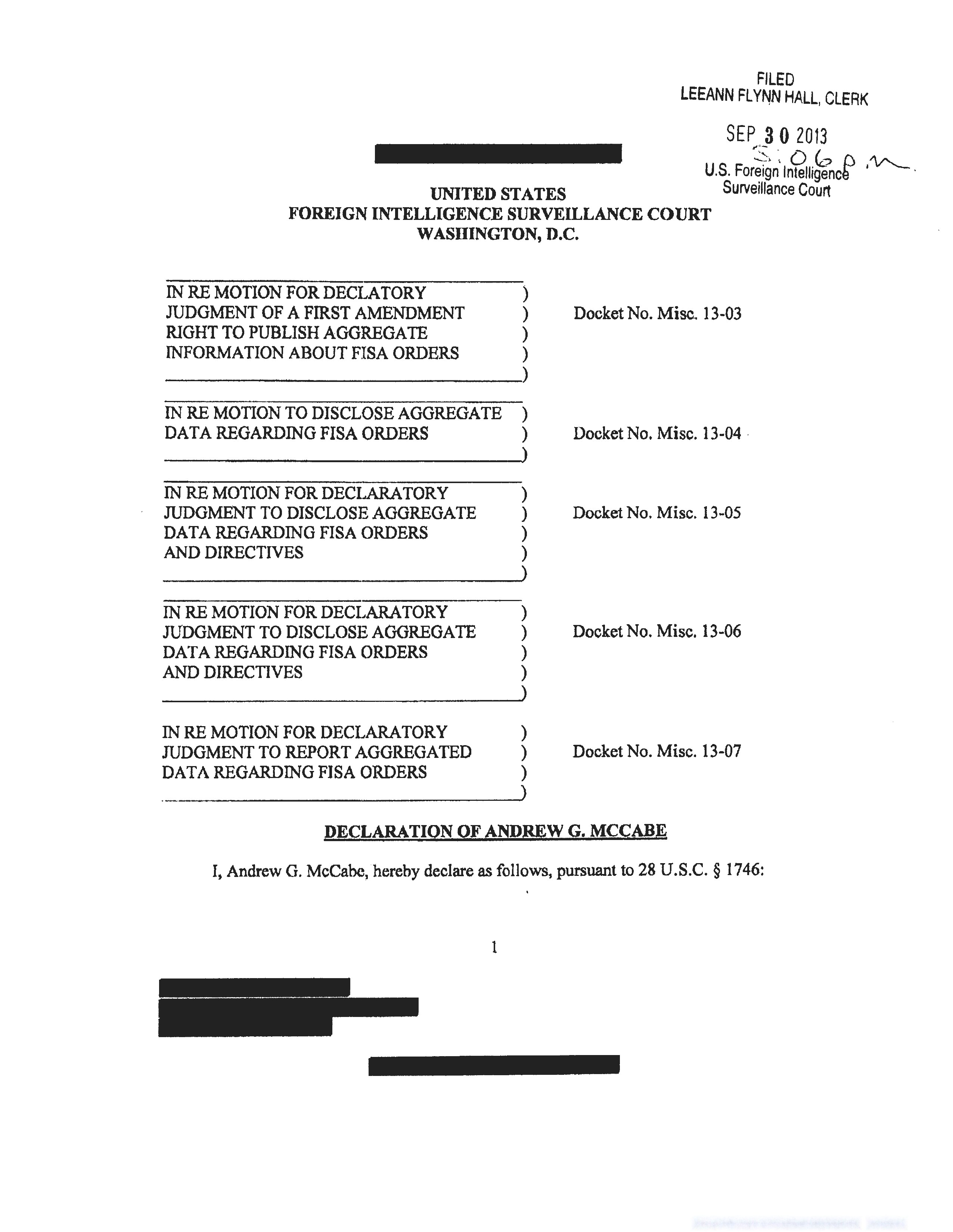









UNITED STATES
FILED
LEEANN FLYNN HALL, CLERK
SEP 30 2013
5:0
U.S. Foreign Intelligence
060
Surveillance Court
FOREIGN INTELLIGENCE SURVEILLANCE COURT
WASHINGTON, D.C.
IN RE MOTION FOR DECLATORY
)
JUDGMENT OF A FIRST AMENDMENT
)
Docket No. Misc. 13-03
RIGHT TO PUBLISH AGGREGATE
INFORMATION ABOUT FISA ORDERS
)
IN RE MOTION TO DISCLOSE AGGREGATE
DATA REGARDING FISA ORDERS
)
Docket No. Misc. 13-04
)
IN RE MOTION FOR DECLARATORY
JUDGMENT TO DISCLOSE AGGREGATE
DATA REGARDING FISA ORDERS
AND DIRECTIVES
)
)
Docket No. Misc. 13-05
)
)
IN RE MOTION FOR DECLARATORY
JUDGMENT TO DISCLOSE AGGREGATE
DATA REGARDING FISA ORDERS
AND DIRECTIVES
)
)
Docket No. Misc. 13-06
)
)
IN RE MOTION FOR DECLARATORY
JUDGMENT TO REPORT AGGREGATED
DATA REGARDING FISA ORDERS
)
)
Docket No. Misc. 13-07
)
DECLARATION OF ANDREW G. MCCABE
I, Andrew G. McCabe, hereby declare as follows, pursuant to 28 U.S.C. § 1746:
1
[REDACTED]
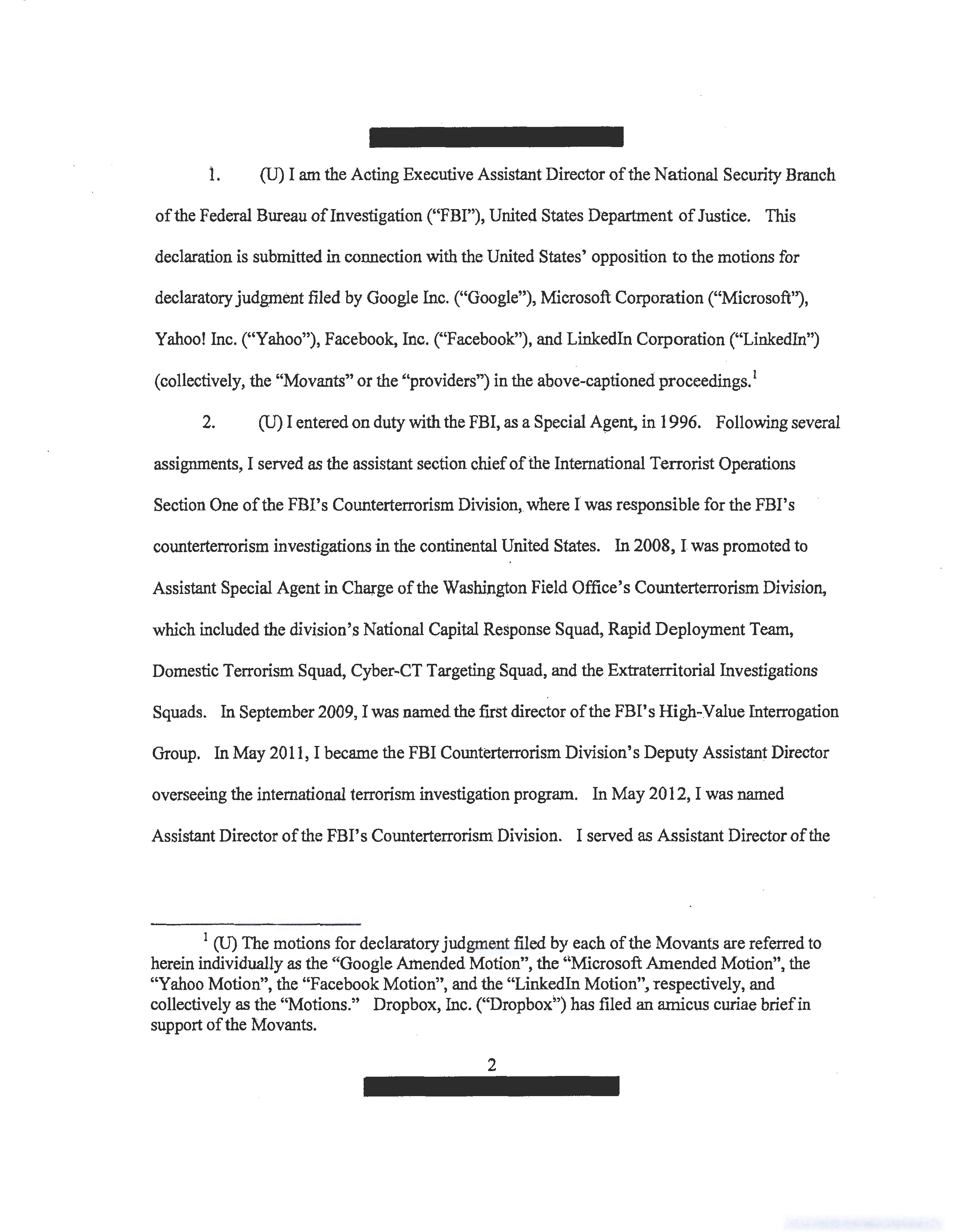
- (U) I am the Acting Executive Assistant Director of the National Security Branch
of the Federal Bureau of Investigation ("FBI"), United States Department of Justice. This
declaration is submitted in connection with the United States' opposition to the motions for
declaratory judgment filed by Google Inc. ("Google"), Microsoft Corporation ("Microsoft"),
Yahoo! Inc. ("Yahoo"), Facebook, Inc. ("Facebook"), and LinkedIn Corporation ("LinkedIn")
(collectively, the "Movants" or the "providers") in the above-captioned proceedings.¹
- (U) I entered on duty with the FBI, as a Special Agent, in 1996. Following several
assignments, I served as the assistant section chief of the International Terrorist Operations
Section One of the FBI's Counterterrorism Division, where I was responsible for the FBI's
counterterrorism investigations in the continental United States. In 2008, I was promoted to
Assistant Special Agent in Charge of the Washington Field Office's Counterterrorism Division,
which included the division's National Capital Response Squad, Rapid Deployment Team,
Domestic Terrorism Squad, Cyber-CT Targeting Squad, and the Extraterritorial Investigations
Squads. In September 2009, I was named the first director of the FBI's High-Value Interrogation
Group. In May 2011, I became the FBI Counterterrorism Division's Deputy Assistant Director
overseeing the international terrorism investigation program. In May 2012, I was named
Assistant Director of the FBI's Counterterrorism Division. I served as Assistant Director of the
¹ (U) The motions for declaratory judgment filed by each of the Movants are referred to
herein individually as the "Google Amended Motion", the "Microsoft Amended Motion", the
"Yahoo Motion", the "Facebook Motion", and the "LinkedIn Motion", respectively, and
collectively as the "Motions." Dropbox, Inc. ("Dropbox") has filed an amicus curiae brief in
support of the Movants.
2
[REDACTED]
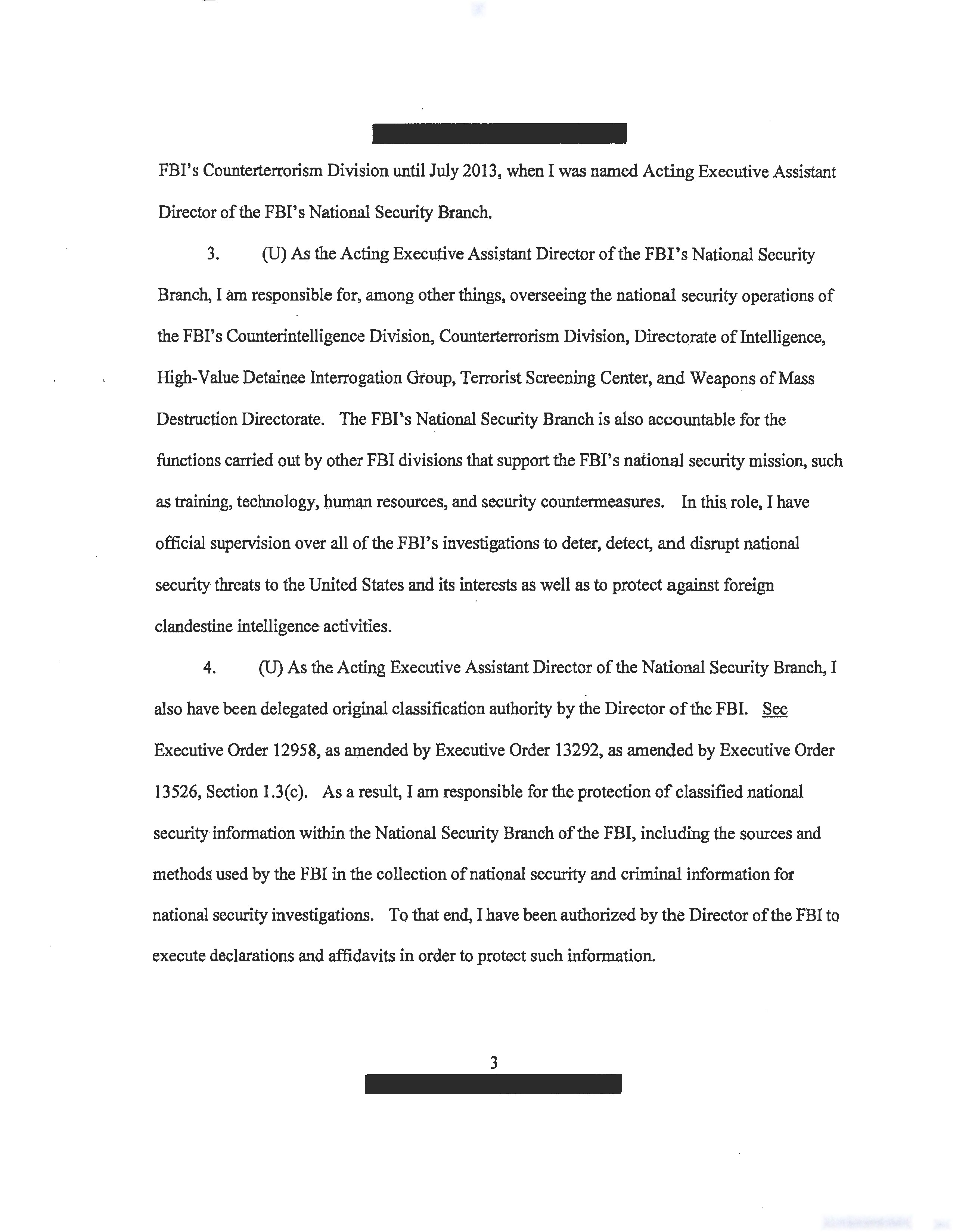
FBI's Counterterrorism Division until July 2013, when I was named Acting Executive Assistant
Director of the FBI's National Security Branch.
- (U) As the Acting Executive Assistant Director of the FBI's National Security
Branch, I am responsible for, among other things, overseeing the national security operations of
the FBI's Counterintelligence Division, Counterterrorism Division, Directorate of Intelligence,
High-Value Detainee Interrogation Group, Terrorist Screening Center, and Weapons of Mass
Destruction Directorate. The FBI's National Security Branch is also accountable for the
functions carried out by other FBI divisions that support the FBI's national security mission, such
as training, technology, human resources, and security countermeasures. In this role, I have
official supervision over all of the FBI's investigations to deter, detect, and disrupt national
security threats to the United States and its interests as well as to protect against foreign
clandestine intelligence activities.
- (U) As the Acting Executive Assistant Director of the National Security Branch, I
also have been delegated original classification authority by the Director of the FBI. See
Executive Order 12958, as amended by Executive Order 13292, as amended by Executive Order
13526, Section 1.3(c). As a result, I am responsible for the protection of classified national
security information within the National Security Branch of the FBI, including the sources and
methods used by the FBI in the collection of national security and criminal information for
national security investigations. To that end, I have been authorized by the Director of the FBI to
execute declarations and affidavits in order to protect such information.
3
[REDACTED]
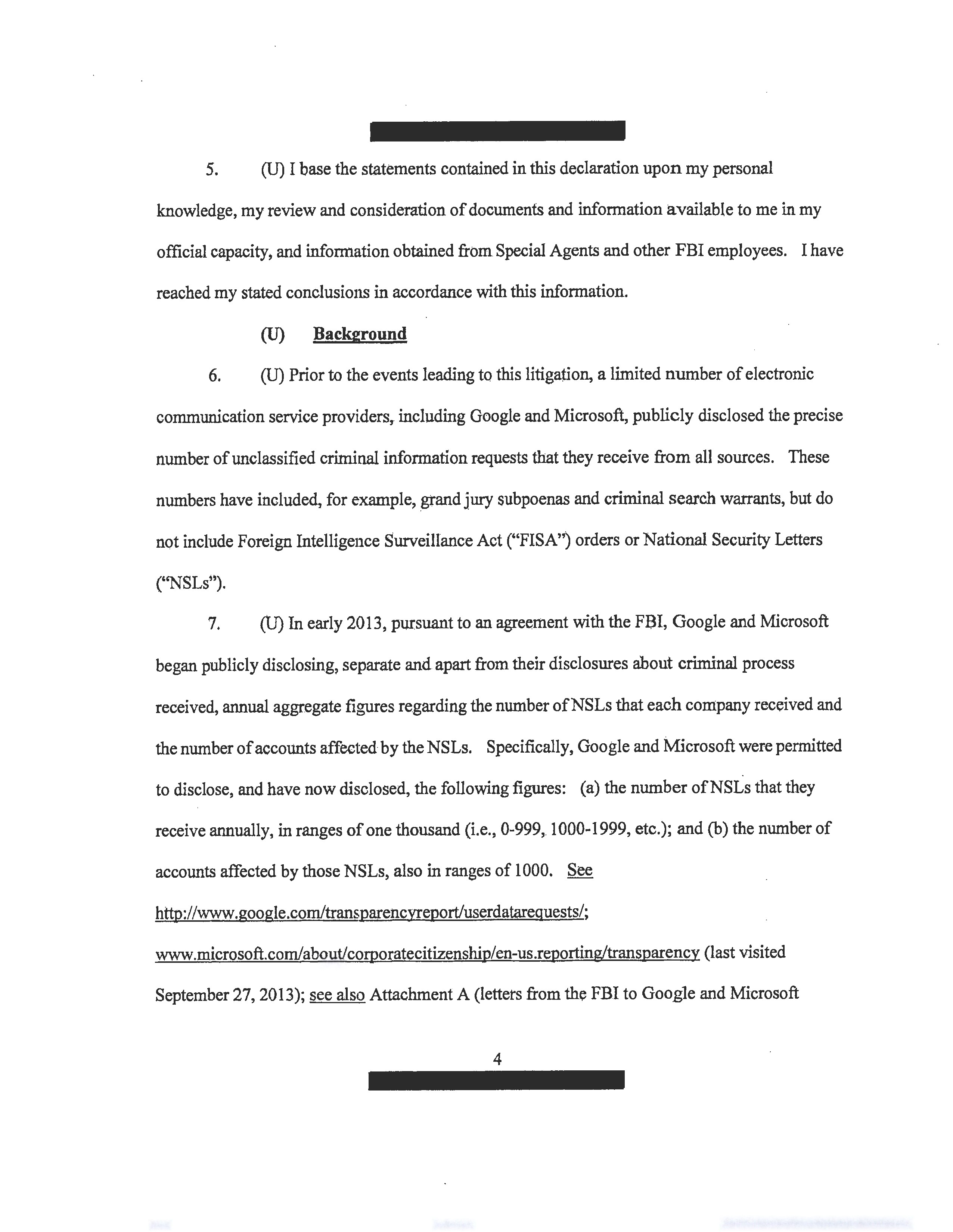
5. (U) I base the statements contained in this declaration upon my personal
knowledge, my review and consideration of documents and information available to me in my
official capacity, and information obtained from Special Agents and other FBI employees. I have
reached my stated conclusions in accordance with this information.
(U) Background
- (U) Prior to the events leading to this litigation, a limited number of electronic
communication service providers, including Google and Microsoft, publicly disclosed the precise
number of unclassified criminal information requests that they receive from all sources. These
numbers have included, for example, grand jury subpoenas and criminal search warrants, but do
not include Foreign Intelligence Surveillance Act ("FISA") orders or National Security Letters
("NSLs").
- (U) In early 2013, pursuant to an agreement with the FBI, Google and Microsoft
began publicly disclosing, separate and apart from their disclosures about criminal process
received, annual aggregate figures regarding the number of NSLs that each company received and
the number of accounts affected by the NSLs. Specifically, Google and Microsoft were permitted
to disclose, and have now disclosed, the following figures: (a) the number of NSLs that they
receive annually, in ranges of one thousand (i.e., 0-999, 1000-1999, etc.); and (b) the number of
accounts affected by those NSLs, also in ranges of 1000. See
http://www.google.com/transparencyreport/userdatarequests/;
www.microsoft.com/about/corporatecitizenship/en-us.reporting/transparency (last visited
September 27, 2013); see also Attachment A (letters from the FBI to Google and Microsoft
4
[REDACTED]
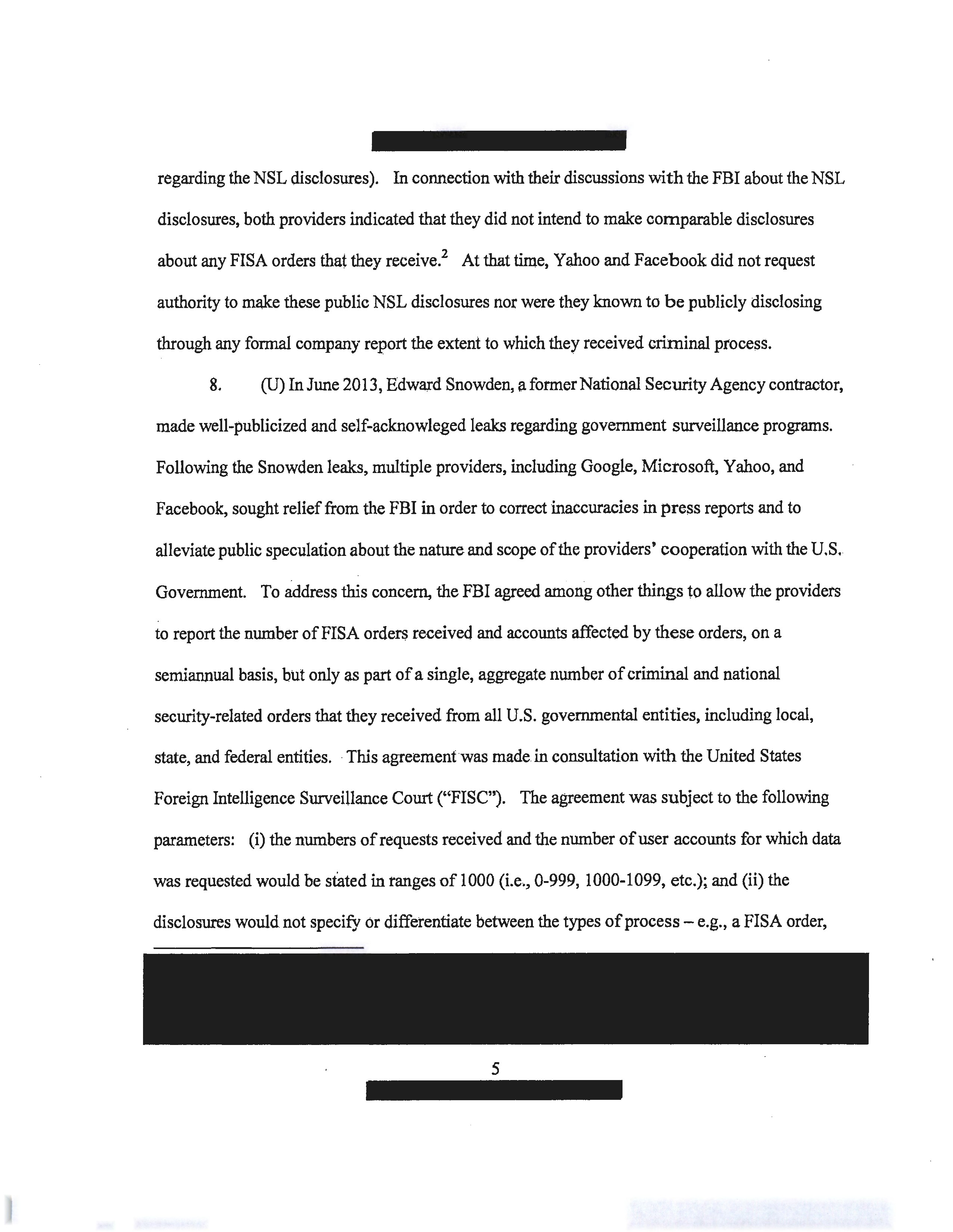
regarding the NSL disclosures). In connection with their discussions with the FBI about the NSL
disclosures, both providers indicated that they did not intend to make comparable disclosures
about any FISA orders that they receive. At that time, Yahoo and Facebook did not request
authority to make these public NSL disclosures nor were they known to be publicly disclosing
through any formal company report the extent to which they received criminal process.
- (U) In June 2013, Edward Snowden, a former National Security Agency contractor,
made well-publicized and self-acknowledged leaks regarding government surveillance programs.
Following the Snowden leaks, multiple providers, including Google, Microsoft, Yahoo, and
Facebook, sought relief from the FBI in order to correct inaccuracies in press reports and to
alleviate public speculation about the nature and scope of the providers' cooperation with the U.S.
Government. To address this concern, the FBI agreed among other things to allow the providers
to report the number of FISA orders received and accounts affected by these orders, on a
semiannual basis, but only as part of a single, aggregate number of criminal and national
security-related orders that they received from all U.S. governmental entities, including local,
state, and federal entities. This agreement was made in consultation with the United States
Foreign Intelligence Surveillance Court ("FISC"). The agreement was subject to the following
parameters: (i) the numbers of requests received and the number of user accounts for which data
was requested would be stated in ranges of 1000 (i.e., 0-999, 1000-1099, etc.); and (ii) the
disclosures would not specify or differentiate between the types of process – e.g., a FISA order,
5
[REDACTED]
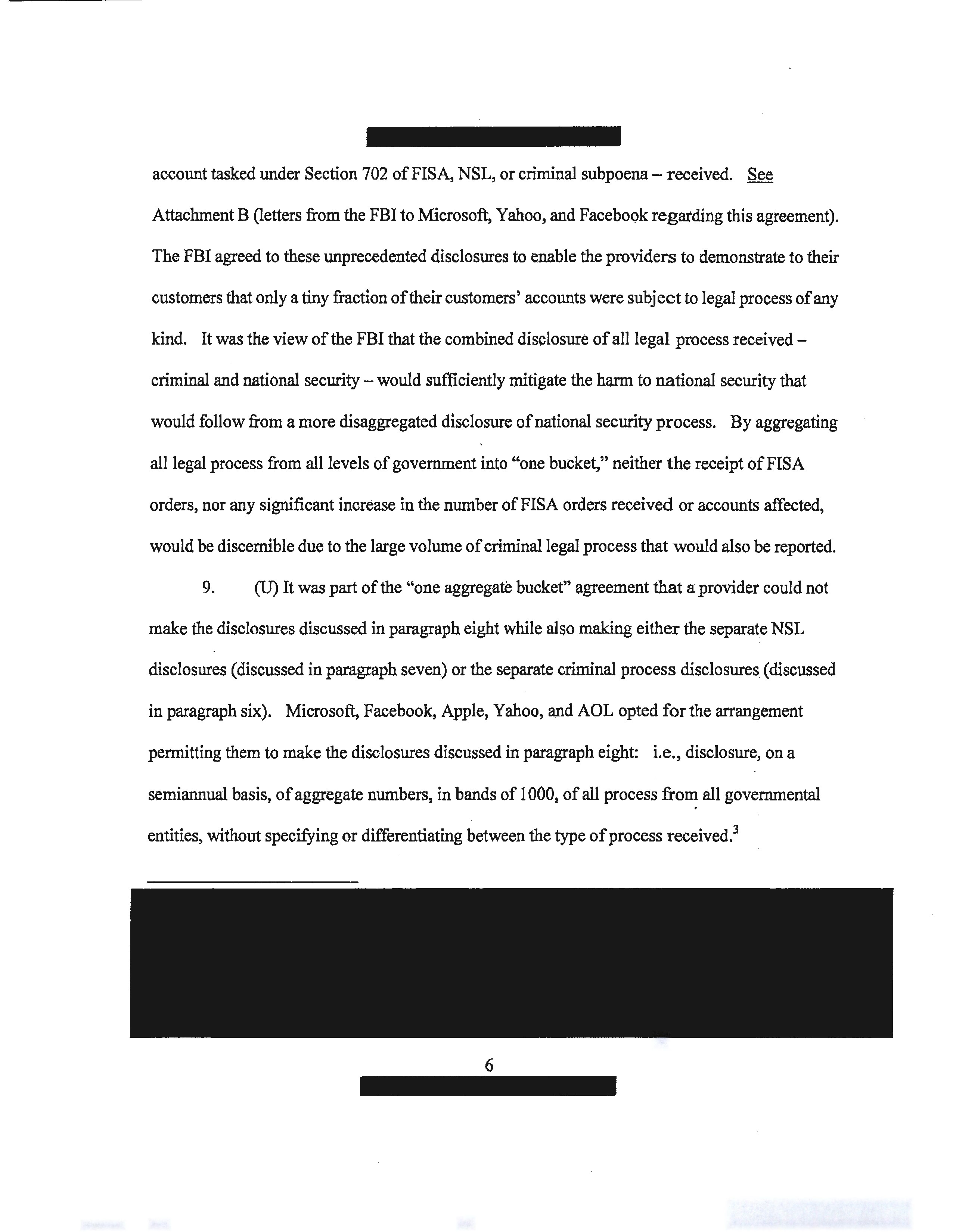
account tasked under Section 702 of FISA, NSL, or criminal subpoena – received. See
Attachment B (letters from the FBI to Microsoft, Yahoo, and Facebook regarding this agreement).
The FBI agreed to these unprecedented disclosures to enable the providers to demonstrate to their
customers that only a tiny fraction of their customers' accounts were subject to legal process of any
kind. It was the view of the FBI that the combined disclosure of all legal process received –
criminal and national security – would sufficiently mitigate the harm to national security that
would follow from a more disaggregated disclosure of national security process. By aggregating
all legal process from all levels of government into "one bucket," neither the receipt of FISA
orders, nor any significant increase in the number of FISA orders received or accounts affected,
would be discernible due to the large volume of criminal legal process that would also be reported.
- (U) It was part of the "one aggregate bucket" agreement that a provider could not
make the disclosures discussed in paragraph eight while also making either the separate NSL
disclosures (discussed in paragraph seven) or the separate criminal process disclosures (discussed
in paragraph six). Microsoft, Facebook, Apple, Yahoo, and AOL opted for the arrangement
permitting them to make the disclosures discussed in paragraph eight: i.e., disclosure, on a
semiannual basis, of aggregate numbers, in bands of 1000, of all process from all governmental
entities, without specifying or differentiating between the type of process received.3
[REDACTED]
6
[REDACTED]
10. (U) As the providers have recognized in their various transparency reports, publicly
reporting a combined number of (a) legal process received and (b) potentially affected accounts
has allowed and will continue to allow them to explain that only a very small fraction of their users
and accounts are affected by legal process of any kind, much less national security process.
[REDACTED]
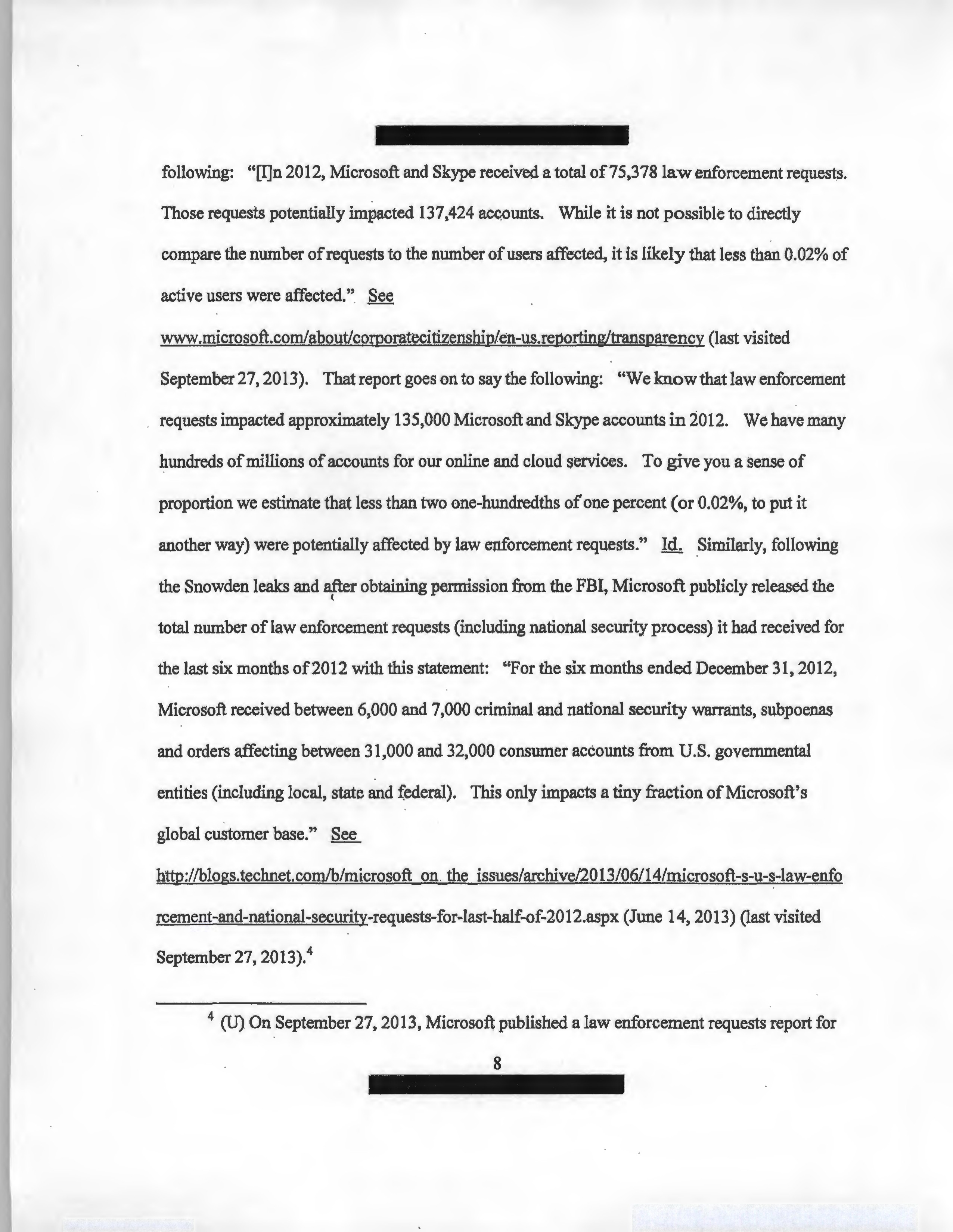
- (U) Microsoft's numbers are to the same effect. Microsoft's 2012 Law
Enforcement Requests Report, which was published before the Snowden leaks, stated the
7
[REDACTED]
following: "[I]n 2012, Microsoft and Skype received a total of 75,378 law enforcement requests.
Those requests potentially impacted 137,424 accounts. While it is not possible to directly
compare the number of requests to the number of users affected, it is likely that less than 0.02% of
active users were affected." See
www.microsoft.com/about/corporatecitizenship/en-us.reporting/transparency (last visited
September 27, 2013). That report goes on to say the following: "We know that law enforcement
requests impacted approximately 135,000 Microsoft and Skype accounts in 2012. We have many
hundreds of millions of accounts for our online and cloud services. To give you a sense of
proportion we estimate that less than two one-hundredths of one percent (or 0.02%, to put it
another way) were potentially affected by law enforcement requests." Id. Similarly, following
the Snowden leaks and after obtaining permission from the FBI, Microsoft publicly released the
total number of law enforcement requests (including national security process) it had received for
the last six months of 2012 with this statement: "For the six months ended December 31, 2012,
Microsoft received between 6,000 and 7,000 criminal and national security warrants, subpoenas
and orders affecting between 31,000 and 32,000 consumer accounts from U.S. governmental
entities (including local, state and federal). This only impacts a tiny fraction of Microsoft's
global customer base." See
http://blogs.technet.com/b/microsoft_on_the_issues/archive/2013/06/14/microsoft-s-u-s-law-enfo
rcement-and-national-security-requests-for-last-half-of-2012.aspx (June 14, 2013) (last visited
September 27, 2013).4
4 (U) On September 27, 2013, Microsoft published a law enforcement requests report for
8
[REDACTED]
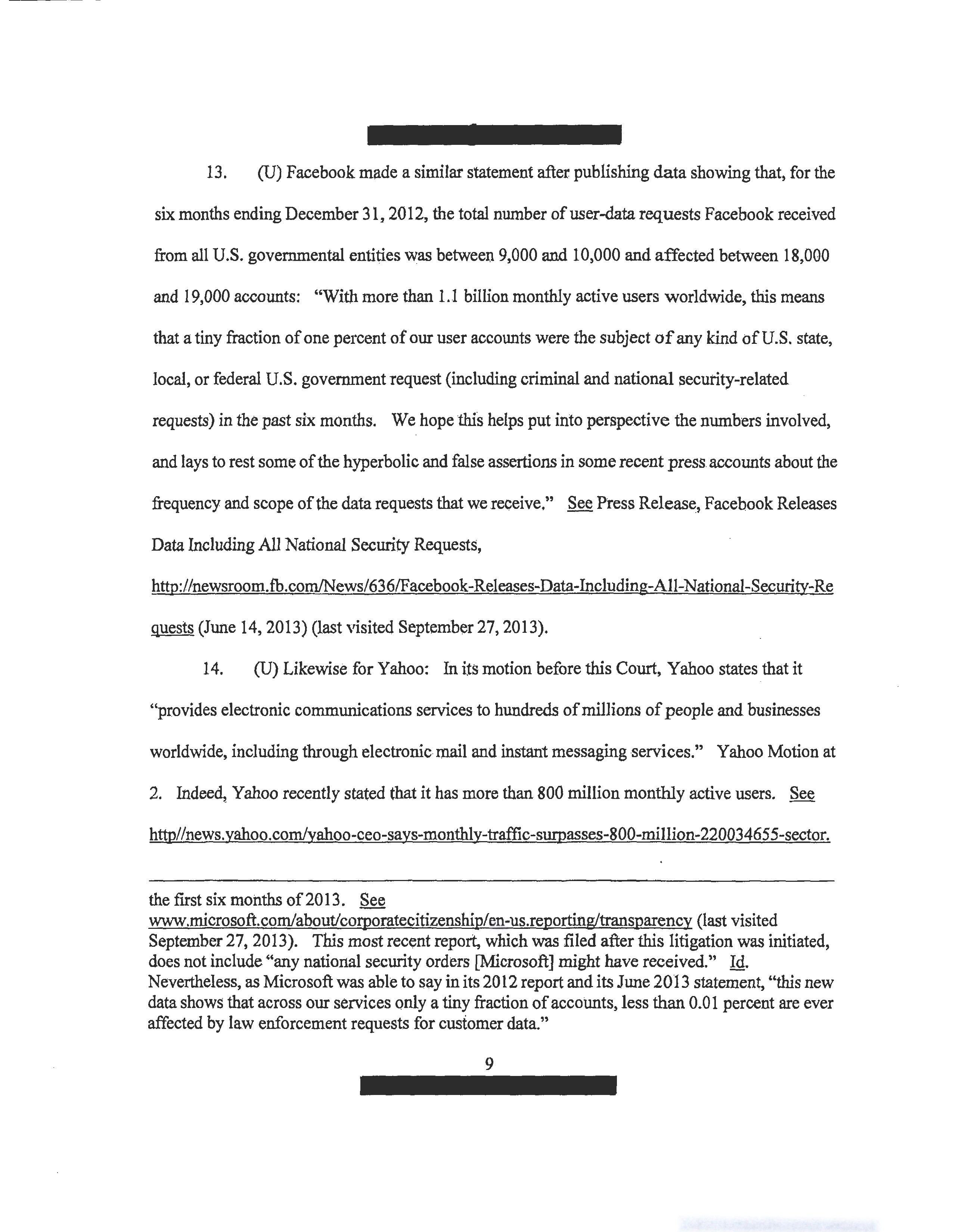
13. (U) Facebook made a similar statement after publishing data showing that, for the
six months ending December 31, 2012, the total number of user-data requests Facebook received
from all U.S. governmental entities was between 9,000 and 10,000 and affected between 18,000
and 19,000 accounts: "With more than 1.1 billion monthly active users worldwide, this means
that a tiny fraction of one percent of our user accounts were the subject of any kind of U.S. state,
local, or federal U.S. government request (including criminal and national security-related
requests) in the past six months. We hope this helps put into perspective the numbers involved,
and lays to rest some of the hyperbolic and false assertions in some recent press accounts about the
frequency and scope of the data requests that we receive." See Press Release, Facebook Releases
Data Including All National Security Requests,
http://newsroom.fb.com/News/636/Facebook-Releases-Data-Including-All-National-Security-Re
quests (June 14, 2013) (last visited September 27, 2013).
- (U) Likewise for Yahoo: In its motion before this Court, Yahoo states that it
"provides electronic communications services to hundreds of millions of people and businesses
worldwide, including through electronic mail and instant messaging services." Yahoo Motion at - Indeed, Yahoo recently stated that it has more than 800 million monthly active users. See
http//news.yahoo.com/yahoo-ceo-says-monthly-traffic-surpasses-800-million-220034655-sector.
the first six months of 2013. See
www.microsoft.com/about/corporatecitizenship/en-us.reporting/transparency (last visited
September 27, 2013). This most recent report, which was filed after this litigation was initiated,
does not include "any national security orders [Microsoft] might have received." Id.
Nevertheless, as Microsoft was able to say in its 2012 report and its June 2013 statement, "this new
data shows that across our services only a tiny fraction of accounts, less than 0.01 percent are ever
affected by law enforcement requests for customer data."
9
[REDACTED]
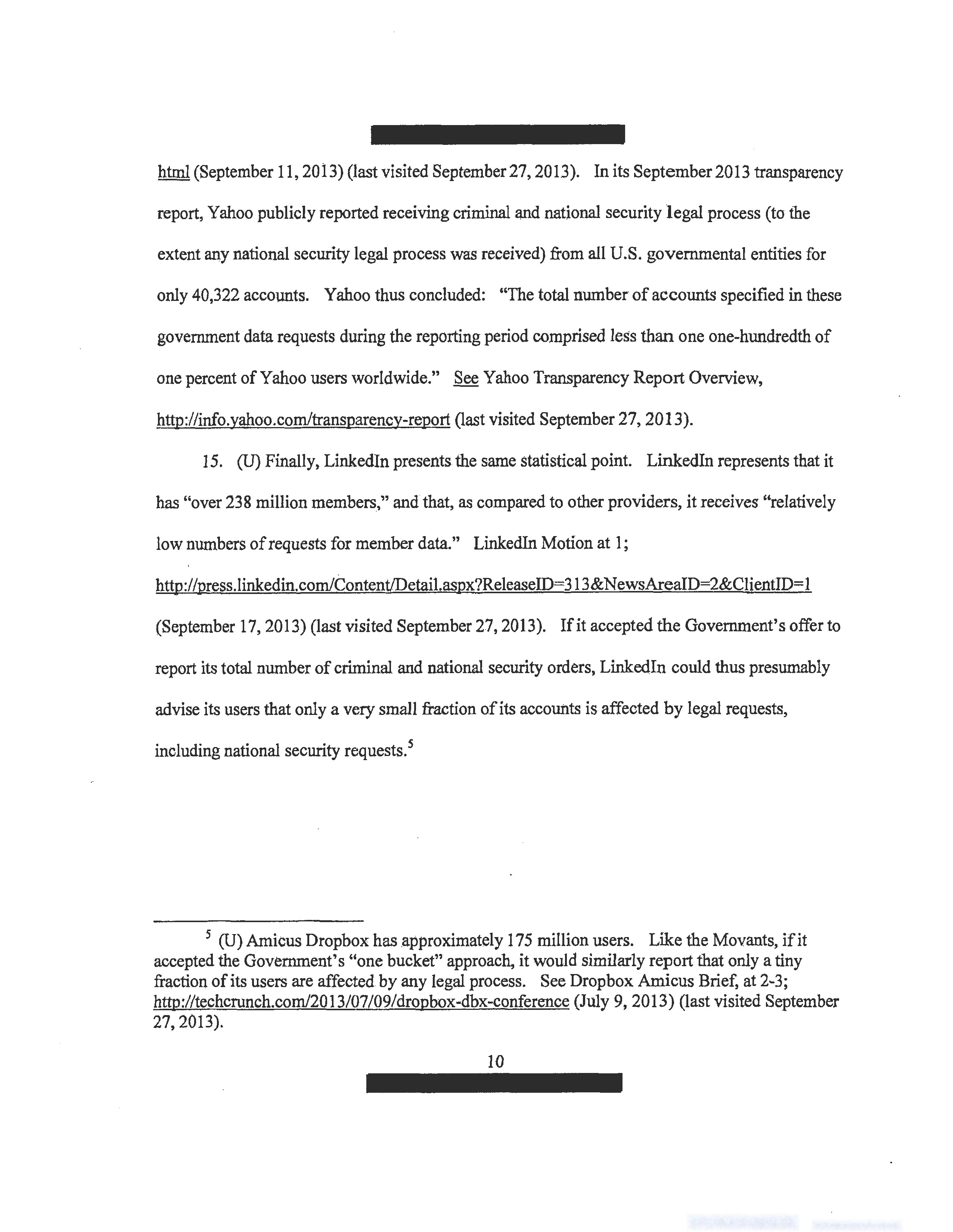
html (September 11, 2013) (last visited September 27, 2013). In its September 2013 transparency
report, Yahoo publicly reported receiving criminal and national security legal process (to the
extent any national security legal process was received) from all U.S. governmental entities for
only 40,322 accounts. Yahoo thus concluded: "The total number of accounts specified in these
government data requests during the reporting period comprised less than one one-hundredth of
one percent of Yahoo users worldwide." See Yahoo Transparency Report Overview,
http://info.yahoo.com/transparency-report (last visited September 27, 2013).
- (U) Finally, LinkedIn presents the same statistical point. LinkedIn represents that it
has "over 238 million members," and that, as compared to other providers, it receives "relatively
low numbers of requests for member data." LinkedIn Motion at 1;
http://press.linkedin.com/Content/Detail.aspx?ReleaseID=313&NewsAreaID=2&ClientID=1
(September 17, 2013) (last visited September 27, 2013). If it accepted the Government's offer to
report its total number of criminal and national security orders, LinkedIn could thus presumably
advise its users that only a very small fraction of its accounts is affected by legal requests,
including national security requests.5
5 (U) Amicus Dropbox has approximately 175 million users. Like the Movants, if it
accepted the Government's "one bucket" approach, it would similarly report that only a tiny
fraction of its users are affected by any legal process. See Dropbox Amicus Brief, at 2-3;
http://techcrunch.com/2013/07/09/dropbox-dbx-conference (July 9, 2013) (last visited September
27, 2013).
10
[REDACTED]
(U) The Pending Motions and the Purpose Of This Declaration
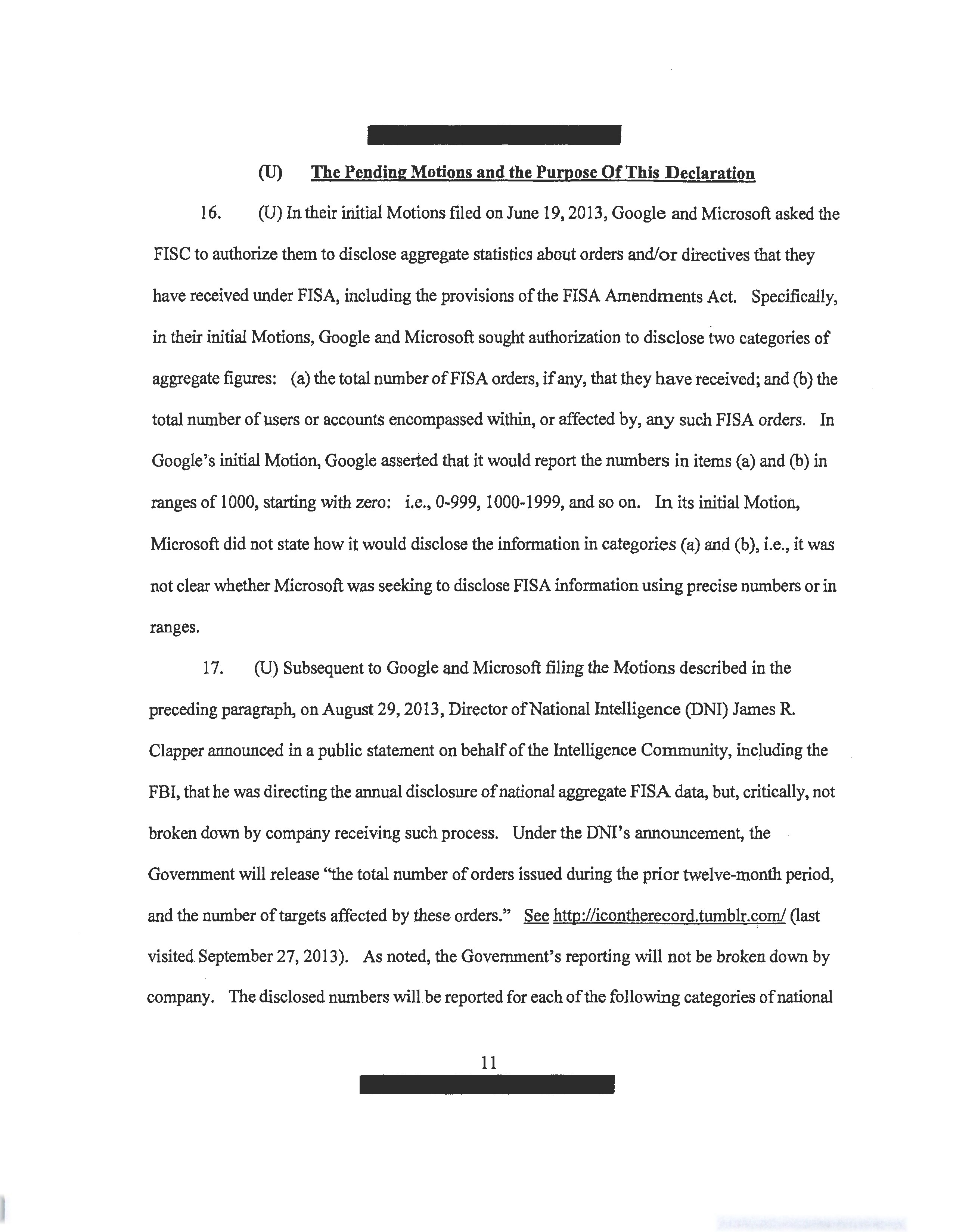
- (U) In their initial Motions filed on June 19, 2013, Google and Microsoft asked the
FISC to authorize them to disclose aggregate statistics about orders and/or directives that they
have received under FISA, including the provisions of the FISA Amendments Act. Specifically,
in their initial Motions, Google and Microsoft sought authorization to disclose two categories of
aggregate figures: (a) the total number of FISA orders, if any, that they have received; and (b) the
total number of users or accounts encompassed within, or affected by, any such FISA orders. In
Google's initial Motion, Google asserted that it would report the numbers in items (a) and (b) in
ranges of 1000, starting with zero: i.e., 0-999, 1000-1999, and so on. In its initial Motion,
Microsoft did not state how it would disclose the information in categories (a) and (b), i.e., it was
not clear whether Microsoft was seeking to disclose FISA information using precise numbers or in
ranges.
- (U) Subsequent to Google and Microsoft filing the Motions described in the
preceding paragraph, on August 29, 2013, Director of National Intelligence (DNI) James R.
Clapper announced in a public statement on behalf of the Intelligence Community, including the
FBI, that he was directing the annual disclosure of national aggregate FISA data, but, critically, not
broken down by company receiving such process. Under the DNI's announcement, the
Government will release "the total number of orders issued during the prior twelve-month period,
and the number of targets affected by these orders." See http://icontherecord.tumblr.com/ (last
visited September 27, 2013). As noted, the Government's reporting will not be broken down by
company. The disclosed numbers will be reported for each of the following categories of national
11
[REDACTED]
security authorities: (i) FISA orders based on probable cause (Titles I and III of FISA, and
sections 703 and 704); (ii) Section 702 of FISA; (iii) FISA Business Records (Title V of FISA);
(iv) FISA Pen Register/Trap and Trace (Title IV of FISA); and (v) National Security Letters
issued pursuant to 12 U.S.C. § 3414(a)(5), 15 U.S.C. §§ 1681u(a) and (b), 15 U.S.C. § 1681v, and
18 U.S.C. § 2709. In announcing the release of this information, the DNI emphasized that this
initiative was consistent with the President's directive to "make public as much information as
possible about certain sensitive U.S. Government surveillance programs while being mindful of
the need to protect sensitive classified intelligence and national security." See
http://icontherecord.tumblr.com/page/2 (August 29, 2013) (last visited September 27, 2013).
- (U) Thus, combined with the "one aggregate bucket" disclosures that are broken
out by company, the public will have full visibility into the numbers and types of process utilized
per year (and accounts affected), and companies and their customers will know the full scope, on
an aggregate basis, every 6 months as to the percentage of accounts affected at a company.
Notwithstanding the U.S. Government's plans to make public an unprecedented amount of
national aggregate information concerning U.S. Government surveillance programs, Google and
Microsoft amended their initial motions and now seek significantly broader relief than what they
had first requested. Whereas Google's initial motion sought declaratory relief that would permit
it to publish two data points within ranges of 1000, Google's amended motion seeks declaratory
relief that would permit it to disclose eight data points regarding classified FISA process, and to do
so in precise numbers rather than bands of one thousand. See Amended Google Motion at 7.
Microsoft's amended motion seeks permission to make even more granular disclosures. See
12
[REDACTED]
Amended Microsoft Motion at 5. Microsoft seeks permission to release separate statistics "for
each provision of FISA and/or the [FISA Amendments Act] pursuant to which Microsoft may
receive process,"⁶ including both the precise number of orders or directives (if any) and the
number of accounts affected for each statutory provision. Microsoft also seeks permission to split
those numbers further into separate categories for "non-content" requests and "content and
non-content" requests. Id. (emphasis in original).
- (U) Yahoo, Facebook, and LinkedIn's requests "involve similar, but not identical,
requests for relief [as those] filed by Google and Microsoft." Yahoo Motion at 9 n.6; Facebook
Motion at 7 n.3. Like Google and Microsoft, these companies also seek declaratory judgments
that would permit them to disclose data regarding both the specific number of classified FISA
process that they receive, and the particular FISA authorities under which they receive that
process. See Yahoo Motion at 4; Facebook Motion at 3; LinkedIn Motion at 6.
- (U) As explained below, the FISA data that Google and Microsoft sought to publish
in their initial Motions constitutes information classified at the Secret level because its disclosure
could reasonably be expected to cause serious damage to the national security of the United States.
See Executive Order 13526 § 1.2(a)(2). The harm to the national security is even greater with
respect to the significantly more expansive disclosures now sought by the five companies here.
This declaration addresses: (1) factors considered by the FBI when classifying information, (2)
specific policies that govern the FBI's classification of information, (3) a discussion of how the
⁶ (U) If "provision" is interpreted to mean "title" then there would be five "provisions," as
five titles of FISA contain information collection authority (Titles I, III, IV, V, and VII).
However, if the term "provision" is interpreted to mean "section," the number would be higher.
13
[REDACTED]
information sought to be disclosed by the providers would harm national security, and (4) a
discussion of how the more detailed and more disaggregated disclosures now proposed by the
Movants are even more detrimental to national security than the disclosures initially sought by
Google and Microsoft as part of their initial Motions.
- (U) Each paragraph in this declaration is marked immediately after the number of
the paragraph with letters in parentheses, indicating the level of classification and restrictions on
dissemination applicable to that particular paragraph. Paragraphs marked with a "U" are
unclassified. Paragraphs marked with a "TS" are classified Top Secret. Paragraphs marked with
an "S" are classified as Secret. A designation of SI reflects "Special Intelligence" protected as
Sensitive Compartmented Information. Designations of "NF" or "NOFORN" reflect information
that may not be disseminated to foreign countries or nationals. The "FISA" dissemination control
marking denotes that information was obtained or derived from surveillance authorized pursuant
to the Foreign Intelligence Surveillance Act of 1978, as amended. The designation "FOUO"
refers to information that is for official use only. Because this declaration is itself a classified
document, it is being made available to the Court ex parte, in camera.
(U) Classification of Information
- (U) The conduct of national security investigations, and the collection, production,
and dissemination of intelligence to support counterterrorism, counterintelligence, and other U.S.
national security objectives, requires the FBI to collect, analyze, and disseminate information
eligible for classification under Executive Order 13526.
14
[REDACTED]
- (U) The decision whether to classify or declassify information, including but not
limited to whether the FBI has conducted or is conducting an investigation, the amount and nature
of intelligence that the FBI may have collected during an investigation, and how that intelligence
was collected, is based on a variety of factors and considerations that are weighed by officials,
such as myself, who have been delegated original classification authority. In weighing these
factors, some of which are subtle and complex, I assess whether the disclosure of information, at
any given time, may lead to an unacceptable risk of compromising the FBI's past or ongoing
intelligence gathering efforts with respect to a particular investigation or investigations, and
whether disclosure may lead to an unacceptable risk of compromising investigative sources,
methods, or techniques. Among other things, my assessment and judgment as to the harm to the
national security that reasonably could be expected from disclosure in any given case at any
particular time is affected by whether a mosaic of information can be pieced together by our
adversaries, both individuals and groups, which would allow them to better evade ongoing
investigations and more easily formulate or revise their counter-surveillance efforts.
(U) The FBI National Security Information Classification Guide
- (U) The Federal Bureau of Investigation National Security Information
Classification Guide ("NSICG") provides guidance concerning the classification and level of
protection afforded to FBI-originated national security information. The NSICG is issued under
authority of Executive Order 13526; Information Security Oversight Office Directive Number 1
(32 CFR Section 2001.10); Department of Justice Security Program Operating Manual; the FBI
15
[REDACTED]
Security Policy Manual; and the designated Original Classification Authority of the Executive
Assistant Director, National Security Branch.
- (U) The NSICG identifies categories of information frequently obtained in the
course of national security investigations and intelligence analysis and provides guidance on
whether information in these categories should be designated Unclassified (U), Confidential (C),
Secret (S), or Top Secret (TS).
[REDACTED]
- (U) The FISA order information sought to be disclosed implicates the NSICG
categories referenced in the preceding paragraph, and accordingly is classified as Secret. The
FISA information at issue would provide international terrorists, terrorist organizations, foreign
intelligence services, cyber intruders, and other persons or entities who pose a threat to the national
16
[REDACTED]
security (collectively, "adversaries") with significant insight into, and information about, the U.S.
Government's counterterrorism and counterintelligence efforts and capabilities including, among
other things, the Government's collection capabilities under FISA. Armed with this information,
adversaries can take action to conceal their activities, alter their methods of operation, or otherwise
counter, thwart, or frustrate the ability of the FBI to pursue them. This would undermine both
current and future efforts by the FBI to collect foreign intelligence and to detect, obtain
information about, or prevent or protect against threats to the national security.
- (U) National security investigations present evolving challenges, and the FBI's
efforts to combat threats to the national security are fluid. The kinds of disclosures requested
even in the initial Google and Microsoft Motions have never previously been made. This is all the
more true with respect to the more detailed and more disaggregated disclosures now proposed in
the current motions by five companies. It would be impossible to specifically identify each and
every harm that could arise from the disclosures that the Movants seek to make. However, I note
here some of the harms to the national security interests of the United States that would logically
flow from the proposed disclosures.
[REDACTED]
17
[REDACTED]
18
[REDACTED]
19
[REDACTED]
20
[REDACTED]
21
[REDACTED]
22
[REDACTED]
23
[REDACTED]
24
[REDACTED]
25
[REDACTED]
39. (U) Armed with information about the Government's collection capabilities,
adversaries will take actions detrimental to the national security. Adversaries may alter their
behavior by switching to services that the Government is not intercepting. Should an adversary
switch to such services, then the Government would not have an interception or monitoring
capability with regard to communications made on these services. This significantly and
irreparably undermines current and future counterterrorism and counterintelligence efforts.
[REDACTED]
26
[REDACTED]
27
[REDACTED]
28
[REDACTED]
29
[REDACTED]
(U) The Harms to the National Security Will be Compounded By Other
Companies Likely Seeking the Same Relief
- (U) If Google, Microsoft, Yahoo, Facebook, and LinkedIn are permitted to disclose
the FISA information that is the subject of their Motions, it is likely that other companies will seek
the same relief. Indeed, initially only Google and Microsoft sought authority from the FISC to
disclose publicly the FISA information, and the relief they sought did not include publishing
specific numbers or distinguishing among the type of statutory authority used. Barely one month
later, Yahoo, Facebook, and LinkedIn have petitioned this Court for authority to disclose their own
receipt of FISA orders, and Google and Microsoft have since amended their Motions to publicly
[REDACTED]
30
[REDACTED]
disclose information that is substantially more granular in nature – and thus more revealing of
USIC intelligence collection capabilities.
[REDACTED]
31
[REDACTED]
32
[REDACTED]
33
[REDACTED]
34
[REDACTED]
35
[REDACTED]
(U) Prior Disclosures Regarding Receipt of Criminal Process and NSLs Do
Not Lead To The Same Harms
[REDACTED]
36
[REDACTED]
37
[REDACTED]
[REDACTED]
- (U) Another important distinction is that NSLs are unclassified legal process,
whereas FISA orders are classified, generally at the Secret level. The FBI has confirmed that
[REDACTED]
38
[REDACTED]
employees from each of the Movants who work with the FBI on FISA matters have signed binding
"Classified Information Nondisclosure Agreement(s)" (SF-312) reflecting their obligation to
protect classified information. The current version of the SF-312 nondisclosure agreement went
into effect in July 2013. Both the current and prior versions of the SF-312 nondisclosure
agreement include the following language: "I hereby agree that I will never divulge classified
information to anyone unless: (a) I have officially verified that the recipient has been properly
authorized by the United States Government to receive it; or (b) I have been given prior written
notice of authorization from the United States Government Department or Agency..." See
SF-312 Classified Information Nondisclosure Agreement (effective July 2013), available at:
http://www.gsa.gov/portal/forms/download/116218; SF-312 Classified Information
Nondisclosure Agreement (pre-July 2013), available at:
http://armypubs.army.mil/eforms/pdf/S312.PDF.¹⁶ The protection of classified information
surrounding FISA orders is of a paramount concern to the United States government. NSLs,
which are not classified, present different concerns.
(U) Disclosure of National Aggregate Figures Does Not Give Rise to the
Same Concerns
[REDACTED]
39
[REDACTED]
(U) Conclusion
- (U) Protecting the national security of the United States requires that intelligence
sources, methods, and techniques be protected from disclosure. In keeping with the
above-referenced authorities and after a considered assessment of all of the facts and
circumstances concerning this matter, I have concluded that the disclosure of the FISA
information at issue in this litigation reasonably could be expected to harm the national security of
the United States.
[REDACTED]
40
[REDACTED]
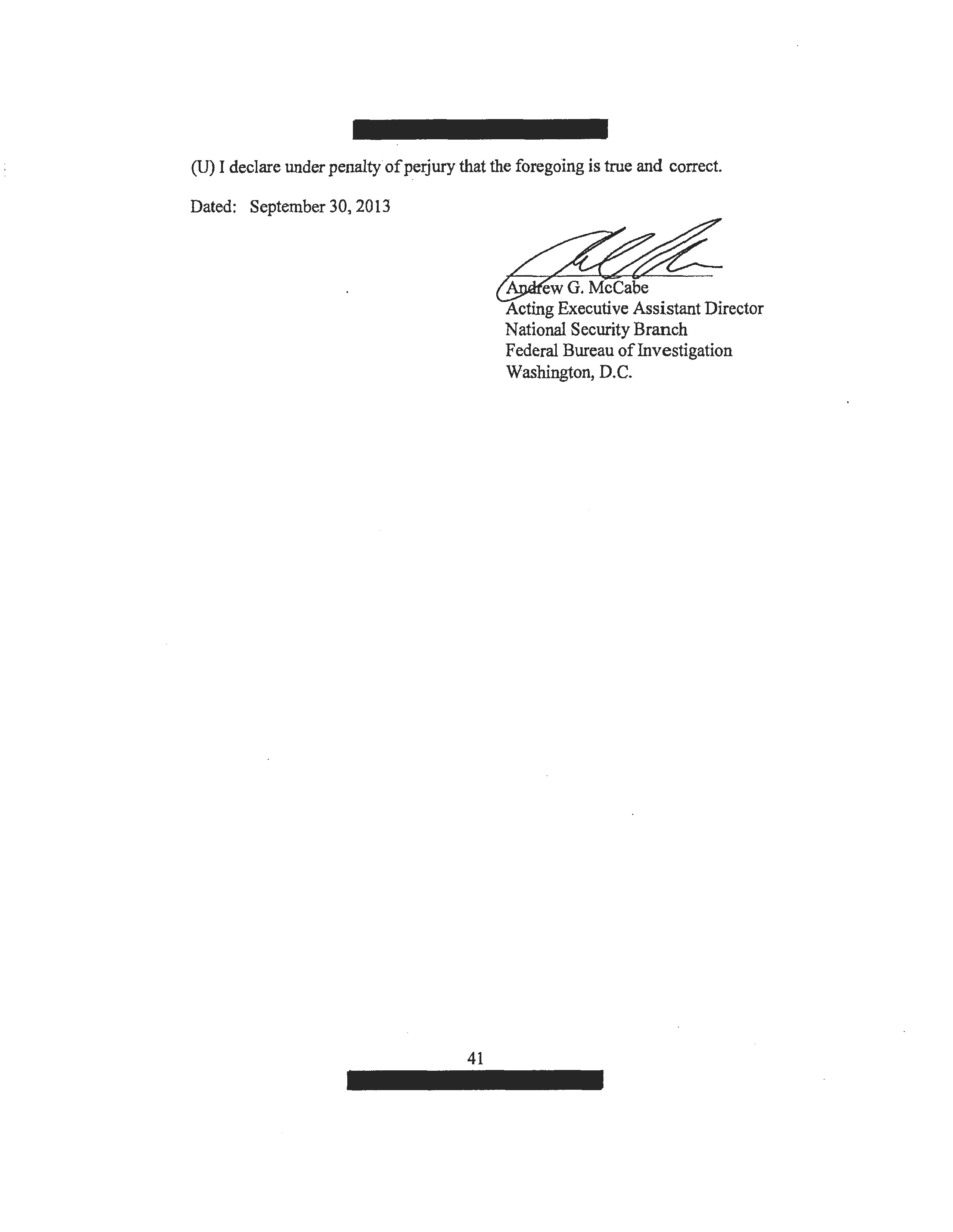
(U) I declare under penalty of perjury that the foregoing is true and correct.
Dated: September 30, 2013
Andrew G. McCabe
Acting Executive Assistant Director
National Security Branch
Federal Bureau of Investigation
Washington, D.C.
41
(U) ATTACHMENT “A”
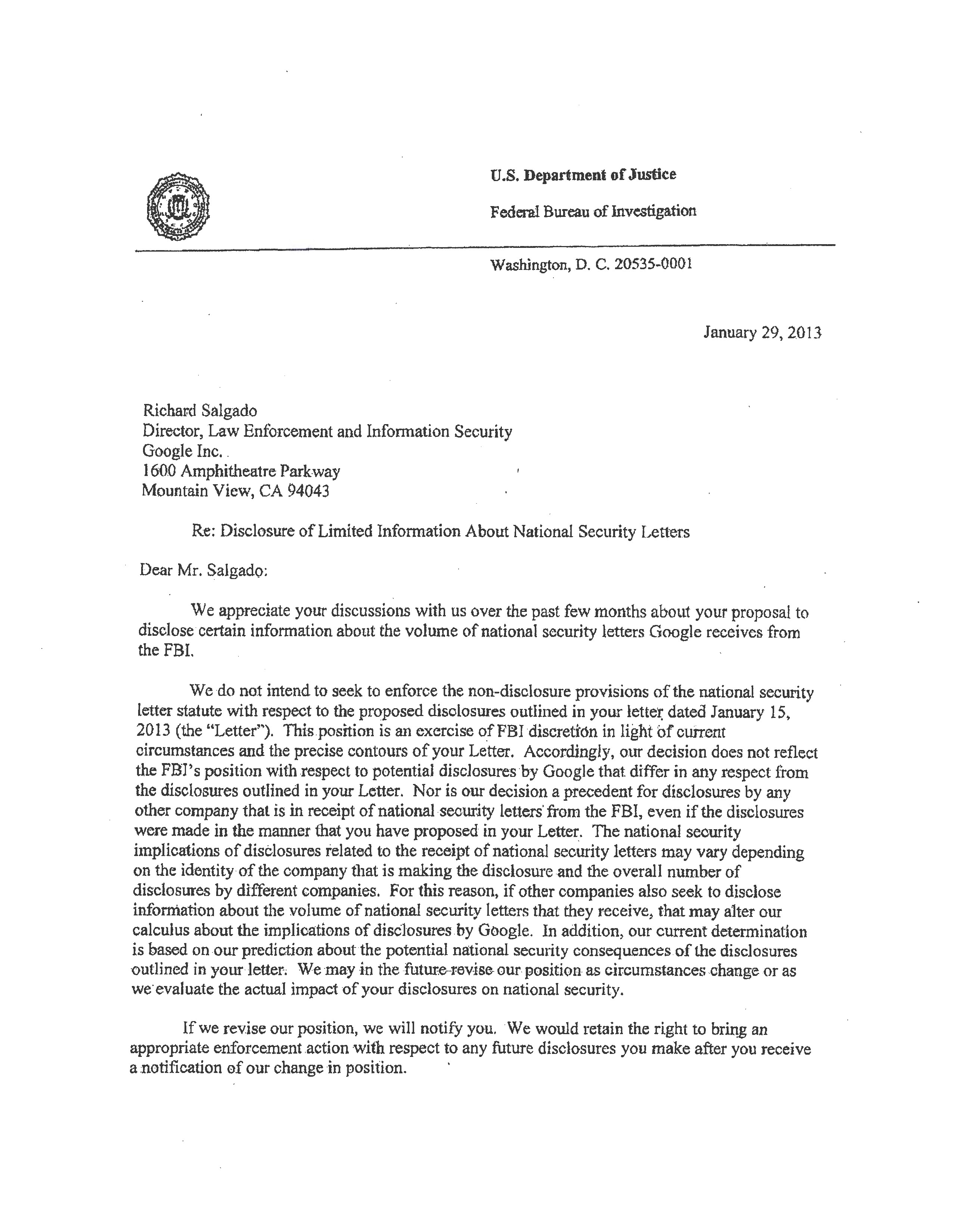
U.S. Department of Justice
Federal Bureau of Investigation
Washington, D. C. 20535-0001
January 29, 2013
Richard Salgado
Director, Law Enforcement and Information Security
Google Inc..
1600 Amphitheatre Parkway
Mountain View, CA 94043
Re: Disclosure of Limited Information About National Security Letters
Dear Mr. Salgado:
We appreciate your discussions with us over the past few months about your proposal to
disclose certain information about the volume of national security letters Google receives from
the FBI.
We do not intend to seek to enforce the non-disclosure provisions of the national security
letter statute with respect to the proposed disclosures outlined in your letter dated January 15,
2013 (the "Letter"). This position is an exercise of FBI discretion in light of current
circumstances and the precise contours of your Letter. Accordingly, our decision does not reflect
the FBI's position with respect to potential disclosures by Google that differ in any respect from
the disclosures outlined in your Letter. Nor is our decision a precedent for disclosures by any
other company that is in receipt of national security letters from the FBI, even if the disclosures
were made in the manner that you have proposed in your Letter. The national security
implications of disclosures related to the receipt of national security letters may vary depending
on the identity of the company that is making the disclosure and the overall number of
disclosures by different companies. For this reason, if other companies also seek to disclose
information about the volume of national security letters that they receive, that may alter our
calculus about the implications of disclosures by Google. In addition, our current determination
is based on our prediction about the potential national security consequences of the disclosures
outlined in your letter. We may in the future revise our position as circumstances change or as
we evaluate the actual impact of your disclosures on national security.
If we revise our position, we will notify you. We would retain the right to bring an
appropriate enforcement action with respect to any future disclosures you make after you receive
a notification of our change in position.
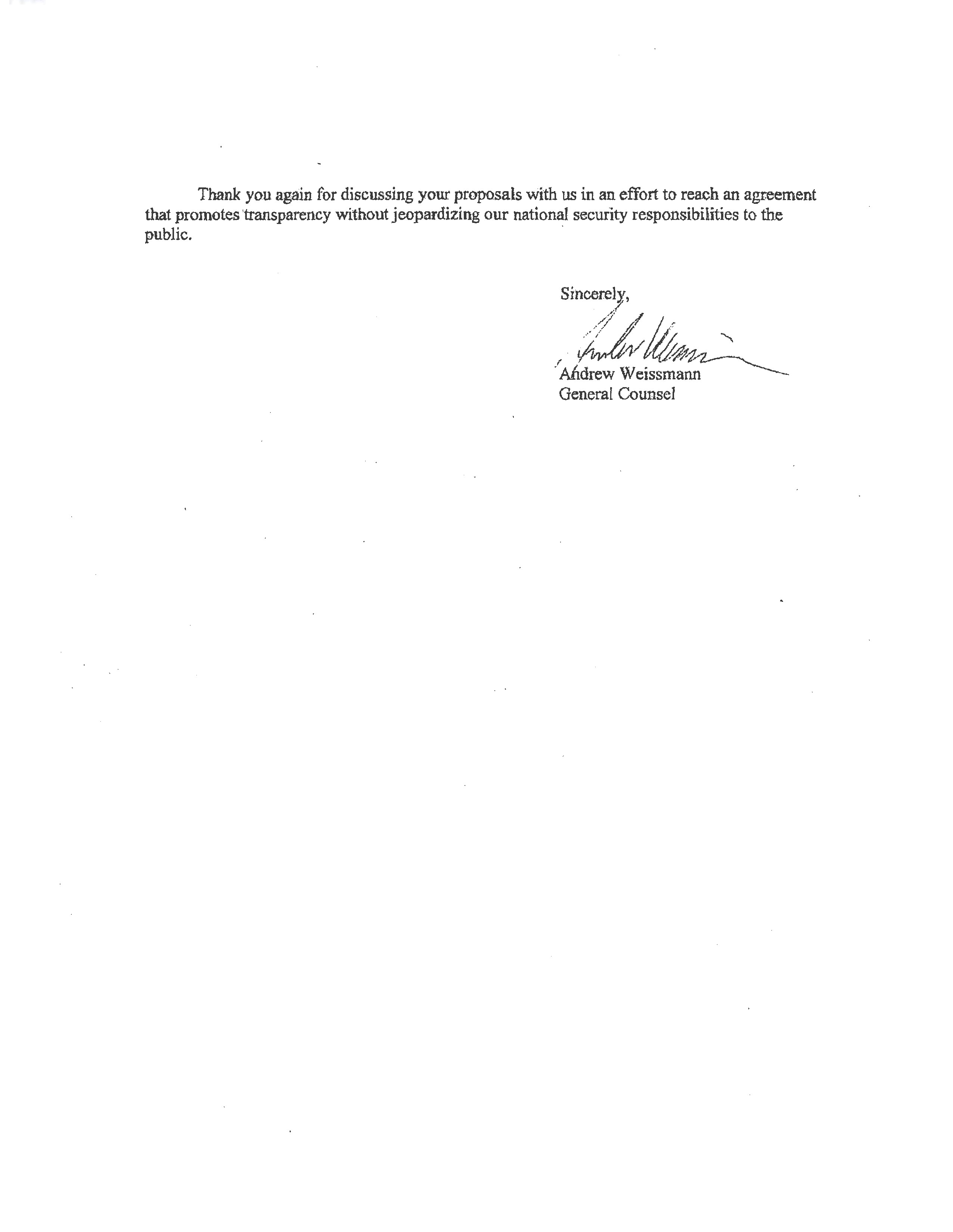
Thank you again for discussing your proposals with us in an effort to reach an agreement
that promotes transparency without jeopardizing our national security responsibilities to the
public.
Sincerely,
Andrew Weissmann
General Counsel
U.S. Department of Justice
Federal Bureau of Investigation
Washington, D. C. 20535-0001
March 19. 2013
Bryan Schilling
Attorney
Microsoft Corporation
One Microsoft Way
Redmond. WA 98052
Re: Microsoft's Pending Transparency Report
Dear Mr. Schilling:
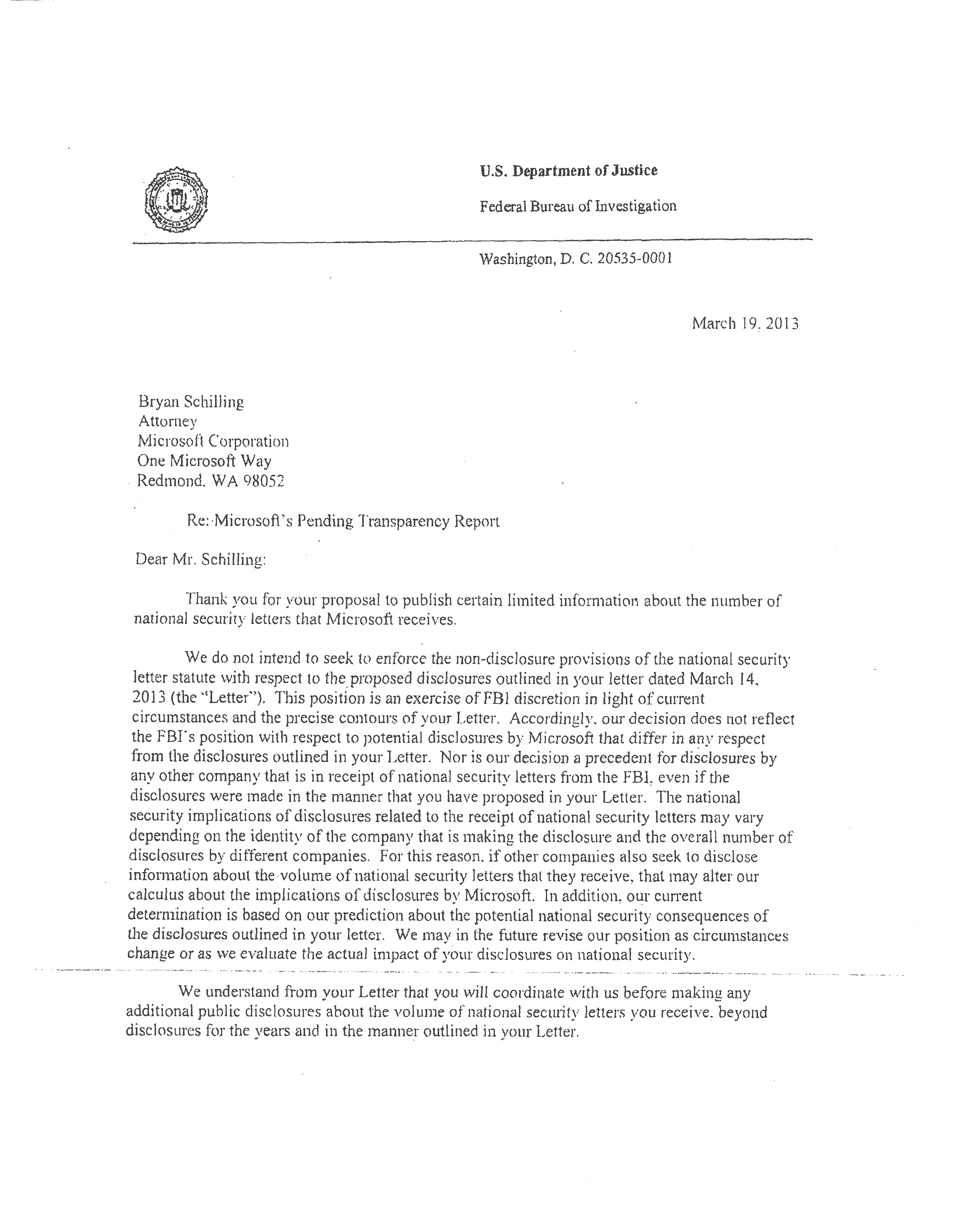
Thank you for your proposal to publish certain limited information about the number of
national security letters that Microsoft receives.
We do not intend to seek to enforce the non-disclosure provisions of the national security
letter statute with respect to the proposed disclosures outlined in your letter dated March 14,
2013 (the "Letter"). This position is an exercise of FBI discretion in light of current
circumstances and the precise contours of your Letter. Accordingly, our decision does not reflect
the FBI's position with respect to potential disclosures by Microsoft that differ in any respect
from the disclosures outlined in your Letter. Nor is our decision a precedent for disclosures by
any other company that is in receipt of national security letters from the FBI, even if the
disclosures were made in the manner that you have proposed in your Letter. The national
security implications of disclosures related to the receipt of national security letters may vary
depending on the identity of the company that is making the disclosure and the overall number of
disclosures by different companies. For this reason, if other companies also seek to disclose
information about the volume of national security letters that they receive, that may alter our
calculus about the implications of disclosures by Microsoft. In addition, our current
determination is based on our prediction about the potential national security consequences of
the disclosures outlined in your letter. We may in the future revise our position as circumstances
change or as we evaluate the actual impact of your disclosures on national security.
We understand from your Letter that you will coordinate with us before making any
additional public disclosures about the volume of national security letters you receive, beyond
disclosures for the years and in the manner outlined in your Letter.
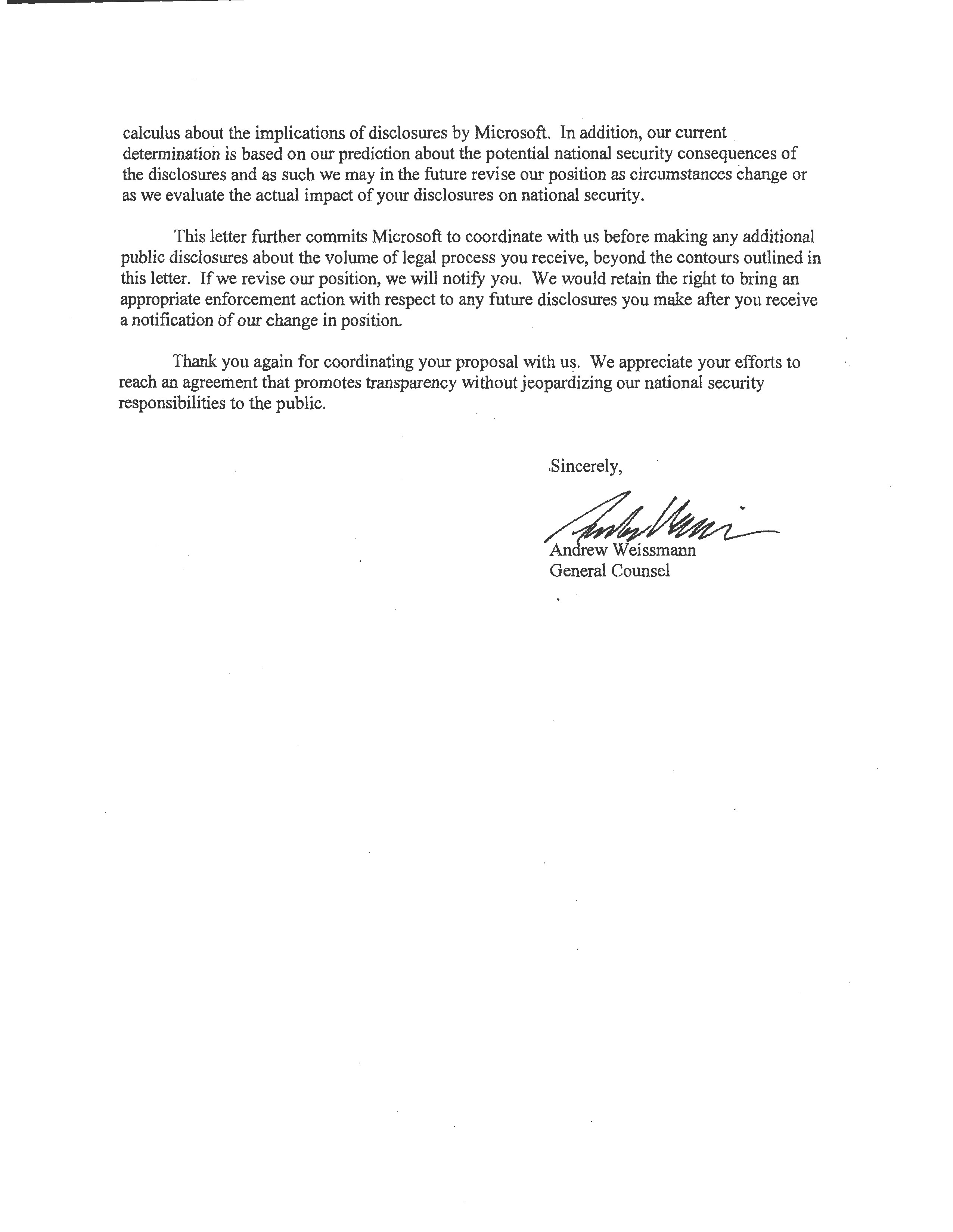
Thank you again for coordinating your proposal with us. We appreciate your efforts to
reach an agreement that promotes transparency without jeopardizing our national security
responsibilities to the public.
Sincerely.
Andrew Weissmann
General Counsel
(U) ATTACHMENT "B"
U.S. Department of Justice
Federal Bureau of Investigation
Office of the General Counsel
Washington, D.C. 20535
June 14, 2013
Mr. John Frank
Vice President/Deputy General Counsel
Office of the General Counsel
Microsoft Corporation
1 Microsoft Way
Redmond, WA 98052
Re: Microsoft's Pending Transparency Report
Dear Mr. Frank:
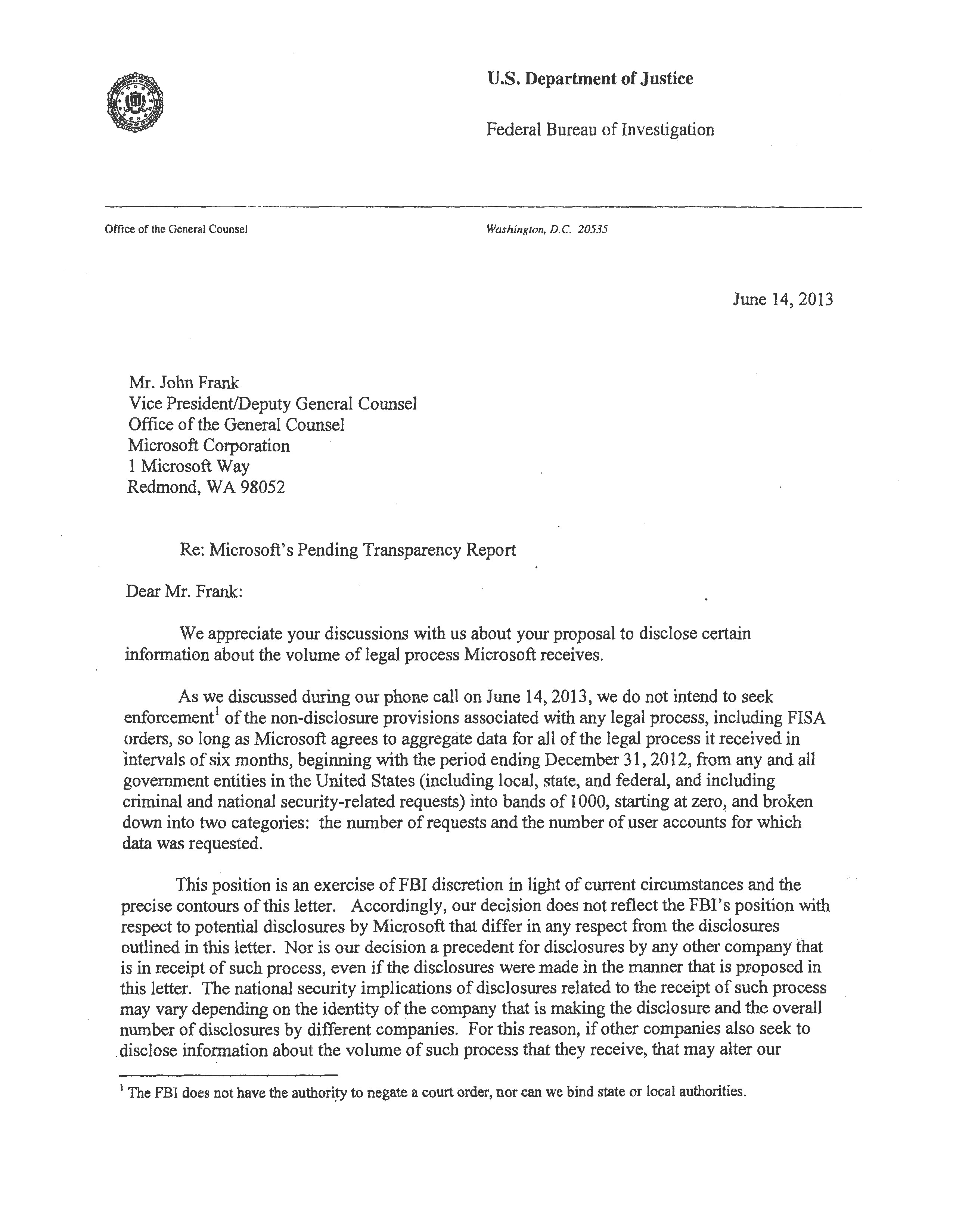
We appreciate your discussions with us about your proposal to disclose certain
information about the volume of legal process Microsoft receives.
As we discussed during our phone call on June 14, 2013, we do not intend to seek
enforcement¹ of the non-disclosure provisions associated with any legal process, including FISA
orders, so long as Microsoft agrees to aggregate data for all of the legal process it received in
intervals of six months, beginning with the period ending December 31, 2012, from any and all
government entities in the United States (including local, state, and federal, and including
criminal and national security-related requests) into bands of 1000, starting at zero, and broken
down into two categories: the number of requests and the number of user accounts for which
data was requested.
This position is an exercise of FBI discretion in light of current circumstances and the
precise contours of this letter. Accordingly, our decision does not reflect the FBI's position with
respect to potential disclosures by Microsoft that differ in any respect from the disclosures
outlined in this letter. Nor is our decision a precedent for disclosures by any other company that
is in receipt of such process, even if the disclosures were made in the manner that is proposed in
this letter. The national security implications of disclosures related to the receipt of such process
may vary depending on the identity of the company that is making the disclosure and the overall
number of disclosures by different companies. For this reason, if other companies also seek to
disclose information about the volume of such process that they receive, that may alter our
calculus about the implications of disclosures by Microsoft. In addition, our current
determination is based on our prediction about the potential national security consequences of
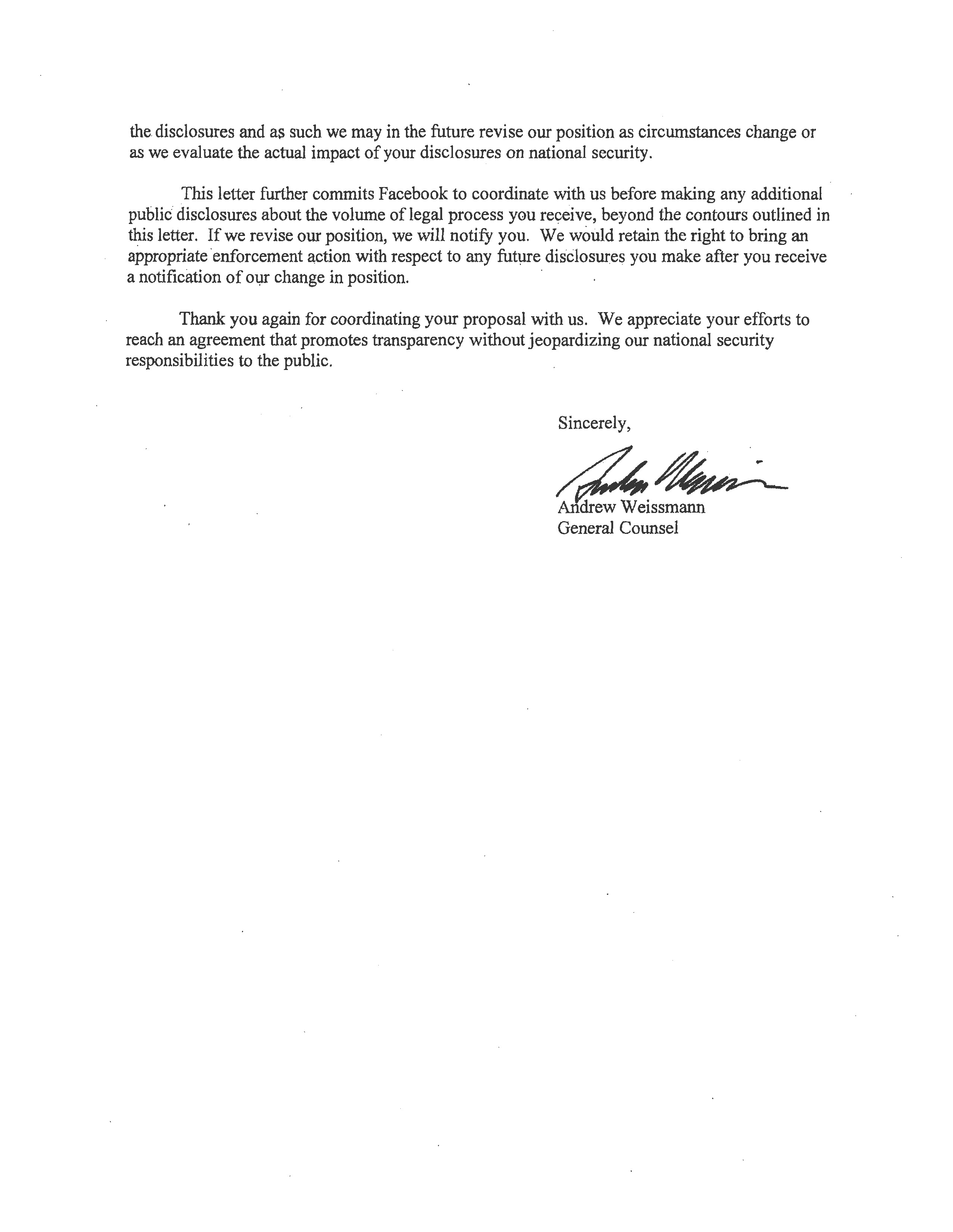
¹ The FBI does not have the authority to negate a court order, nor can we bind state or local authorities.
the disclosures and as such we may in the future revise our position as circumstances change or
as we evaluate the actual impact of your disclosures on national security.
This letter further commits Microsoft to coordinate with us before making any additional
public disclosures about the volume of legal process you receive, beyond the contours outlined in
this letter. If we revise our position, we will notify you. We would retain the right to bring an
appropriate enforcement action with respect to any future disclosures you make after you receive
a notification of our change in position.
Thank you again for coordinating your proposal with us. We appreciate your efforts to
reach an agreement that promotes transparency without jeopardizing our national security
responsibilities to the public.
Sincerely,
Andrew Weissmann
General Counsel
U.S. Department of Justice
Federal Bureau of Investigation
Office of the General Counsel
Washington, D.C. 20535
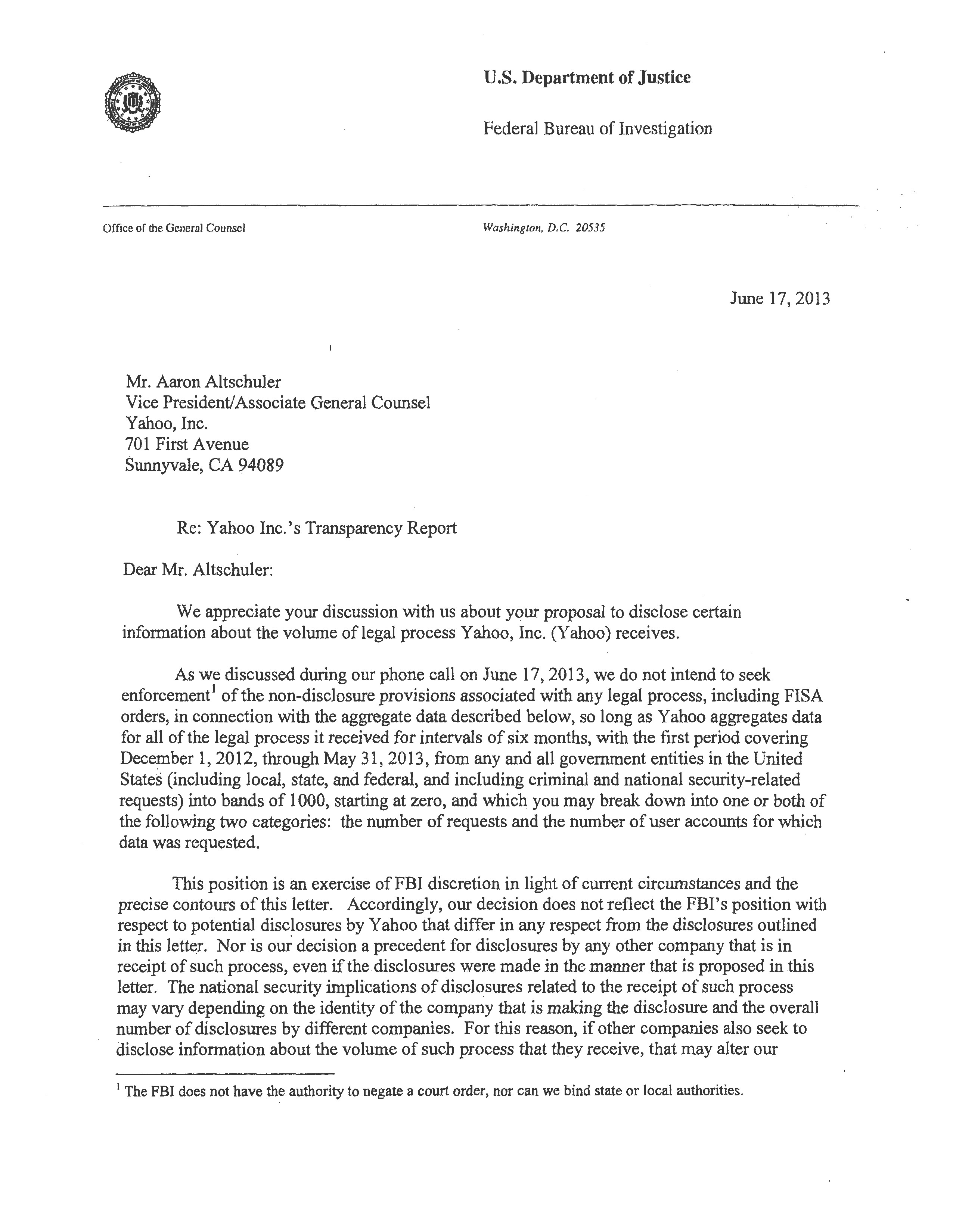
June 17, 2013
Mr. Aaron Altschuler
Vice President/Associate General Counsel
Yahoo, Inc.
701 First Avenue
Sunnyvale, CA 94089
Re: Yahoo Inc.'s Transparency Report
Dear Mr. Altschuler:
We appreciate your discussion with us about your proposal to disclose certain
information about the volume of legal process Yahoo, Inc. (Yahoo) receives.
As we discussed during our phone call on June 17, 2013, we do not intend to seek
enforcement¹ of the non-disclosure provisions associated with any legal process, including FISA
orders, in connection with the aggregate data described below, so long as Yahoo aggregates data
for all of the legal process it received for intervals of six months, with the first period covering
December 1, 2012, through May 31, 2013, from any and all government entities in the United
States (including local, state, and federal, and including criminal and national security-related
requests) into bands of 1000, starting at zero, and which you may break down into one or both of
the following two categories: the number of requests and the number of user accounts for which
data was requested.
This position is an exercise of FBI discretion in light of current circumstances and the
precise contours of this letter. Accordingly, our decision does not reflect the FBI's position with
respect to potential disclosures by Yahoo that differ in any respect from the disclosures outlined
in this letter. Nor is our decision a precedent for disclosures by any other company that is in
receipt of such process, even if the disclosures were made in the manner that is proposed in this
letter. The national security implications of disclosures related to the receipt of such process
may vary depending on the identity of the company that is making the disclosure and the overall
number of disclosures by different companies. For this reason, if other companies also seek to
disclose information about the volume of such process that they receive, that may alter our
calculus about the implications of disclosures by Yahoo. In addition, our current
determination is based on our prediction about the potential national security consequences of
¹ The FBI does not have the authority to negate a court order, nor can we bind state or local authorities.
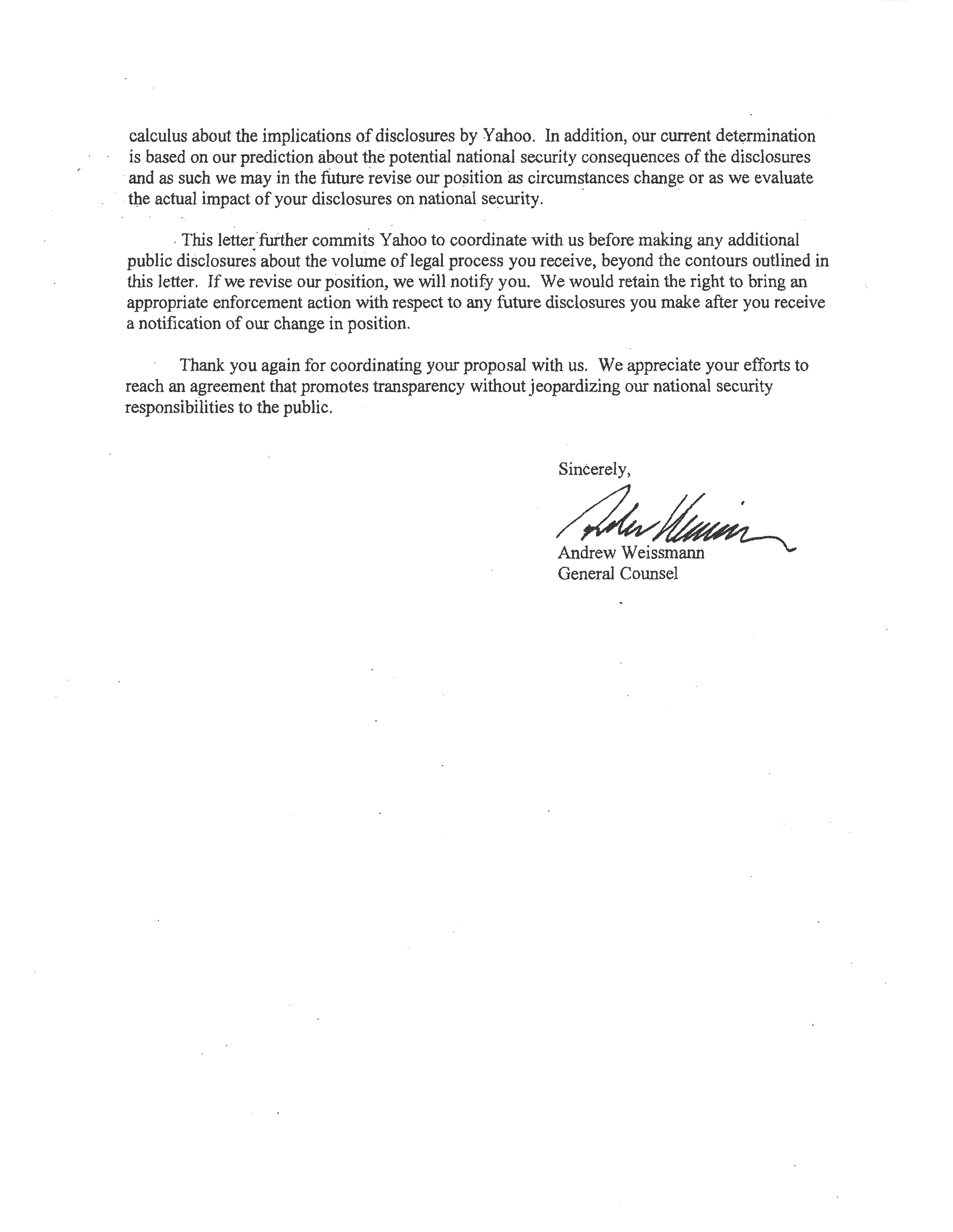
calculus about the implications of disclosures by Yahoo. In addition, our current determination
is based on our prediction about the potential national security consequences of the disclosures
and as such we may in the future revise our position as circumstances change or as we evaluate
the actual impact of your disclosures on national security.
This letter further commits Yahoo to coordinate with us before making any additional
public disclosures about the volume of legal process you receive, beyond the contours outlined in
this letter. If we revise our position, we will notify you. We would retain the right to bring an
appropriate enforcement action with respect to any future disclosures you make after you receive
a notification of our change in position.
Thank you again for coordinating your proposal with us. We appreciate your efforts to
reach an agreement that promotes transparency without jeopardizing our national security
responsibilities to the public.
Sincerely,
Andrew Weissmann
General Counsel
U.S. Department of Justice
Federal Bureau of Investigation
Office of the General Counsel
Washington, D.C. 20535
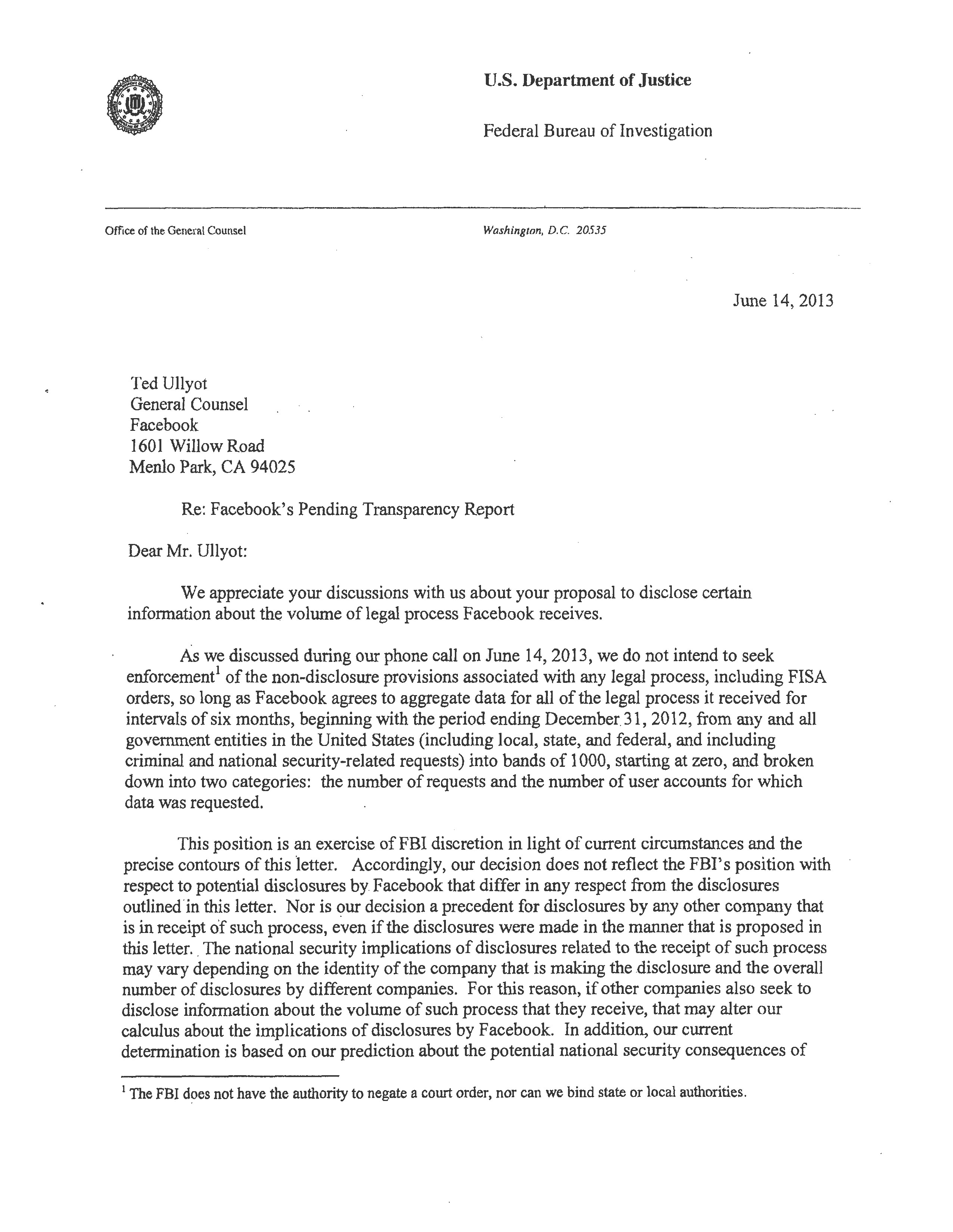
June 14, 2013
Ted Ullyot
General Counsel
Facebook
1601 Willow Road
Menlo Park, CA 94025
Re: Facebook's Pending Transparency Report
Dear Mr. Ullyot:
We appreciate your discussions with us about your proposal to disclose certain
information about the volume of legal process Facebook receives.
As we discussed during our phone call on June 14, 2013, we do not intend to seek
enforcement¹ of the non-disclosure provisions associated with any legal process, including FISA
orders, so long as Facebook agrees to aggregate data for all of the legal process it received for
intervals of six months, beginning with the period ending December 31, 2012, from any and all
government entities in the United States (including local, state, and federal, and including
criminal and national security-related requests) into bands of 1000, starting at zero, and broken
down into two categories: the number of requests and the number of user accounts for which
data was requested.
This position is an exercise of FBI discretion in light of current circumstances and the
precise contours of this letter. Accordingly, our decision does not reflect the FBI's position with
respect to potential disclosures by Facebook that differ in any respect from the disclosures
outlined in this letter. Nor is our decision a precedent for disclosures by any other company that
is in receipt of such process, even if the disclosures were made in the manner that is proposed in
this letter. The national security implications of disclosures related to the receipt of such process
may vary depending on the identity of the company that is making the disclosure and the overall
number of disclosures by different companies. For this reason, if other companies also seek to
disclose information about the volume of such process that they receive, that may alter our
calculus about the implications of disclosures by Facebook. In addition, our current
determination is based on our prediction about the potential national security consequences of
¹ The FBI does not have the authority to negate a court order, nor can we bind state or local authorities.
the disclosures and as such we may in the future revise our position as circumstances change or
as we evaluate the actual impact of your disclosures on national security.
This letter further commits Facebook to coordinate with us before making any additional
public disclosures about the volume of legal process you receive, beyond the contours outlined in
this letter. If we revise our position, we will notify you. We would retain the right to bring an
appropriate enforcement action with respect to any future disclosures you make after you receive
a notification of our change in position.
Thank you again for coordinating your proposal with us. We appreciate your efforts to
reach an agreement that promotes transparency without jeopardizing our national security
responsibilities to the public.
Sincerely,
Andrew Weissmann
General Counsel
(U) ATTACHMENT “C”
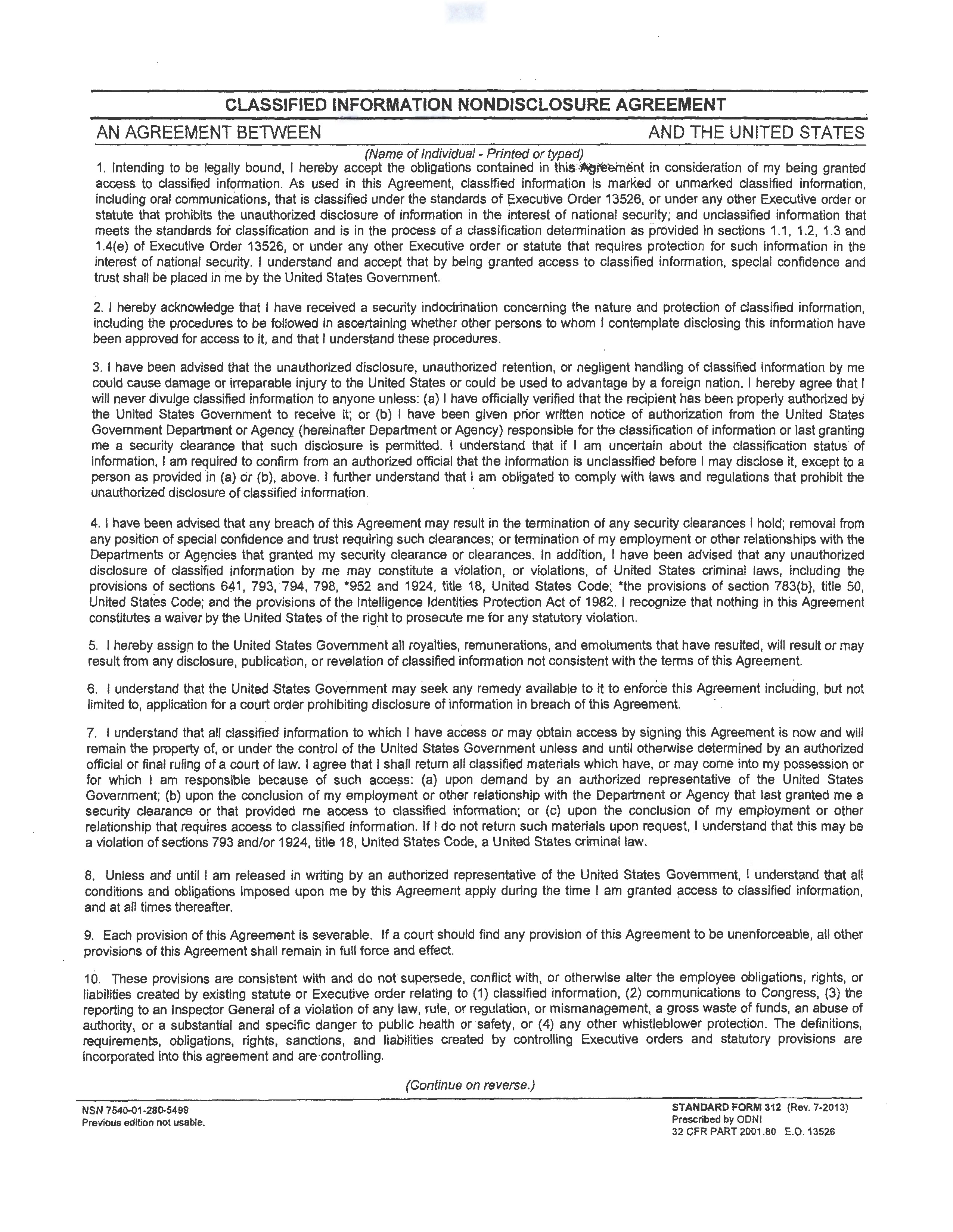
CLASSIFIED INFORMATION NONDISCLOSURE AGREEMENT
AN AGREEMENT BETWEEN
AND THE UNITED STATES
(Name of Individual - Printed or typed)
- Intending to be legally bound, I hereby accept the obligations contained in this Agreement in consideration of my being granted
access to classified information. As used in this Agreement, classified information is marked or unmarked classified information,
including oral communications, that is classified under the standards of Executive Order 13526, or under any other Executive order or
statute that prohibits the unauthorized disclosure of information in the interest of national security; and unclassified information that
meets the standards for classification and is in the process of a classification determination as provided in sections 1.1, 1.2, 1.3 and
1.4(e) of Executive Order 13526, or under any other Executive order or statute that requires protection for such information in the
interest of national security. I understand and accept that by being granted access to classified information, special confidence and
trust shall be placed in me by the United States Government.
- I hereby acknowledge that I have received a security indoctrination concerning the nature and protection of classified information,
including the procedures to be followed in ascertaining whether other persons to whom I contemplate disclosing this information have
been approved for access to it, and that I understand these procedures.
- I have been advised that the unauthorized disclosure, unauthorized retention, or negligent handling of classified information by me
could cause damage or irreparable injury to the United States or could be used to advantage by a foreign nation. I hereby agree that I
will never divulge classified information to anyone unless: (a) I have officially verified that the recipient has been properly authorized by
the United States Government to receive it; or (b) I have been given prior written notice of authorization from the United States
Government Department or Agency (hereinafter Department or Agency) responsible for the classification of information or last granting
me a security clearance that such disclosure is permitted. I understand that if I am uncertain about the classification status of
information, I am required to confirm from an authorized official that the information is unclassified before I may disclose it, except to a
person as provided in (a) or (b), above. I further understand that I am obligated to comply with laws and regulations that prohibit the
unauthorized disclosure of classified information.
- I have been advised that any breach of this Agreement may result in the termination of any security clearances I hold; removal from
any position of special confidence and trust requiring such clearances; or termination of my employment or other relationships with the
Departments or Agencies that granted my security clearance or clearances. In addition, I have been advised that any unauthorized
disclosure of classified information by me may constitute a violation, or violations, of United States criminal laws, including the
provisions of sections 641, 793, 794, 798, *952 and 1924, title 18, United States Code; *the provisions of section 783(b), title 50,
United States Code; and the provisions of the Intelligence Identities Protection Act of 1982. I recognize that nothing in this Agreement
constitutes a waiver by the United States of the right to prosecute me for any statutory violation.
- I hereby assign to the United States Government all royalties, remunerations, and emoluments that have resulted, will result or may
result from any disclosure, publication, or revelation of classified information not consistent with the terms of this Agreement.
- I understand that the United States Government may seek any remedy available to it to enforce this Agreement including, but not
limited to, application for a court order prohibiting disclosure of information in breach of this Agreement.
- I understand that all classified information to which I have access or may obtain access by signing this Agreement is now and will
remain the property of, or under the control of the United States Government unless and until otherwise determined by an authorized
official or final ruling of a court of law. I agree that I shall return all classified materials which have, or may come into my possession or
for which I am responsible because of such access: (a) upon demand by an authorized representative of the United States
Government; (b) upon the conclusion of my employment or other relationship with the Department or Agency that last granted me a
security clearance or that provided me access to classified information; or (c) upon the conclusion of my employment or other
relationship that requires access to classified information. If I do not return such materials upon request, I understand that this may be
a violation of sections 793 and/or 1924, title 18, United States Code, a United States criminal law.
- Unless and until I am released in writing by an authorized representative of the United States Government, I understand that all
conditions and obligations imposed upon me by this Agreement apply during the time I am granted access to classified information,
and at all times thereafter.
- Each provision of this Agreement is severable. If a court should find any provision of this Agreement to be unenforceable, all other
provisions of this Agreement shall remain in full force and effect.
- These provisions are consistent with and do not supersede, conflict with, or otherwise alter the employee obligations, rights, or
liabilities created by existing statute or Executive order relating to (1) classified information, (2) communications to Congress, (3) the
reporting to an Inspector General of a violation of any law, rule, or regulation, or mismanagement, a gross waste of funds, an abuse of
authority, or a substantial and specific danger to public health or safety, or (4) any other whistleblower protection. The definitions,
requirements, obligations, rights, sanctions, and liabilities created by controlling Executive orders and statutory provisions are
incorporated into this agreement and are controlling.
(Continue on reverse.)
NSN 7540-01-280-5499
Previous edition not usable.
STANDARD FORM 312 (Rev. 7-2013)
Prescribed by ODNI
32 CFR PART 2001.80 E.O. 13526
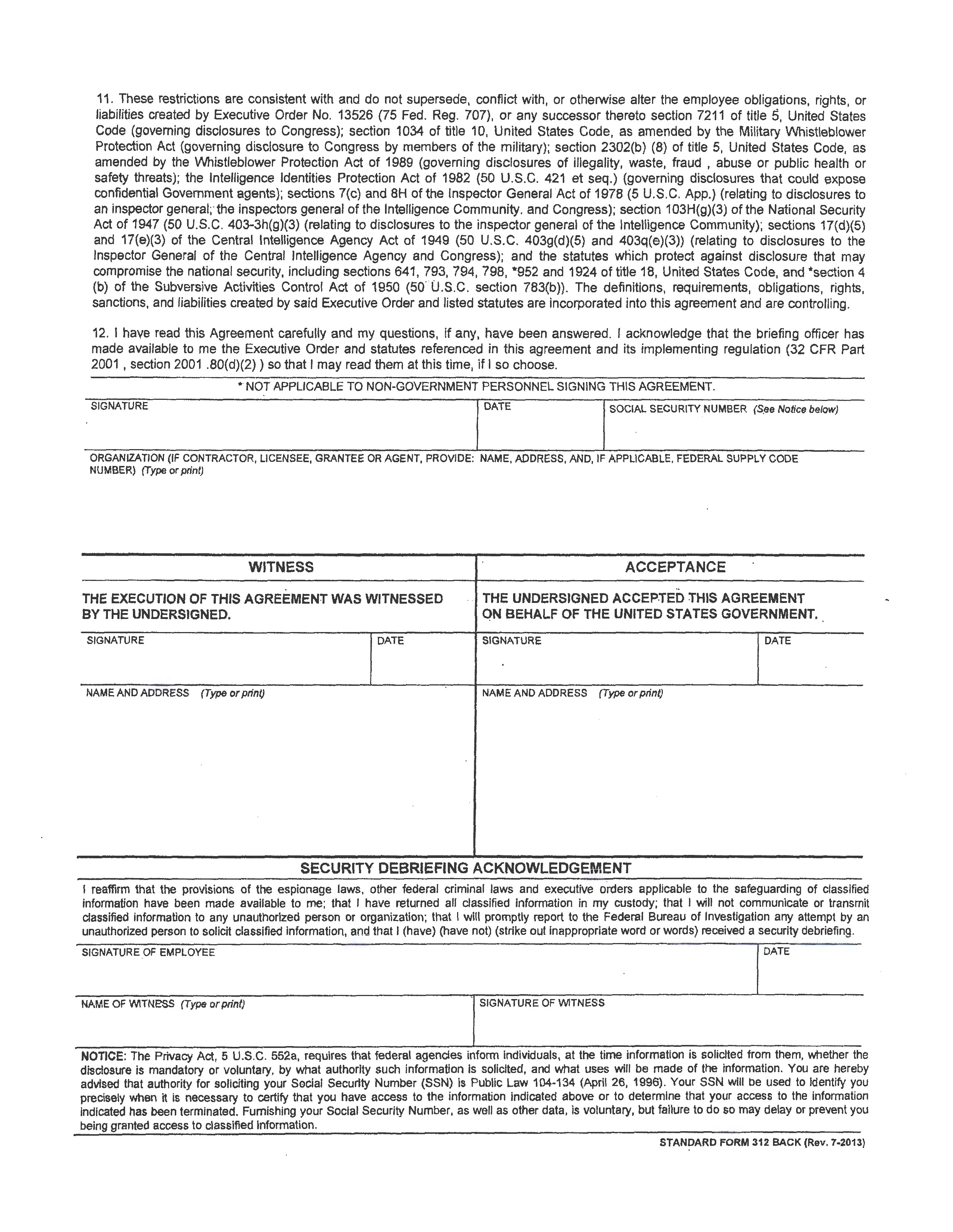
11. These restrictions are consistent with and do not supersede, conflict with, or otherwise alter the employee obligations, rights, or
liabilities created by Executive Order No. 13526 (75 Fed. Reg. 707), or any successor thereto section 7211 of title 5, United States
Code (governing disclosures to Congress); section 1034 of title 10, United States Code, as amended by the Military Whistleblower
Protection Act (governing disclosure to Congress by members of the military); section 2302(b) (8) of title 5, United States Code, as
amended by the Whistleblower Protection Act of 1989 (governing disclosures of illegality, waste, fraud, abuse or public health or
safety threats); the Intelligence Identities Protection Act of 1982 (50 U.S.C. 421 et seq.) (governing disclosures that could expose
confidential Government agents); sections 7(c) and 8H of the Inspector General Act of 1978 (5 U.S.C. App.) (relating to disclosures to
an inspector general; the inspectors general of the Intelligence Community, and Congress); section 103H(g) (3) of the National Security
Act of 1947 (50 U.S.C. 403-3h(g) (3) (relating to disclosures to the inspector general of the Intelligence Community); sections 17(d)(5)
and 17(e)(3) of the Central Intelligence Agency Act of 1949 (50 U.S.C. 403g(d) (5) and 403q(e) (3)) (relating to disclosures to the
Inspector General of the Central Intelligence Agency and Congress); and the statutes which protect against disclosure that may
compromise the national security, including sections 641, 793, 794, 798, *952 and 1924 of title 18, United States Code, and *section 4
(b) of the Subversive Activities Control Act of 1950 (50 U.S.C. section 783(b)). The definitions, requirements, obligations, rights,
sanctions, and liabilities created by said Executive Order and listed statutes are incorporated into this agreement and are controlling.
- I have read this Agreement carefully and my questions, if any, have been answered. I acknowledge that the briefing officer has
made available to me the Executive Order and statutes referenced in this agreement and its implementing regulation (32 CFR Part
2001, section 2001.80(d)(2)) so that I may read them at this time, if I so choose.
- NOT APPLICABLE TO NON-GOVERNMENT PERSONNEL SIGNING THIS AGREEMENT.
SIGNATURE
DATE
SOCIAL SECURITY NUMBER (See Notice below)
ORGANIZATION (IF CONTRACTOR, LICENSEE, GRANTEE OR AGENT, PROVIDE: NAME, ADDRESS, AND, IF APPLICABLE, FEDERAL SUPPLY CODE
NUMBER) (Type or print)
WITNESS
ACCEPTANCE
THE EXECUTION OF THIS AGREEMENT WAS WITNESSED
BY THE UNDERSIGNED.
THE UNDERSIGNED ACCEPTED THIS AGREEMENT ON
BEHALF OF THE UNITED STATES GOVERNMENT.
SIGNATURE
NAME AND ADDRESS (Type or print)
DATE
SIGNATURE
NAME AND ADDRESS (Type or print)
DATE
SECURITY DEBRIEFING ACKNOWLEDGEMENT
I reaffirm that the provisions of the espionage laws, other federal criminal laws and executive orders applicable to the safeguarding of classified
information have been made available to me; that I have returned all classified information in my custody; that I will not communicate or
transmit classified information to any unauthorized person or organization; that I will promptly report to the Federal Bureau of Investigation any
attempt by an unauthorized person to solicit classified information, and that 1.(have) (have not) (strike out inappropriate word or words)
received a security debriefing.
SIGNATURE OF EMPLOYEE
DATE
NAME OF WITNESS (Type or print)
SIGNATURE OF WITNESS
NOTICE: The Privacy Act, 5 U.S.C. 552a, requires that federal agencies inform individuals, at the time information is solicited from them, whether the
disclosure is mandatory or voluntary, by what authority such information is solicited, and what uses will be made of the information. You are hereby
advised that authority for soliciting your Social Security Account Number (SSN) is Executive Order 9397. Your SSN will be used to identify you
precisely when it is necessary to 1) certify that you have access to the information indicated above or 2) determine that your access to the information
indicated has been terminated. Although disclosure of your SSN is not mandatory, your failure to do so may impede the processing of such certifications or determinations, or possibly result in the dental of your being granted access to classified
information.
- NOT APPLICABLE TO NON-GOVERNMENT PERSONNEL SIGNING THIS AGREEMENT.
STANDARD FORM 312 BACK (REV. 1.00)
APD V1.00
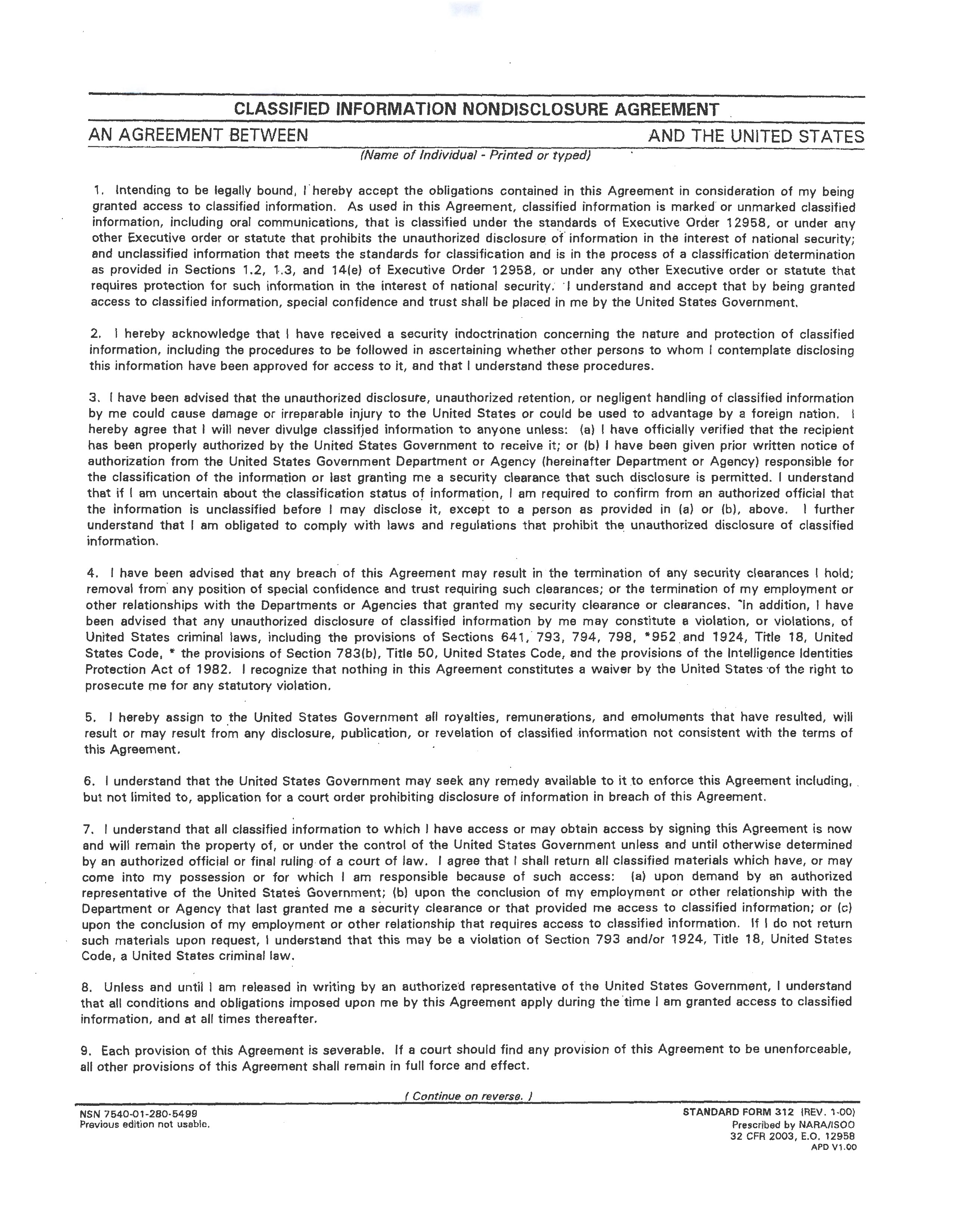
CLASSIFIED INFORMATION NONDISCLOSURE AGREEMENT
AN AGREEMENT BETWEEN
AND THE UNITED STATES
(Name of Individual - Printed or typed)
- Intending to be legally bound, I hereby accept the obligations contained in this Agreement in consideration of my being
granted access to classified information. As used in this Agreement, classified information is marked or unmarked classified
information, including oral communications, that is classified under the standards of Executive Order 12958, or under any
other Executive order or statute that prohibits the unauthorized disclosure of information in the interest of national security;
and unclassified information that meets the standards for classification and is in the process of a classification determination
as provided in Sections 1.2, 1.3, and 14(e) of Executive Order 12958, or under any other Executive order or statute that
requires protection for such information in the interest of national security. I understand and accept that by being granted
access to classified information, special confidence and trust shall be placed in me by the United States Government.
- I hereby acknowledge that I have received a security indoctrination concerning the nature and protection of classified
information, including the procedures to be followed in ascertaining whether other persons to whom I contemplate disclosing
this information have been approved for access to it, and that I understand these procedures.
- I have been advised that the unauthorized disclosure, unauthorized retention, or negligent handling of classified information
by me could cause damage or irreparable injury to the United States or could be used to advantage by a foreign nation. I
hereby agree that I will never divulge classified information to anyone unless: (a) I have officially verified that the recipient
has been properly authorized by the United States Government to receive it; or (b) I have been given prior written notice of
authorization from the United States Government Department or Agency (hereinafter Department or Agency) responsible for
the classification of the information or last granting me a security clearance that such disclosure is permitted. I understand
that if I am uncertain about the classification status of information, I am required to confirm from an authorized official that
the information is unclassified before I may disclose it, except to a person as provided in (a) or (b), above. I further
understand that I am obligated to comply with laws and regulations that prohibit the unauthorized disclosure of classified
information.
- I have been advised that any breach of this Agreement may result in the termination of any security clearances I hold;
removal from any position of special confidence and trust requiring such clearances; or the termination of my employment or
other relationships with the Departments or Agencies that granted my security clearance or clearances. In addition, I have
been advised that any unauthorized disclosure of classified information by me may constitute a violation, or violations, of
United States criminal laws, including the provisions of Sections 641, 793, 794, 798, *952 and 1924, Title 18, United
States Code, the provisions of Section 783(b), Title 50, United States Code, and the provisions of the Intelligence Identities
Protection Act of 1982. I recognize that nothing in this Agreement constitutes a waiver by the United States of the right to
prosecute me for any statutory violation.
- I hereby assign to the United States Government all royalties, remunerations, and emoluments that have resulted, will
result or may result from any disclosure, publication, or revelation of classified information not consistent with the terms of
this Agreement.
- I understand that the United States Government may seek any remedy available to it to enforce this Agreement including,
but not limited to, application for a court order prohibiting disclosure of information in breach of this Agreement.
- I understand that all classified information to which I have access or may obtain access by signing this Agreement is now
and will remain the property of, or under the control of the United States Government unless and until otherwise determined
by an authorized official or final ruling of a court of law. I agree that I shall return all classified materials which have, or may
come into my possession or for which I am responsible because of such access: (a) upon demand by an authorized
representative of the United States Government; (b) upon the conclusion of my employment or other relationship with the
Department or Agency that last granted me a security clearance or that provided me access to classified information; or (c)
upon the conclusion of my employment or other relationship that requires access to classified information. If I do not return
such materials upon request, I understand that this may be a violation of Section 793 and/or 1924, Title 18, United States
Code, a United States criminal law.
- Unless and until I am released in writing by an authorized representative of the United States Government, I understand
that all conditions and obligations imposed upon me by this Agreement apply during the time I am granted access to classified
information, and at all times thereafter.
- Each provision of this Agreement is severable. If a court should find any provision of this Agreement to be unenforceable,
all other provisions of this Agreement shall remain in full force and effect.
(Continue on reverse.)
NSN 7540-01-280-5499
Previous edition not usable.
STANDARD FORM 312 (REV. 1-00)
Prescribed by NARA/ISOO
32 CFR 2003, E.O. 12958
APD V1.00
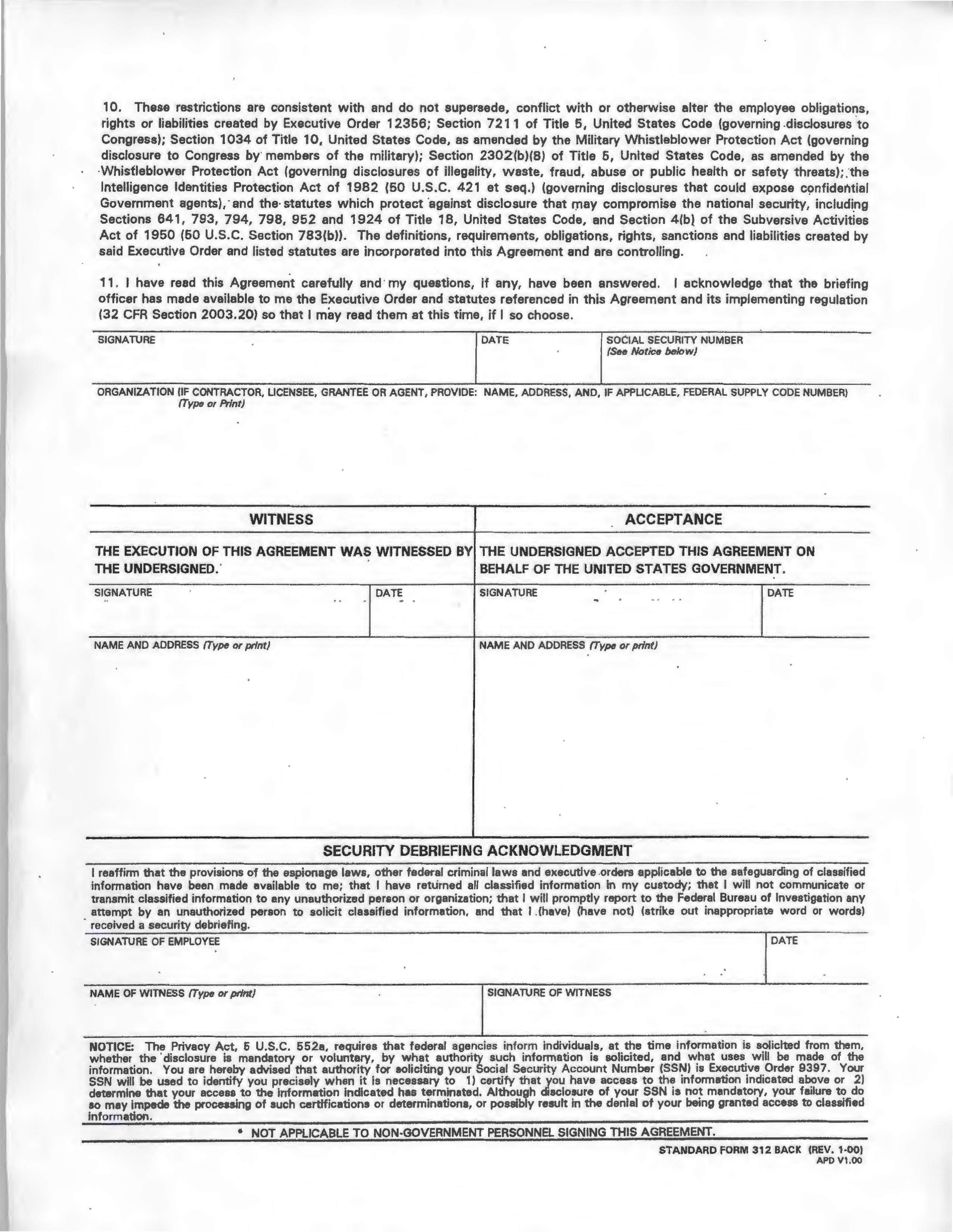
10. These restrictions are consistent with and do not supersede, conflict with or otherwise alter the employee obligations,
rights or liabilities created by Executive Order 12356; Section 7211 of Title 5, United States Code (governing disclosures to
Congress); Section 1034 of Title 10, United States Code, as amended by the Military Whistleblower Protection Act (governing
disclosure to Congress by members of the military); Section 2302(b)(8) of Title 5, United States Code, as amended by the
Whistleblower Protection Act (governing disclosures of illegality, waste, fraud, abuse or public health or safety threats); the
Intelligence Identities Protection Act of 1982 (50 U.S.C. 421 et seq.) (governing disclosures that could expose confidential
Government agents), and the statutes which protect against disclosure that may compromise the national security, including
Sections 641, 793, 794, 798, 952 and 1924 of Title 18, United States Code, and Section 4(b) of the Subversive Activities
Act of 1950 (50 U.S.C. Section 783(b)). The definitions, requirements, obligations, rights, sanctions and liabilities created by
said Executive Order and listed statutes are incorporated into this Agreement and are controlling.
- I have read this Agreement carefully and my questions, if any, have been answered. I acknowledge that the briefing
officer has made available to me the Executive Order and statutes referenced in this Agreement and its implementing regulation
(32 CFR Section 2003.20) so that I may read them at this time, if I so choose.
- NOT APPLICABLE TO NON-GOVERNMENT PERSONNEL SIGNING THIS AGREEMENT.
SIGNATURE
DATE
SOCIAL SECURITY NUMBER (See Notice below)
ORGANIZATION (IF CONTRACTOR, LICENSEE, GRANTEE OR AGENT, PROVIDE: NAME, ADDRESS, AND, IF APPLICABLE, FEDERAL SUPPLY CODE NUMBER)
(Type or Print)
WITNESS
ACCEPTANCE
THE EXECUTION OF THIS AGREEMENT WAS WITNESSED BY THE UNDERSIGNED ACCEPTED THIS AGREEMENT ON
THE UNDERSIGNED.
BEHALF OF THE UNITED STATES GOVERNMENT.
SIGNATURE
NAME AND ADDRESS (Type or print)
DATE
SIGNATURE
NAME AND ADDRESS (Type or print)
DATE
SECURITY DEBRIEFING ACKNOWLEDGMENT
I reaffirm that the provisions of the espionage laws, other federal criminal laws and executive orders applicable to the safeguarding of classified
information have been made available to me; that I have returned all classified information in my custody; that I will not communicate or
transmit classified information to any unauthorized person or organization; that I will promptly report to the Federal Bureau of Investigation any
attempt by an unauthorized person to solicit classified information, and that 1.(have) (have not) (strike out inappropriate word or words)
received a security debriefing.
SIGNATURE OF EMPLOYEE
DATE
NAME OF WITNESS (Type or print)
SIGNATURE OF WITNESS
NOTICE: The Privacy Act, 5 U.S.C. 552a, requires that federal agencies inform individuals, at the time information is solicited from them,
whether the 'disclosure is mandatory or voluntary, by what authority such information is solicited, and what uses will be made of the
information. You are hereby advised that authority for soliciting your Social Security Account Number (SSN) is Executive Order 9397. Your
SSN will be used to identify you precisely when it is necessary to 1) certify that you have access to the information indicated above or 2)
determine that your access to the information indicated has been terminated. Although disclosure of your SSN is not mandatory, your failure to do
so may impede the processing of such certifications or determinations, or possibly result in the dental of your being granted access to classified
information.
- NOT APPLICABLE TO NON-GOVERNMENT PERSONNEL SIGNING THIS AGREEMENT.
STANDARD FORM 312 BACK (REV. 1.00)
APD V1.00
Related Documents
-
Notice of Motion, Memorandum in Support of Motion by Media Freedom and Information Access Clinic for Reconsideration of This Court's September 13, 2013 Opinion on the Issue of Article III Standing, and Declaration of Maxwell S. Mishkin, In re Orders of this Court Interpreting Section 215 of the Patriot Act FOIA [pdf]
-
FISC Notice of Compliance Incident with Supplemental Declaration FOIA [pdf]
Memorandum of the Government providing the FISC with notice of additional compliance incidents identified during NSA’s ongoing end-to-end review of the telephony metadata program. ACLU/EFF FOIA Litigation.
People: Alexander, Keith B.ACLU,EFF ↗ (2013-09-10) -
DNI Clapper 2012 Jewel State Secrets Declaration FOIA [pdf]
Classified declaration of James R. Clapper disclosing information regarding the government. ACLU/EFF FOIA Litigation.
People: Clapper, James R. · Delery, Stuart F. · Hunt, Joseph H. · Garvey, Vincent M. · Coppolino, Anthony J. · Berman, Marcia · Jewel, Carolyn · White, Jeffrey S.ACLU,EFF ↗ (2013-12-20) -
DNI Clapper 2013 Jewel Shubert SSP Unclassified Signed Declaration FOIA [pdf]
Public declaration of James R. Clapper disclosing information regarding the government. ACLU/EFF FOIA Litigation.
People: Clapper, James R. · Delery, Stuart F. · Hunt, Joseph H. · Coppolino, Anthony J. · Gilligan, James J. · Berman, Marcia · Dearinger, Bryan · Patton, Rodney · Jewel, Carolyn · White, Jeffrey S.ACLU,EFF ↗ (2013-12-20) -
NSA Fleisch 2013 Jewel Shubert Declaration Unclassified FOIA [pdf]
Unclassified declaration of Frances J. Fleisch disclosing information regarding the government. ACLU/EFF FOIA Litigation.
People: Shubert, Virginia · Delery, Stuart F. · Hunt, Joseph H. · Coppolino, Anthony J. · Gilligan, James J. · Berman, Marcia · Dearinger, Bryan · Patton, Rodney · Jewel, Carolyn · Obama, Barack · White, Jeffrey S. · Fleisch, Frances J.ACLU,EFF ↗ (2013-12-20)