Notice of Motion, Memorandum in Support of Motion by Media Freedom and Information Access Clinic for Reconsideration of This Court's September 13, 2013 Opinion on the Issue of Article III Standing, and Declaration of Maxwell S. Mishkin, In re Orders of this Court Interpreting Section 215 of the Patriot Act
Open PDFDocument date: 2013-10-11
Type: FOIA
Pages: 25
Classification: -
Dissemination: -
FISC/FISCR Court Filings
My notes
U.S. FOREIGN
INTELLIGENCE
SURVEILLANCE COURT
UNITED STATES
FOREIGN INTELLIGENCE SURVEILLANCE COURT
WASHINGTON, D.C.
2013 OCT 11 PM 4:26
LEEANN FLYNN HALL
CLERK OF COURT
IN RE ORDERS OF THIS COURT
INTERPRETING SECTION 215
OF THE PATRIOT ACT
Docket No. Misc. 13-02
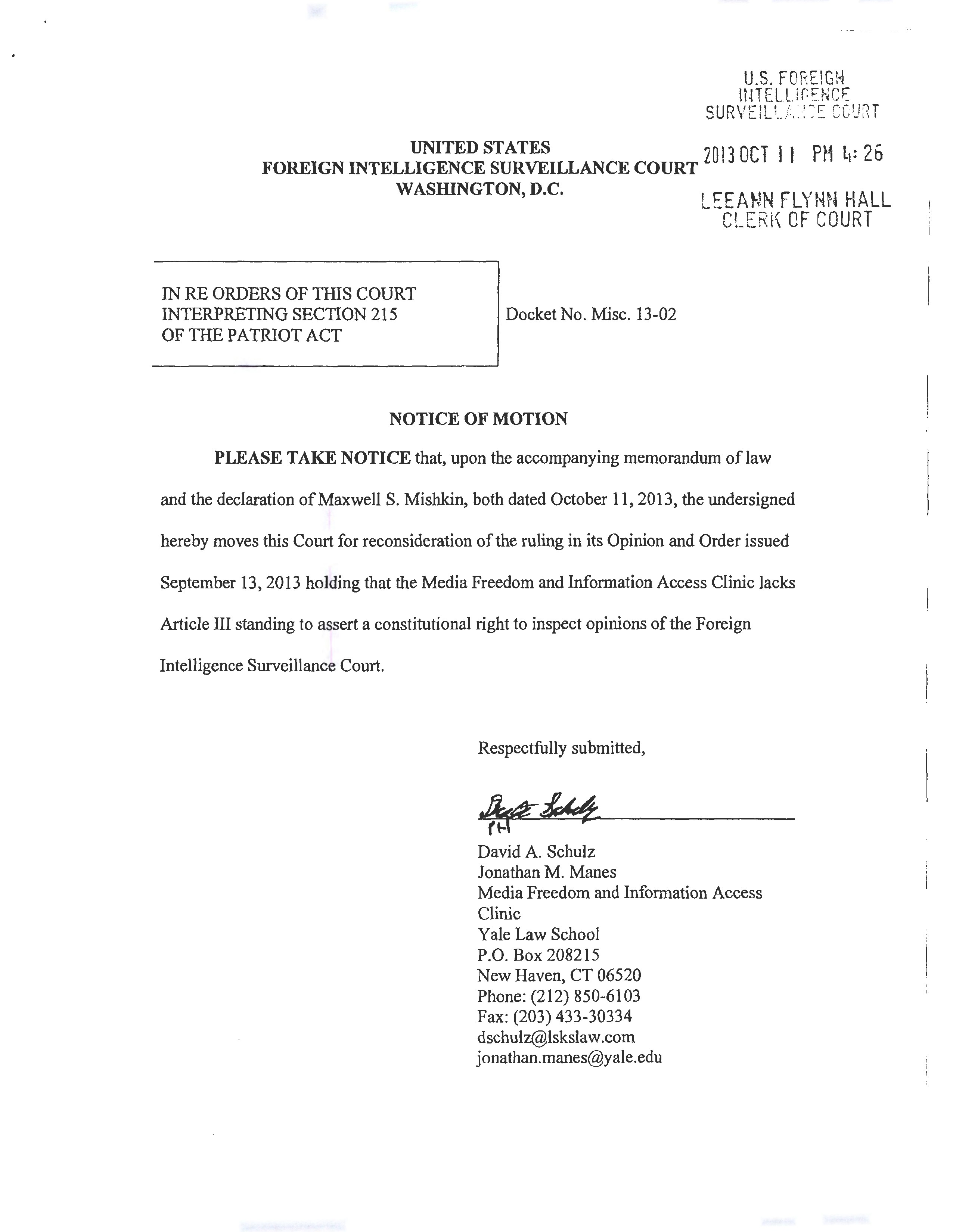
NOTICE OF MOTION
PLEASE TAKE NOTICE that, upon the accompanying memorandum of law
and the declaration of Maxwell S. Mishkin, both dated October 11, 2013, the undersigned
hereby moves this Court for reconsideration of the ruling in its Opinion and Order issued
September 13, 2013 holding that the Media Freedom and Information Access Clinic lacks
Article III standing to assert a constitutional right to inspect opinions of the Foreign
Intelligence Surveillance Court.
Respectfully submitted,
David A. Schulz
Jonathan M. Manes
Media Freedom and Information Access
Clinic
Yale Law School
P.O. Box 208215
New Haven, CT 06520
Phone: (212) 850-6103
Fax: (203) 433-30334
dschulz@lskslaw.com
jonathan.manes@yale.edu
U.S. FOREIGN
INTELLIGENCE
SURVEILLANCE COUR
UNITED STATES
FOREIGN INTELLIGENCE SURVEILLANCE COURT
WASHINGTON, D.C.
2013 OCT 11 PM 4:2
LEEANN FLYNN HA
CLERK OF COURT
IN RE ORDERS OF THIS COURT
INTERPRETING SECTION 215
OF THE PATRIOT ACT
Docket No. Misc. 13-02
MEMORANDUM IN SUPPORT OF MOTION BY MEDIA FREEDOM AND
INFORMATION ACCESS CLINIC FOR RECONSIDERATION OF THIS COURT'S
SEPTEMBER 13, 2013 OPINION ON THE ISSUE OF ARTICLE III STANDING
David A. Schulz
Jonathan M. Manes
Media Freedom and Information Access Clinic
Yale Law School
P.O. Box 208215
New Haven, CT 06520
Phone: (212) 850-6103
Fax: (203) 433-30334
dschulz@lskslaw.com
jonathan.manes@yale.cdu
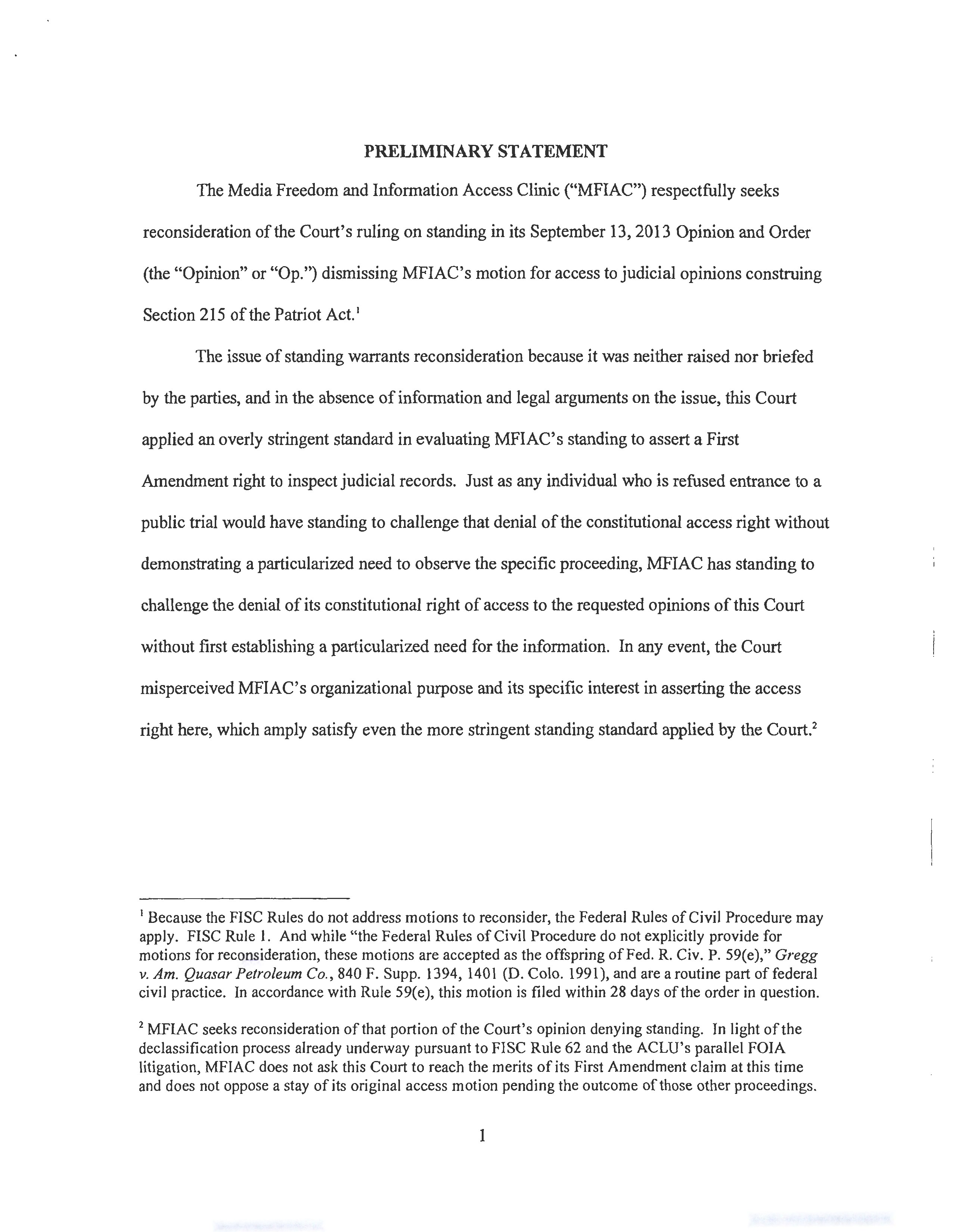
PRELIMINARY STATEMENT
The Media Freedom and Information Access Clinic ("MFIAC") respectfully seeks
reconsideration of the Court's ruling on standing in its September 13, 2013 Opinion and Order
(the "Opinion" or "Op.") dismissing MFIAC's motion for access to judicial opinions construing
Section 215 of the Patriot Act.¹
The issue of standing warrants reconsideration because it was neither raised nor briefed
by the parties, and in the absence of information and legal arguments on the issue, this Court
applied an overly stringent standard in evaluating MFIAC's standing to assert a First
Amendment right to inspect judicial records. Just as any individual who is refused entrance to a
public trial would have standing to challenge that denial of the constitutional access right without
demonstrating a particularized need to observe the specific proceeding, MFIAC has standing to
challenge the denial of its constitutional right of access to the requested opinions of this Court
without first establishing a particularized need for the information. In any event, the Court
misperceived MFIAC's organizational purpose and its specific interest in asserting the access
right here, which amply satisfy even the more stringent standing standard applied by the Court.²
¹ Because the FISC Rules do not address motions to reconsider, the Federal Rules of Civil Procedure may
apply. FISC Rule 1. And while "the Federal Rules of Civil Procedure do not explicitly provide for
motions for reconsideration, these motions are accepted as the offspring of Fed. R. Civ. P. 59(e)," Gregg
v. Am. Quasar Petroleum Co., 840 F. Supp. 1394, 1401 (D. Colo. 1991), and are a routine part of federal
civil practice. In accordance with Rule 59(e), this motion is filed within 28 days of the order in question.
² MFIAC seeks reconsideration of that portion of the Court's opinion denying standing. In light of the
declassification process already underway pursuant to FISC Rule 62 and the ACLU's parallel FOIA
litigation, MFIAC does not ask this Court to reach the merits of its First Amendment claim at this time
and does not oppose a stay of its original access motion pending the outcome of those other proceedings.
1
ARGUMENT
I.
RECONSIDERATION IS APPROPRIATE BECAUSE STANDING
WAS NOT RAISED OR BRIEFED BEFORE MFIAC'S DISMISSAL
The Court's order dismissing MFIAC for lack of standing was issued without any
briefing from the parties addressing the issue. The Government did not challenge the standing of
either party, and neither the ACLU nor MFIAC anticipated that their standing would be
questioned. Nor did the Court indicate that standing was a concern before issuing its Opinion
finding that MFIAC lacked standing. Accordingly, this motion for reconsideration will be
MFIAC's first opportunity to address the legal requirements for standing and to provide
information about its organizational activities, both of which support MFIAC's standing to assert
a violation of its First Amendment right to inspect the judicial opinions of this Court.
Reconsideration is appropriate where, as here, a court "has made a decision outside the
adversarial issues presented to the Court by the parties." *Above the Belt, Inc. v. Mel Bohannan
Roofing, Inc.*, 99 F.R.D. 99, 101 (E.D. Va. 1983); see also DirecTV, Inc. v. Hart, 366 F. Supp. 2d
315, 318 (E.D.N.C. 2004) (granting reconsideration where "the parties were not able to brief and
argue the issues upon which the order... ultimately was decided"); Neal v. Honeywell, Inc., 958
F. Supp. 345, 347 (N.D. Ill. 1997) (reconsidering ruling where parties "had not raised the issue
and hence... had not briefed it on the motion for summary judgment"). As recognized in
Yacobo v. Achim, No. 06-C-1425, 2008 WL 907444 (N.D. Ill. Mar. 31, 2008), “[b]asing a ruling
on issues not raised through the adversarial process... would most likely qualify as a manifest
error of law." Id. at *1.
MFIAC does not seek reconsideration to present "theories previously advanced and
rejected." Palmer v. Champion Mortgage, 465 F.3d 24, 30 (1st Cir. 2006). Rather, MFIAC
seeks to explain for the first time the legal and factual bases for its standing. As detailed below,
2
MFIAC respectfully submits that the Court applied an incorrect legal standard in evaluating the
injury-in-fact requirement of constitutional standing to allege a violation of First Amendment
access rights. See Walker v. McCaughtry, 72 F. Supp. 2d 1025 (E.D. Wis. 1999) (granting
motion to reconsider denial of habeas corpus relief where the court applied an incorrect standard
to a claim of denial of assistance). Furthermore, as set forth in the accompanying Declaration of
Maxwell S. Mishkin, dated October 11, 2013 ("Mishkin Decl."), facts about MFIAC's activities
and objectives that were not available to the Court in its sua sponte review of the public record
establish MFIAC's standing under even the more stringent test applied in the Opinion. See
Tokar v. City of Chicago, No. 96-CV-5331, 2000 WL 1230489, at *1 (N.D. Ill. Aug. 25, 2000)
(granting reconsideration of retaliation claim where court "misapprehended a critical fact" that
"satisfactorily demonstrated a causal nexus"); see also Edward H. Bohlin Co. v. Banning Co., 6
F.3d 350, 355 (5th Cir. 1993) ("the need to render just decisions on the basis of all the facts" can
outweigh the imperative of finality).
Under these circumstances, basic fairness requires reconsideration. The standing inquiry
enunciated by the Court could inappropriately impede the ability of future litigants to exercise
their First Amendment right of access to judicial proceedings and records, and the particular
ruling with respect to MFIAC's standing could hamper its ability to carry out its organizational
mission to support robust investigative journalism and to preserve the public's right of access to
information about the actions of government. See Mishkin Decl. ¶5.
II.
THE COURT APPLIED AN INCORRECT STANDARD IN DENYING
MFIAC'S STANDING TO ENFORCE THE FIRST AMENDMENT ACCESS RIGHT
To demonstrate Article III standing, a party seeking judicial review must show "(1) that it
has suffered an 'injury in fact'; (2) that the injury is caused by or fairly traceable to the
3
challenged actions of the defendant; and (3) that it is likely that the injury will be redressed by a
favorable decision." Ethyl Corp. v. Envtl. Prot. Agency, 306 F.3d 1144, 1147 (D.C. Cir. 2002)
(citing Lujan v. Defenders of Wildlife, 504 U.S. 555, 560-61 (1992)). Here, only MFIAC's
"injury-in-fact" is in dispute. That injury--the denial of access to the requested FISC
opinions--is more than sufficient to meet the requirements for Article III standing.
The Court erred, we respectfully submit, by suggesting that parties seeking access to
court records must allege not only that they have been denied access to court records—and are
thereby deprived of the very constitutional right they assert—but further demonstrate that this
denial "impedes their own activities in a concrete and particular way," or that access "would be
of concrete, particular assistance to them in their own activities." Op. at 5. Demonstrating
"concrete, particular assistance" or harm to one's "activities" is not necessary to satisfy Article
III standing requirements. To the contrary, the denial of access itself is an Article III injury. See
N.Y. Civil Liberties Union v. N.Y.C. Transit Auth., 684 F.3d 286 (2d Cir. 2011).
A party who asserts a constitutional right of access to review court records, and is denied
that access, has suffered an injury that is both concrete and particular: it has been deprived of
information to which it has asserted a personal right of access. Of course, the injury when court
records are improperly sealed is shared by all those who are denied access to the sealed
information, but that does not render it insufficient under Article III, so long as the party seeking
to invoke the court's jurisdiction itself seeks disclosure and has been denied access. See Fed.
³ MFIAC unquestionably satisfies the other two prongs of standing analysis: causation and redressability.
There can be no doubt that MFIAC's inability to inspect this Court's opinions "fairly can be traced to"
this Court's decision to deny public access to them. *Valley Forge Christian Coll. v. Americans United for
Separation of Church & State, Inc.*, 454 U.S. 464, 472 (1982). It is likewise clear that there is a
""substantial probability' that a favorable outcome would redress [MFIAC's] injuries." *Town of
Barnstable v. Fed. Aviation Admin.*, 659 F.3d 28, 31 (D.C. Cir. 2011). By releasing the requested
portions of its opinions, this Court would enforce the access right MFIAC asserts.
4
Election Comm'n v. Akins, 524 U.S. 11, 24 (1998) ("[W]here a harm is concrete, though widely
shared, the Court has found 'injury in fact."); Public Citizen v. U.S. Dep't of Justice, 491 U.S.
440, 449-50 (1989) ("The fact that other citizens or groups of citizens might make the same
complaint after unsuccessfully demanding disclosure under FACA does not lessen appellants'
asserted injury."). See infra § II.B.
To be sure, the few courts that have explicitly considered whether a party has standing to
assert a right of access have, on occasion, commented upon the party's reasons for seeking
access. But in doing so, these courts have never imposed a requirement that "concrete and
particular" harm to the party's specific objective be demonstrated as a prerequisite to standing, as
this Court has done. Instead, courts look to the "activities" of a party only to determine that the
party in fact has some cognizable interest in the information sought. So courts properly assure
themselves that, for example, a party is not seeking judicial relief with respect to court records or
proceedings they in fact have no interest in using or attending, see *Ernst v. Child & Youth Servs.
of Chester Cnty.*, 108 F.3d 486 (3d Cir. 1997), or to ensure that a party has at least some interest
in the records it seeks and is not asserting the rights of third parties not before the court, see *N.Y.
Civil Liberties Union*, 684 F.3d 286, or a bare desire to have the government act in accordance
with the law, see Akins, 524 U.S. 11. See infra § II.B.
Here, the basic activity that MFIAC seeks to promote by bringing this motion is apparent
on the face of the pleadings, as the Court acknowledged. Specifically, in seeking to obtain the
Section 215 opinions, MFIAC is pursuing its particular interest in "inform[ing] and enhanc[ing]
public debate about Section 215." Op. at 8.; see also Mot. of ACLU & MFIAC for Release of
Ct. Records at 1; Reply Br. in Supp. of Mot. at 1-3. Under the applicable law, this is a
cognizable interest sufficient to establish standing. Indeed, this interest must be cognizable, for
5
the quality of public debate on major national issues and the importance of holding the
government accountable is at the core of the First Amendment's protections for the freedoms of
speech, press, and petition. The Article III injury that MFIAC suffered—denial of access—is
plainly an injury to a cognizable interest and suffices to establish standing. See infra § II.B-C.
Perhaps the most troubling aspect of the Court's standing analysis is that the Court
reached its conclusion on MFIAC's standing even while acknowledging MFIAC's effort "to
inform and enhance public debate about Section 215." Op. at 8. Put differently, the Court's
opinion suggests that organizations whose "activity" is to disseminate information of public
interest do not suffer an injury sufficient even to invoke the court's jurisdiction when they are
denied their constitutional right of access to court records in service of that activity. If that
standard were correct, then standing could become a significant obstacle to the enforcement of
the public's right of access precisely by those who endeavor to vindicate that right in service of
the public interest. We doubt that this result, so clearly in tension with the objectives of the First
Amendment, is what the Court intended, and so we respectfully request the Court to reconsider,
or at least to clarify, its reasoning. See infra § I.C.
A. A Denial of Access to Court Records Alone
Inflicts Actual Injury Sufficient for Standing
As a general matter, standing "often turns on the nature and source of the claim asserted"
and, in particular, on "whether the constitutional . . . provision on which the claim rests properly
can be understood as granting persons in the plaintiff's position a right to judicial relief." *Warth
v. Seldin*, 422 U.S. 490, 500 (1975). The right in question here—the First Amendment right of
access to judicial proceedings and records—is, of course, a general right afforded to all members
of the public, each of whom has the same claim of access. As recognized in *Globe Newspaper
Co. v. Superior Court for Norfolk Cnty.*, 457 U.S. 596 (1982), the First Amendment access right
6
"serves to ensure that the individual citizen can effectively participate in and contribute to our
republican system of self-government." Id. at 604 (emphasis added); see also *Richmond
Newspapers Inc. v. Virginia*, 448 U.S. 555, 576 (1980) (First Amendment prohibits "the
government from limiting the stock of information from which members of the public may
draw") (emphasis added). There is also no question that organizations have this right just as
individuals do. See, e.g., N.Y. Civil Liberties Union v. N.Y.C. Transit Auth., 684 F.3d 286 (2d
Cir. 2011).
Accordingly, when a court improperly closes its proceedings or seals records subject to
the First Amendment right, any citizen—or any collection of citizens—denied access to the
proceeding or record suffers a concrete and particularized injury. In other words, the injury is
"concrete" because the party seeking access is in fact being deprived of information, and it is
"particular" because the party specifically sought and was denied the material. On this view,
whether the injury is "concrete and particular" does not depend at all on how the denial of access
in turn affects the party's further activities or interests, except in the minimal sense that the party
must actually have an interest in disclosure that is frustrated by the denial of access.
This view finds support in the principal cases upon which this Court relied. For instance,
in New York Civil Liberties Union v. New York City Transit Authority, the Second Circuit
reiterated that "in order to have standing to challenge the [impugned policy restricting access],
the NYCLU must establish that it (through its agents) suffered a concrete injury as a result of the
policy." 684 F.3d at 295. The two-paragraph discussion that followed focused solely on
whether the policy did in fact result in the denial of access, without regard to how it affected
NYCLU's activities. The court concluded the discussion, after finding that the policy did
actually result in NYCLU's agents being denied access, by holding that “NYCLU has
7
established that it suffered an actual injury—exclusion from at least some TAB hearings—as a
result of the NYCTA's access policy." Id. (emphasis added).
The only discussion of how this injury affected NYCLU's "activities" came after the
court had held that NYCLU suffered a concrete injury. Specifically, once the court found that
NYCLU suffered an "actual injury," the court only then asked whether "this injury, in turn, is to
a cognizable interest." Id. It is only at this later stage of the analysis—determining whether
NYCLU's interest is "cognizable"—that the court discussed how the challenged access policy
would "impede" the organization's activities. Id. at 295-96. And nowhere in that discussion
does the Second Circuit suggest, as this Court held, that standing depends on a finding that the
denial of access "impeded [NYCLU's] own interests in a concrete, particular way," or that
access "would be of concrete, particular assistance to them in their own activities." Op. at 5.
Instead, the court's discussion of "cognizable interests" responded to a strand of the standing
jurisprudence that categorically excludes certain interests from serving as a basis for standing;
for example, a plaintiff lacks a "cognizable interest" where his or her only interest is an "alleged
right to have the Government act in accordance with the law," Lujan v. Defenders of Wildlife,
504 U.S. 555, 575 (1992), or asserts an "interest in the prosecution or nonprosecution of
another," Linda R.S. v. Richard D., 410 U.S. 614, 619 (1973). Here, however, it was clear—on
the face of the original motion itself—that MFIAC's interest was not to enforce abstract
compliance with the law, but rather to compel the Court to disclose a specifically limited set of
opinions to which it asserted a personal constitutional right of access.
Moreover, even if NYCLU may be read to require some inquiry into whether an access
injury is "cognizable," nothing in NYCLU suggests that MFIAC's acknowledged interests in the
requested opinions—gathering information for the purpose of disseminating it to the public and
8
enhancing public debate—are somehow insufficient to support standing, as this Court found.
Indeed, the NYCLU's interests in accessing the proceedings at issue there—to gather
information about certain administrative proceedings to better serve future clients—are
analogous to MFIAC's interest here, which is to gather information about FISC proceedings in
furtherance of MFIAC's mission and for the benefit of the broader public.
The principle that a finding of "injury" in the access context does not depend on the
purpose for which records are sought is further demonstrated by Huminski v. Corsones, 396 F.3d
53 (2d Cir. 2005), a case in which the plaintiff was denied access to courtroom proceedings that
were open to the public. The Second Circuit first observed that the First Amendment access
right provides "quintessential protection for the individual" and that the Supreme Court has
permitted the right to be "asserted by an identified excluded individual." Id. at 83. It then
emphasized that "any member of the public—not only members of the public selected by the
courts themselves—may come and bear witness to what happens beyond the courtroom door."
Id. at 84. Accordingly, the court did not question Mr. Huminski's standing to sue over his denial
of access, and found that the First Amendment access right had been violated, irrespective of the
purposes for which he sought access. See id.
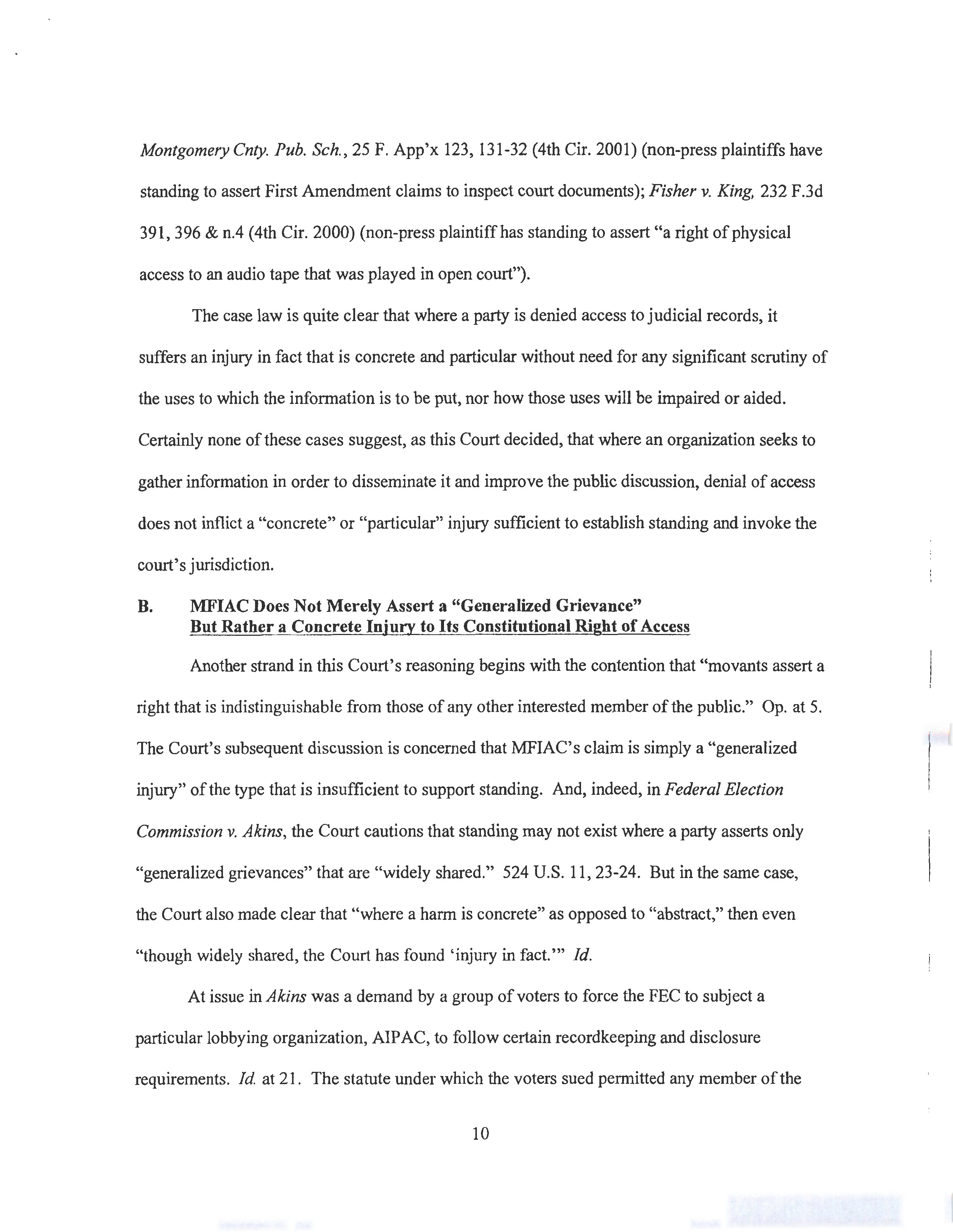
Other courts, too, have routinely accepted that denial of access to information subject to
the First Amendment access right inflicts a manifest injury on any party seeking access to it. For
instance, this past summer, when advocacy organizations including the Center for Constitutional
Rights, journalists, and media organizations including Democracy Now! asserted a First
Amendment right of access to documents related to the court martial of Private Manning, there
was no question that these groups had standing. See Ctr. for Constitutional Rights v. Lind, No.
13-1504, 2013 WL 3167910, at *4 n.8 (D. Md. June 19, 2013); see also, e.g., Rosenfeld v.
9
Montgomery Cnty. Pub. Sch., 25 F. App'x 123, 131-32 (4th Cir. 2001) (non-press plaintiffs have
standing to assert First Amendment claims to inspect court documents); Fisher v. King, 232 F.3d
391, 396 & n.4 (4th Cir. 2000) (non-press plaintiff has standing to assert "a right of physical
access to an audio tape that was played in open court").
The case law is quite clear that where a party is denied access to judicial records, it
suffers an injury in fact that is concrete and particular without need for any significant scrutiny of
the uses to which the information is to be put, nor how those uses will be impaired or aided.
Certainly none of these cases suggest, as this Court decided, that where an organization seeks to
gather information in order to disseminate it and improve the public discussion, denial of access
does not inflict a "concrete" or "particular" injury sufficient to establish standing and invoke the
court's jurisdiction.
B. MFIAC Does Not Merely Assert a "Generalized Grievance"
But Rather a Concrete Injury to Its Constitutional Right of Access
Another strand in this Court's reasoning begins with the contention that "movants assert a
right that is indistinguishable from those of any other interested member of the public." Op. at 5.
The Court's subsequent discussion is concerned that MFIAC's claim is simply a "generalized
injury" of the type that is insufficient to support standing. And, indeed, in *Federal Election
Commission v. Akins*, the Court cautions that standing may not exist where a party asserts only
"generalized grievances" that are "widely shared." 524 U.S. 11, 23-24. But in the same case,
the Court also made clear that "where a harm is concrete" as opposed to "abstract," then even
"though widely shared, the Court has found 'injury in fact." Id.
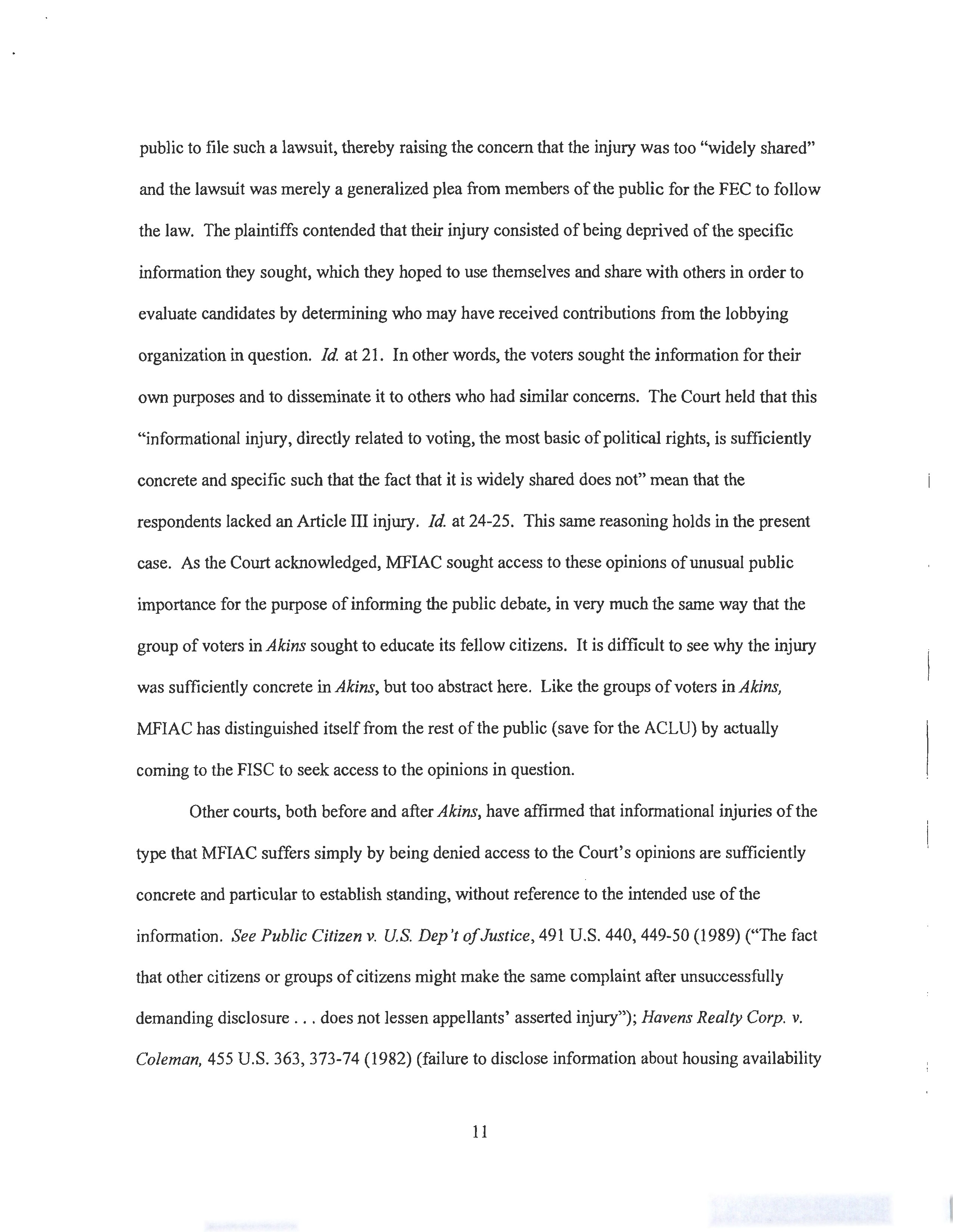
At issue in Akins was a demand by a group of voters to force the FEC to subject a
particular lobbying organization, AIPAC, to follow certain recordkeeping and disclosure
requirements. Id. at 21. The statute under which the voters sued permitted any member of the
10
public to file such a lawsuit, thereby raising the concern that the injury was too "widely shared"
and the lawsuit was merely a generalized plea from members of the public for the FEC to follow
the law. The plaintiffs contended that their injury consisted of being deprived of the specific
information they sought, which they hoped to use themselves and share with others in order to
evaluate candidates by determining who may have received contributions from the lobbying
organization in question. Id. at 21. In other words, the voters sought the information for their
own purposes and to disseminate it to others who had similar concerns. The Court held that this
"informational injury, directly related to voting, the most basic of political rights, is sufficiently
concrete and specific such that the fact that it is widely shared does not" mean that the
respondents lacked an Article III injury. Id. at 24-25. This same reasoning holds in the present
case. As the Court acknowledged, MFIAC sought access to these opinions of unusual public
importance for the purpose of informing the public debate, in very much the same way that the
group of voters in Akins sought to educate its fellow citizens. It is difficult to see why the injury
was sufficiently concrete in Akins, but too abstract here. Like the groups of voters in Akins,
MFIAC has distinguished itself from the rest of the public (save for the ACLU) by actually
coming to the FISC to seek access to the opinions in question.
Other courts, both before and after Akins, have affirmed that informational injuries of the
type that MFIAC suffers simply by being denied access to the Court's opinions are sufficiently
concrete and particular to establish standing, without reference to the intended use of the
information. See Public Citizen v. U.S. Dep't of Justice, 491 U.S. 440, 449-50 (1989) ("The fact
that other citizens or groups of citizens might make the same complaint after unsuccessfully
demanding disclosure... does not lessen appellants' asserted injury"); *Havens Realty Corp. v.
Coleman*, 455 U.S. 363, 373-74 (1982) (failure to disclose information about housing availability
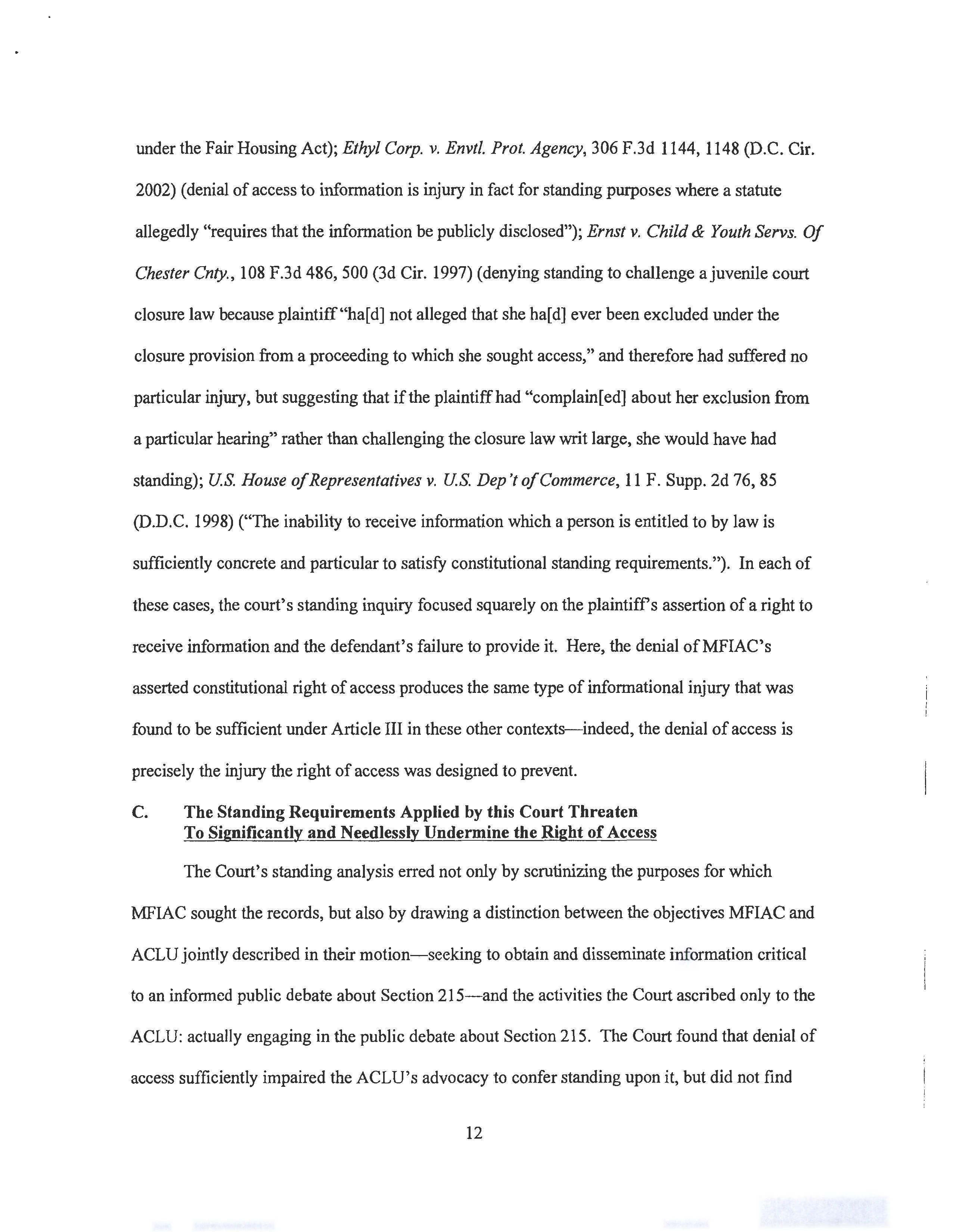
11
under the Fair Housing Act); Ethyl Corp. v. Envtl. Prot. Agency, 306 F.3d 1144, 1148 (D.C. Cir.
2002) (denial of access to information is injury in fact for standing purposes where a statute
allegedly "requires that the information be publicly disclosed"); *Ernst v. Child & Youth Servs. Of
Chester Cnty.*, 108 F.3d 486, 500 (3d Cir. 1997) (denying standing to challenge a juvenile court
closure law because plaintiff "ha[d] not alleged that she ha[d] ever been excluded under the
closure provision from a proceeding to which she sought access," and therefore had suffered no
particular injury, but suggesting that if the plaintiff had "complain[ed] about her exclusion from
a particular hearing" rather than challenging the closure law writ large, she would have had
standing); U.S. House of Representatives v. U.S. Dep't of Commerce, 11 F. Supp. 2d 76, 85
(D.D.C. 1998) ("The inability to receive information which a person is entitled to by law is
sufficiently concrete and particular to satisfy constitutional standing requirements."). In each of
these cases, the court's standing inquiry focused squarely on the plaintiff's assertion of a right to
receive information and the defendant's failure to provide it. Here, the denial of MFIAC's
asserted constitutional right of access produces the same type of informational injury that was
found to be sufficient under Article III in these other contexts—indeed, the denial of access is
precisely the injury the right of access was designed to prevent.
C. The Standing Requirements Applied by this Court Threaten
To Significantly and Needlessly Undermine the Right of Access
The Court's standing analysis erred not only by scrutinizing the purposes for which
MFIAC sought the records, but also by drawing a distinction between the objectives MFIAC and
ACLU jointly described in their motion—seeking to obtain and disseminate information critical
to an informed public debate about Section 215—and the activities the Court ascribed only to the
ACLU: actually engaging in the public debate about Section 215. The Court found that denial of
access sufficiently impaired the ACLU's advocacy to confer standing upon it, but did not find
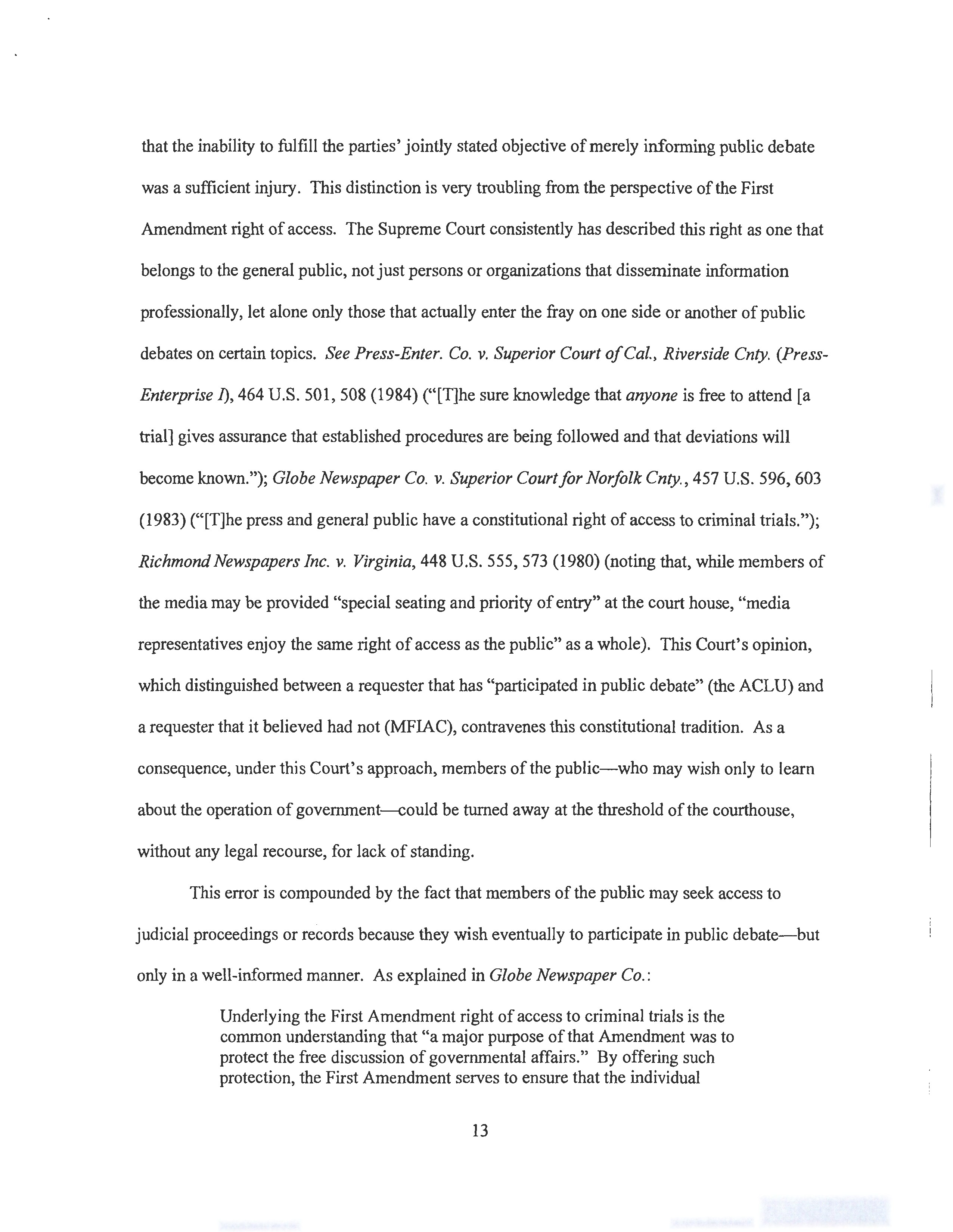
12
that the inability to fulfill the parties' jointly stated objective of merely informing public debate
was a sufficient injury. This distinction is very troubling from the perspective of the First
Amendment right of access. The Supreme Court consistently has described this right as one that
belongs to the general public, not just persons or organizations that disseminate information
professionally, let alone only those that actually enter the fray on one side or another of public
debates on certain topics. See Press-Enter. Co. v. Superior Court of Cal., Riverside Cnty. (*Press-
Enterprise I*), 464 U.S. 501, 508 (1984) ("[T]he sure knowledge that anyone is free to attend [a
trial] gives assurance that established procedures are being followed and that deviations will
become known."); Globe Newspaper Co. v. Superior Court for Norfolk Cnty., 457 U.S. 596, 603
(1983) ("[T]he press and general public have a constitutional right of access to criminal trials.");
Richmond Newspapers Inc. v. Virginia, 448 U.S. 555, 573 (1980) (noting that, while members of
the media may be provided "special seating and priority of entry" at the court house, "media
representatives enjoy the same right of access as the public" as a whole). This Court's opinion,
which distinguished between a requester that has "participated in public debate" (the ACLU) and
a requester that it believed had not (MFIAC), contravenes this constitutional tradition. As a
consequence, under this Court's approach, members of the public—who may wish only to learn
about the operation of government—could be turned away at the threshold of the courthouse,
without any legal recourse, for lack of standing.
This error is compounded by the fact that members of the public may seek access to
judicial proceedings or records because they wish eventually to participate in public debate—but
only in a well-informed manner. As explained in Globe Newspaper Co.:
Underlying the First Amendment right of access to criminal trials is the
common understanding that "a major purpose of that Amendment was to
protect the free discussion of governmental affairs." By offering such
protection, the First Amendment serves to ensure that the individual
13
citizen can effectively participate in and contribute to our republican
system of self-government.
457 U.S. at 596 (citation omitted) (quoting Mills v. Alabama, 384 U.S. 214, 218 (1966)). The
Court's approach, requiring a requestor to have participated in public debate on a given issue
before it can establish standing, threatens to cede the enforcement of the First Amendment right
of access to partisans in any given debate. It would leave out in the cold those members of the
public and civil society who advocate for transparency without necessarily taking a substantive
position on each issue. There is nothing in the First Amendment nor the law of standing that
justifies this result, which cannot be squared with Mills, common sense, or the basic purposes of
the First Amendment.⁴
Finally, it is important to note that one of the key motivations for strictly policing the
requirements of standing is not present here in its usual form: the separation of powers.
MFIAC's motion, by its very nature, does not ask this Court to meddle in the affairs of the
executive or legislative branches; instead, the dispute here concerns the practices of this Court
and the judicial records that this Court controls. "Every court has supervisory power over its
own records and files," Nixon v. Warner Commc'ns, Inc., 435 U.S. 589, 598 (1978), and it is this
Court's exercise of that fundamentally judicial power that forms the heart of MFIAC's action.
MFIAC does not ask this Court to become engaged in a tangled "policy dispute[] that [is]
appropriately addressed by the elected branches," Coalition for Mercury-Free Drugs v. Sebelius,
671 F.3d 1275, 1278 (D.C. Cir. 2012), but rather asks this Court's to assess the constitutionality
⁴ In recognition of the essential values at stake in the First Amendment context, courts have rightly
construed standing requirements for asserting First Amendment claims more liberally than in other
contexts, "lest free speech be chilled." Harrell v. Florida Bar, 608 F.3d 1241, 1254 (11th Cir. 2010); see
also 16 Moore's Federal Practice - Civil §101.61 (Matthew Bender ed., 3d ed. 2013) ("Within the First
Amendment context, courts properly apply an expanded notion of standing to determine who may
institute the asserted claim for relief....").
14
of its own practices. Little purpose would be served were the Court to strictly construe the injury
requirement in right of access cases, except to make it more difficult for members of the public
even to ask the Court to consider their constitutional right to step inside.
III.
MFIAC HAS STANDING TO PURSUE THIS FIRST AMENDMENT
CLAIM EVEN UNDER THE STANDARD APPLIED BY THIS COURT
Because standing was not raised by the Government, the facts concerning MFIAC's
mission and activities were not developed for the Court. MFIAC's activities are described in the
accompanying Mishkin Declaration, and they plainly establish MFIAC's standing even under the
more stringent standard applied by the Court.
This Court identified sua sponte one cognizable interest of MFIAC: the ability to
meaningfully continue taking part in "the legislative and public debates" about the very subject
of the access request. Op. at 8. Because the issue was not previously briefed by either party, the
Court did not have the opportunity to examine the record of MFIAC's activities, and mistakenly
believed that MFIAC has not "participated in public debate about Section 215." Id. at 9 n.13. A
full showing of the facts reveals that MFIAC—through a variety of activities—has engaged in
the public debate over many of the core policy issues implicated by Section 215: balancing
privacy interests with national security concerns, preserving the First Amendment right to
communicate anonymously, and ensuring meaningful oversight of law enforcement activities,
including domestic surveillance programs. See Mishkin Decl. ¶¶ 11-15. Indeed, access to the
Section 215 opinions would benefit MFIAC precisely because it would allow MFIAC to better
inform this debate going forward.
The Court also may have failed to perceive the extent to which MFIAC publicly
disseminates information obtained through its litigation activities, as it intends to do here. See id.
¶¶ 10, 12. Because cognizable interests of MFIAC have been harmed by the denial of access to
15
Section 215 opinions, and because gaining such access will significantly aid its litigation,
advocacy, and educational activities, MFIAC has satisfied the injury-in-fact element of Article
III standing even under the standard applied by the Court.
CONCLUSION
For the foregoing reasons, movant respectfully requests this Court to reconsider and
amend its Opinion of September 13, 2013, to hold that MFIAC has Article III standing to assert a
right of access to the opinions of this Court interpreting Section 215 of the Patriot Act.
Given the weighty legal questions at issue, as well as the relevance of the opinions to an
ongoing debate of immense public interest, movant also requests oral argument before the Court.
Respectfully submitted,
David A. Schulz
Jonathan M. Manes
Media Freedom and Information Access Clinic
Yale Law School⁵
P.O. Box 208215
New Haven, CT 06520
Phone: (212) 850-6103
Fax: (203) 433-30334
dschulz@lskslaw.com
jonathan.manes@yale.edu
⁵ This memorandum has been prepared by a clinic operated by Yale Law School, but does not purport to
present the school's institutional views, if any. Yale Law School students assisting on the papers: Pat
Hayden '14, Max Mishkin '14, Anjali Motgi '14, and Brianna van Kan '15.
16
U.S. FOREIGN
INTELLIGENCE
SURVEILLANCE COURT
UNITED STATES
FOREIGN INTELLIGENCE SURVEILLANCE COURT
WASHINGTON, D.C.
2013 OCT 11 PM 4:26
LEEANN FLYNN HALL
CLERK OF COURT
IN RE ORDERS OF THIS COURT
INTERPRETING SECTION 215
OF THE PATRIOT ACT
Docket No. Misc. 13-02
DECLARATION OF MAXWELL S. MISHKIN
I, Maxwell S. Mishkin, pursuant to 28 U.S.C. § 1746, declare as follows:
- I am a third-year law student at Yale Law School and a student co-director of the
Media Freedom and Information Access Clinic ("MFIAC"). I make this declaration in support
of MFIAC's motion for reconsideration of this Court's Opinion of September 13, 2013, on the
issue of standing. I base the statements contained herein on personal knowledge and my review
of both publicly available documents and records accessible to me in my capacity as a student
director of MFIAC.
- As discussed below, MFIAC's mission and activities are dedicated to protecting
the public's right of access to information about government activities. MFIAC regularly
litigates the scope and application of the First Amendment access right, on behalf of journalists
and in its own name. MFIAC endeavors to make all information obtained through its efforts
publicly available, to further public understanding, and to enable public oversight of government
institutions. MFIAC has an interest in ensuring a proper legal standard is applied in weighing
the public access right in this case and in facilitating the dissemination of this Court's opinions
concerning the scope of authority granted by Section 215 of the Patriot Act.
1
MFIAC'S HISTORY AND MISSION
- MFIAC was founded by a group of four law students and was officially launched
in February 2010 as an initiative of the Information Society Project and the Knight Law & Media
Program at Yale Law School, with the goal of increasing government transparency and
supporting both traditional and emerging forms of newsgathering through impact litigation and
policy work. When the Floyd Abrams Institute for Freedom of Expression was established at the
Yale Law School in October 2011, MFIAC became a component of the Abrams Institute.
- Yale Law School Professor Jack Balkin, Knight Professor of Constitutional Law
and the First Amendment, and visiting Lecturer in Law David A. Schulz, partner at Levine
Sullivan Koch & Schulz, LLP, are Co-Directors of MFIAC. Jonathan Manes, Abrams Clinical
Fellow of the Information Society Project, supervises students in the clinic on a day-to-day basis.
- MFIAC's mission is two-fold: to support robust investigative journalism and to
promote the public's right of access to information in defense of democracy. MFIAC carries out
this mission by providing free legal services to journalists seeking to exercise public access
rights but lacking access to legal support, and through impact litigation brought in its own name.
- MFIAC functions not only as a legal clinic, but also as a legal and policy
organization, pursuing initiatives in its own name and in aid of other organizations at Yale Law
School. MFIAC initiates litigation and files amicus briefs on issues related to national security,
government transparency, law enforcement oversight, personal privacy, and online anonymity,
among other topics. MFIAC educates journalists, law students, and other interested members of
the public on how to seek access to public records or proceedings at the state and federal level.
MFIAC is frequently involved in activities that inform the public on topics such as how to
balance personal privacy with national security and how to increase government transparency.
2
MFIAC'S REPRESENTATION OF CLIENTS
- MFIAC provides free legal services to clients who otherwise lack the resources to
retain counsel and who are seeking to compel access to information from government agencies at
the federal, state, or local level. Its clients have included journalists, scholars, freelance writers,
bloggers, and others. In deciding whether to take on a representation, MFIAC determines
whether the clients' objectives in the representation are consistent with MFIAC's mission to
promote government transparency.
- Among the representations handled by MFIAC in its brief history, the clinic has:
- assisted a journalist in compelling the Department of Defense to release the
identities of Guantanamo Bay detainees considered unfit for either release or trial.
Rosenberg v. Dep't of Defense, No. 1:13-cv-00342 (GK) (D.D.C. July 3, 2013). - represented an online journalist in gaining access to pre-sentencing "letters of
support" in a criminal prosecution, in a precedent-setting victory defining the
common law right of access to court documents in the First Circuit. *United States
v. Kravetz*, 706 F.3d 47 (1st. Cir. 2013). - succeeded on behalf of another journalist in defeating a "Glomar" response by the
Department of Defense to a request for information about an investigation into an
allegedly abusive work environment at the U.S. Strategic Command, the agency
responsible for global missile defense. McMichael v. Dep't of Defense, 910 F.
Supp. 2d 47 (D.D.C. 2012). - worked with the ACLU to seek from various government agencies their
interpretation of the surveillance authority granted by Executive Order 12333,
which authorizes federal agencies to collect intelligence, particularly abroad, and
sets forth certain limits on intelligence-gathering activities relevant to civil
liberties. This effort is ongoing at the administrative level today.
- As these sample cases reflect, one of the factors that MFIAC weighs in deciding
whether to take a case is whether its adjudication may serve to clarify ambiguity in the law—
such as the scope of the common law and First Amendment access rights, or the scope of a FOIA
exemption—so that outcomes will assist others seeking information from government actors.
3
- MFIAC also furthers its mission by requiring prospective clients to agree that any
information obtained through litigation handled by MFIAC will be made available to the general
public. MFIAC generally retains the right to post information obtained on its own website
within a few days after its public release. MFIAC thus has a direct stake not only in developing
legal principles, but also in ensuring the dissemination of information to the public.
MFIAC'S EDUCATION AND ADVOCACY EFFORTS
- MFIAC engages in litigation and other advocacy efforts in its own name and as
counsel to amici. These efforts to date have focused largely on surveillance, law enforcement,
and national security issues, such as the issues raised in MFIAC's motion before this Court.
- From its inception, MFIAC has addressed the privacy implications of data
monitoring and other domestic surveillance activities carried out in the name of national security.
For example, MFIAC has engaged in independent research and advocacy into use by the
Department of Homeland Security ("DHS") of so-called “fusion centers." MFIAC filed multiple
Freedom of Information Act requests in its own name seeking records disclosing the relationship
of Connecticut state law enforcement agencies to the Fusion Center Initiative of DHS, and all the
voluminous documents obtained have been catalogued by the Yale Law School library for online
reference and research. MFIAC also filed a comment with DHS expressing "concern about the
expense, mission creep, and privacy effects" of a proposed "Fusion System" database. See
Comment of MFIAC on DHS Dkt. No. DHS-2010-0052, 75 Fed. Reg. 69689-93 (Nov. 15,
2010), available at http://epic.org/privacy/fusion/MFIA_FusionCenters_CommentFinal.pdf.
- MFIAC has advocated for effective oversight of other law enforcement activities
as well. On behalf of a group of local, state, and national media, journalist, open government,
and civil liberties organizations, MFIAC filed an amicus brief in Commissioner of Public Safety
4
v. Freedom of Information Commission, et al., a case currently pending before the Connecticut
Supreme Court addressing the scope of an exemption for law enforcement records under the
state's Freedom of Information law.
- MFIAC also carries out educational activities designed to increase public
knowledge and awareness of open government issues, including the difficulty of reporting on
certain topics related to national security and the challenges that requestors may face in using the
Freedom of Information Act. For example, each year, MFIAC hosts a "FOIA Boot Camp" at
Yale Law School for journalists, students, and other members of the public. Speakers walk
through the process of filing requests for records under the federal FOIA and state FOI laws,
explain the importance of access to government information, and address many of the challenges
that requestors often face.
- Each year MFIAC is also involved in numerous conferences, presentations, and
other events aimed at fostering public awareness of and debate over topics including balancing
online privacy and national security, and understanding the scope and scale of federal law
enforcement surveillance programs. Such events have included conferences or presentations on
such topics as "NSA Surveillance and Foreign Affairs," "Protecting Journalism: Anonymous and
Secure Communications for Reporters and Sources," "Open Government and the First
Amendment: Strengthening our Democracy through Transparency, Participation, and
Collaboration," "The Espionage Act and The Press: From The Pentagon Papers to Wikileaks,"
"Is Big Brother Tracking You: Location Data and Fourth Amendment Privacy," "Nothing to
Hide: The False Tradeoff Between Privacy and Security," "Privacy and Prior Consent," and
"Surveillance." These presentations are, with rare exception, free and open to the public.
Videos of many of these talks and others can likewise be viewed online.
5
CONCLUSION
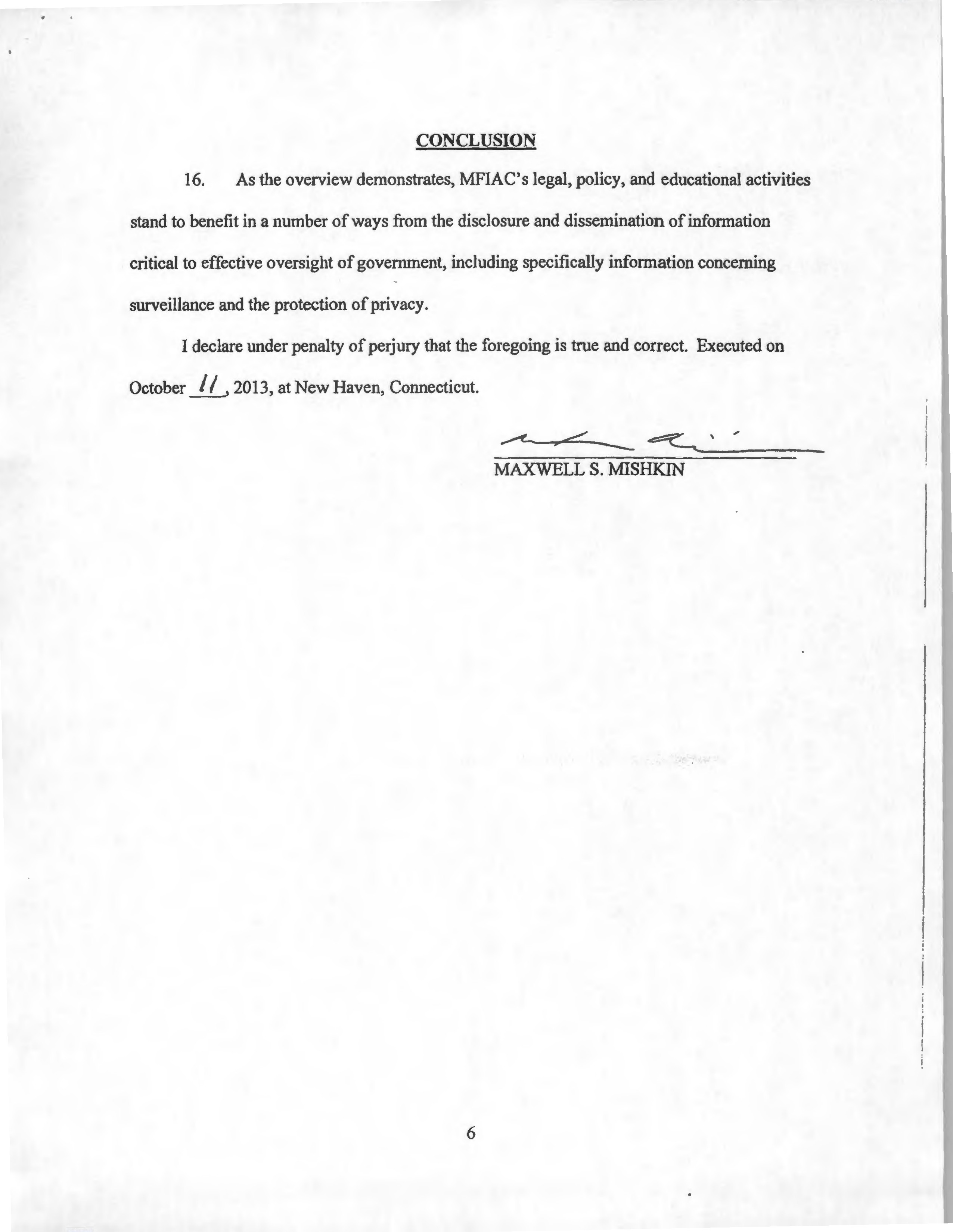
- As the overview demonstrates, MFIAC's legal, policy, and educational activities
stand to benefit in a number of ways from the disclosure and dissemination of information
critical to effective oversight of government, including specifically information concerning
surveillance and the protection of privacy.
I declare under penalty of perjury that the foregoing is true and correct. Executed on
October 11, 2013, at New Haven, Connecticut.
MAXWELL S. MISHKIN
6
U.S. FOREIGN
INTELLIGENCE
SURVEILLANCE COURT
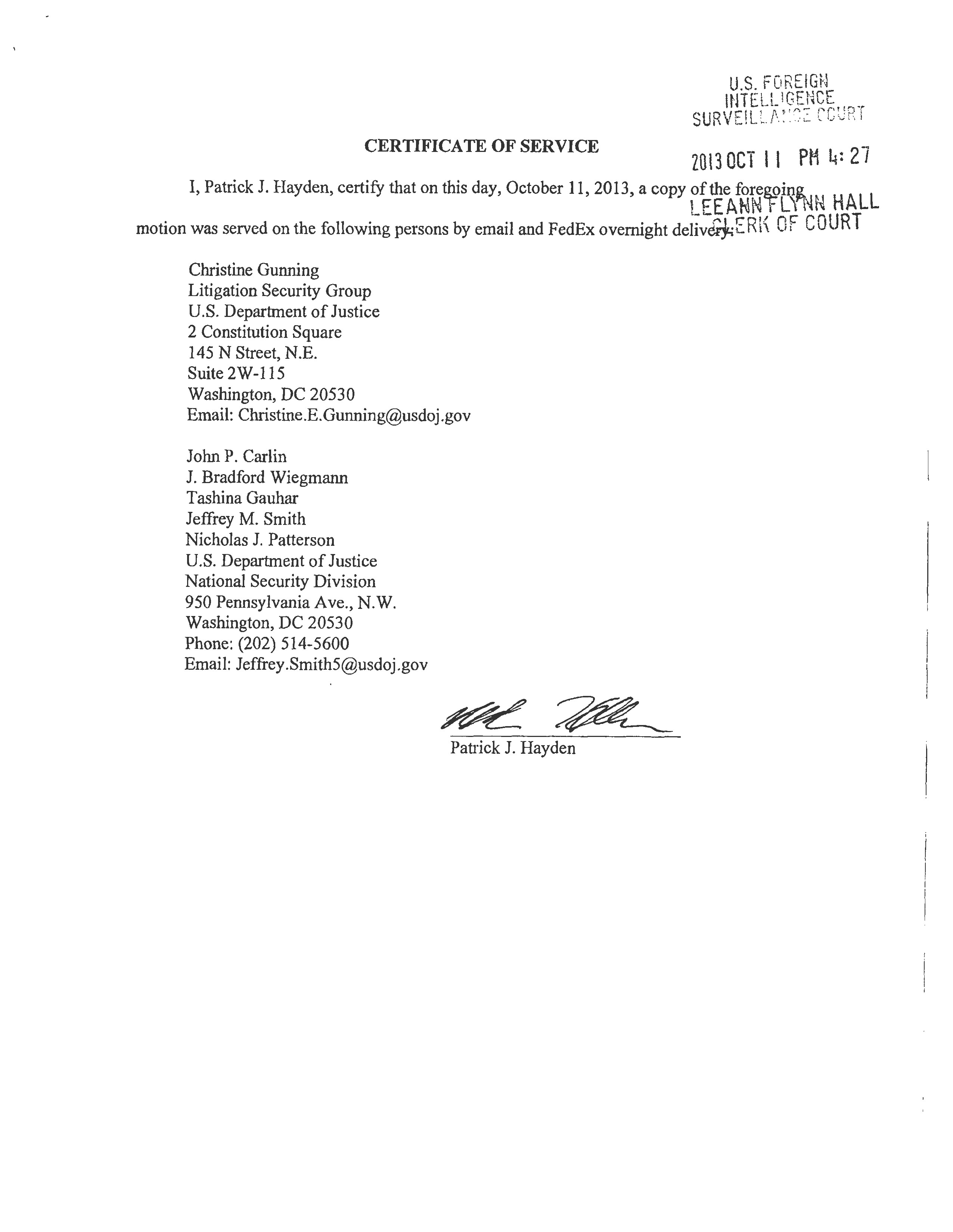
CERTIFICATE OF SERVICE
2013 OCT 11 PM 4:27
I, Patrick J. Hayden, certify that on this day, October 11, 2013, a copy of the foregoing
LEEANN FLYNN HALL
motion was served on the following persons by email and FedEx overnight delivery.CLERK OF COURT
Christine Gunning
Litigation Security Group
U.S. Department of Justice
2 Constitution Square
145 N Street, N.E.
Suite 2W-115
Washington, DC 20530
Email: Christine.E.Gunning@usdoj.gov
John P. Carlin
J. Bradford Wiegmann
Tashina Gauhar
Jeffrey M. Smith
Nicholas J. Patterson
U.S. Department of Justice
National Security Division
950 Pennsylvania Ave., N.W.
Washington, DC 20530
Phone: (202) 514-5600
Email: Jeffrey.Smith5@usdoj.gov
Patrick J. Hayden
Related Documents
-
Motion of The Reporters Committee for Freedom of the Press and 25 Media Organizations for Leave to File Brief as Amicus Curiae in Support of the November 6, 2013 Motion by the American Civil Liberties Union, et al., for the Release of Court Records; the October 11, 2013 Motion by the Media Freedom and Information Clinic for Reconsideration of this Court's September 13, 2013 Opinion on the Issue of Article III Standing; and the November 12, 2013 Motion of ProPublica, Inc. for Release of Court Records,... FOIA [pdf]
-
-
Brief of Amici Curiae U.S. Representatives Amash, Broun, Gabbard, Griffith, Holt, Jones, Lee, Lofgren, Massie, McClintock, Norton, O'Rourke, Pearce, Salmon, Sanford, and Yoho in Support of the Motion of the American Civil Liberties Union, the American Civil Liberties Union of the Nation's Capital, and the Media Freedom and Information Access Clinic for the Release of Court Records, In re Orders of this Court Interpreting Section 215 of the Patriot Act FOIA [pdf]
-
Motion of U.S. Representatives Amash, Broun, Gabbard, Griffith, Holt, Jones, Lee, Lofgren, Massie, McClintock, Norton, O'Rourke, Pearce, Salmon, Sanford, and Yoho for Leave to File a Brief as Amici Curiae in Support of the Motion of the American Civil Liberties Union, the American Civil Liberties Union of the Nation's Capital, and the Media Freedom and Information Access Clinic for the Release of Court Records, In re Orders of this Court Interpreting Section 215 of the Patriot Act FOIA [pdf]