DNI Clapper 2012 Jewel State Secrets Declaration
Open PDFDocument date: 2012-09-11
Type: FOIA
Pages: 33
Classification: TOP SECRET TSP SI HCS
Dissemination: ORCON, NOFORN
Classified declaration of James R. Clapper disclosing information regarding the government. ACLU/EFF FOIA Litigation.
My notes
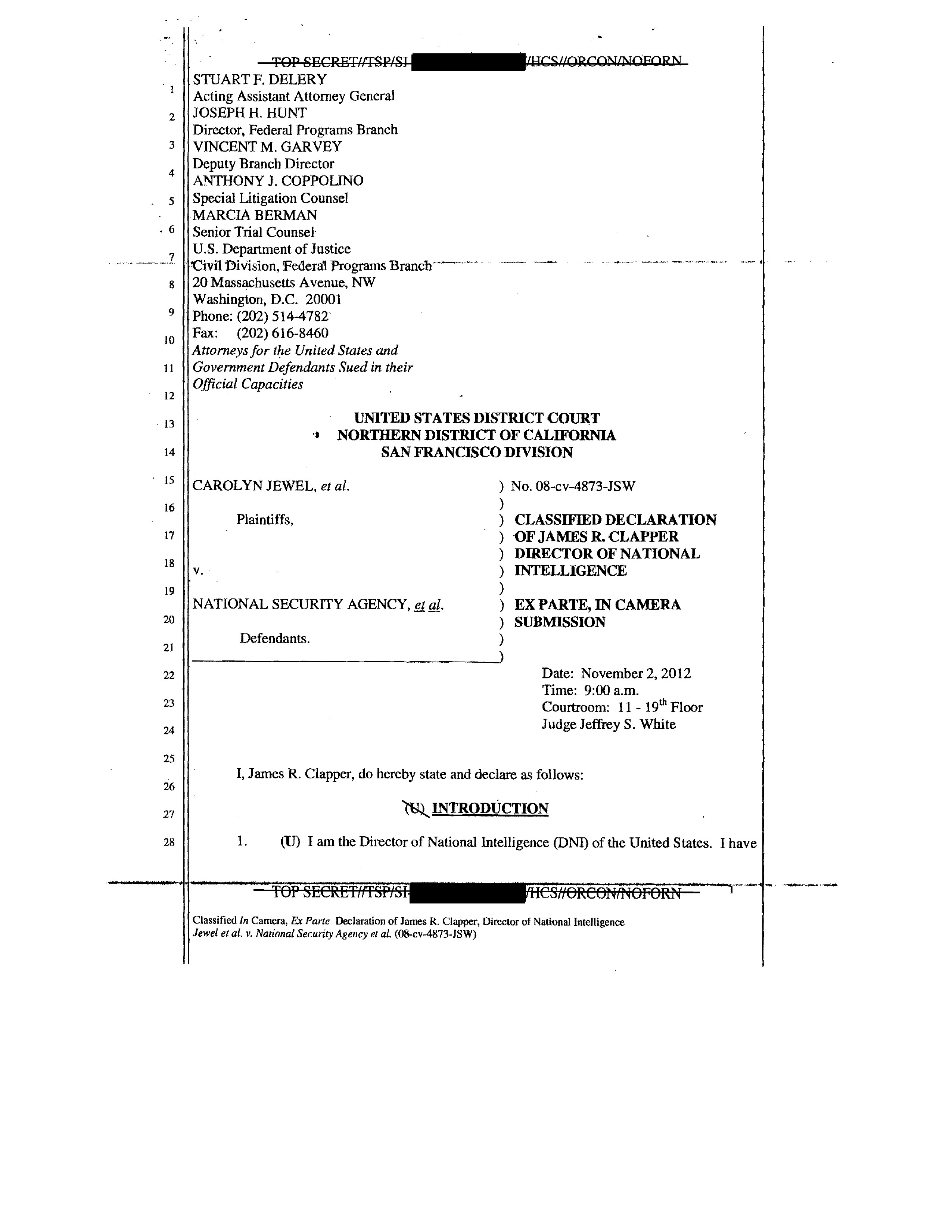
TOP SECRET//TSP/SI
/HCS//ORCON/NOFORN
1 STUART F. DELERY
Acting Assistant Attorney General
JOSEPH H. HUNT
2 Director, Federal Programs Branch
3 VINCENT M. GARVEY
Deputy Branch Director
4 ANTHONY J. COPPOLINO
5 Special Litigation Counsel
.6 MARCIA BERMAN
Senior Trial Counsel
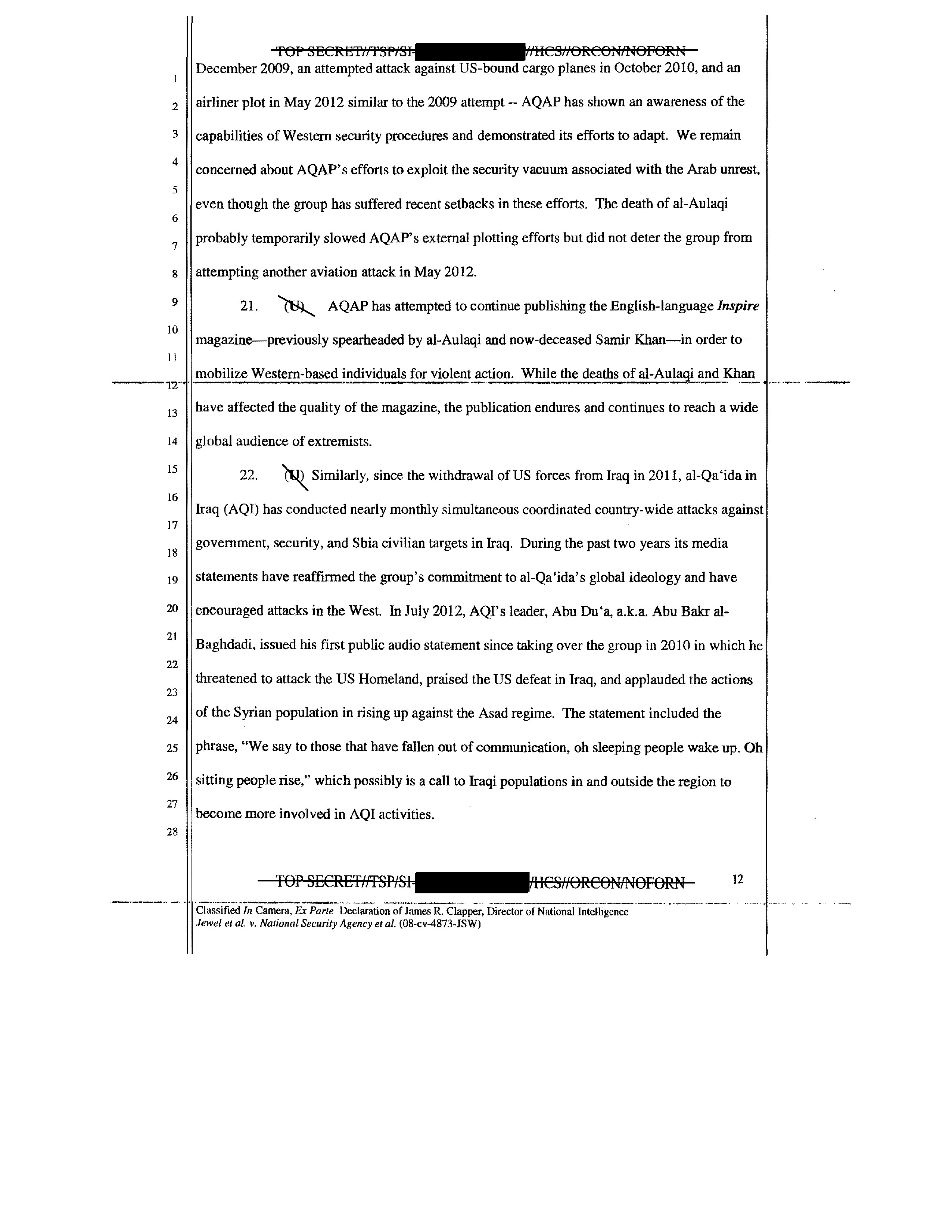
U.S. Department of Justice
7 Civil Division, Federal Programs Branch
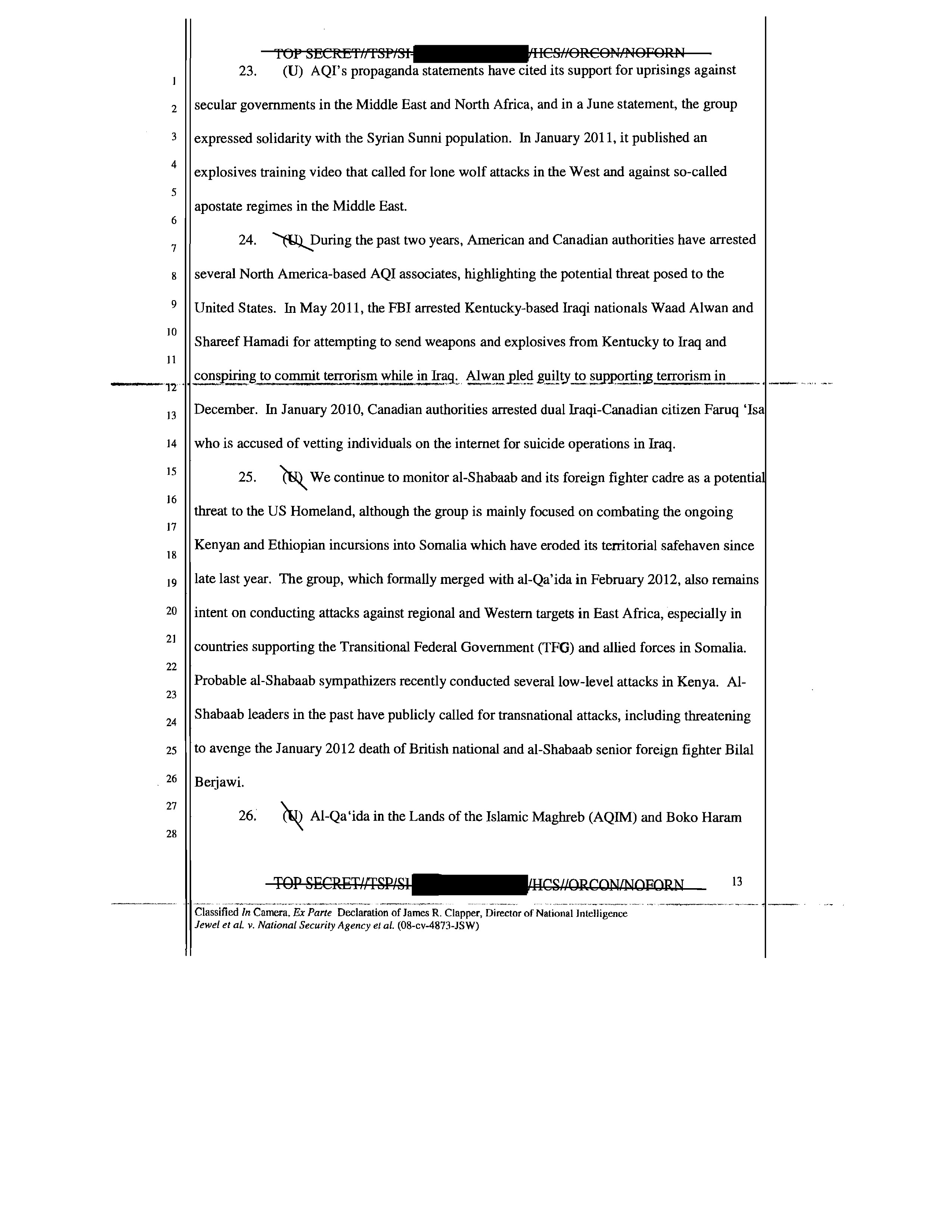
8 20 Massachusetts Avenue, NW
Washington, D.C. 20001
9 Phone: (202) 514-4782
10 Fax: (202) 616-8460
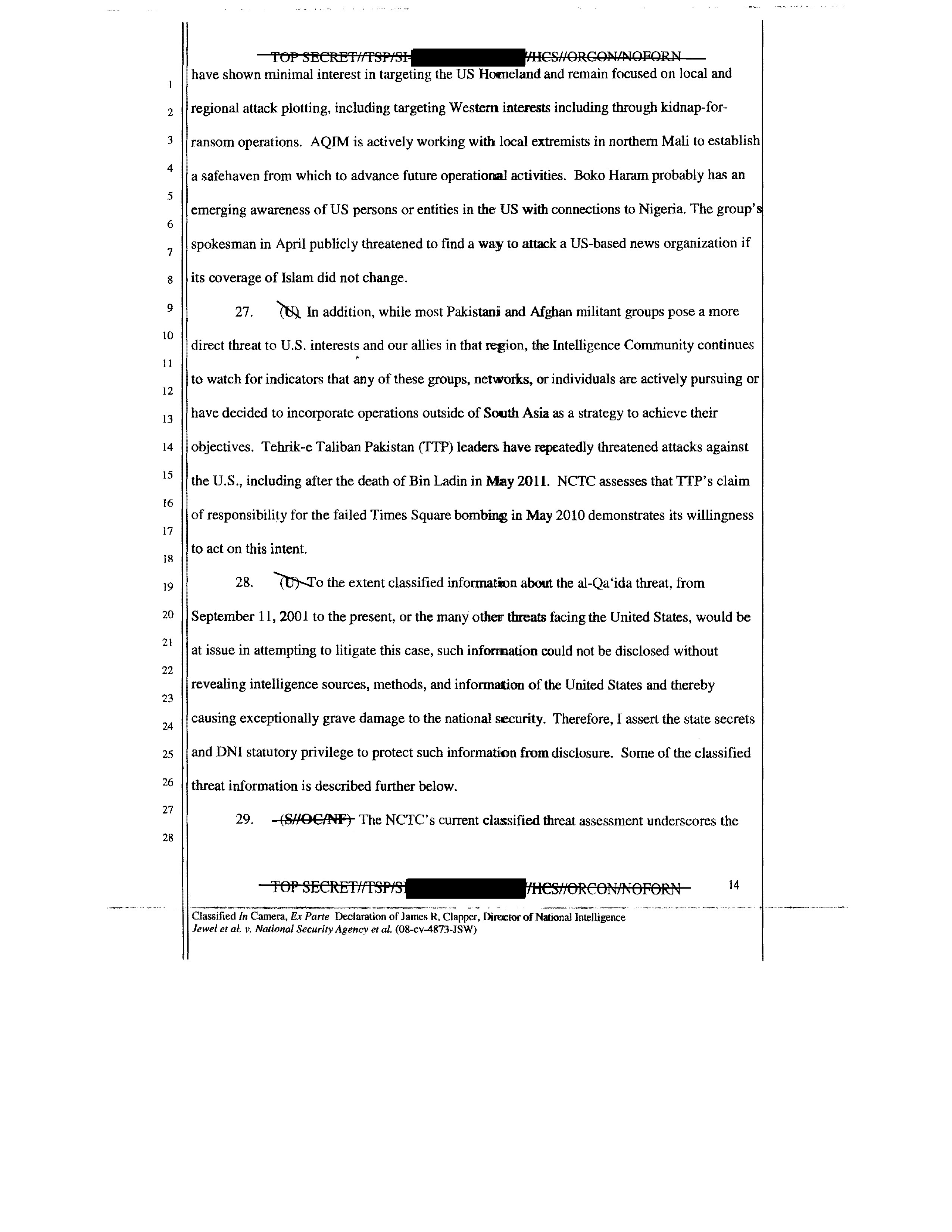
Attorneys for the United States and
11 Government Defendants Sued in their
Official Capacities
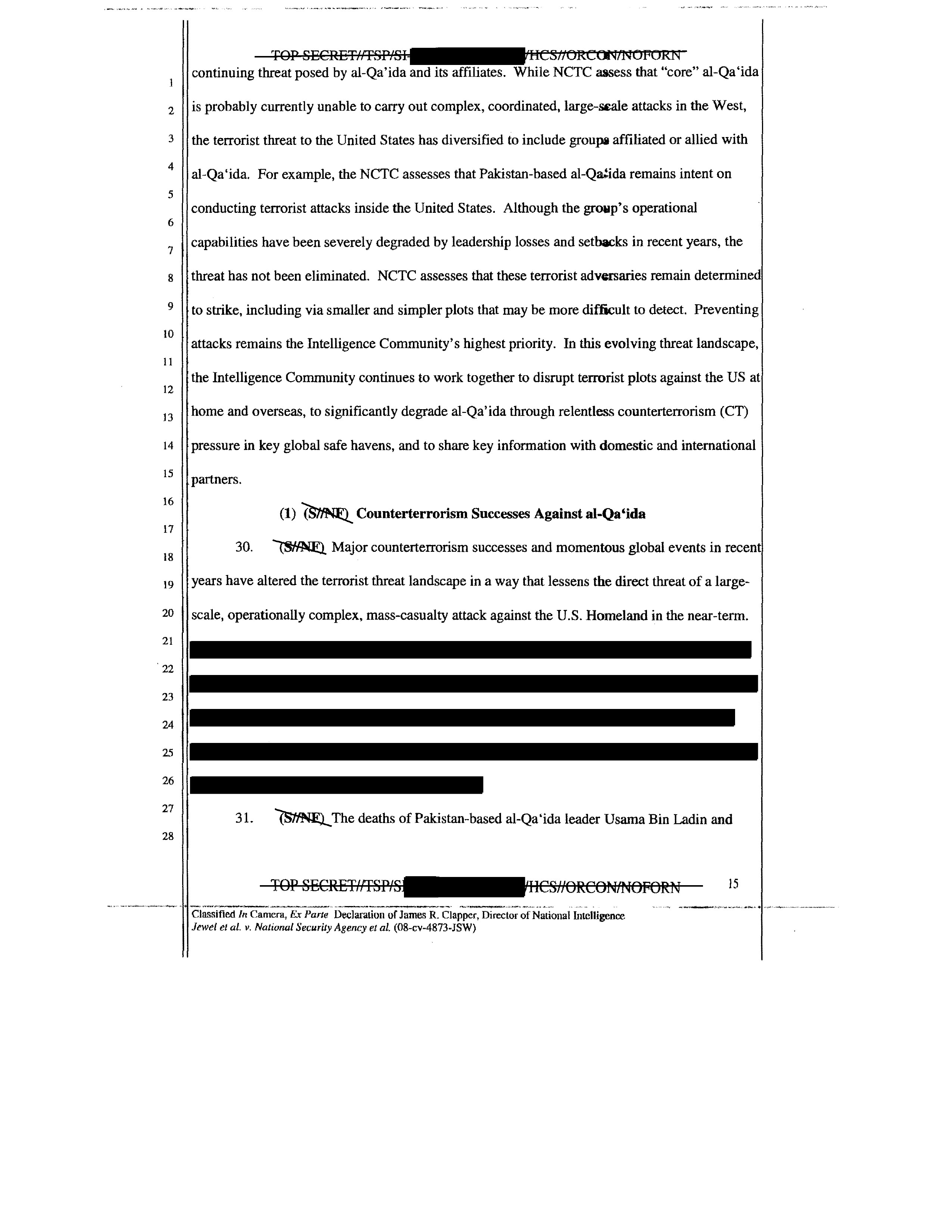
12
UNITED STATES DISTRICT COURT
NORTHERN DISTRICT OF CALIFORNIA
SAN FRANCISCO DIVISION
13
14
15 CAROLYN JEWEL, et al.
16 Plaintiffs,
17
18 V.
19 NATIONAL SECURITY AGENCY, et al.
20 Defendants.
) No. 08-cv-4873-JSW
)
) CLASSIFIED DECLARATION
) OF JAMES R. CLAPPER
) DIRECTOR OF NATIONAL
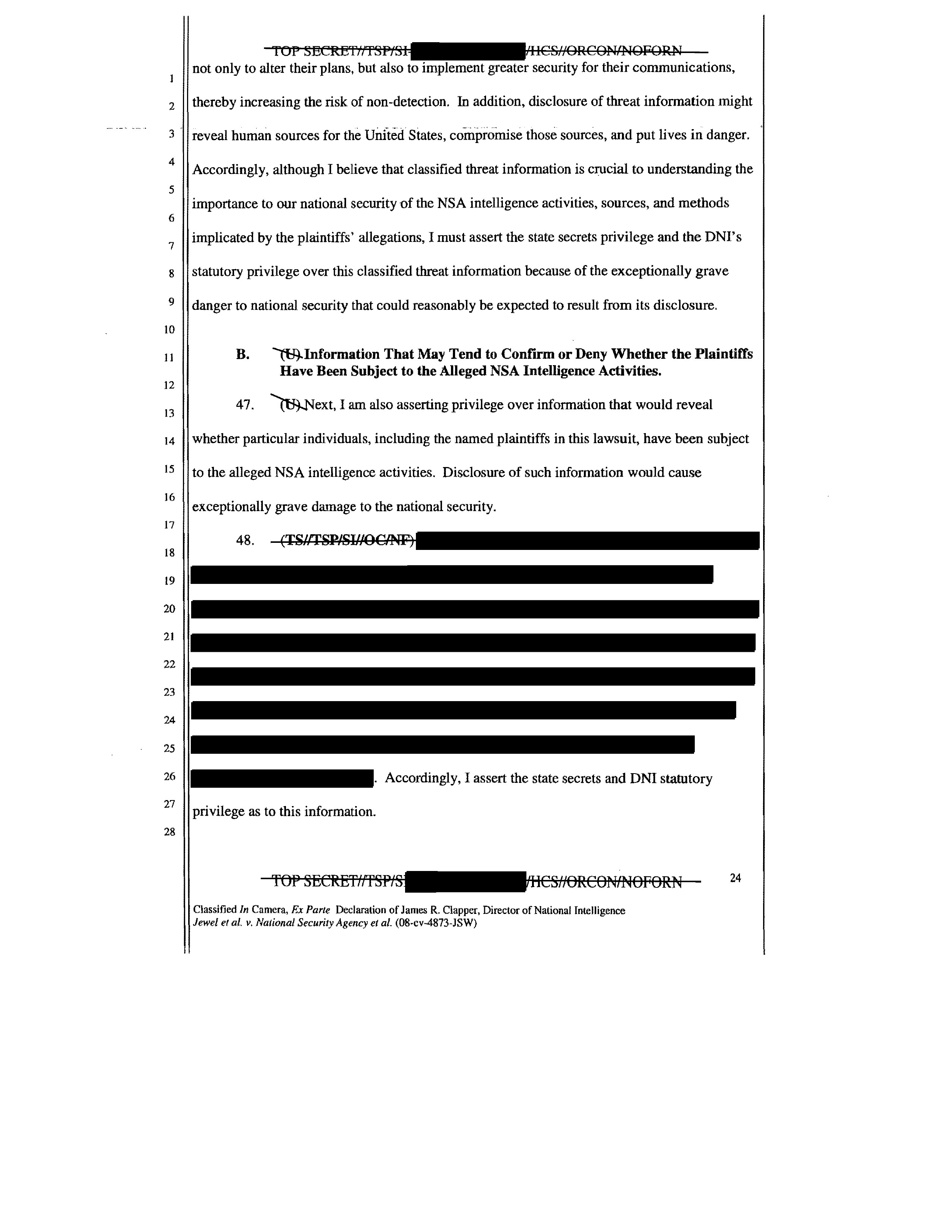
) INTELLIGENCE
)
) EX PARTE, IN CAMERA
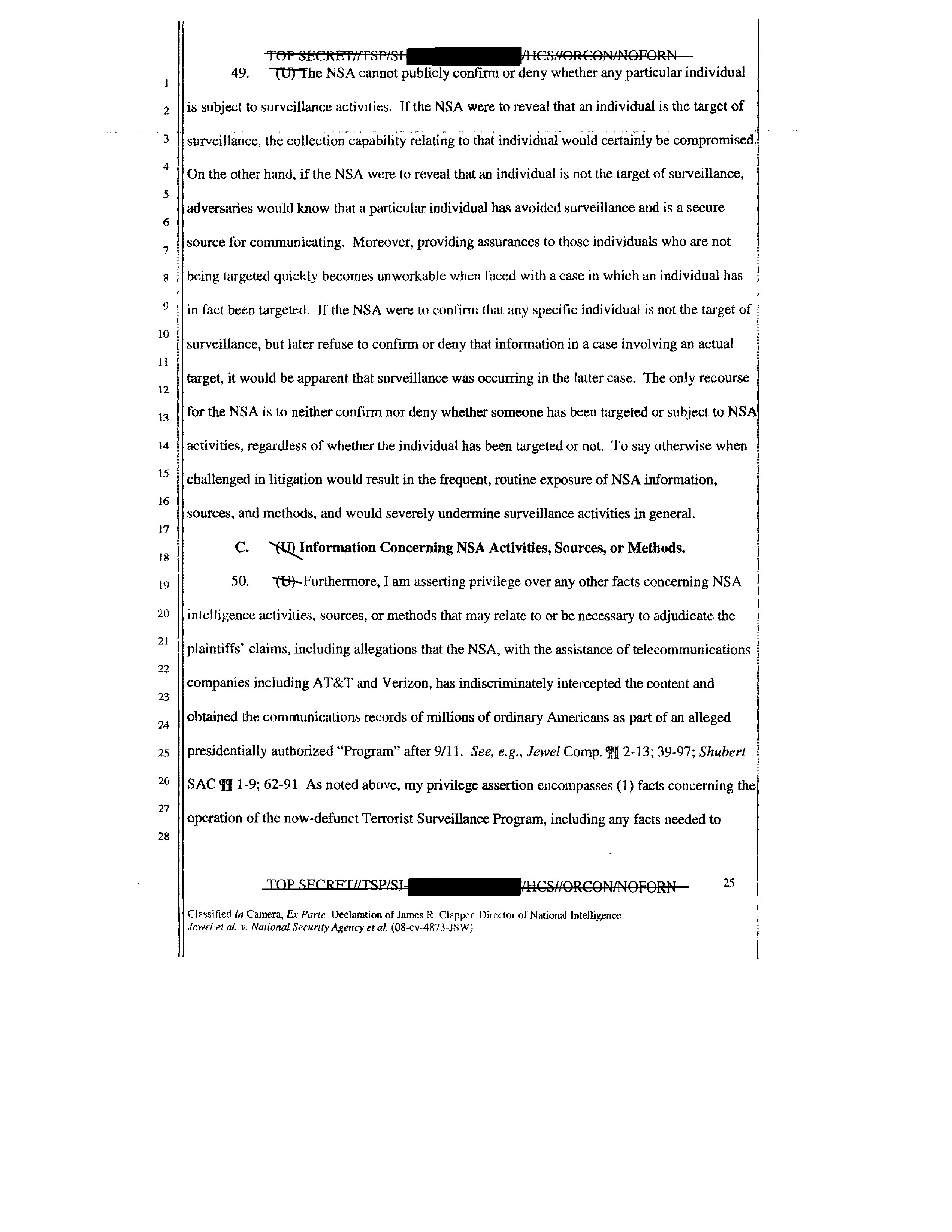
) SUBMISSION
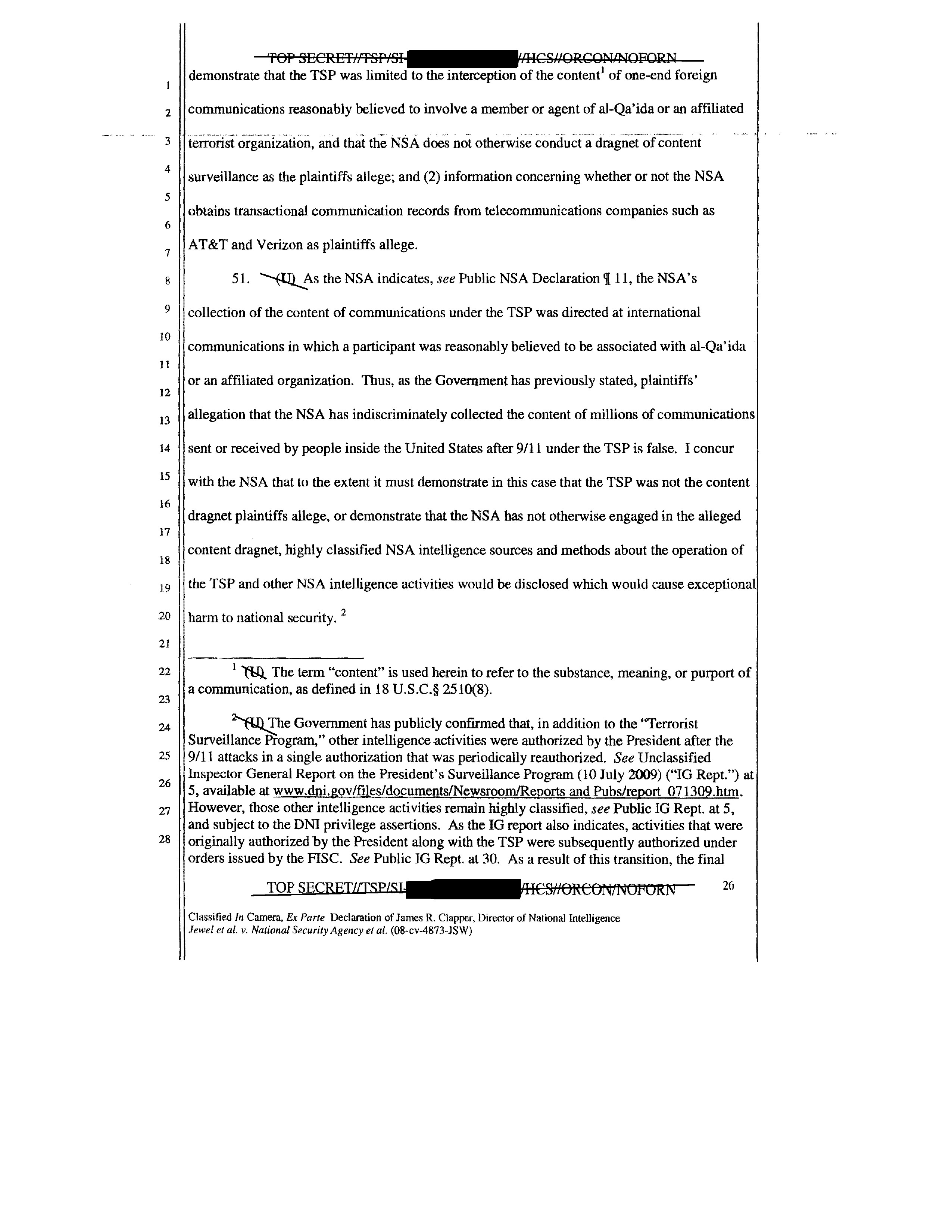
)
21
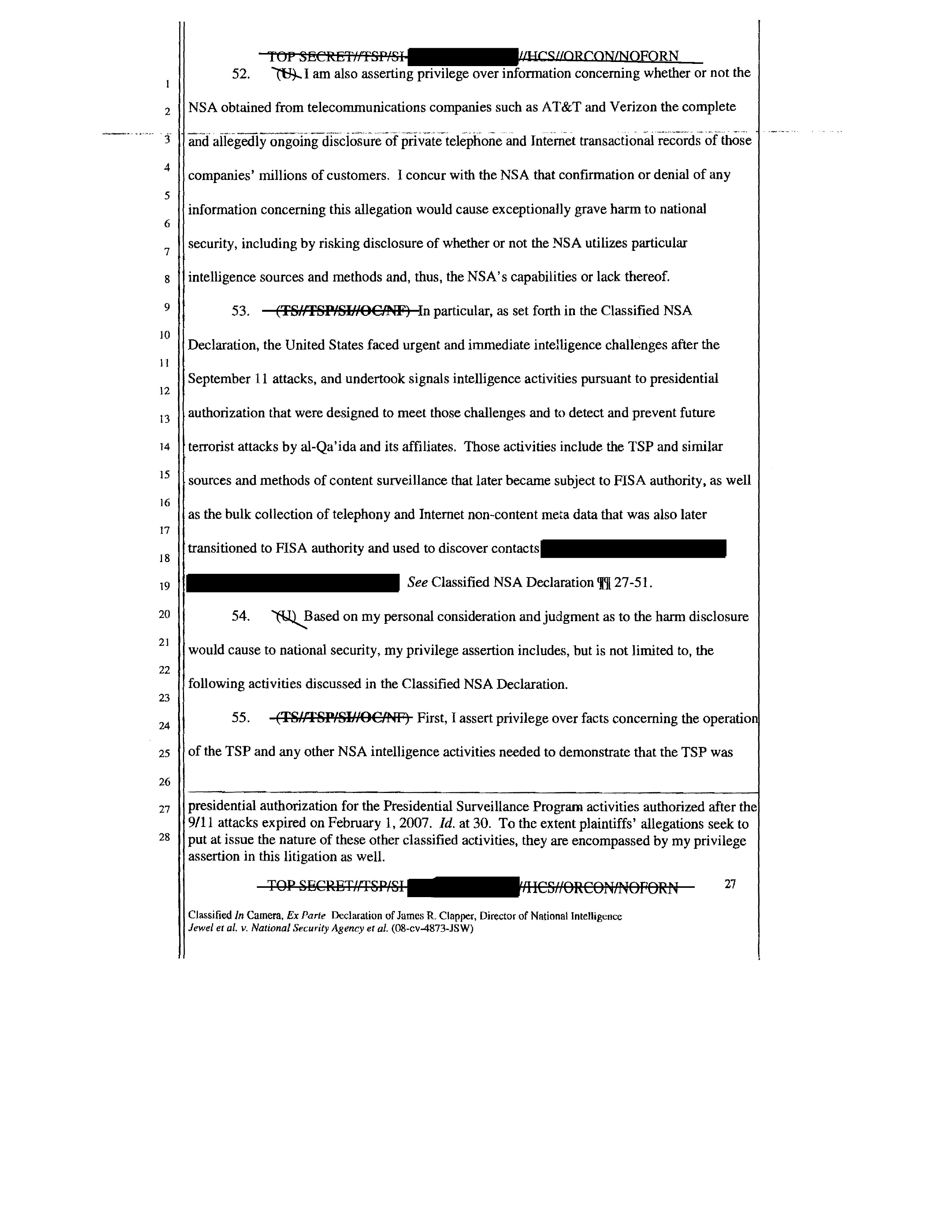
22 Date: November 2, 2012
23 Time: 9:00 a.m.
24 Courtroom: 11 - 19th Floor
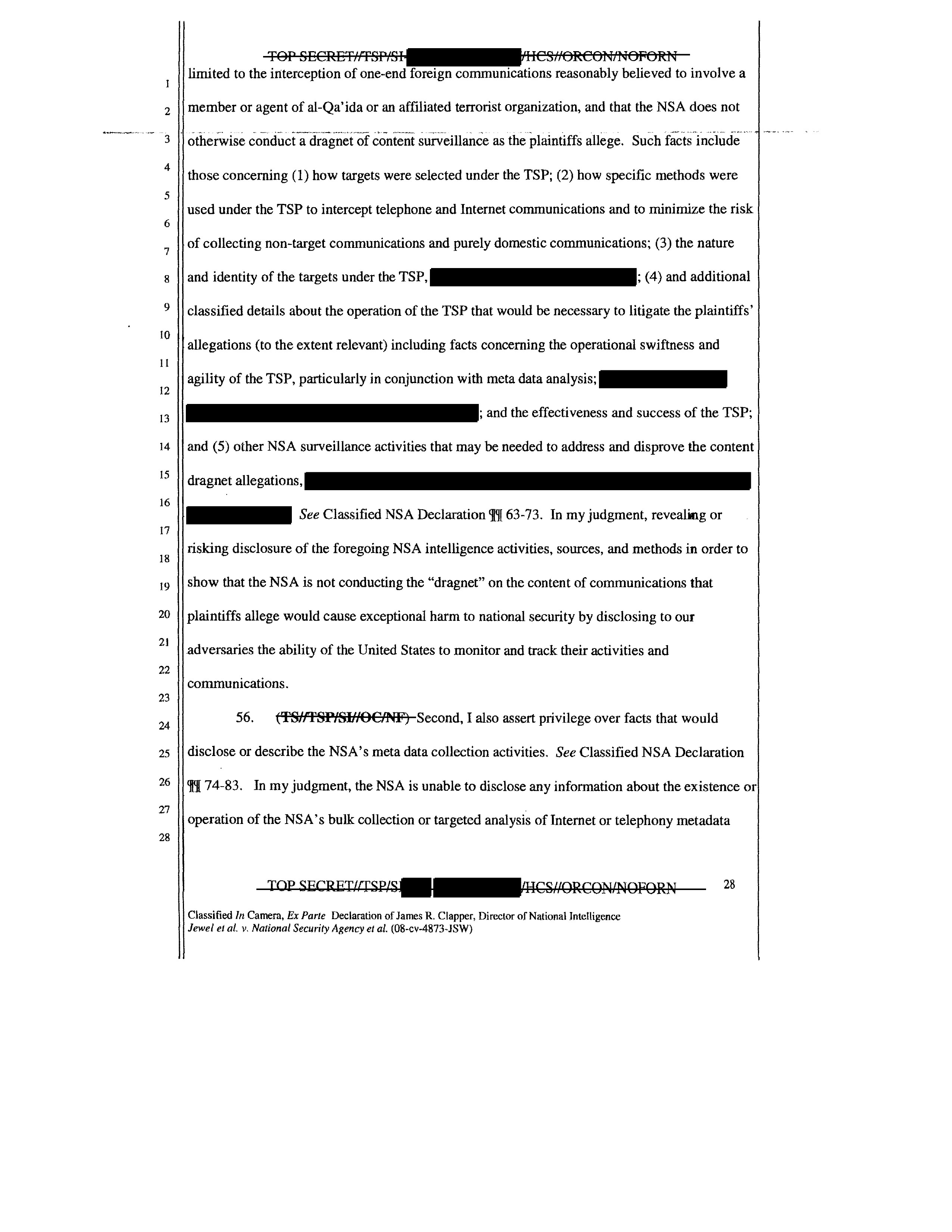
Judge Jeffrey S. White
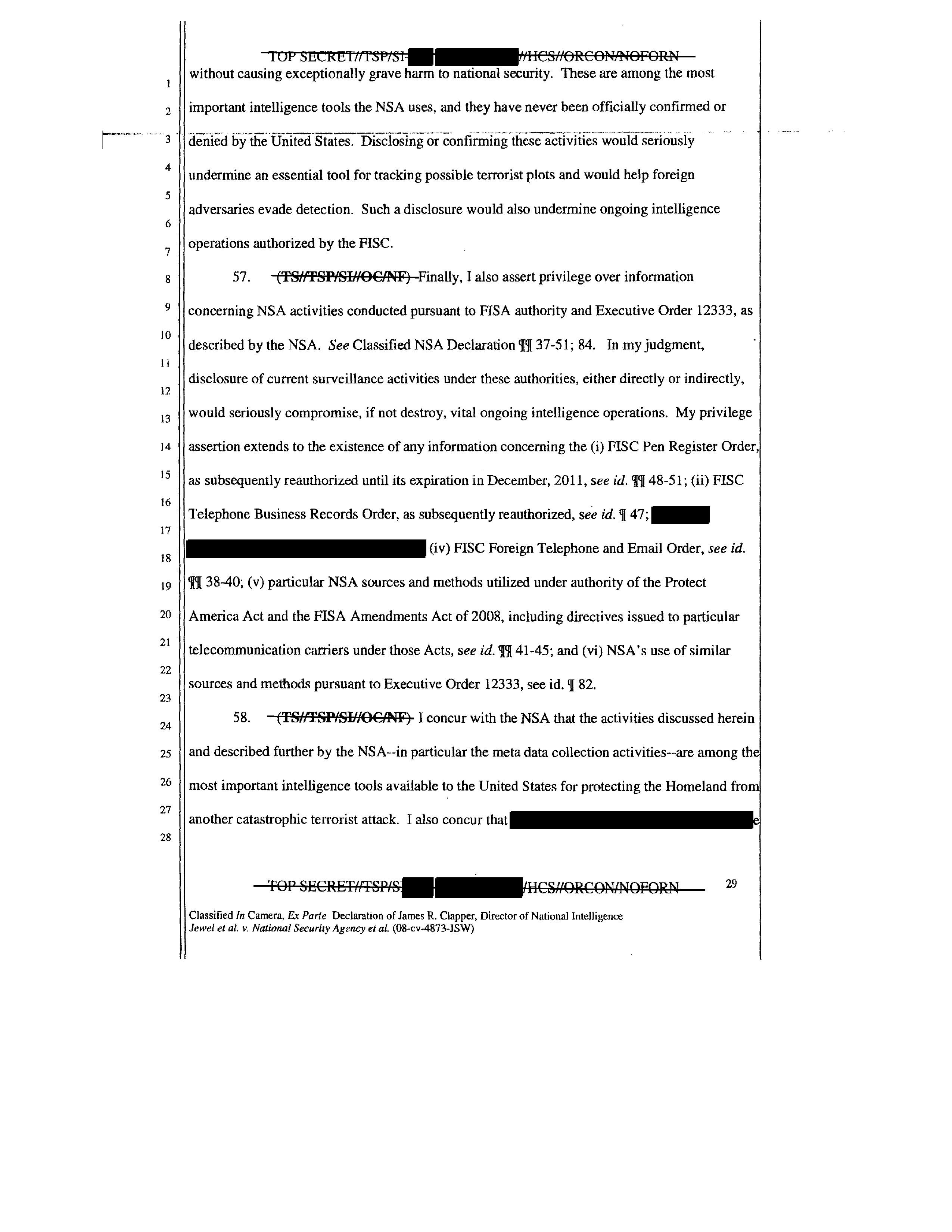
25
I, James R. Clapper, do hereby state and declare as follows:
26
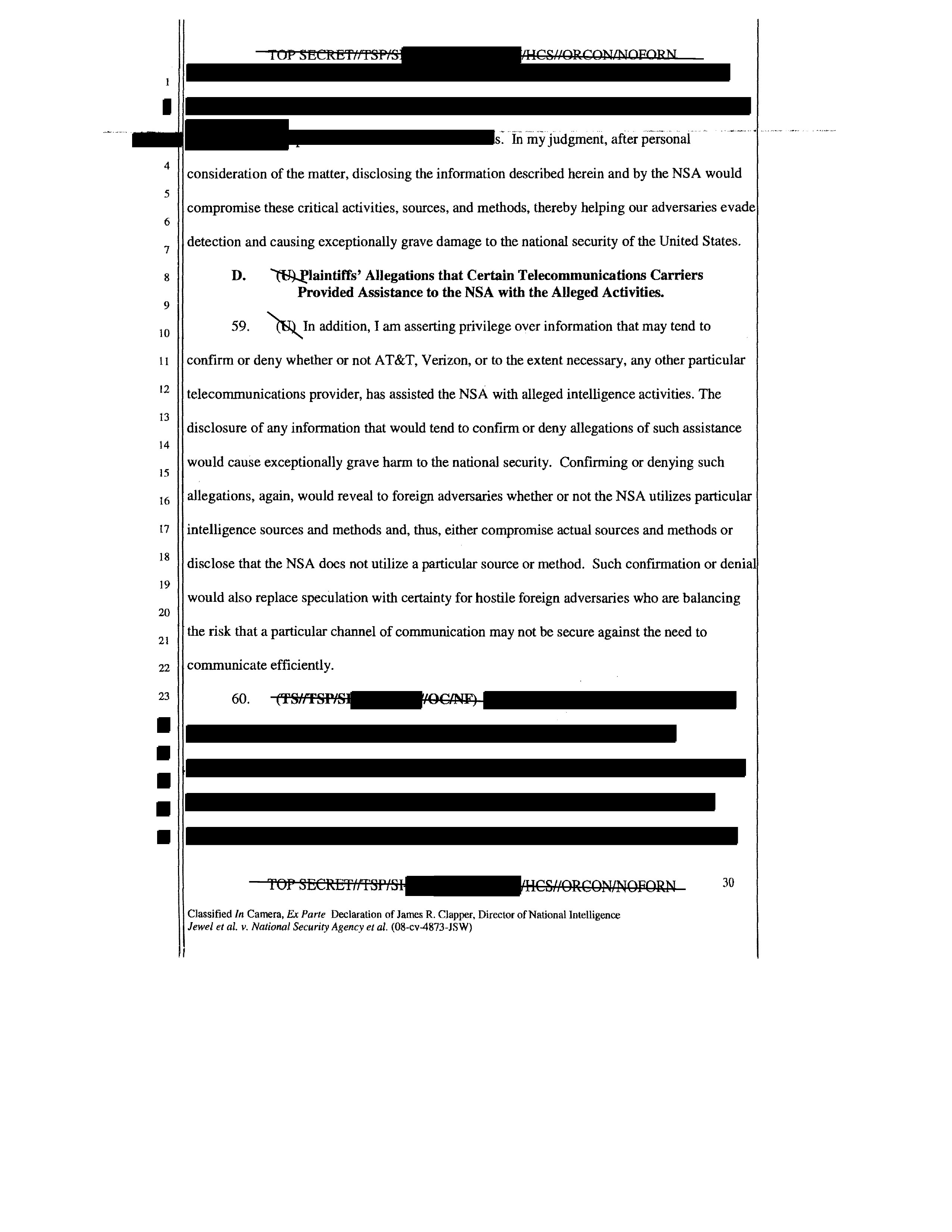
INTRODUCTION
27
28 1. (U) I am the Director of National Intelligence (DNI) of the United States. I have
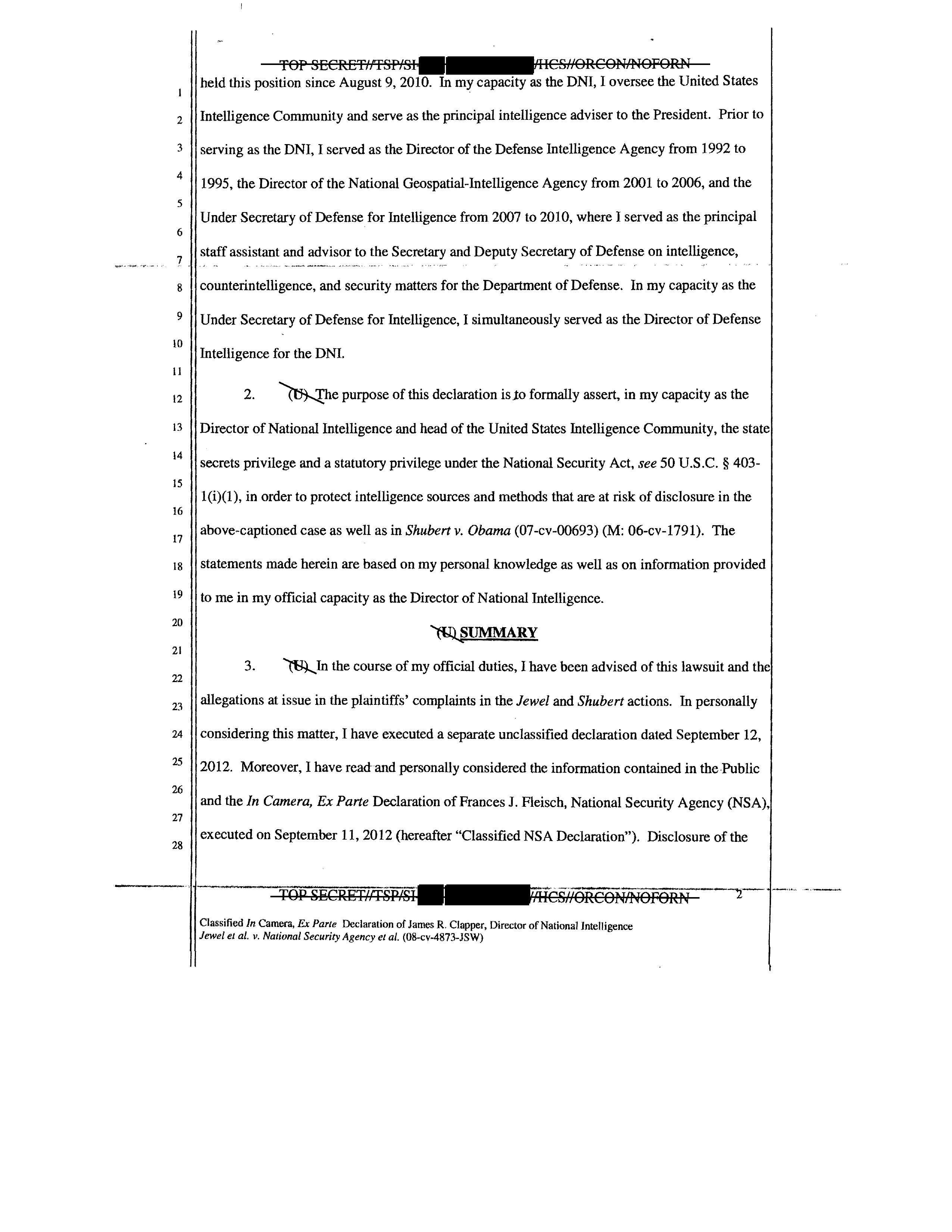
held this position since August 9, 2010. In my capacity as the DNI, I oversee the United States
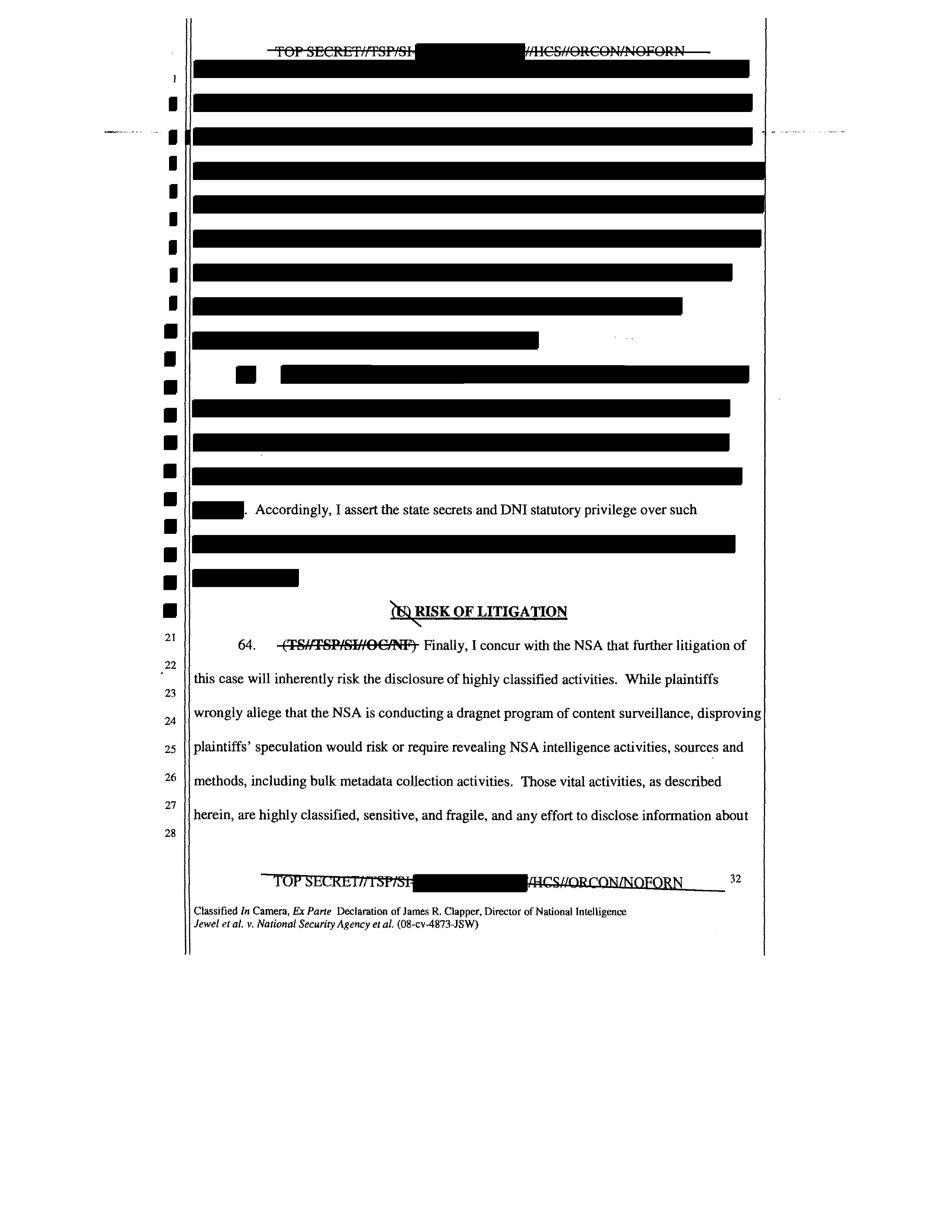
2 Intelligence Community and serve as the principal intelligence adviser to the President. Prior to
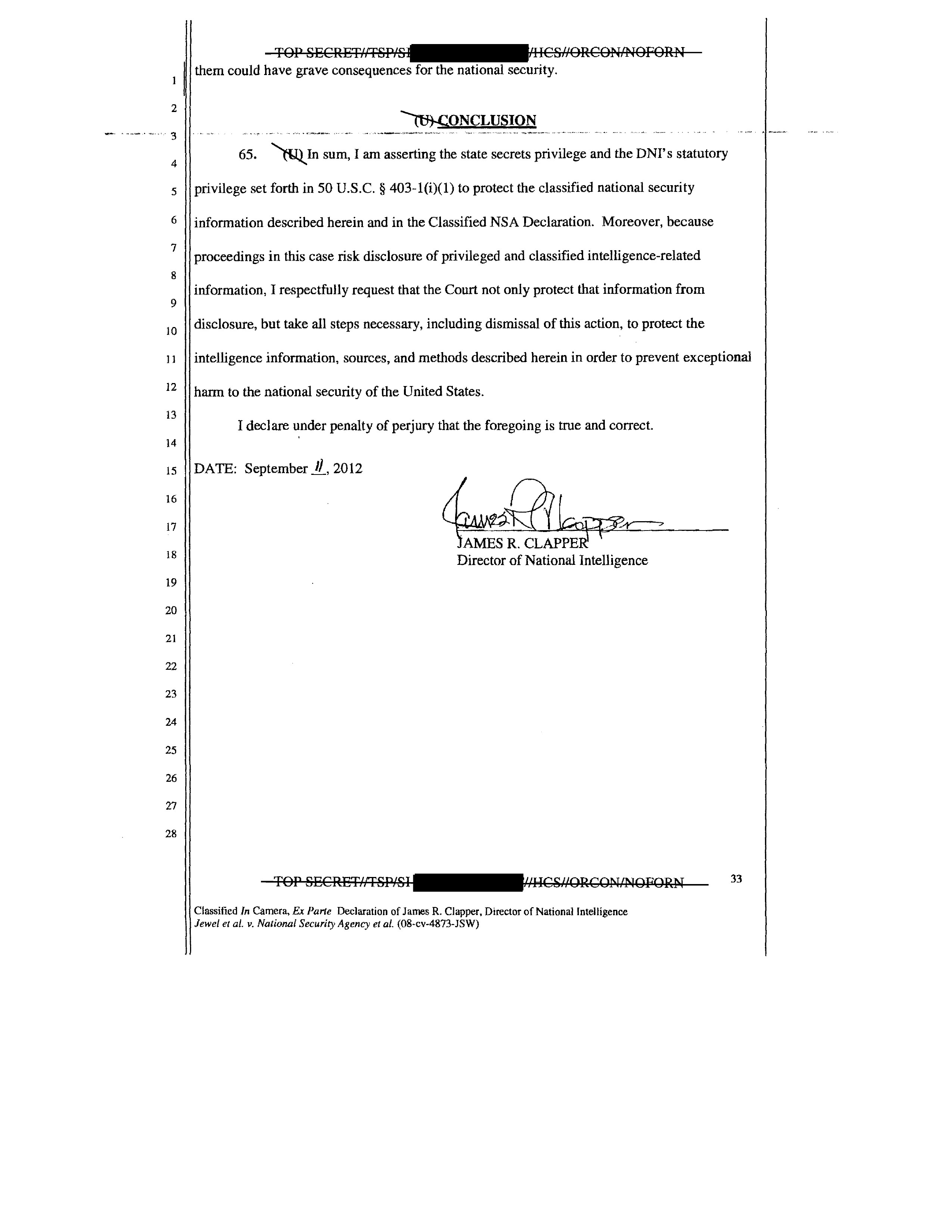
3 serving as the DNI, I served as the Director of the Defense Intelligence Agency from 1992 to
4 1995, the Director of the National Geospatial-Intelligence Agency from 2001 to 2006, and the
5 Under Secretary of Defense for Intelligence from 2007 to 2010, where I served as the principal
6 staff assistant and advisor to the Secretary and Deputy Secretary of Defense on intelligence,
7 counterintelligence, and security matters for the Department of Defense. In my capacity as the
8 Under Secretary of Defense for Intelligence, I simultaneously served as the Director of Defense
9 Intelligence for the DNI.
10
11 2. (U) The purpose of this declaration is to formally assert, in my capacity as the
12 Director of National Intelligence and head of the United States Intelligence Community, the state
13 secrets privilege and a statutory privilege under the National Security Act, see 50 U.S.C. § 403-
14 1(i)(1), in order to protect intelligence sources and methods that are at risk of disclosure in the
15 above-captioned case as well as in Shubert v. Obama (07-cv-00693) (M: 06-cv-1791). The
16 statements made herein are based on my personal knowledge as well as on information provided
17 to me in my official capacity as the Director of National Intelligence.
18
19 SUMMARY
20
21 3. (U) In the course of my official duties, I have been advised of this lawsuit and the
22 allegations at issue in the plaintiffs' complaints in the Jewel and Shubert actions. In personally
23 considering this matter, I have executed a separate unclassified declaration dated September 12,
24 2012. Moreover, I have read and personally considered the information contained in the Public
25 and the In Camera, Ex Parte Declaration of Frances J. Fleisch, National Security Agency (NSA),
26 executed on September 11, 2012 (hereafter "Classified NSA Declaration"). Disclosure of the
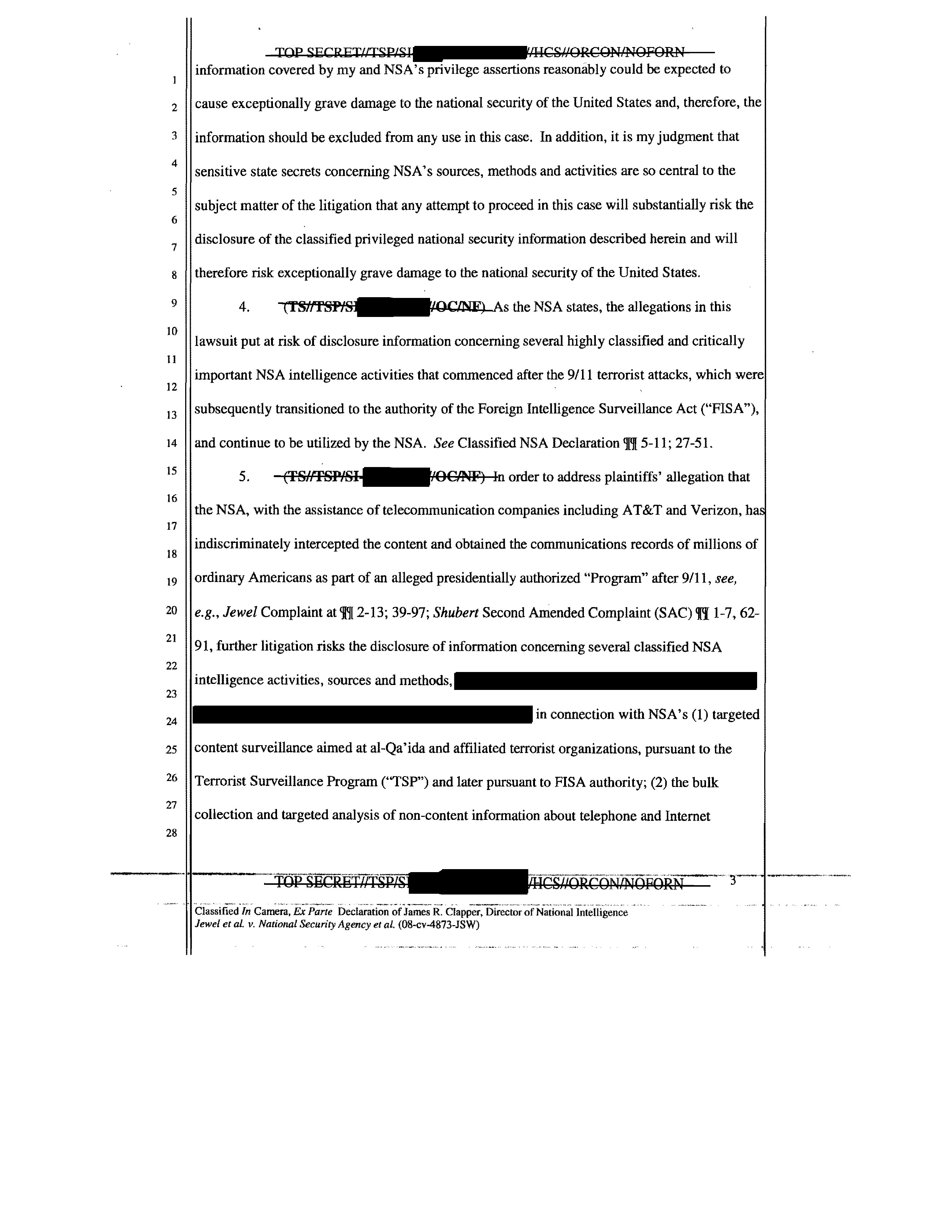
27
28 information covered by my and NSA's privilege assertions reasonably could be expected to
1 cause exceptionally grave damage to the national security of the United States and, therefore, the
2 information should be excluded from any use in this case. In addition, it is my judgment that
3 sensitive state secrets concerning NSA's sources, methods and activities are so central to the
4 subject matter of the litigation that any attempt to proceed in this case will substantially risk the
5 disclosure of the classified privileged national security information described herein and will
6 therefore risk exceptionally grave damage to the national security of the United States.
7
8 4. (TS//TSP/SI [REDACTED] HOC/NF) As the NSA states, the allegations in this
9 lawsuit put at risk of disclosure information concerning several highly classified and critically
10 important NSA intelligence activities that commenced after the 9/11 terrorist attacks, which were
11 subsequently transitioned to the authority of the Foreign Intelligence Surveillance Act ("FISA"),
12 and continue to be utilized by the NSA. See Classified NSA Declaration ¶¶ 5-11; 27-51.
13
14 5. (TS//TSP/SI- [REDACTED] HOC/NF) In order to address plaintiffs' allegation that
15 the NSA, with the assistance of telecommunication companies including AT&T and Verizon, has
16 indiscriminately intercepted the content and obtained the communications records of millions of
17 ordinary Americans as part of an alleged presidentially authorized "Program" after 9/11, see,
18 e.g., Jewel Complaint at ¶¶ 2-13; 39-97; Shubert Second Amended Complaint (SAC) ¶¶ 1-7, 62-
19 91, further litigation risks the disclosure of information concerning several classified NSA
20 intelligence activities, sources and methods, [REDACTED] in connection with NSA's (1) targeted
21 content surveillance aimed at al-Qa'ida and affiliated terrorist organizations, pursuant to the
22 Terrorist Surveillance Program ("TSP") and later pursuant to FISA authority; (2) the bulk
23 collection and targeted analysis of non-content information about telephone and Internet
24
25 communications—critically important and highly sensitive activities that have also been
26 conducted pursuant to Foreign Intelligence Surveillance Court ("FISC") orders, or other
27 authority, and that enable the NSA to uncover the contacts [REDACTED] and (3) [REDACTED].
28 This lawsuit therefore puts at risk of disclosure
1 information concerning essential foreign intelligence-gathering activities utilized to meet the
2 extremely serious threat of another terrorist attack on the U.S. Homeland, a threat which I
3 describe further below.
4
5 6. (TS//TSP/SI [REDACTED] HOC/NF) Accordingly, as set forth further below, I am
6 asserting the state secrets privilege and the DNI's authority to protect intelligence sources and
7 methods pursuant to 50 U.S.C. § 403-1(i)(1) to protect against the disclosure of the highly
8 classified intelligence sources and methods put at issue in this case and vital to the national
9 security of the United States, including: (1) any information that would tend to confirm or deny
10 whether particular individuals, including the named plaintiffs, have been subject to the alleged
11 NSA intelligence activities; (2) information concerning NSA intelligence sources and methods,
12 including facts demonstrating that the content collection under the TSP was limited to specific
13 al-Qa'ida and associated terrorist-related international communications and that the NSA did not
14 and does not otherwise conduct a dragnet of content surveillance as plaintiffs allege; (3) facts
15 that would tend to confirm or deny other intelligence activities authorized by the President after
16 9/11 and later transitioned to the authority of the FISA – that is, the existence of the NSA's bulk
17 non-content (i.e., meta data) collection, and any information about those activities; and (4)
18 [REDACTED]
19 I specifically concur with the NSA that public speculation about
20 alleged NSA activities does not diminish the need to protect intelligence sources and methods
21 from further exposure, and that official confirmation and disclosure of the classified privileged
22 national security information described herein would cause exceptionally grave damage to the
23 national security. For these reasons, as set forth further below, I request that the Court uphold
24 the state secrets and statutory privilege assertions that I make herein, as well as the statutory
25 privilege assertion made by the NSA pursuant to Section 6 of the National Security Agency Act,
26 see 50 U.S.C. § 402 (note), and protect the information described in this declaration from
27 disclosure.
28
1 (U) CLASSIFICATION OF DECLARATION
2
3 7. (S//SI//NF) Pursuant to the standards in Executive Order 13526, this declaration
4 is classified as: TOP SECRET//TSP/SI [REDACTED] //HCS//ORCON/NOFORN. The details
5 concerning these classification markings are set forth in the Classified NSA Declaration at ¶¶ 12-
6 15 and are briefly summarized here. Under Executive Order 13526, information is classified
7 "TOP SECRET" if unauthorized disclosure of the information reasonably could be expected to
8 cause exceptionally grave damage to the national security of the United States; "SECRET" if
9 unauthorized disclosure of the information reasonably could be expected to cause serious
10 damage to national security; and "CONFIDENTIAL" if unauthorized disclosure of the
11 information reasonably could be expected to cause identifiable damage to national security. At
12 the beginning of each paragraph of this declaration, the letters "U," "C," "S," and "TS" indicate
13 respectively that the information is either UNCLASSIFIED, or is classified CONFIDENTIAL,
14 SECRET, or TOP SECRET.
15
16 8. (S//SI//NF) Additionally, this declaration also contains Sensitive Compartmented
17 Information (SCI), which is subject to special access and handling requirements because it
18 involves or derives from particularly sensitive intelligence sources and methods. This
19 declaration references communications intelligence, also referred to as special intelligence (SI),
20 which is a subcategory of SCI that identifies information that was derived from exploiting
21 cryptographic systems or other protected sources by applying methods or techniques, or from
22 intercepted foreign communications. This declaration also references human intelligence (HCS),
23 another subcategory of SCI that identifies information derived from individuals who provide
24 intelligence information.
25
26 9. (TS//TSP/SI [REDACTED] /OC/NF) This declaration also contains information
27 about the Terrorist Surveillance Program (TSP), a controlled access signals intelligence program
28 under presidential authorization in response to the attacks of September 11, 2001. Information
1 pertaining to this program is denoted with the special marking "TSP." [REDACTED]
2
3 10. (S//SI//NF) Finally, information labeled "NOFORN" may not be released to
4 foreign governments, foreign nationals, or non-U.S. citizens without permission of the originator
5 and in accordance with DNI policy. The "ORCON" designator means that the originator of the
6 information controls to whom it is released.
7
8 (U) BACKGROUND ON DIRECTOR OF NATIONAL INTELLIGENCE
9
10 11. (U) The position of Director of National Intelligence was created by Congress in
11 the Intelligence Reform and Terrorism Prevention Act of 2004, Pub. L. 108-458, §§ 1011(a) and
12 1097, 118 Stat. 3638, 3643-63, 3698-99 (2004) (amending sections 102 through 104 of Title I of
13 the National Security Act of 1947). Subject to the authority, direction, and control of the
14 President, the Director of National Intelligence serves as the head of the U.S. Intelligence
15 Community and as the principal adviser to the President, the National Security Council, and the
16 Homeland Security Council for intelligence matters related to the national security. See 50
17 U.S.C. § 403(b)(1), (2).
18
19 12. (U) The United States "Intelligence Community" includes the Office of the
20 Director of National Intelligence; the Central Intelligence Agency; the National Security
21 Agency; the Defense Intelligence Agency; the National Geospatial-Intelligence Agency; the
22 National Reconnaissance Office; other offices within the Department of Defense for the
23 collection of specialized national intelligence through reconnaissance programs; the intelligence
24 elements of the military services, the Federal Bureau of Investigation, the Department of the
25 Treasury, the Department of Energy, the Drug Enforcement Administration, and the Coast
26 Guard; the Bureau of Intelligence and Research of the Department of State; the elements of the
27 Department of Homeland Security concerned with the analysis of intelligence information; and
28 such other elements of any other department or agency as may be designated by the President, or
1 jointly designated by the DNI and heads of the department or agency concerned, as an element of
2 the Intelligence Community. See 50 U.S.C. § 401a(4).
3
4 13. (U) The responsibilities and authorities of the Director of National Intelligence
5 are set forth in the National Security Act of 1947, as amended. See 50 U.S.C. § 403-1. These
6 responsibilities include ensuring that national intelligence is provided to the President, the heads
7 of the departments and agencies of the Executive Branch, the Chairman of the Joint Chiefs of
8 Staff and senior military commanders, and the Senate and House of Representatives and
9 committees thereof. See 50 U.S.C. § 403-1(a)(1). The DNI is also charged with establishing the
10 objectives of, determining the requirements and priorities for, and managing and directing the
11 tasking, collection, analysis, production, and dissemination of national intelligence by elements
12 of the Intelligence Community. Id. § 403-1(f)(1)(A)(i) and (ii). The DNI is also responsible for
13 developing and determining, based on proposals submitted by the heads of agencies and
14 departments within the Intelligence Community, an annual consolidated budget for the National
15 Intelligence Program for presentation to the President, for ensuring the effective execution of the
16 annual budget for intelligence and intelligence-related activities, and for managing and allotting
17 appropriations for the National Intelligence Program. Id. § 403-1(c)(1)-(5).
18
19 14. (U) In addition, the National Security Act of 1947, as amended, provides that
20 "[t]he Director of National Intelligence shall protect intelligence sources and methods from
21 unauthorized disclosure." 50 U.S.C. § 403-1(i)(1). Consistent with this responsibility, the DNI
22 establishes and implements guidelines for the Intelligence Community for the classification of
23 information under applicable law, Executive orders, or other Presidential directives and access to
24 and dissemination of intelligence. Id. § 403-1(i)(2)(A), (B). In particular, the DNI is responsible
25 for the establishment of uniform standards and procedures for the grant of access to Sensitive
26 Compartmented Information ("SCI") to any officer or employee of any agency or department of
27 the United States, and for ensuring the consistent implementation of those standards throughout
28 such departments and agencies. Id. § 403-1(j)(1), (2).
1
2 15. (U) By virtue of my position as the Director of National Intelligence, and unless
3 otherwise directed by the President, I have access to all intelligence related to the national
4 security that is collected by any department, agency, or other entity of the United States. See 50
5 U.S.C. § 403-1(b); Executive Order 12333 § 1.3(a), as amended. Pursuant to Executive Order
6 13526, the President has authorized me to exercise original TOP SECRET classification
7 authority.
8
9 (U) ASSERTION OF STATE SECRETS PRIVILEGE
10
11 16. (U) After careful and actual personal consideration of the matter, based upon my
12 own knowledge and information obtained in the course of my official duties, including the
13 information contained in the Public and Classified In Camera, Ex Parte Declaration of Frances J.
14 Fleisch, National Security Agency, I have determined that the disclosure of certain
15 information—as set forth herein and described in more detail in the Classified NSA
16 Declaration—would cause exceptionally grave damage to the national security of the United
17 States and, therefore, must be protected from disclosure and excluded from this case. Thus, as to
18 this information, I formally assert the state secrets privilege. In addition, it is my judgment that
19 sensitive state secrets concerning NSA's sources, methods and activities are so central to the
20 subject matter of the litigation that any attempt to proceed in the case will substantially risk the
21 disclosure of the privileged information described herein and in more detail in the classified
22 declarations, and will therefore risk exceptionally grave damage to the national security of the
23 United States.
24
25 (U) ASSERTION OF STATUTORY PRIVILEGE UNDER NATIONAL SECURITY ACT
26
27 17. (U) Through this declaration, I also hereby invoke and assert a statutory privilege
28 held by the Director of National Intelligence under the National Security Act to protect the
1 information described herein, see 50 U.S.C. § 403-1(i)(1). My assertion of this statutory
2 privilege for intelligence sources and methods is coextensive with my state secrets privilege
3 assertion.
4
5 INFORMATION SUBJECT TO ASSERTIONS OF PRIVILEGE
6
7 18. (U) In general and unclassified terms, the following categories of information
8 are subject to my state secrets and statutory privilege assertions:
9 A. [REDACTED] Information concerning the specific nature of the
10 terrorist threat posed by al-Qa'ida and its affiliates and
11 other threats to the United States; and
12 B. [REDACTED] Information that may tend to confirm or deny whether
13 the plaintiffs have been subject to any alleged NSA
14 intelligence activity that may be at issue in this matter; and
15 C. (U) Any information concerning NSA intelligence
16 activities, sources, or methods that may relate to or be
17 necessary to adjudicate plaintiffs' allegations, including
18 allegations that the NSA, with the assistance of
19 telecommunications carriers such as AT&T and Verizon,
20 indiscriminately intercepts the content of communications
21 and also collects the communication records of millions of
22 Americans as part of an alleged "Program" authorized by
23 the President after 9/11. See, e.g., Jewel Complaint ¶¶ 2-13;
24 39-97; Shubert SAC ¶¶ 1-9; 57-58; 62-91.
25 The scope of this assertion includes but is not limited
26 to:
27 (i) (U) Information concerning the scope and
28 operation of the now inoperative "Terrorist Surveillance
1 Program" ("TSP") regarding the interception of the content
2 of certain one-end international communications
3 reasonably believed to involve a member or agent of al-
4 Qa'ida or an affiliated terrorist organization, and any other
5 information related to demonstrating that the NSA does not
6 otherwise engage in the content surveillance dragnet that
7 the plaintiffs allege; and
8
9 (ii) (U) Information concerning whether or not the
10 NSA obtained from telecommunications companies such as
11 AT&T and Verizon communication transactional records as
12 alleged in the Complaint; see, e.g., Jewel Complaint ¶¶ 10;
13 82-97; Shubert SAC ¶ 102; and
14
15 (iii) (U) Information that may tend to confirm or
16 deny whether AT&T or Verizon (and to the extent relevant
17 or necessary, any other telecommunications carrier),
18 provided assistance to the NSA in connection with any
19 alleged activity, see, e.g., Jewel Complaint ¶¶ 2, 7-8, 10,
20 13, 50-97; Shubert SAC ¶¶ 6, 10-13; 66-68.
21
22 (U) DESCRIPTION OF INFORMATION SUBJECT TO PRIVILEGE AND HARM OF
23 DISCLOSURE
24
25 A. (U) Information Concerning the al-Qa'ida Terrorist Threat
26
27 19. (U) The intelligence activities, sources, and methods that are implicated by this
28 lawsuit, and put at risk of disclosure in further proceedings, must be viewed and understood in
1 the context of the threat faced by the United States. In unclassified terms, more than a decade
2 after the September 11th attacks, we remain in a global conflict with al-Qa'ida and we face an
3 evolving threat from its affiliates and adherents. America's campaign against terrorism did not
4 end with the mission at Bin Ladin's compound. Indeed, the threats we face have become more
5 diverse. As al-Qa'ida's core leadership struggles to remain relevant, the group has turned to its
6 affiliates and adherents to carry out attacks and to advance its ideology. These groups are from
7 an array of countries, including Yemen, Somalia, Nigeria, and Iraq. To varying degrees, these
8 groups coordinate their activities and follow the direction of al-Qa'ida leaders in Pakistan. Many
9 of the extremist groups themselves are multidimensional, blurring the lines between terrorist
10 groups, insurgency, and criminal gangs.
11
12 20. (U) For example, al-Qa'ida in the Arabian Peninsula (AQAP) remains of
13 particular concern to the United States. The National Counterterrorism Center (NCTC) assesses
14 that this is the most likely entity to attempt attacks in the west. Even in the wake of Anwar al-
15 Aulaqi's death, this group maintains the intent and capability to conduct anti-US attacks with
16 little to no warning. In its three attempted attacks against the US Homeland -- the airliner plot of
17 December 2009, an attempted attack against US-bound cargo planes in October 2010, and an
18 airliner plot in May 2012 similar to the 2009 attempt -- AQAP has shown an awareness of the
19 capabilities of Western security procedures and demonstrated its efforts to adapt. We remain
20 concerned about AQAP's efforts to exploit the security vacuum associated with the Arab unrest,
21 even though the group has suffered recent setbacks in these efforts. The death of al-Aulaqi
22 probably temporarily slowed AQAP's external plotting efforts but did not deter the group from
23 attempting another aviation attack in May 2012.
24
25 21. (U) AQAP has attempted to continue publishing the English-language Inspire
26 magazine—previously spearheaded by al-Aulaqi and now-deceased Samir Khan—in order to
27 mobilize Western-based individuals for violent action. While the deaths of al-Aulaqi and Khan
28 have affected the quality of the magazine, the publication endures and continues to reach a wide
1 global audience of extremists.
2
3 22. (U) Similarly, since the withdrawal of US forces from Iraq in 2011, al-Qa'ida in
4 Iraq (AQI) has conducted nearly monthly simultaneous coordinated country-wide attacks against
5 government, security, and Shia civilian targets in Iraq. During the past two years its media
6 statements have reaffirmed the group's commitment to al-Qa'ida's global ideology and have
7 encouraged attacks in the West. In July 2012, AQI's leader, Abu Du'a, a.k.a. Abu Bakr al-
8 Baghdadi, issued his first public audio statement since taking over the group in 2010 in which he
9 threatened to attack the US Homeland, praised the US defeat in Iraq, and applauded the actions
10 of the Syrian population in rising up against the Asad regime. The statement included the
11 phrase, "We say to those that have fallen out of communication, oh sleeping people wake up. Oh
12 sitting people rise," which possibly is a call to Iraqi populations in and outside the region to
13 become more involved in AQI activities.
14
15 23. (U) AQI's propaganda statements have cited its support for uprisings against
16 secular governments in the Middle East and North Africa, and in a June statement, the group
17 expressed solidarity with the Syrian Sunni population. In January 2011, it published an
18 explosives training video that called for lone wolf attacks in the West and against so-called
19 apostate regimes in the Middle East.
20
21 24. (U) During the past two years, American and Canadian authorities have arrested
22 several North America-based AQI associates, highlighting the potential threat posed to the
23 United States. In May 2011, the FBI arrested Kentucky-based Iraqi nationals Waad Alwan and
24 Shareef Hamadi for attempting to send weapons and explosives from Kentucky to Iraq and
25 conspiring to commit terrorism while in Iraq. Alwan pled guilty to supporting terrorism in
26 December. In January 2010, Canadian authorities arrested dual Iraqi-Canadian citizen Faruq 'Isa
27 who is accused of vetting individuals on the internet for suicide operations in Iraq.
28
1 25. (U) We continue to monitor al-Shabaab and its foreign fighter cadre as a potential
2 threat to the US Homeland, although the group is mainly focused on combating the ongoing
3 Kenyan and Ethiopian incursions into Somalia which have eroded its territorial safehaven since
4 late last year. The group, which formally merged with al-Qa'ida in February 2012, also remains
5 intent on conducting attacks against regional and Western targets in East Africa, especially in
6 countries supporting the Transitional Federal Government (TFG) and allied forces in Somalia.
7 Probable al-Shabaab sympathizers recently conducted several low-level attacks in Kenya. Al-
8 Shabaab leaders in the past have publicly called for transnational attacks, including threatening
9 to avenge the January 2012 death of British national and al-Shabaab senior foreign fighter Bilal
10 Berjawi.
11
12 26. (U) Al-Qa'ida in the Lands of the Islamic Maghreb (AQIM) and Boko Haram
13 have shown minimal interest in targeting the US Homeland and remain focused on local and
14 regional attack plotting, including targeting Western interests including through kidnap-for-
15 ransom operations. AQIM is actively working with local extremists in northern Mali to establish
16 a safehaven from which to advance future operational activities. Boko Haram probably has an
17 emerging awareness of US persons or entities in the US with connections to Nigeria. The group's
18 spokesman in April publicly threatened to find a way to attack a US-based news organization if
19 its coverage of Islam did not change.
20
21 27. (U) In addition, while most Pakistani and Afghan militant groups pose a more
22 direct threat to U.S. interests and our allies in that region, the Intelligence Community continues
23 to watch for indicators that any of these groups, networks, or individuals are actively pursuing or
24 have decided to incorporate operations outside of South Asia as a strategy to achieve their
25 objectives. Tehrik-e Taliban Pakistan (TTP) leaders have repeatedly threatened attacks against
26 the U.S., including after the death of Bin Ladin in May 2011. NCTC assesses that TTP's claim
27 of responsibility for the failed Times Square bombing in May 2010 demonstrates its willingness
28 to act on this intent.
1
2 28. (U) To the extent classified information about the al-Qa'ida threat, from
3 September 11, 2001 to the present, or the many other threats facing the United States, would be
4 at issue in attempting to litigate this case, such information could not be disclosed without
5 revealing intelligence sources, methods, and information of the United States and thereby
6 causing exceptionally grave damage to the national security. Therefore, I assert the state secrets
7 and DNI statutory privilege to protect such information from disclosure. Some of the classified
8 threat information is described further below.
9
10 29. (S//OC/NF) The NCTC's current classified threat assessment underscores the
11 continuing threat posed by al-Qa'ida and its affiliates. While NCTC assess that "core" al-Qa'ida
12 is probably currently unable to carry out complex, coordinated, large-scale attacks in the West,
13 the terrorist threat to the United States has diversified to include groups affiliated or allied with
14 al-Qa'ida. For example, the NCTC assesses that Pakistan-based al-Qaida remains intent on
15 conducting terrorist attacks inside the United States. Although the group's operational
16 capabilities have been severely degraded by leadership losses and setbacks in recent years, the
17 threat has not been eliminated. NCTC assesses that these terrorist adversaries remain determined
18 to strike, including via smaller and simpler plots that may be more difficult to detect. Preventing
19 attacks remains the Intelligence Community's highest priority. In this evolving threat landscape,
20 the Intelligence Community continues to work together to disrupt terrorist plots against the US at
21 home and overseas, to significantly degrade al-Qa'ida through relentless counterterrorism (CT)
22 pressure in key global safe havens, and to share key information with domestic and international
23 partners.
24
25 (1) (S//NF) Counterterrorism Successes Against al-Qa'ida
26
27 30. (S//NF) Major counterterrorism successes and momentous global events in recent
28 years have altered the terrorist threat landscape in a way that lessens the direct threat of a large-
1 scale, operationally complex, mass-casualty attack against the U.S. Homeland in the near-term.
2 [REDACTED]
3
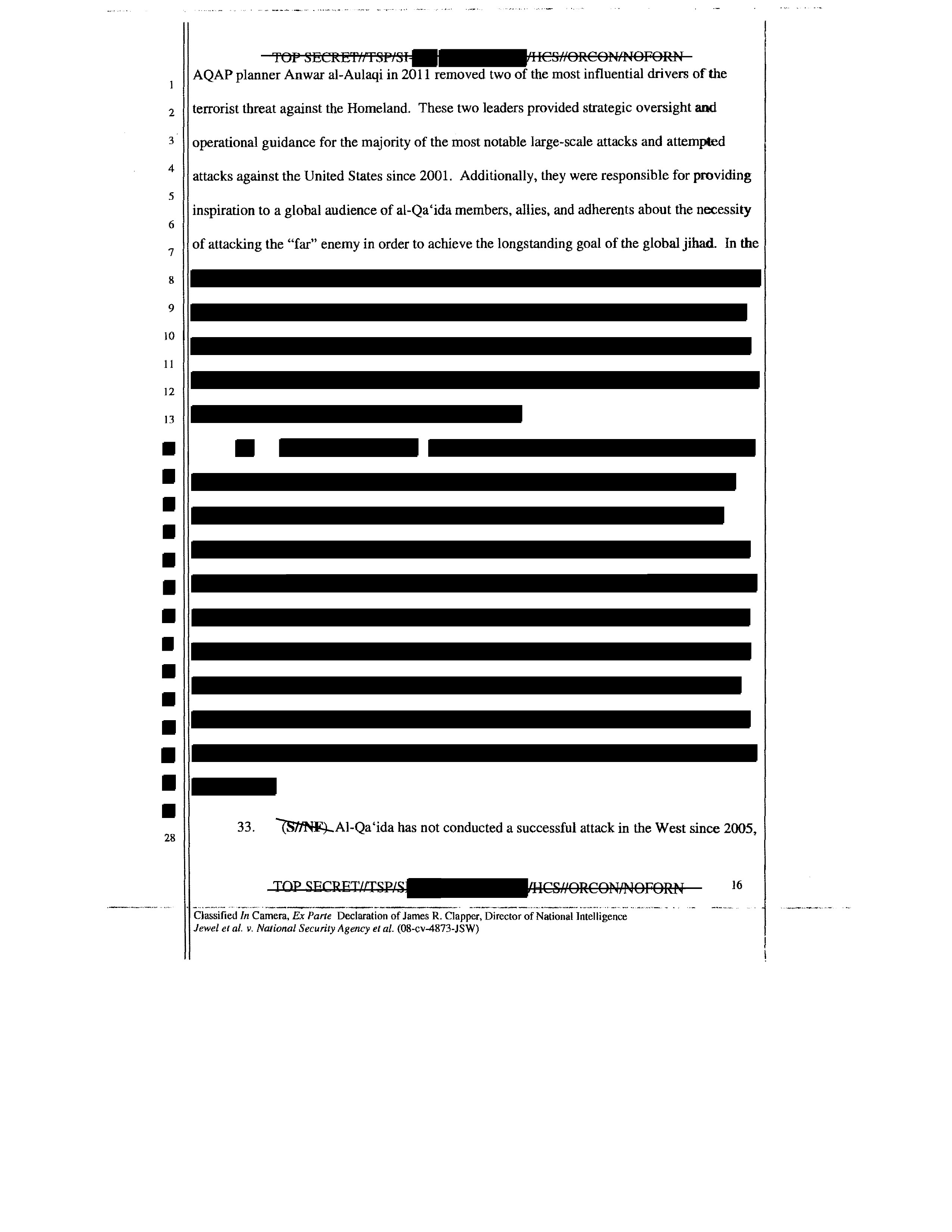
4 31. (S//NF) The deaths of Pakistan-based al-Qa'ida leader Usama Bin Ladin and
5 AQAP planner Anwar al-Aulaqi in 2011 removed two of the most influential drivers of the
6 terrorist threat against the Homeland. These two leaders provided strategic oversight and
7 operational guidance for the majority of the most notable large-scale attacks and attempted
8 attacks against the United States since 2001. Additionally, they were responsible for providing
9 inspiration to a global audience of al-Qa'ida members, allies, and adherents about the necessity
10 of attacking the "far" enemy in order to achieve the longstanding goal of the global jihad. In the
11 [REDACTED]
12
13 33. (S//NF) Al-Qa'ida has not conducted a successful attack in the West since 2005,
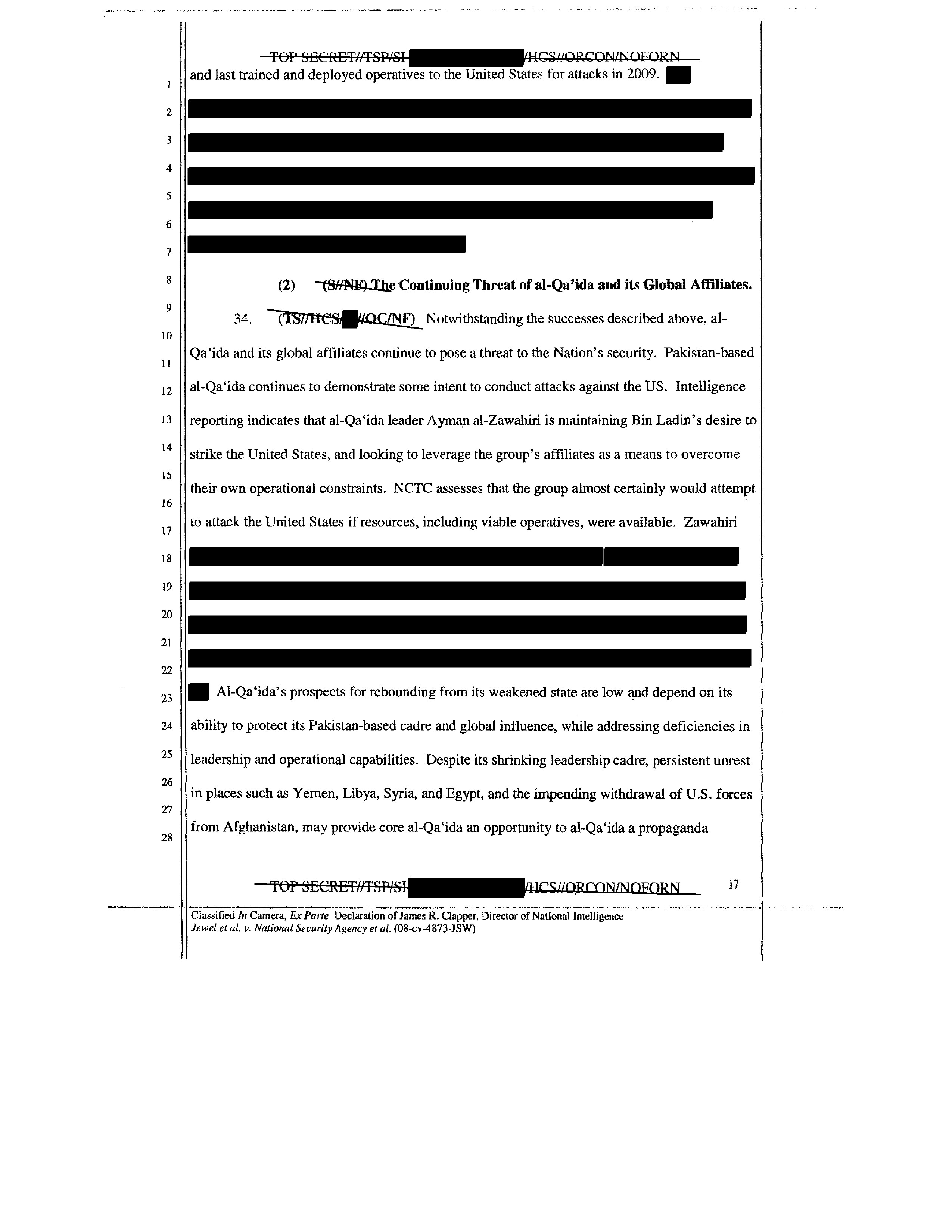
14 and last trained and deployed operatives to the United States for attacks in 2009.
15 [REDACTED]
16 (2) (S//NF) The Continuing Threat of al-Qa'ida and its Global Affiliates.
17
18 34. (TS//HCS [REDACTED] /OC/NF) Notwithstanding the successes described above, al-
19 Qa'ida and its global affiliates continue to pose a threat to the Nation's security. Pakistan-based
20 al-Qa'ida continues to demonstrate some intent to conduct attacks against the US. Intelligence
21 reporting indicates that al-Qa'ida leader Ayman al-Zawahiri is maintaining Bin Ladin's desire to
22 strike the United States, and looking to leverage the group's affiliates as a means to overcome
23 their own operational constraints. NCTC assesses that the group almost certainly would attempt
24 to attack the United States if resources, including viable operatives, were available. Zawahiri
25 [REDACTED] Al-Qa'ida's prospects for rebounding from its weakened state are low and depend on its
26 ability to protect its Pakistan-based cadre and global influence, while addressing deficiencies in
27 leadership and operational capabilities. Despite its shrinking leadership cadre, persistent unrest
28 in places such as Yemen, Libya, Syria, and Egypt, and the impending withdrawal of U.S. forces
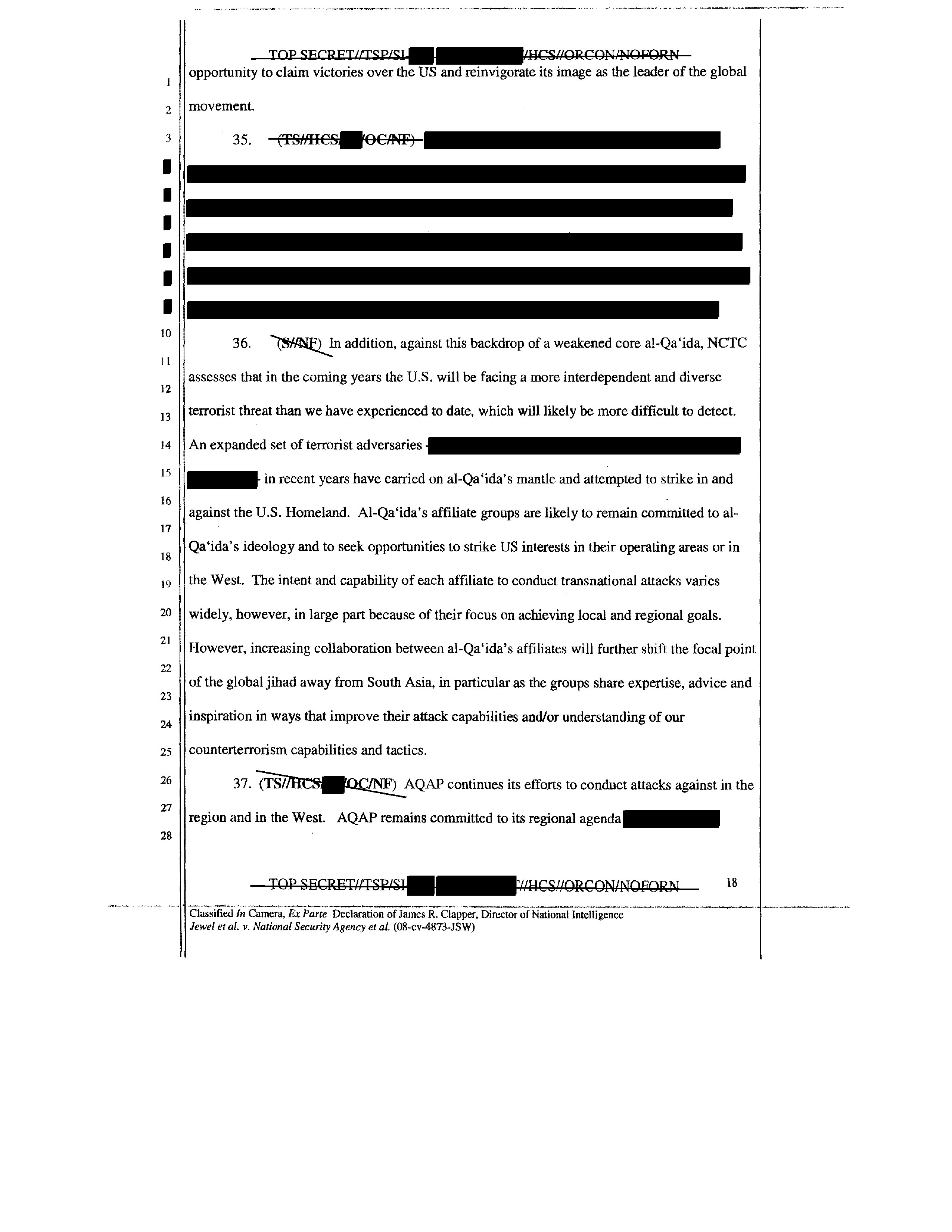
1 from Afghanistan, may provide core al-Qa'ida an opportunity to al-Qa'ida a propaganda
2 opportunity to claim victories over the US and reinvigorate its image as the leader of the global
3 movement.
4
5 35. (TS//HCS [REDACTED] /OC/NF) [REDACTED]
6
7 36. (S//NF) In addition, against this backdrop of a weakened core al-Qa'ida, NCTC
8 assesses that in the coming years the U.S. will be facing a more interdependent and diverse
9 terrorist threat than we have experienced to date, which will likely be more difficult to detect.
10 An expanded set of terrorist adversaries [REDACTED] in recent years have carried on al-Qa'ida's mantle and attempted to strike in and
11 against the U.S. Homeland. Al-Qa'ida's affiliate groups are likely to remain committed to al-
12 Qa'ida's ideology and to seek opportunities to strike US interests in their operating areas or in
13 the West. The intent and capability of each affiliate to conduct transnational attacks varies
14 widely, however, in large part because of their focus on achieving local and regional goals.
15 However, increasing collaboration between al-Qa'ida's affiliates will further shift the focal point
16 of the global jihad away from South Asia, in particular as the groups share expertise, advice and
17 inspiration in ways that improve their attack capabilities and/or understanding of our
18 counterterrorism capabilities and tactics.
19
20 37. (TS//HCS [REDACTED] /OC/NF) AQAP continues its efforts to conduct attacks against in the
21 region and in the West. AQAP remains committed to its regional agenda [REDACTED]
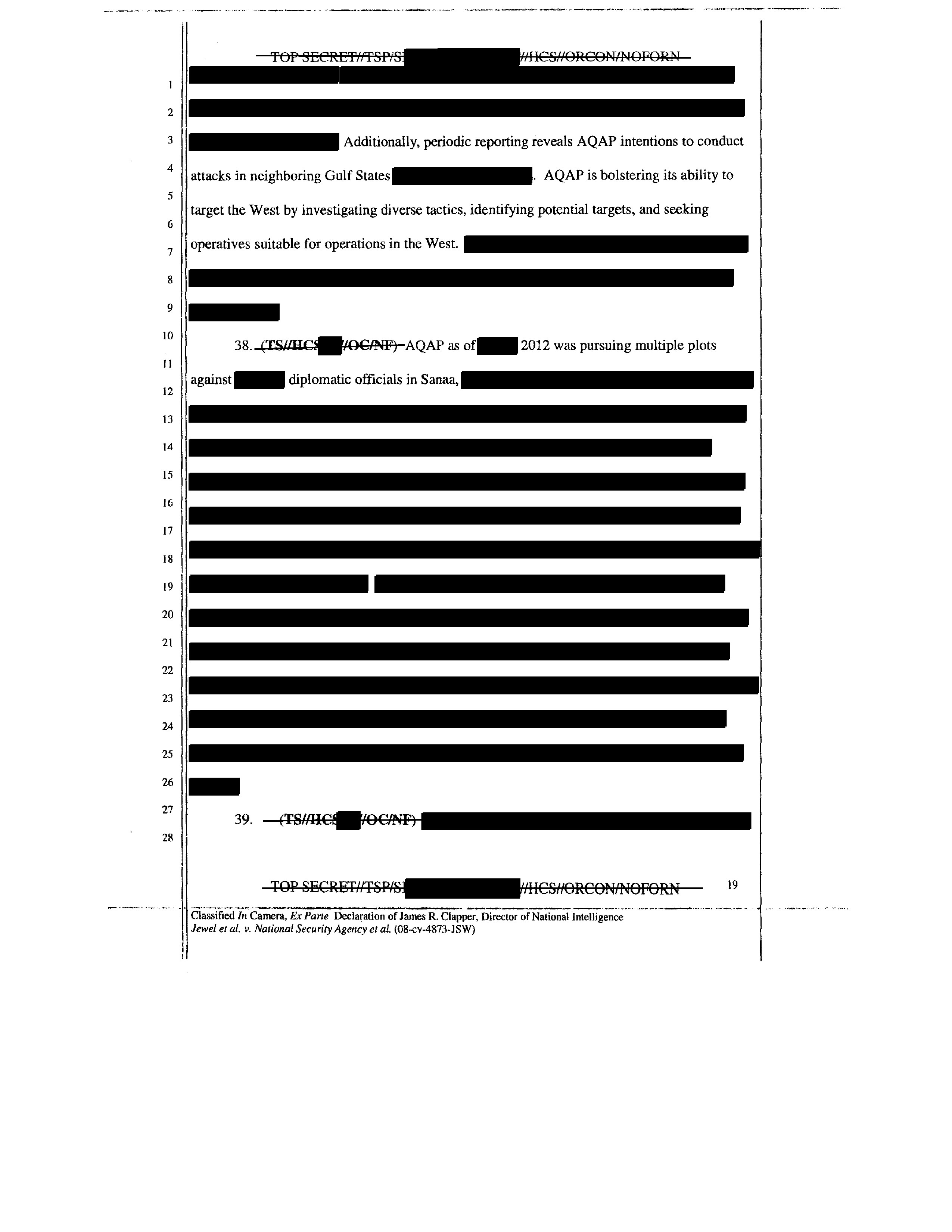
22 Additionally, periodic reporting reveals AQAP intentions to conduct
23 attacks in neighboring Gulf States [REDACTED] AQAP is bolstering its ability to
24 target the West by investigating diverse tactics, identifying potential targets, and seeking
25 operatives suitable for operations in the West.
26
27 38. (TS//HCS/OC/NF)-AQAP as of [REDACTED] 2012 was pursuing multiple plots
28 against [REDACTED] diplomatic officials in Sanaa, [REDACTED]
1 39. (TS//HCS/OC/NF) [REDACTED]
2
3 (3) (S//NF) Al-Qa'ida's Weapons and Tactics
4
5 42. (S//NF) The continuing al-Qa'ida threat can also be seen in the type of weapons
6 and tactics it may employ. [REDACTED] In its propaganda al-Qa'ida has encouraged "lone-wolf"
7 extremists to conduct Homeland small arms attacks because firearms are easy to acquire and use
8 effectively in the US, an assertion borne out by a number of homegrown violent extremists'
9 small-arms attacks and disrupted plots over the past 3 years. [REDACTED] Al-Qa'ida-inspired extremists will
10 attempt to exploit emerging consumer technologies for building, concealing and triggering IEDs,
11 and leverage online resources to provide the know-how for new attack methods [REDACTED]
12
13 43. (S//NF) [REDACTED]
14
15 (4) (S//NF)
16
17 44. (TS//HCS//OC//NF) [REDACTED]
18
19 45. (S//NF) [REDACTED]
20
21 46. (U) In sum, a variety of entities continue to pose a significant threat to the
22 nation's security. The Government is utilizing all lawful intelligence gathering capabilities,
23 including those set forth in the Classified NSA Declaration, to meet these threats and to protect
24 the American people. I set forth this information not only to provide the Court with background
25 information necessary to understand why the intelligence activities implicated by or directly at
26 issue in this case are being undertaken, but also to assert a claim of privilege over classified
27 threat information. The Government cannot disclose classified threat information in addressing
28 plaintiffs' allegations or other issues in this case, or even in publicly supporting its assertion of
1 privilege, because to do so would disclose to our adversaries what we know of their plans and
2 how we may be obtaining information about them. Such disclosures would lead our adversaries
3 not only to alter their plans, but also to implement greater security for their communications,
4 thereby increasing the risk of non-detection. In addition, disclosure of threat information might
5 reveal human sources for the United States, compromise those sources, and put lives in danger.
6 Accordingly, although I believe that classified threat information is crucial to understanding the
7 importance to our national security of the NSA intelligence activities, sources, and methods
8 implicated by the plaintiffs' allegations, I must assert the state secrets privilege and the DNI's
9 statutory privilege over this classified threat information because of the exceptionally grave
10 danger to national security that could reasonably be expected to result from its disclosure.
11
12 B. (U) Information That May Tend to Confirm or Deny Whether the Plaintiffs
13 Have Been Subject to the Alleged NSA Intelligence Activities.
14
15 47. (U) Next, I am also asserting privilege over information that would reveal
16 whether particular individuals, including the named plaintiffs in this lawsuit, have been subject
17 to the alleged NSA intelligence activities. Disclosure of such information would cause
18 exceptionally grave damage to the national security.
19
20 48. (TS//TSP/SI//OC/NF) [REDACTED]
21 Accordingly, I assert the state secrets and DNI statutory
22 privilege as to this information.
23
24 49. (U) The NSA cannot publicly confirm or deny whether any particular individual
25 is subject to surveillance activities. If the NSA were to reveal that an individual is the target of
26 surveillance, the collection capability relating to that individual would certainly be compromised.
27 On the other hand, if the NSA were to reveal that an individual is not the target of surveillance,
28 adversaries would know that a particular individual has avoided surveillance and is a secure
1 source for communicating. Moreover, providing assurances to those individuals who are not
2 being targeted quickly becomes unworkable when faced with a case in which an individual has
3 in fact been targeted. If the NSA were to confirm that any specific individual is not the target of
4 surveillance, but later refuse to confirm or deny that information in a case involving an actual
5 target, it would be apparent that surveillance was occurring in the latter case. The only recourse
6 for the NSA is to neither confirm nor deny whether someone has been targeted or subject to NSA
7 activities, regardless of whether the individual has been targeted or not. To say otherwise when
8 challenged in litigation would result in the frequent, routine exposure of NSA information,
9 sources, and methods, and would severely undermine surveillance activities in general.
10
11 C. (U) Information Concerning NSA Activities, Sources, or Methods.
12
13 50. (U) Furthermore, I am asserting privilege over any other facts concerning NSA
14 intelligence activities, sources, or methods that may relate to or be necessary to adjudicate the
15 plaintiffs' claims, including allegations that the NSA, with the assistance of telecommunications
16 companies including AT&T and Verizon, has indiscriminately intercepted the content and
17 obtained the communications records of millions of ordinary Americans as part of an alleged
18 presidentially authorized "Program" after 9/11. See, e.g., Jewel Comp. ¶¶ 2-13; 39-97; Shubert
19 SAC ¶¶ 1-9; 62-91 As noted above, my privilege assertion encompasses (1) facts concerning the
20 operation of the now-defunct Terrorist Surveillance Program, including any facts needed to
21 demonstrate that the TSP was limited to the interception of the content¹ of one-end foreign
22 communications reasonably believed to involve a member or agent of al-Qa'ida or an affiliated
23 terrorist organization, and that the NSA does not otherwise conduct a dragnet of content
24 surveillance as the plaintiffs allege; and (2) information concerning whether or not the NSA
25 obtains transactional communication records from telecommunications companies such as
26 AT&T and Verizon as plaintiffs allege.
27
28 51. (U) As the NSA indicates, see Public NSA Declaration ¶ 11, the NSA's
1 collection of the content of communications under the TSP was directed at international
2 communications in which a participant was reasonably believed to be associated with al-Qa'ida
3 or an affiliated organization. Thus, as the Government has previously stated, plaintiffs'
4 allegation that the NSA has indiscriminately collected the content of millions of communications
5 sent or received by people inside the United States after 9/11 under the TSP is false. I concur
6 with the NSA that to the extent it must demonstrate in this case that the TSP was not the content
7 dragnet plaintiffs allege, or demonstrate that the NSA has not otherwise engaged in the alleged
8 content dragnet, highly classified NSA intelligence sources and methods about the operation of
9 the TSP and other NSA intelligence activities would be disclosed which would cause exceptional
10 harm to national security.²
11
12 ¹ The term "content" is used herein to refer to the substance, meaning, or purport of
13 a communication, as defined in 18 U.S.C.§ 2510(8).
14
15 ² The Government has publicly confirmed that, in addition to the "Terrorist
16 Surveillance Program," other intelligence activities were authorized by the President after the
17 9/11 attacks in a single authorization that was periodically reauthorized. See Unclassified
18 Inspector General Report on the President's Surveillance Program (10 July 2009) ("IG Rept.") at
19 5, available at www.dni.gov/files/documents/Newsroom/Reports and Pubs/report_071309.htm.
20 However, those other intelligence activities remain highly classified, see Public IG Rept. at 5,
21 and subject to the DNI privilege assertions. As the IG report also indicates, activities that were
22 originally authorized by the President along with the TSP were subsequently authorized under
23 orders issued by the FISC. See Public IG Rept. at 30. As a result of this transition, the final
24 52. (U) I am also asserting privilege over information concerning whether or not the
25 NSA obtained from telecommunications companies such as AT&T and Verizon the complete
26 and allegedly ongoing disclosure of private telephone and Internet transactional records of those
27 companies' millions of customers. I concur with the NSA that confirmation or denial of any
28 information concerning this allegation would cause exceptionally grave harm to national
1 security, including by risking disclosure of whether or not the NSA utilizes particular
2 intelligence sources and methods and, thus, the NSA's capabilities or lack thereof.
3
4 53. (TS//TSP/SI//OC/NF) In particular, as set forth in the Classified NSA
5 Declaration, the United States faced urgent and immediate intelligence challenges after the
6 September 11 attacks, and undertook signals intelligence activities pursuant to presidential
7 authorization that were designed to meet those challenges and to detect and prevent future
8 terrorist attacks by al-Qa'ida and its affiliates. Those activities include the TSP and similar
9 sources and methods of content surveillance that later became subject to FISA authority, as well
10 as the bulk collection of telephony and Internet non-content meta data that was also later
11 transitioned to FISA authority and used to discover contacts [REDACTED] See Classified NSA Declaration ¶¶ 27-51.
12
13 54. (U) Based on my personal consideration and judgment as to the harm disclosure
14 would cause to national security, my privilege assertion includes, but is not limited to, the
15 following activities discussed in the Classified NSA Declaration.
16
17 55. (TS//TSP/SI//OC/NF) First, I assert privilege over facts concerning the operation
18 of the TSP and any other NSA intelligence activities needed to demonstrate that the TSP was
19 [REDACTED] presidential authorization for the Presidential Surveillance Program activities authorized after the
20 9/11 attacks expired on February 1, 2007. Id. at 30. To the extent plaintiffs' allegations seek to
21 put at issue the nature of these other classified activities, they are encompassed by my privilege
22 assertion in this litigation as well.
23 limited to the interception of one-end foreign communications reasonably believed to involve a
24 member or agent of al-Qa'ida or an affiliated terrorist organization, and that the NSA does not
25 otherwise conduct a dragnet of content surveillance as the plaintiffs allege. Such facts include
26 those concerning (1) how targets were selected under the TSP; (2) how specific methods were
27 used under the TSP to intercept telephone and Internet communications and to minimize the risk
28 of collecting non-target communications and purely domestic communications; (3) the nature
1 and identity of the targets under the TSP, [REDACTED]; (4) and additional
2 classified details about the operation of the TSP that would be necessary to litigate the plaintiffs'
3 allegations (to the extent relevant) including facts concerning the operational swiftness and
4 agility of the TSP, particularly in conjunction with meta data analysis; [REDACTED]; and the effectiveness and success of the TSP;
5 and (5) other NSA surveillance activities that may be needed to address and disprove the content
6 dragnet allegations, [REDACTED] See Classified NSA Declaration ¶¶ 63-73. In my judgment, revealing or
7 risking disclosure of the foregoing NSA intelligence activities, sources, and methods in order to
8 show that the NSA is not conducting the "dragnet" on the content of communications that
9 plaintiffs allege would cause exceptional harm to national security by disclosing to our
10 adversaries the ability of the United States to monitor and track their activities and
11 communications.
12
13 56. (TS//TSP/SI//OC/NF) Second, I also assert privilege over facts that would
14 disclose or describe the NSA's meta data collection activities. See Classified NSA Declaration
15 ¶¶ 74-83. In my judgment, the NSA is unable to disclose any information about the existence or
16 operation of the NSA's bulk collection or targeted analysis of Internet or telephony metadata
17 without causing exceptionally grave harm to national security. These are among the most
18 important intelligence tools the NSA uses, and they have never been officially confirmed or
19 denied by the United States. Disclosing or confirming these activities would seriously
20 undermine an essential tool for tracking possible terrorist plots and would help foreign
21 adversaries evade detection. Such a disclosure would also undermine ongoing intelligence
22 operations authorized by the FISC.
23
24 57. (TS//TSP/SI//OC/NF) Finally, I also assert privilege over information
25 concerning NSA activities conducted pursuant to FISA authority and Executive Order 12333, as
26 described by the NSA. See Classified NSA Declaration ¶¶ 37-51; 84. In my judgment,
27 disclosure of current surveillance activities under these authorities, either directly or indirectly,
28 would seriously compromise, if not destroy, vital ongoing intelligence operations. My privilege
1 assertion extends to the existence of any information concerning the (i) FISC Pen Register Order,
2 as subsequently reauthorized until its expiration in December, 2011, see id. ¶¶ 48-51; (ii) FISC
3 Telephone Business Records Order, as subsequently reauthorized, see id. ¶ 47; [REDACTED] (iv) FISC Foreign Telephone and Email Order, see id.
4 ¶¶ 38-40; (v) particular NSA sources and methods utilized under authority of the Protect
5 America Act and the FISA Amendments Act of 2008, including directives issued to particular
6 telecommunication carriers under those Acts, see id. ¶¶ 41-45; and (vi) NSA's use of similar
7 sources and methods pursuant to Executive Order 12333, see id. ¶ 82.
8
9 58. (TS//TSP/SI//OC/NF) I concur with the NSA that the activities discussed herein
10 and described further by the NSA--in particular the meta data collection activities--are among the
11 most important intelligence tools available to the United States for protecting the Homeland from
12 another catastrophic terrorist attack. I also concur that [REDACTED] In my judgment, after personal
13 consideration of the matter, disclosing the information described herein and by the NSA would
14 compromise these critical activities, sources, and methods, thereby helping our adversaries evade
15 detection and causing exceptionally grave damage to the national security of the United States.
16
17 D. (U) Plaintiffs' Allegations that Certain Telecommunications Carriers
18 Provided Assistance to the NSA with the Alleged Activities.
19
20 59. (U) In addition, I am asserting privilege over information that may tend to
21 confirm or deny whether or not AT&T, Verizon, or to the extent necessary, any other particular
22 telecommunications provider, has assisted the NSA with alleged intelligence activities. The
23 disclosure of any information that would tend to confirm or deny allegations of such assistance
24 would cause exceptionally grave harm to the national security. Confirming or denying such
25 allegations, again, would reveal to foreign adversaries whether or not the NSA utilizes particular
26 intelligence sources and methods and, thus, either compromise actual sources and methods or
27 disclose that the NSA does not utilize a particular source or method. Such confirmation or denial
28 would also replace speculation with certainty for hostile foreign adversaries who are balancing
1 the risk that a particular channel of communication may not be secure against the need to
2 communicate efficiently.
3
4 60. (TS//TSP/SI [REDACTED] /OC/NF) [REDACTED]
5
6 63. (TS//TSP/SI/OC/NF) In addition, I have reviewed the classified
7 certification of then-Attorney General Mukasey submitted to the Court pursuant to Section 802
8 of the FISA Act Amendments Act of 2008 and assert privilege over specific information
9 described therein, [REDACTED]
10
11 Accordingly, I assert the state secrets and DNI statutory privilege over such
12 [REDACTED]
13
14 (U) RISK OF LITIGATION
15
16 64. (TS//TSP/SI//OC/NF) Finally, I concur with the NSA that further litigation of
17 this case will inherently risk the disclosure of highly classified activities. While plaintiffs
18 wrongly allege that the NSA is conducting a dragnet program of content surveillance, disproving
19 plaintiffs' speculation would risk or require revealing NSA intelligence activities, sources and
20 methods, including bulk metadata collection activities. Those vital activities, as described
21 herein, are highly classified, sensitive, and fragile, and any effort to disclose information about
22 them could have grave consequences for the national security.
23
24 (U) CONCLUSION
25
26 65. (U) In sum, I am asserting the state secrets privilege and the DNI's statutory
27 privilege set forth in 50 U.S.C. § 403-1(i)(1) to protect the classified national security
28 information described herein and in the Classified NSA Declaration. Moreover, because
1 proceedings in this case risk disclosure of privileged and classified intelligence-related
2 information, I respectfully request that the Court not only protect that information from
3 disclosure, but take all steps necessary, including dismissal of this action, to protect the
4 intelligence information, sources, and methods described herein in order to prevent exceptional
5 harm to the national security of the United States.
6
7 I declare under penalty of perjury that the foregoing is true and correct.
8
9 DATE: September 11, 2012
10
11 JAMES R. CLAPPER
12 Director of National Intelligence
13
Related Documents
-
DNI Blair 2009 Jewel State Secrets Declaration FOIA [pdf]
Classified declaration of Dennis C. Blair disclosing information regarding the government’s warrantless wiretapping. ACLU/EFF FOIA Litigation.
People: Blair, Dennis C. · Hertz, Michael F. · Letter, Douglas N. · Hunt, Joseph H. · Garvey, Vincent M. · Coppolino, Anthony J. · Jewel, CarolynACLU,EFF ↗ (2013-12-20) -
DNI Clapper 2013 Jewel Shubert SSP Unclassified Signed Declaration FOIA [pdf]
Public declaration of James R. Clapper disclosing information regarding the government. ACLU/EFF FOIA Litigation.
People: Clapper, James R. · Delery, Stuart F. · Hunt, Joseph H. · Coppolino, Anthony J. · Gilligan, James J. · Berman, Marcia · Dearinger, Bryan · Patton, Rodney · Jewel, Carolyn · White, Jeffrey S.ACLU,EFF ↗ (2013-12-20) -
DNI Blair 2009 Shubert State Secrets Declaration FOIA [pdf]
Classified declaration of Dennis C. Blair disclosing information regarding the government. ACLU/EFF FOIA Litigation.
People: Blair, Dennis C. · Brinkmann, Beth S. · Letter, Douglas N. · Hunt, Joseph H. · Garvey, Vincent M. · Coppolino, Anthony J. · Berman, Marcia · Ahern, Paul E. · Walker, Vaughn R.ACLU,EFF ↗ (2013-12-20) -
DNI McConnell 2007 Shubert State Secrets Declaration FOIA [pdf]
Declaration of Lieutenant General Keith B. Alexander disclosing information regarding the government’s warrantless wiretapping.
ACLU,EFF ↗ (2013-12-20) -
NSA Fleisch 2012 Jewel Declaration FOIA [pdf]
Classified declaration of Frances J. Fleisch disclosing information regarding the government. ACLU/EFF FOIA Litigation.
Programs: STELLARWINDACLU,EFF ↗ (2013-12-20)